
Langue
Choisir entre panneaux solaires bifaciaux et monofaciaux ?
Ce guide de 2026 compare l'efficacité, le coût et le retour sur investissement réel. Basé sur plus de 3 000 projets solaires en Afrique, en Asie du Sud-Est et au Moyen-Orient, il vous fournit les données nécessaires pour faire le bon choix. Les panneaux solaires bifaciaux et monofaciaux sont presque identiques de face.
Mais sous la surface, ils fonctionnent différemment — et choisir le mauvais type peut coûter à votre projet 15 à 25% en rendement énergétique annuel, ou ajouter 20% à vos coûts initiaux inutilement.
Cet article va à l'essentiel en s'appuyant sur des données de performance réelles issues de projets Mars Solar en Afrique, en Asie du Sud-Est et au Moyen-Orient. Nous vous proposons une comparaison objective entre les cellules bifaciales et monofaciales.
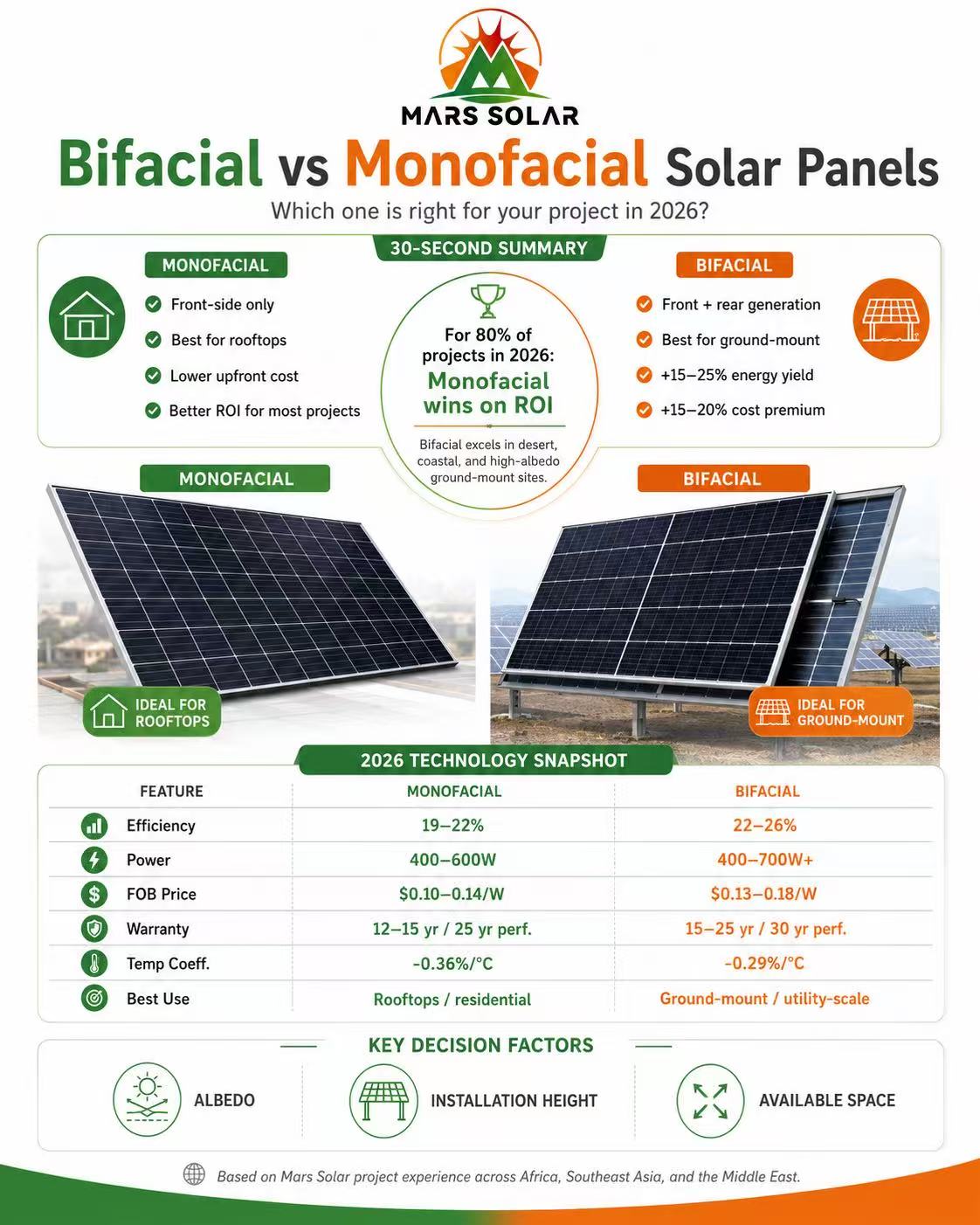
| Spécification | PERC monofacial | TOPCon bifacial de type N |
|---|---|---|
| Plage d'efficacité | 19-22% | 22-26% |
| Gamme de puissance | 400-600 W | 400-700W+ |
| Prix FOB typique | $0,10-0,14/W | $0,13-0,18/W |
| Garantie | Performances sur 12-15 ans / 25 ans | Performances sur 15-25 ans / 30 ans |
| Coefficient de température | -0,36%/°C | -0,29%/°C (meilleure résistance à la chaleur) |
| Cas d'utilisation optimal | Toits, résidentiel | Montage au sol, échelle utilitaire |
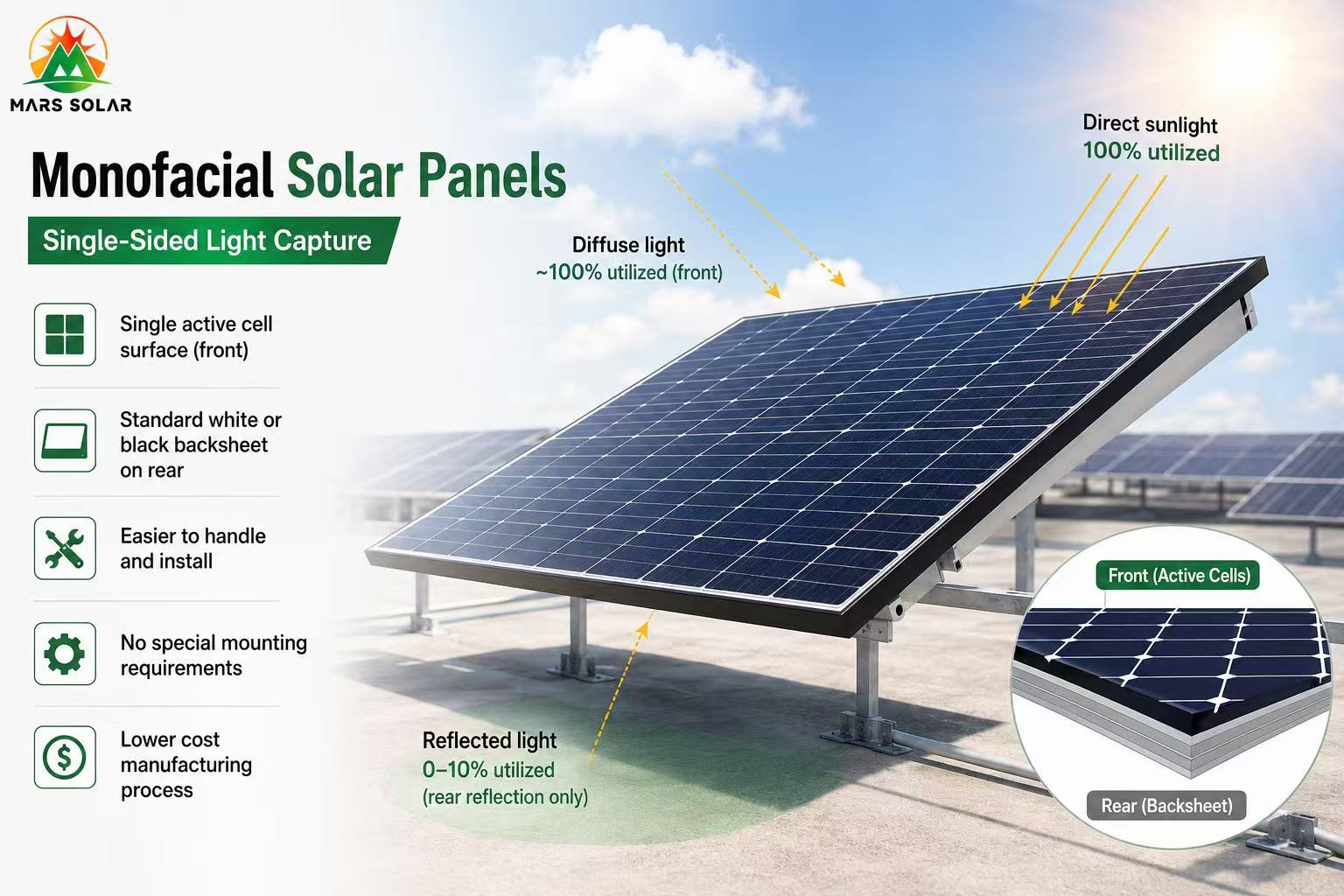
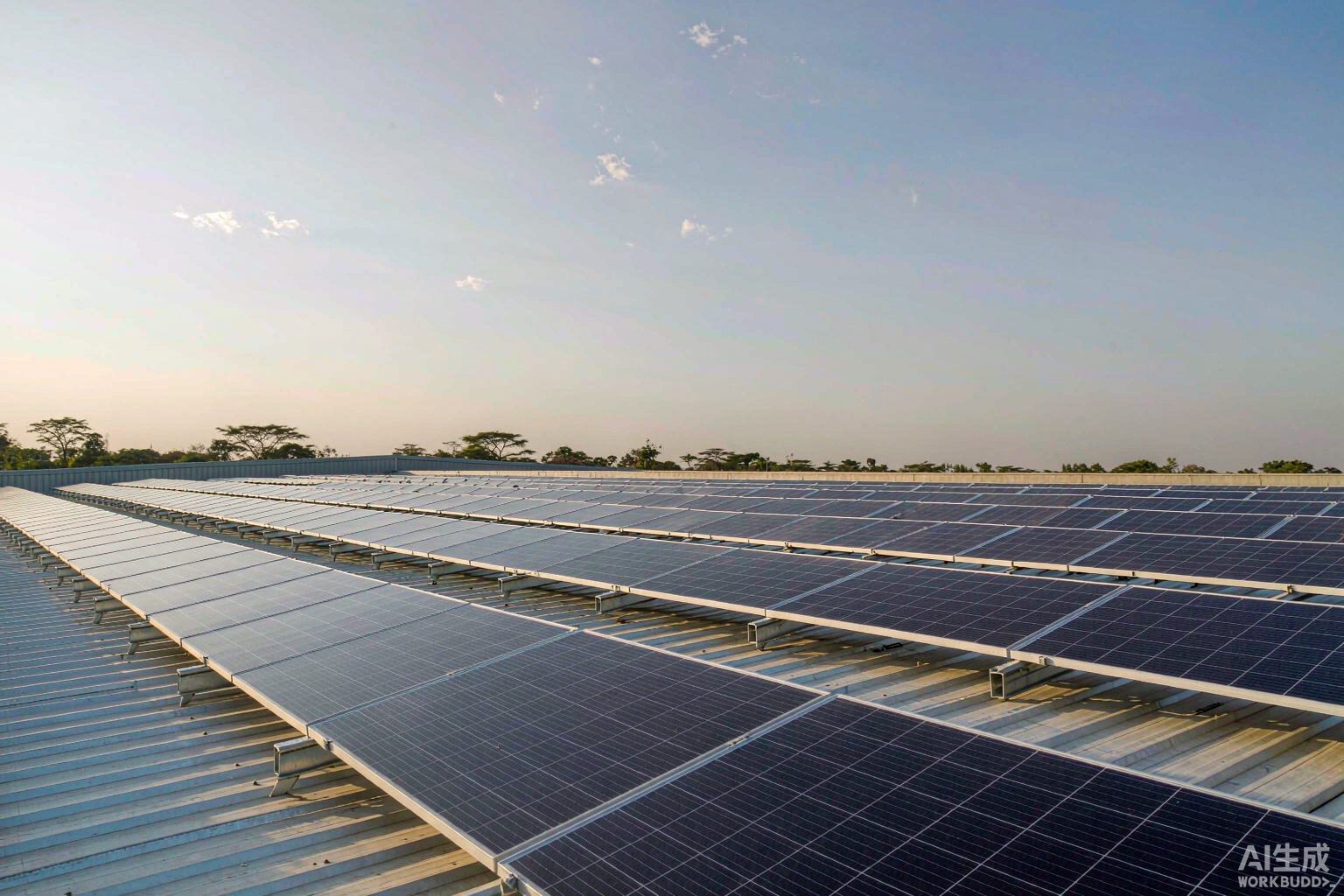
Les panneaux monofaciaux standard ne comportent de cellules solaires que sur leur face avant. La face arrière est soit totalement opaque (feuille arrière blanche), soit légèrement réfléchissante.
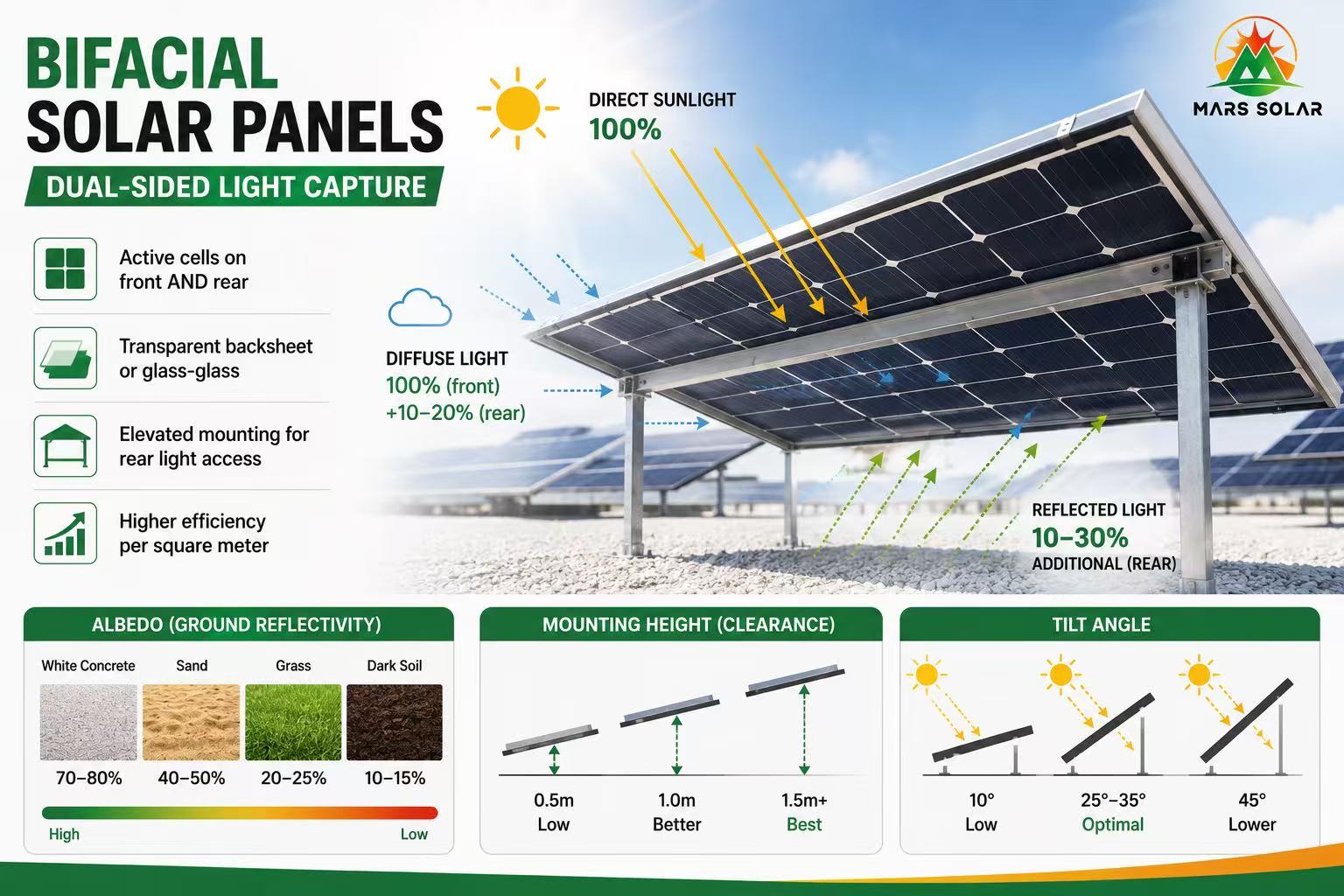
Les panneaux bifaciaux captent la lumière réfléchie et diffusée qui rebondit sur le sol (appelée " lumière d'albédo ").
Le gain bifacial dépend entièrement de :
| Critères | PERC monofacial | TOPCon bifacial de type N | Gagnant |
|---|---|---|---|
| Efficacité | 19-22% | 22-26% | Bifacial |
| Puissance de sortie (typique) | 400 à 600 W par panneau | 400 à 700 W par panneau | Bifacial |
| Prix FOB Chine | $0,10-0,14/W | $0,13-0,18/W | Monofacial |
| Coût par watt | Ligne de base | +15-25% premium | Monofacial |
| Gain bifacial | 0% (simple face) | +10-25% (dépend de l'albédo) | Bifacial |
| Exigence de hauteur de montage | N'importe quel (toit/sol) | Dégagement minimal de 0,5 à 1 m | Monofacial |
| Coefficient de température | -0,36%/°C | -0,29%/°C | Bifacial |
| performance en climat chaud | Bien | Mieux | Bifacial |
| Durée de vie | 25-30 ans | 25-35 ans (verre-verre) | Bifacial |
| Poids | ~23 kg (60 cellules) | environ 26-32 kg | Monofacial |
| Idéal pour les toits | ✅ Parfait | ⚠️ Nécessite une hauteur sous plafond suffisante | Monofacial |
| Idéal pour une installation au sol | ✅ Bien | ✅ Excellent | Bifacial |
| Idéal pour l'Afrique (désert) | ✅ Bien | ✅ Excellent (albédo du sable) | Bifacial |
| Type de projet | Type de panneau recommandé | Pourquoi |
|---|---|---|
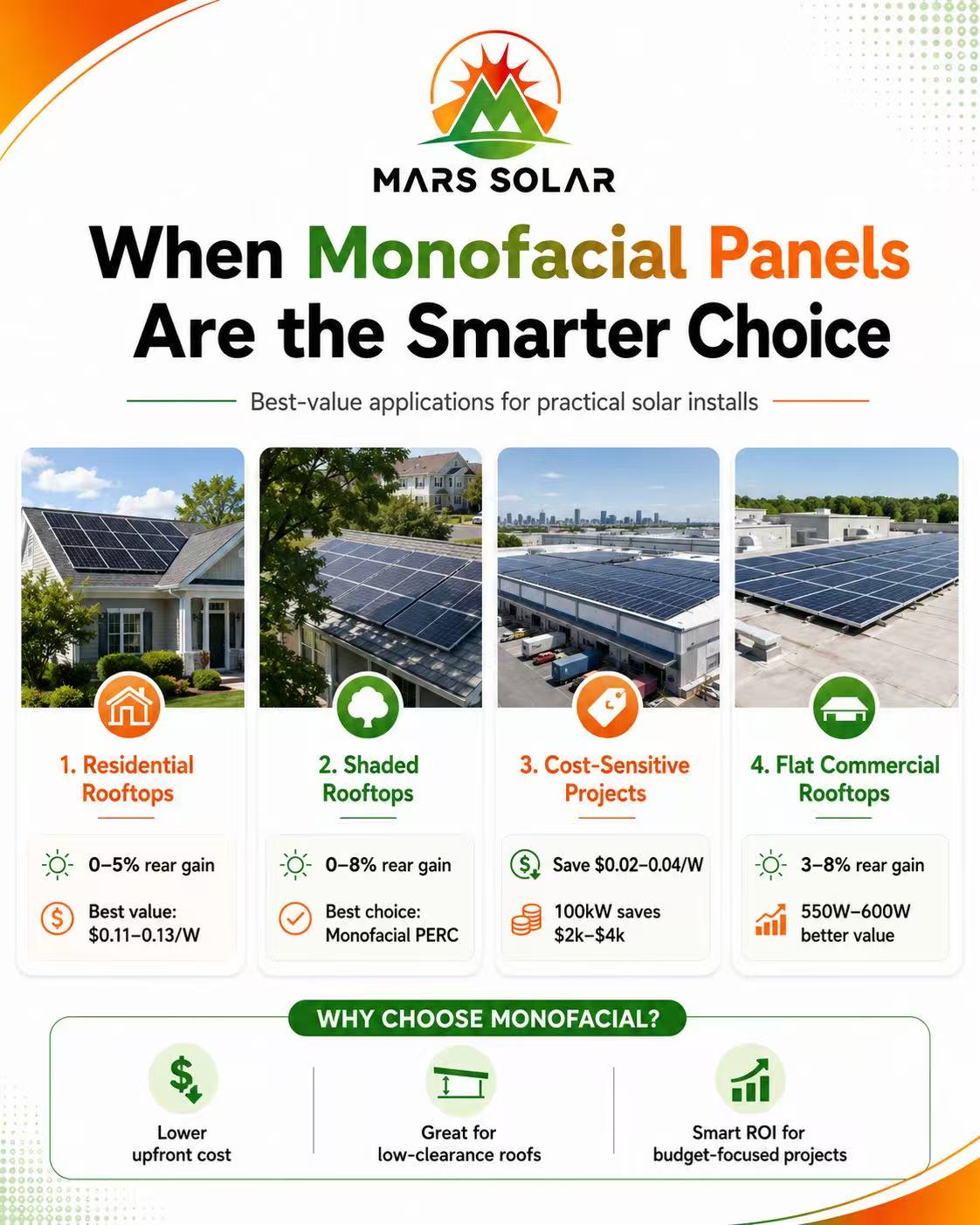
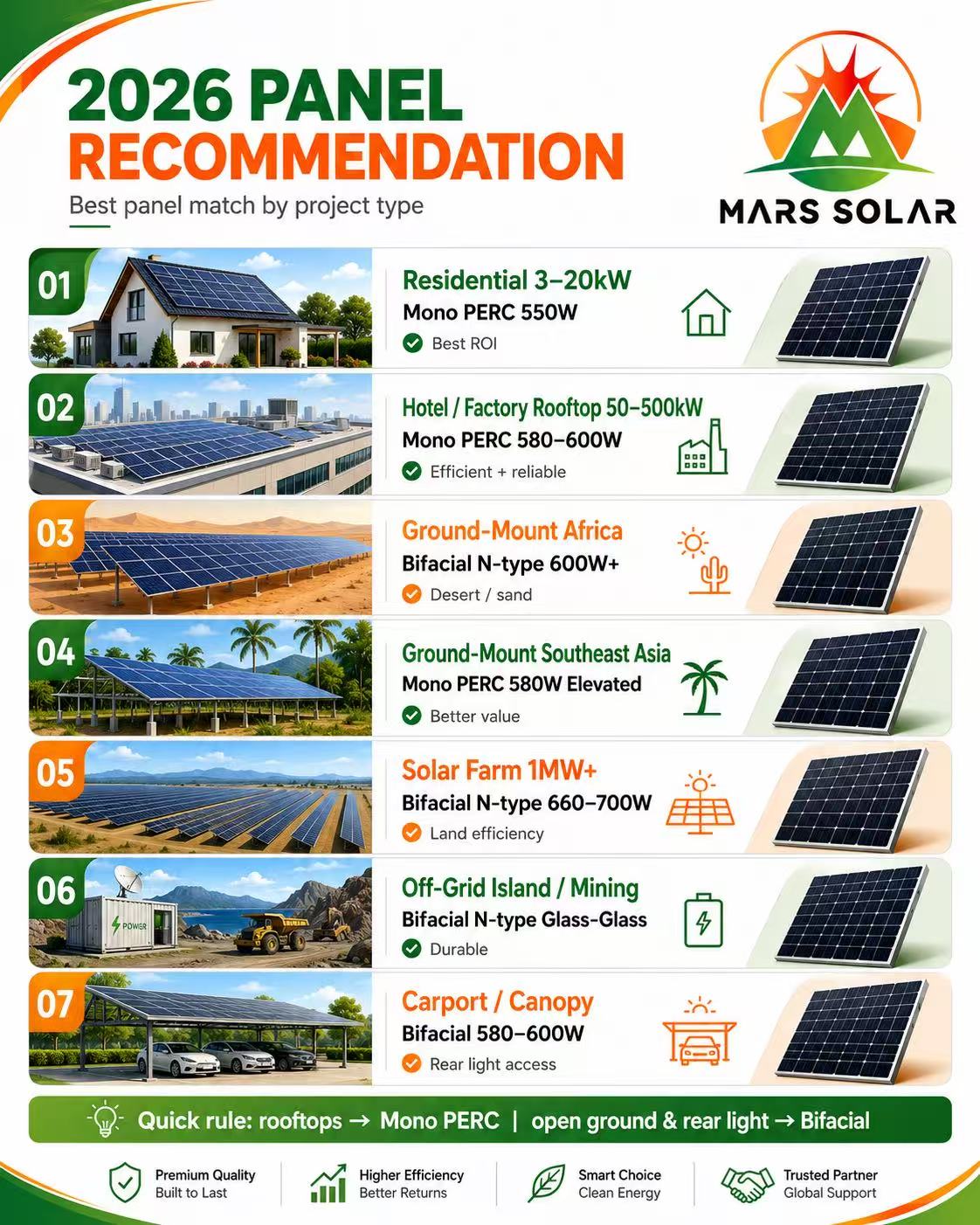
| Résidentiel (3-20 kW) | Mono PERC 550W | Meilleur retour sur investissement, installation facile |
| Toiture d'hôtel/d'usine (50-500 kW) | Mono PERC 580-600W | Haute efficacité et fiabilité |
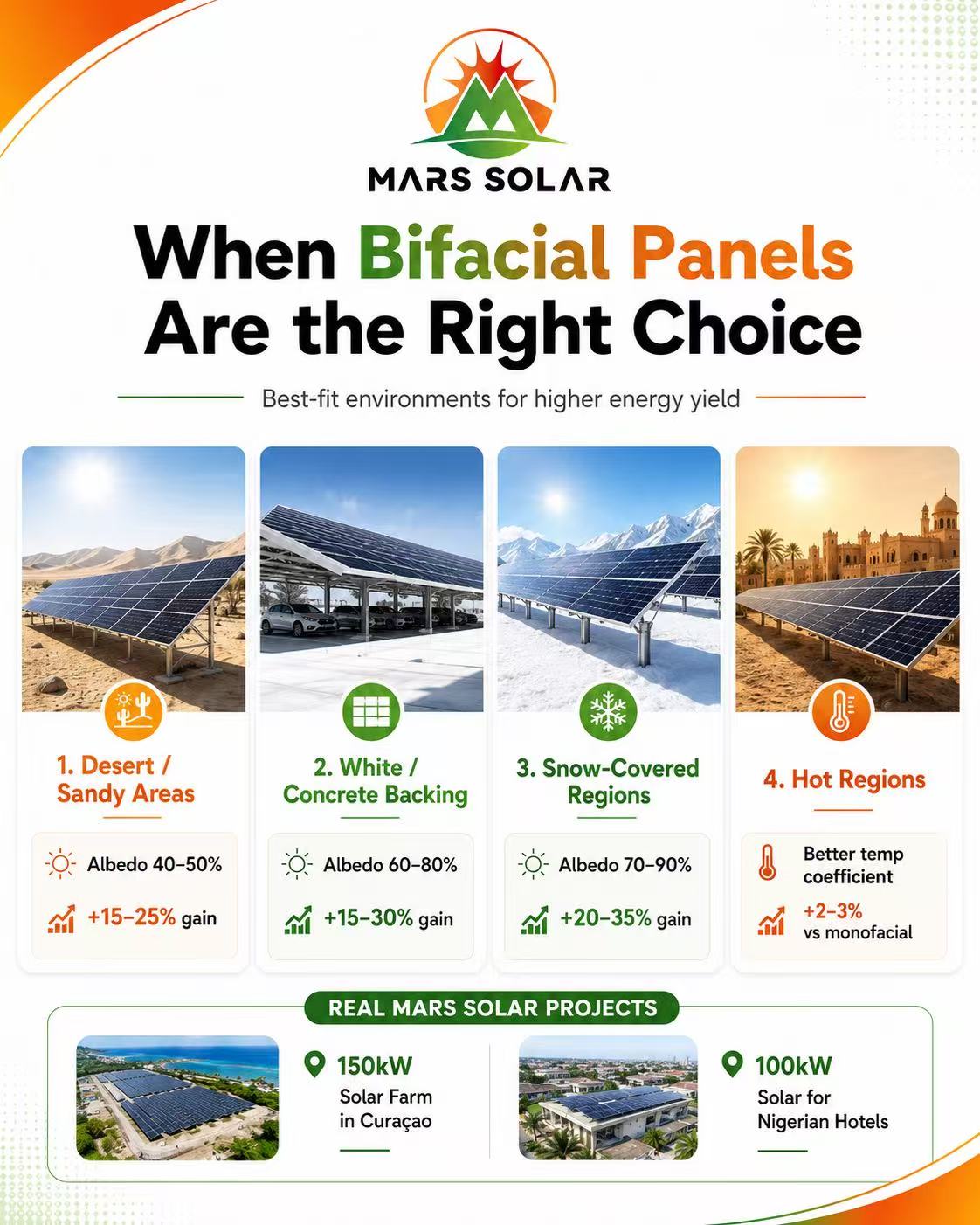
| Afrique du Sud (Désert/Sable) | Bifide de type N 600W+ | Maximiser le gain d'albédo |
| Asie du Sud-Est terrestre | Mono PERC 580W surélevé | Albédo plus faible, meilleure valeur |
| Centrale solaire (1 MW+) | Bifide de type N 660-700 W | efficacité foncière + gain bifacial |
| Île hors réseau/Exploitation minière | Bifacial de type N (verre-verre) | Durabilité et résistance à l'humidité |
| Abri voiture/Auvent | Bifacial 580-600 W | accès naturel à la lumière arrière |
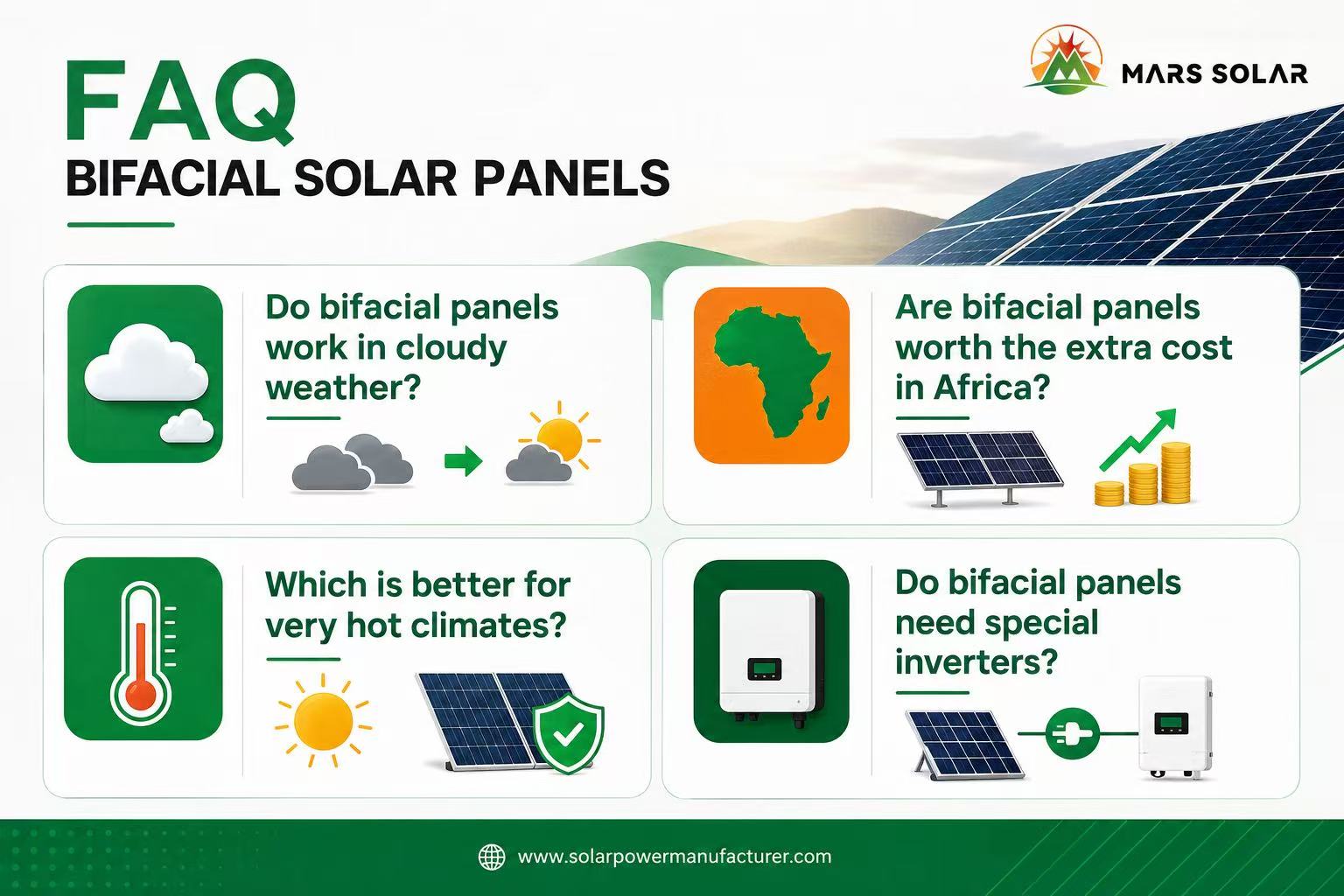
Oui, mais le gain est réduit. Par temps nuageux, la lumière diffuse prédomine. Le gain des lentilles bifaciales passe de 15-25% à 5-10%. Dans les régions constamment nuageuses (Europe du Nord, Royaume-Uni), le surcoût des lentilles bifaciales est plus difficile à justifier.
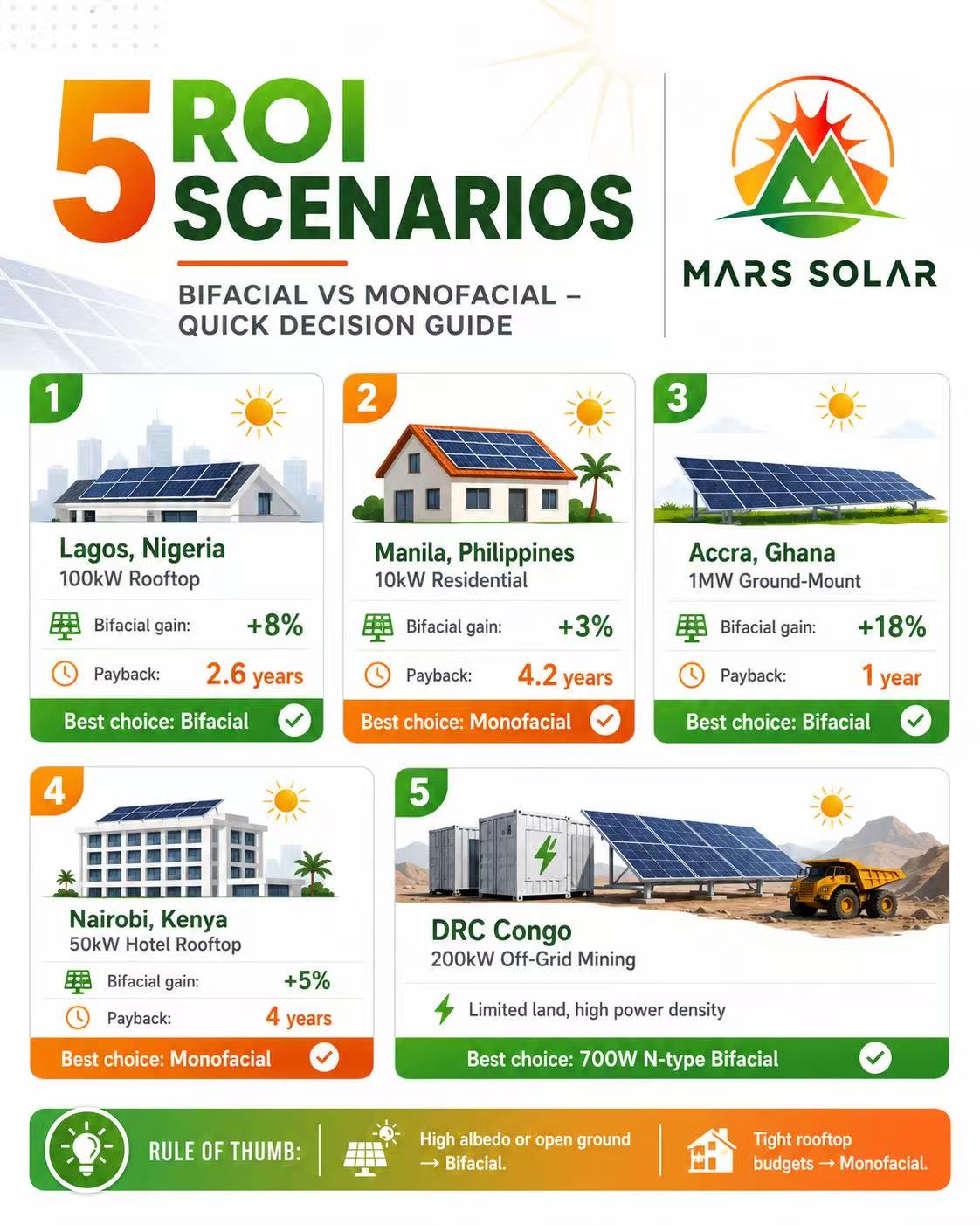
Pour une installation au sol : OUI. Les régions sahariennes et subsahariennes présentent un albédo de 40 à 50 µT/m³ dû au sable. Un gain bifacial de 15 à 25 µT/m³ est bien documenté. Pour une installation sur toiture en Afrique : généralement NON (faible hauteur d’installation, toitures sombres).
Le TOPCon bifacial de type N présente un meilleur coefficient de température (-0,29%/°C contre -0,36%/°C). À des températures supérieures à 35 °C, cela représente une perte de puissance de 2 à 3% en moins par degré. Le bifacial est le choix idéal pour les Émirats arabes unis, l'Arabie saoudite, le Nigéria et les climats similaires.
Non. Les panneaux bifaciaux fonctionnent avec n'importe quel onduleur standard. Le courant continu fourni par les panneaux bifaciaux est identique à celui des panneaux monofaciaux.
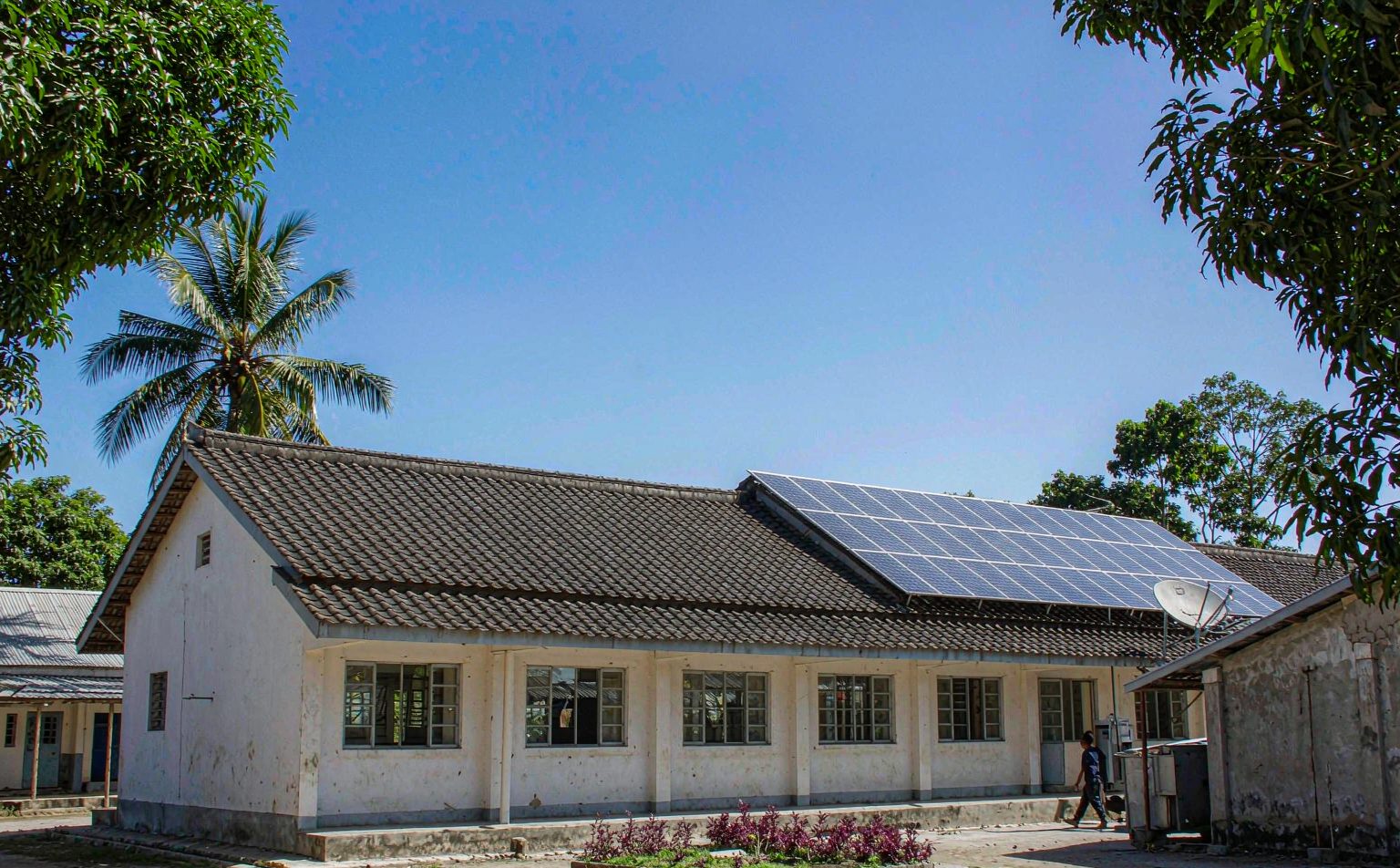
Monofacial, in almost every rooftop case. Bifacial cells need rear-side light and at least a metre of clearance behind the array to capture it, and a flush rooftop gives neither. The choice between bifacial vs monofacial solar panels therefore usually resolves to monofacial on a roof and bifacial on open ground. Where the roof is tilted over a white membrane or a light concrete deck, the gap narrows but rarely closes.
Between 5% and 15% on a well-designed ground-mount, and 20% or more only where the surface albedo is very high — fresh snow, white gravel or a light concrete apron. The gap widens with mounting height, row spacing and reflectance, and collapses to almost nothing over dark soil or dense grass. Any comparison of bifacial vs monofacial solar panels that assumes a flat 20% gain is marketing rather than modelling.
Roughly 0.5 or above. Fresh snow reaches about 0.8, white gravel 0.5–0.6, light concrete 0.3–0.4, dry grass about 0.2 and dark soil about 0.1. On the lower half of that range the rear-side gain does not repay the module premium, and the bifacial vs monofacial solar panels decision should land on monofacial. Ask for the albedo assumption in writing before you sign.
Yes — bifacial modules typically carry a 5–15% premium per watt and are usually glass-on-glass. Because the premium is paid on day one while the extra output arrives over 25 years, a proper bifacial vs monofacial solar panels comparison has to be run on cost per kWh delivered, not cost per watt. The photovoltaic module specification sheet is where the bifaciality factor and the temperature coefficient are declared.
A bifacial array wants about a metre behind the lowest row and a structure that does not shade the rear face; a monofacial table can sit far closer to the ground. That structural requirement is the second cost inside the bifacial vs monofacial solar panels question, and it is why 1 MW ground-mount comparisons come out closer than the module premium alone would suggest.
Yes, but on separate strings and ideally separate MPPT channels. Bread on one string, the weaker operating point wins and the bifacial modules are pulled down to the monofacial voltage. If you are phasing an upgrade, keep the two technologies on their own inputs. Mixing them carelessly is the most common way a bifacial vs monofacial solar panels plan loses the gain it was built to capture.
Less than the marketing suggests. Rear-side exposure helps a little, but the temperature coefficient of the module decides output in Accra, Nairobi or Dubai conditions far more than bifaciality does. When you compare bifacial vs monofacial solar panels for a hot site, compare the temperature coefficient and the degradation curve first, and treat the rear-side gain as the smaller term.
Three inputs decide the answer: the module's bifaciality factor, usually 0.7–0.8; the surface albedo of the site; and the geometry — mounting height, tilt and row spacing. A bifacial vs monofacial solar panels model that omits any one of the three is guessing. Ask your supplier to hand over those assumptions alongside the modelled yield.
Comparable, and often better for bifacial: glass-on-glass bifacial modules are frequently warranted for 30 years against performance, against 25–30 years for a typical monofacial module. That does not settle the bifacial vs monofacial solar panels question by itself, because a longer warranty on a module that generates less over its life is not a saving. Model the energy first.
On a high-albedo ground-mount the bifacial array usually pays back one to two years sooner across a 25-year life. On a dark-surfaced site, a rooftop or a shaded yard, monofacial wins outright and the bifacial premium is money spent on a feature the site cannot use. That is the honest answer to the bifacial vs monofacial solar panels question: it is a site-specific advantage, not a generational improvement.
Usually bifacial, and this is the scale where the choice pays. At 1 MW the structure is engineered anyway, so mounting height is nearly free, and row spacing is set by the layout rather than the roof. On light ground, a bifacial vs monofacial solar panels comparison at this scale typically returns the module premium inside three to four years. On dark laterite or dense grass, monofacial remains the correct answer.
Les plus de 30 ingénieurs de Mars Solar peuvent vous recommander le type de panneau optimal pour votre projet spécifique. Nous fournissons à la fois des panneaux monofaciaux PERC et des panneaux bifaciaux TOPCon de type N — et nous vous recommanderons toujours le type qui offre le meilleur retour sur investissement à votre projet.
Mars Solar (Foshan Mars Solar Technology Co., Ltd.) fabrique et conçoit des systèmes solaires depuis 2008. Plus de 17 ans d'expérience, Plus de 30 ingénieurs, et Plus de 3 000 projets réussis dans plus de 130 pays, Nous aidons les distributeurs et les entrepreneurs EPC à choisir l'équipement solaire adapté à leurs conditions spécifiques.
Obtenez une recommandation de panel gratuite | À propos de nous | Consultez nos études de cas
Dernière mise à jour : juillet 2026
Mots-clés : panneaux solaires bifaciaux vs monofaciaux, meilleur type de panneau solaire 2026, mono PERC vs TOPCon, comparaison de panneaux solaires, recommandation de panneaux solaires Mars

 English English
  Arabic
 Spanish
 French
 Dutch
Dutch
 Portuguese