Taal
Twijfel je tussen bifaciale en monofaciale zonnepanelen?
Deze gids voor 2026 vergelijkt efficiëntie, kosten en rendement in de praktijk. Gebaseerd op meer dan 3.000 zonne-energieprojecten in Afrika, Zuidoost-Azië en het Midden-Oosten, bieden we u de gegevens om de juiste keuze te maken. Bifaciale en monofaciale zonnepanelen zien er van voren bijna identiek uit.
Maar onder de oppervlakte werken ze anders — en de keuze voor het verkeerde type kan uw project 15-251 TP3T aan jaarlijkse energieopbrengst kosten, of 201 TP3T aan uw initiële kosten onnodig verhogen.
Dit artikel prikt door de marketingpraatjes heen. Op basis van echte prestatiegegevens van Mars Solar-projecten in Afrika, Zuidoost-Azië en het Midden-Oosten bieden we u een objectieve vergelijking tussen bifaciale en monofaciale zonnepanelen.
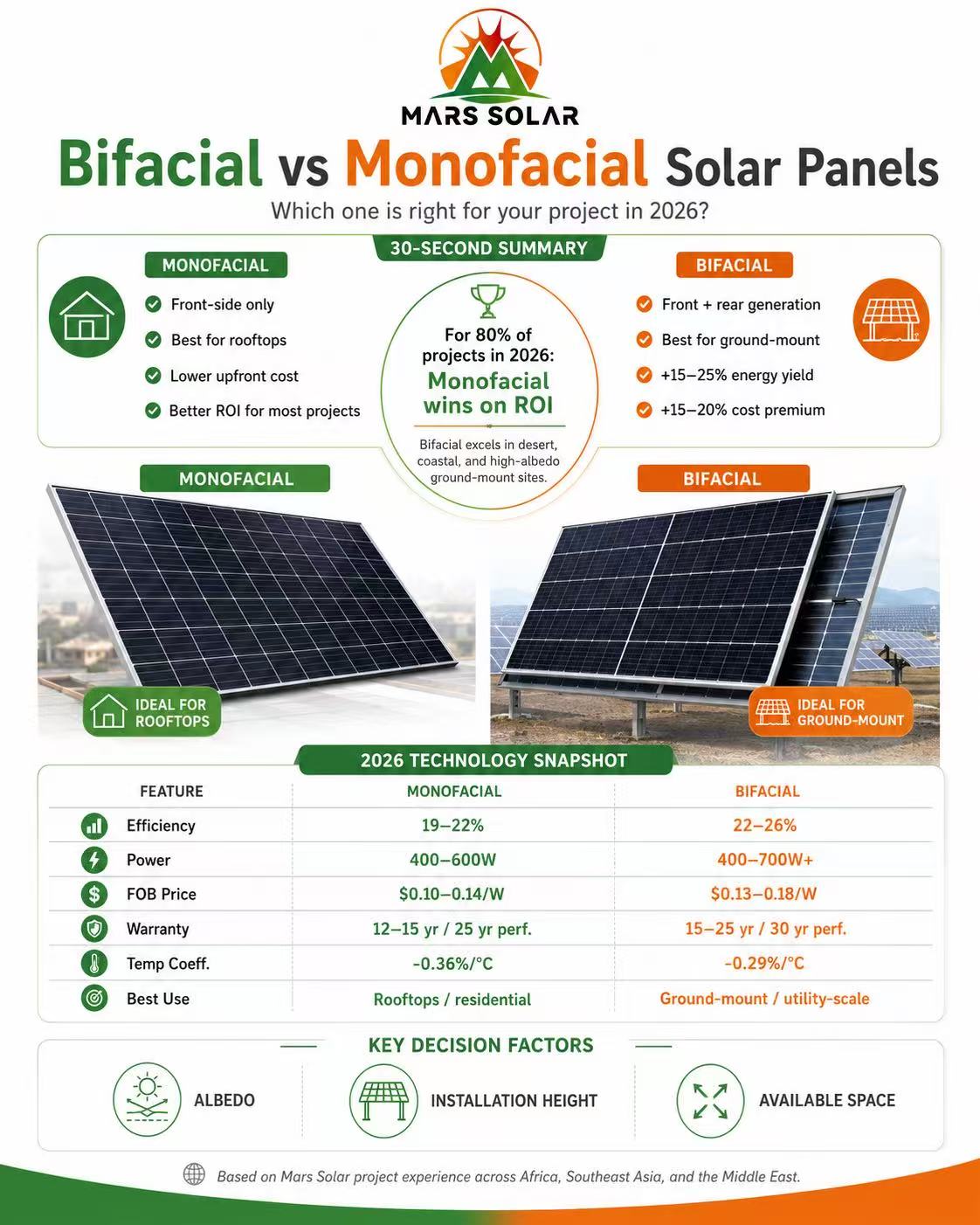
| Specificatie | Monofaciale PERC | Bifaciale N-type TOPCon |
|---|---|---|
| Rendementsbereik | 19-22% | 22-26% |
| Vermogensbereik | 400-600W | 400-700W+ |
| Typische FOB-prijs | $0.10-0.14/W | $0.13-0.18/W |
| Garantie | Prestaties over 12-15 jaar / 25 jaar | Prestaties over 15-25 jaar / 30 jaar |
| Temperatuurcoëfficiënt | -0.36%/°C | -0.29%/°C (beter bij warmte) |
| Beste toepassing | Daken, woongebieden | Grondmontage, utiliteitsschaal |
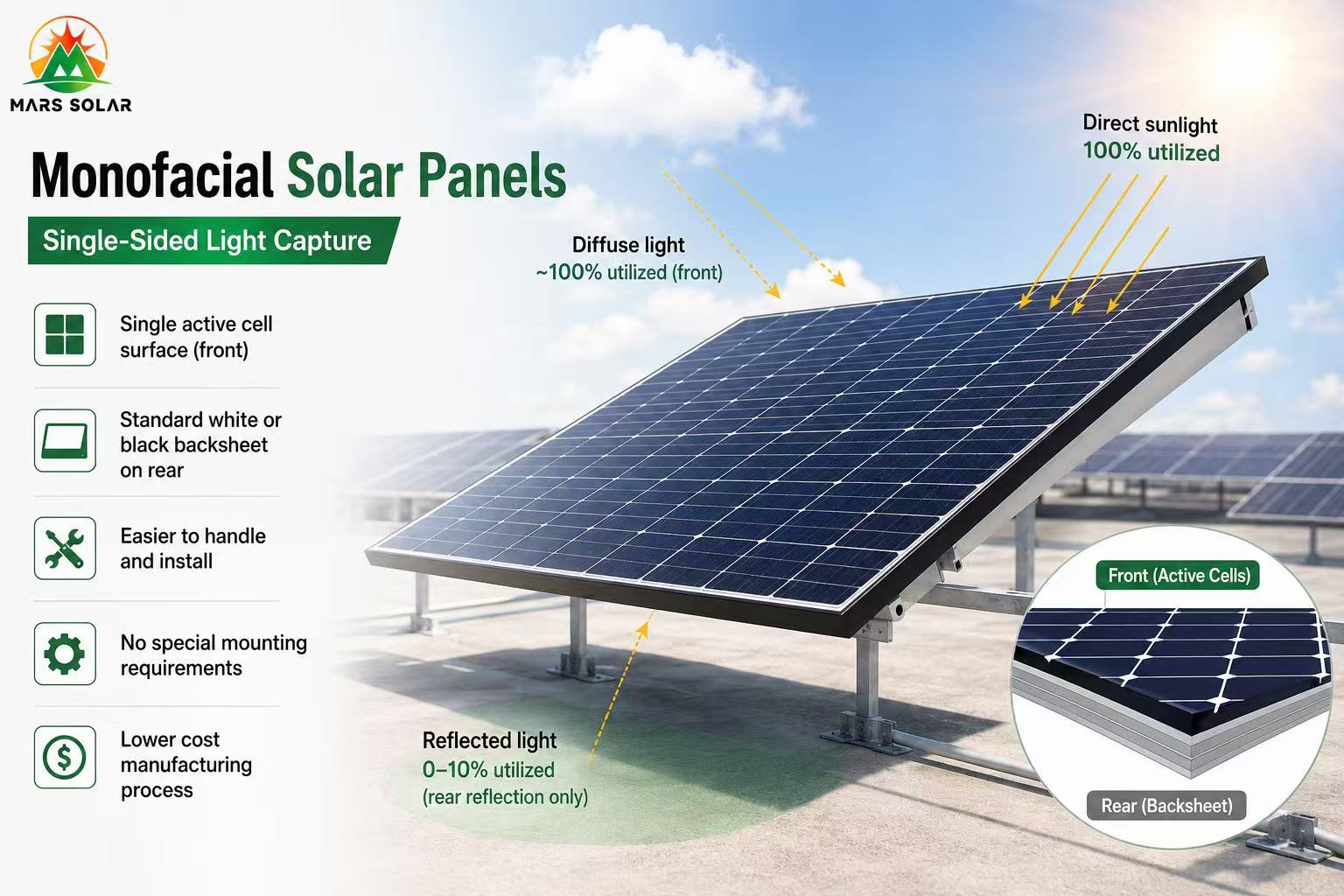
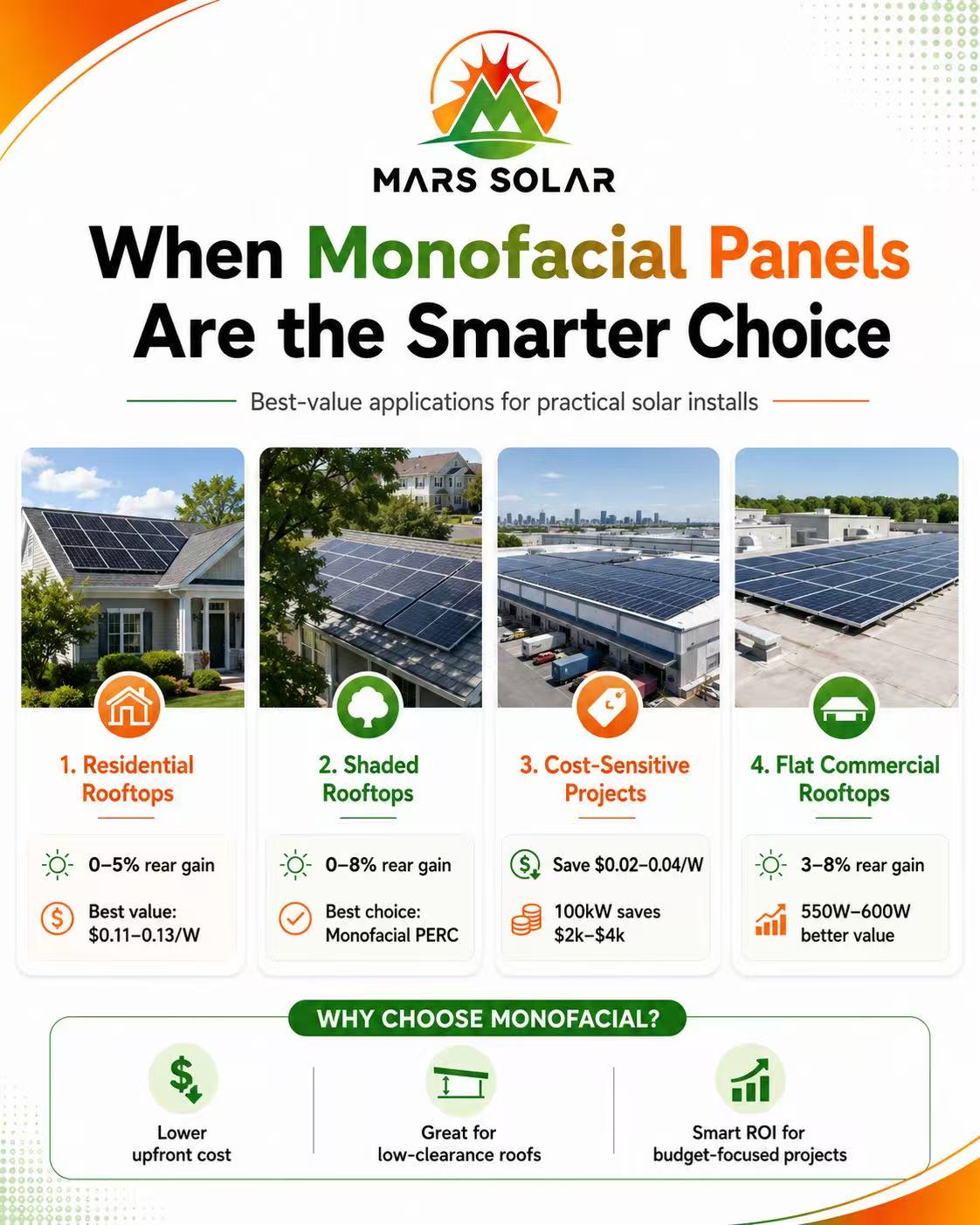
Standaard monofaciale panelen hebben zonnecellen alleen aan de voorzijde. De achterzijde is ofwel volledig ondoorzichtig (witte achterplaat) of licht reflecterend.
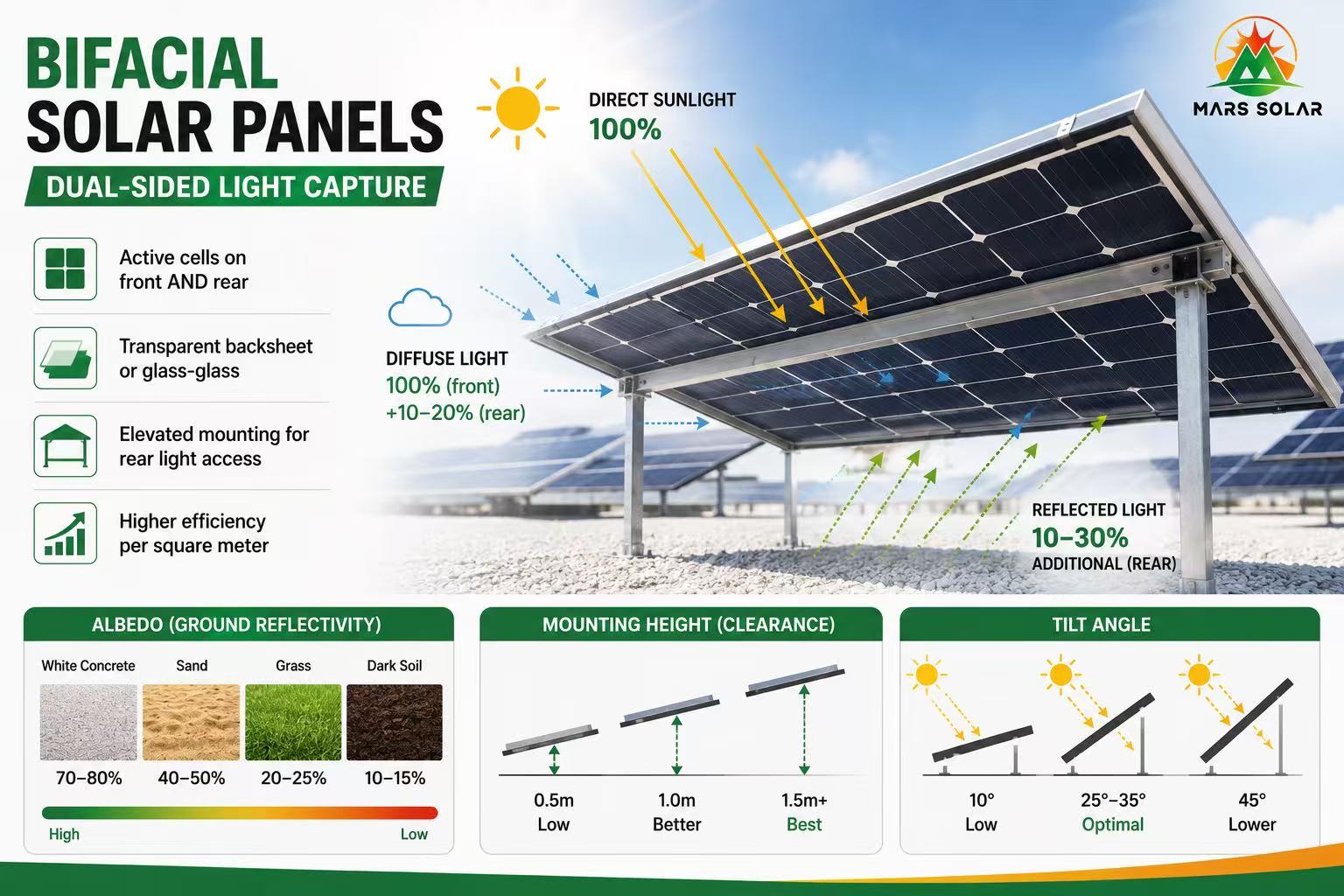
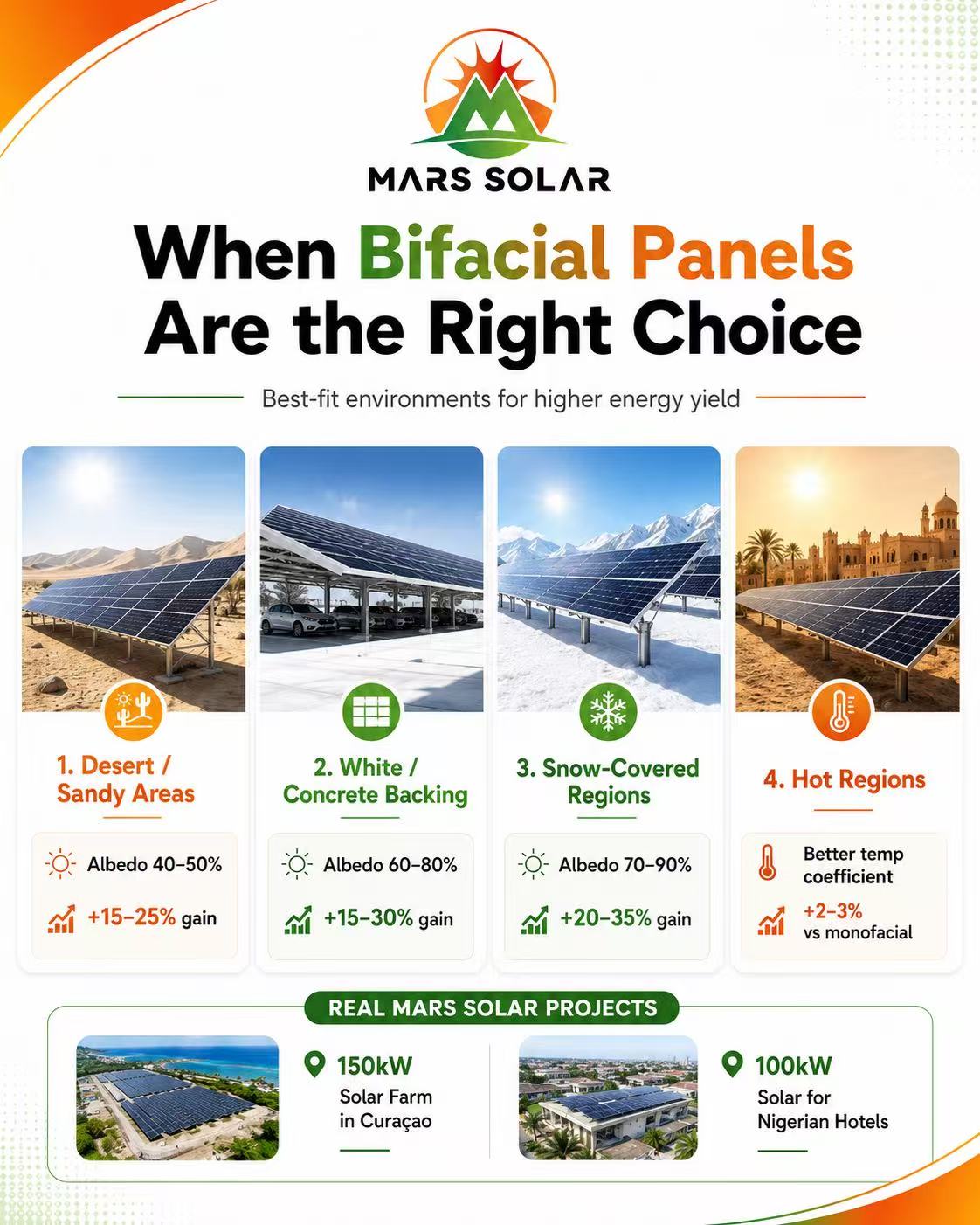
Bifaciale panelen vangen gereflecteerd en verstrooid licht op dat van de grond weerkaatst (dit wordt "albedo-licht" genoemd).
De bifaciale winst hangt volledig af van:
| Criteria | Monofaciale PERC | Bifaciale N-type TOPCon | Winnaar |
|---|---|---|---|
| Efficiëntie | 19-22% | 22-26% | Bifaciaal |
| Uitgangsvermogen (typisch) | 400-600W per paneel | 400-700W per paneel | Bifaciaal |
| FOB-prijs China | $0.10-0.14/W | $0.13-0.18/W | Monofaciaal |
| Kosten per watt | Basislijn | +15-25% premium | Monofaciaal |
| Bifaciale winst | 0% (enkelzijdig) | +10-25% (afhankelijk van albedo) | Bifaciaal |
| Vereiste montagehoogte | Overal (dak/grond) | Minimale doorrijhoogte: 0,5-1 m | Monofaciaal |
| Temperatuurcoëfficiënt | -0.36%/°C | -0.29%/°C | Bifaciaal |
| prestaties in warme klimaten | Goed | Beter | Bifaciaal |
| Levensduur | 25-30 jaar | 25-35 jaar (glas-glas) | Bifaciaal |
| Gewicht | ~23 kg (60 cellen) | ~26-32 kg | Monofaciaal |
| Ideaal voor daken | ✅ Perfect | ⚠️ Vereist vrije hoogte | Monofaciaal |
| Het meest geschikt voor montage op de grond. | ✅ Goed | ✅ Uitstekend | Bifaciaal |
| Het meest geschikt voor Afrika (woestijn). | ✅ Goed | ✅ Uitstekend (zandkleur albedo) | Bifaciaal |
| Projecttype | Aanbevolen paneeltype | Waarom |
|---|---|---|
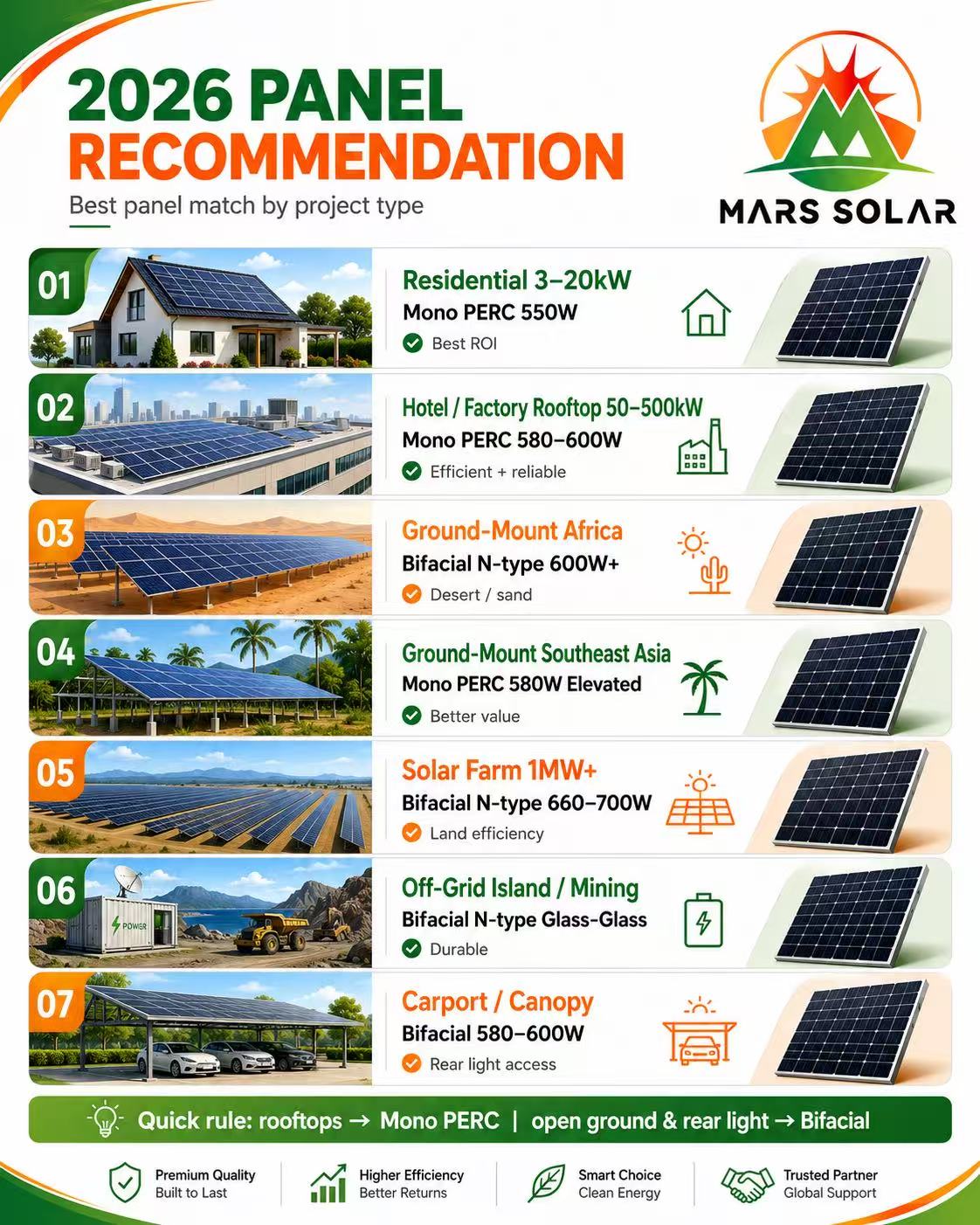
| Residentieel (3-20 kW) | Mono PERC 550W | Optimaal rendement, eenvoudige installatie |
| Dakterras van hotel/fabriek (50-500 kW) | Mono PERC 580-600W | Hoge efficiëntie + betrouwbaarheid |
| Grond-berg Afrika (woestijn/zand) | Bifaciale N-type 600W+ | Maximaliseer de albedo-winst |
| Grondmontage Zuidoost-Azië | Mono PERC 580W verhoogd | Lagere albedo, betere prijs-kwaliteitverhouding |
| Zonne-energiepark (1 MW+) | Bifaciale N-type 660-700W | Landefficiëntie + bifaciale winst |
| Eiland zonder elektriciteitsnet/Mijnbouw | Bifaciale N-type (glas-glas) | Duurzaamheid + vochtbestendigheid |
| Carport/Overkapping | Bifaciale 580-600W | Natuurlijke toegang tot de achterlichten |
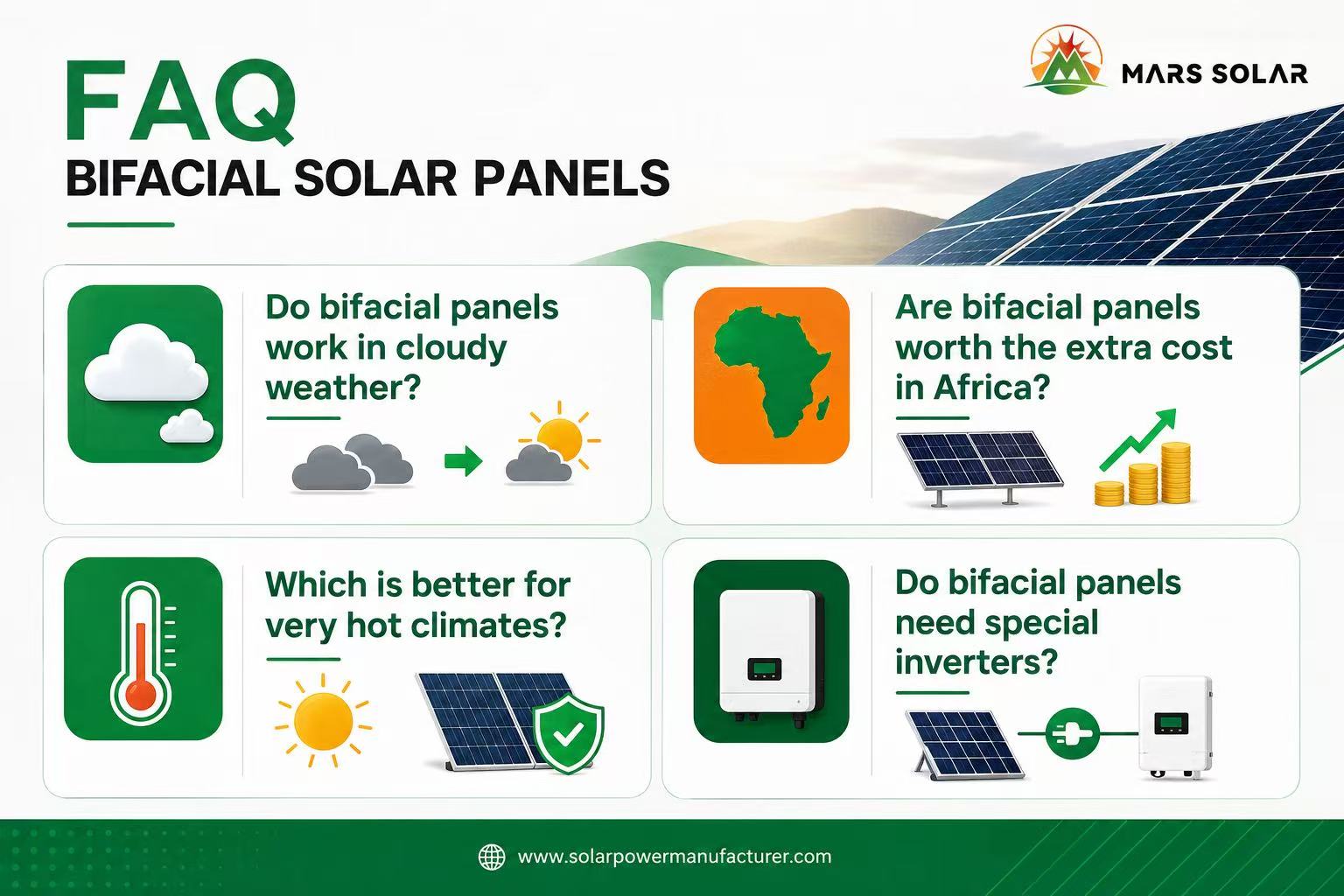
Ja, maar de winst is lager. Op bewolkte dagen domineert diffuus licht. De winst bij bifaciale belichting daalt van 15-25% naar 5-10%. In regio's met aanhoudend bewolkt weer (Noord-Europa, Verenigd Koninkrijk) is de meerprijs voor bifaciale belichting moeilijker te rechtvaardigen.
Voor montage op de grond: JA. De Sahara en sub-Sahara-regio's hebben een albedo van 40-501 TP3T door het zand. Een bifaciale winst van 15-251 TP3T is goed gedocumenteerd. Voor montage op daken in Afrika: meestal NEE (lage montagehoogte, donkere daken).
Bifacial N-type TOPCon has better temperature coefficient (-0.29%/°C vs -0.36%/°C). In temperatures above 35°C, this means 2-3% less power loss per degree. Bifacial is the best choice for UAE, Saudi Arabia, Nigeria, and similar climates.
Nee. Bifaciale panelen werken met elke standaard omvormer. De gelijkstroomingang van bifaciale panelen is identiek aan die van monofaciale panelen.
Monofaciale panelen, in vrijwel alle gevallen op daken. Bifaciale cellen hebben licht aan de achterzijde nodig en minstens een meter vrije ruimte achter de paneelreeks om dat licht op te vangen, en een vlak dak biedt geen van beide. De keuze tussen bifaciale en monofaciale zonnepanelen komt daarom meestal neer op monofaciale panelen op een dak en bifaciale panelen op open terrein. Wanneer het dak schuin boven een wit membraan of een licht betonnen dakplaat ligt, wordt het verschil kleiner, maar verdwijnt het zelden volledig.
Tussen 5% en 15% bij een goed ontworpen grondmontage, en 20% of meer alleen wanneer de albedo van het oppervlak zeer hoog is — verse sneeuw, wit grind of een lichtgekleurde betonnen ondergrond. Het verschil wordt groter naarmate de montagehoogte, de rijafstand en de reflectie toenemen, en verdwijnt vrijwel volledig boven donkere grond of dicht gras. Elke vergelijking tussen bifaciale en monofaciale zonnepanelen waarbij wordt uitgegaan van een vlakke 20%-opbrengst, is eerder marketing dan een modelberekening.
Ongeveer 0,5 of hoger. Verse sneeuw haalt ongeveer 0,8, wit grind 0,5–0,6, licht beton 0,3–0,4, droog gras ongeveer 0,2 en donkere grond ongeveer 0,1. In de onderste helft van dat bereik weegt de opbrengst aan de achterzijde niet op tegen de meerprijs van de module, en bij de keuze tussen bifaciale en monofaciale zonnepanelen moet de voorkeur uitgaan naar monofaciale panelen. Vraag om de aanname inzake de albedo op papier voordat u tekent.
Yes — bifacial modules typically carry a 5–15% premium per watt and are usually glass-on-glass. Because the premium is paid on day one while the extra output arrives over 25 years, a proper bifacial vs monofacial solar panels comparison has to be run on cost per kWh delivered, not cost per watt. The photovoltaic module specification sheet is where the bifaciality factor and the temperature coefficient are declared.
Een bifaciale opstelling heeft ongeveer een meter ruimte nodig achter de onderste rij en een constructie die geen schaduw werpt op de achterzijde; een monofaciale opstelling kan veel dichter bij de grond worden geplaatst. Die structurele vereiste is de tweede kostenpost in de afweging tussen bifaciale en monofaciale zonnepanelen, en het is de reden waarom vergelijkingen tussen grondgemonteerde installaties van 1 MW dichter bij elkaar liggen dan de modulepremie op zich zou doen vermoeden.
Yes, but on separate strings and ideally separate MPPT channels. Bread on one string, the weaker operating point wins and the bifacial modules are pulled down to the monofacial voltage. If you are phasing an upgrade, keep the two technologies on their own inputs. Mixing them carelessly is the most common way a bifacial vs monofacial solar panels plan loses the gain it was built to capture.
Less than the marketing suggests. Rear-side exposure helps a little, but the temperature coefficient of the module decides output in Accra, Nairobi or Dubai conditions far more than bifaciality does. When you compare bifacial vs monofacial solar panels for a hot site, compare the temperature coefficient and the degradation curve first, and treat the rear-side gain as the smaller term.
Three inputs decide the answer: the module's bifaciality factor, usually 0.7–0.8; the surface albedo of the site; and the geometry — mounting height, tilt and row spacing. A bifacial vs monofacial solar panels model that omits any one of the three is guessing. Ask your supplier to hand over those assumptions alongside the modelled yield.
Comparable, and often better for bifacial: glass-on-glass bifacial modules are frequently warranted for 30 years against performance, against 25–30 years for a typical monofacial module. That does not settle the bifacial vs monofacial solar panels question by itself, because a longer warranty on a module that generates less over its life is not a saving. Model the energy first.
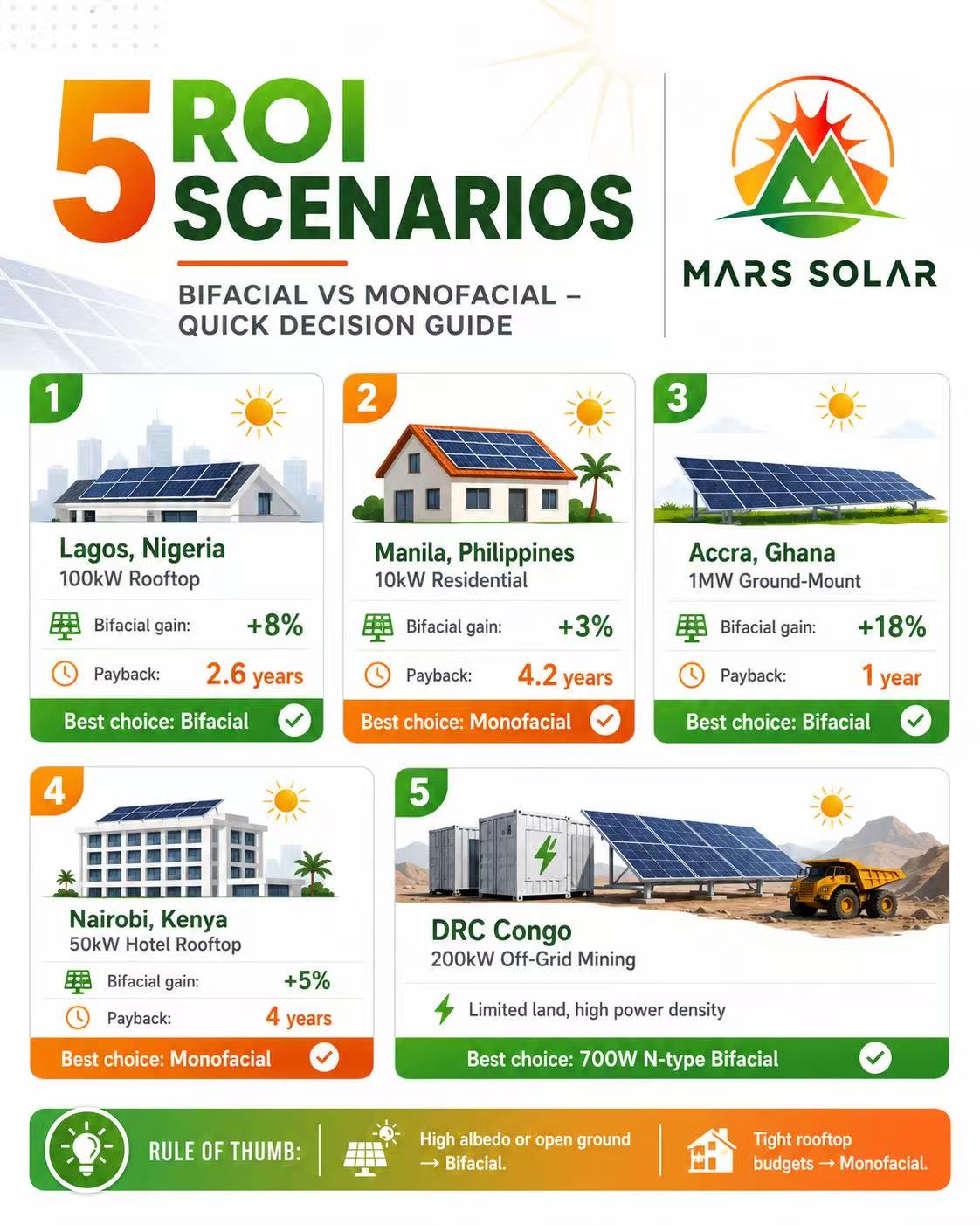
On a high-albedo ground-mount the bifacial array usually pays back one to two years sooner across a 25-year life. On a dark-surfaced site, a rooftop or a shaded yard, monofacial wins outright and the bifacial premium is money spent on a feature the site cannot use. That is the honest answer to the bifacial vs monofacial solar panels question: it is a site-specific advantage, not a generational improvement.
Usually bifacial, and this is the scale where the choice pays. At 1 MW the structure is engineered anyway, so mounting height is nearly free, and row spacing is set by the layout rather than the roof. On light ground, a bifacial vs monofacial solar panels comparison at this scale typically returns the module premium inside three to four years. On dark laterite or dense grass, monofacial remains the correct answer.
De meer dan 30 ingenieurs van Mars Solar kunnen u adviseren over het meest geschikte paneeltype voor uw specifieke project. Wij leveren zowel monofaciale PERC- als bifaciale N-type TOPCon-panelen en adviseren u altijd het type dat het beste rendement op uw investering (ROI) oplevert.
Mars Solar (Foshan Mars Solar Technology Co., Ltd.) produceert en ontwikkelt zonne-energiesystemen sinds 2008. Meer dan 17 jaar ervaring, 30+ ingenieurs, En Meer dan 3.000 succesvolle projecten in meer dan 130 landen., Wij helpen distributeurs en EPC-aannemers bij het kiezen van de juiste zonne-energieapparatuur voor hun specifieke omstandigheden.
Ontvang een gratis paneladvies | Over ons | Bekijk onze cases
Laatst bijgewerkt: juli 2026
Trefwoorden: bifaciale versus monofaciale zonnepanelen, beste type zonnepaneel 2026, mono PERC versus TOPCon, vergelijking van zonnepanelen, aanbeveling voor Mars Solar-panelen

 English English
  Arabic
 Spanish
 French
 Dutch
Dutch
 Portuguese