
Language
Choosing between bifacial vs monofacial solar panels?
This 2026 guide compares efficiency, cost, and real-world ROI. Based on 3,000+ solar projects across Africa, Southeast Asia, and the Middle East, we give you the data to make the right choice.Bifacial and monofacial solar panels look almost identical from the front.
But under the surface, they work differently — and choosing the wrong type can cost your project 15-25% in annual energy yield, or add 20% to your upfront cost unnecessarily.
This article cuts through the marketing noise. Based on real performance data from Mars Solar projects across Africa, Southeast Asia, and the Middle East, we give you an objective Bifacial vs Monofacial comparison.
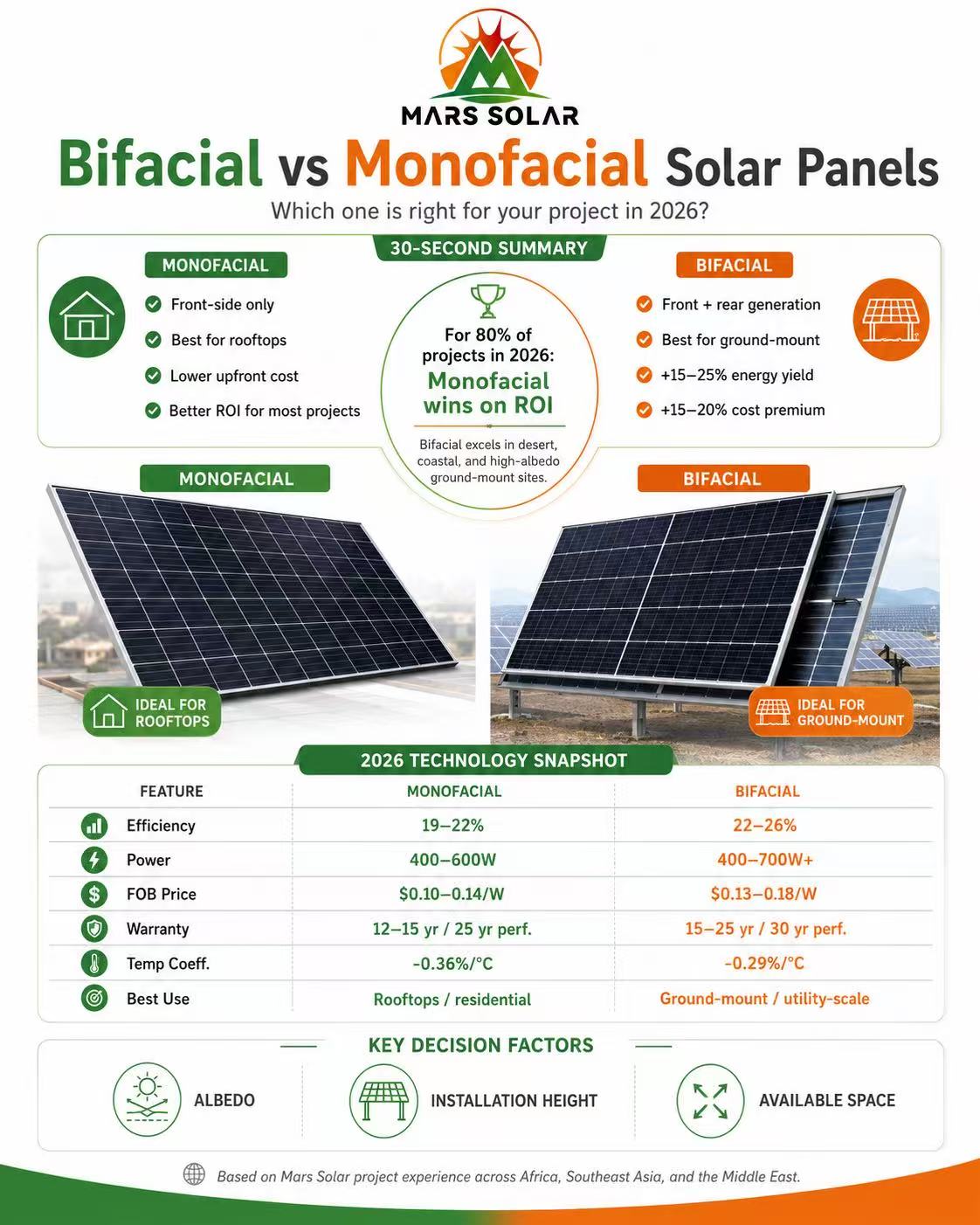
| Specification | Monofacial PERC | Bifacial N-Type TOPCon |
|---|---|---|
| Efficiency range | 19-22% | 22-26% |
| Power range | 400-600W | 400-700W+ |
| Typical FOB price | $0.10-0.14/W | $0.13-0.18/W |
| Warranty | 12-15yr / 25yr performance | 15-25yr / 30yr performance |
| Temperature coefficient | -0.36%/°C | -0.29%/°C (better in heat) |
| Best use case | Rooftops, residential | Ground-mount, utility-scale |
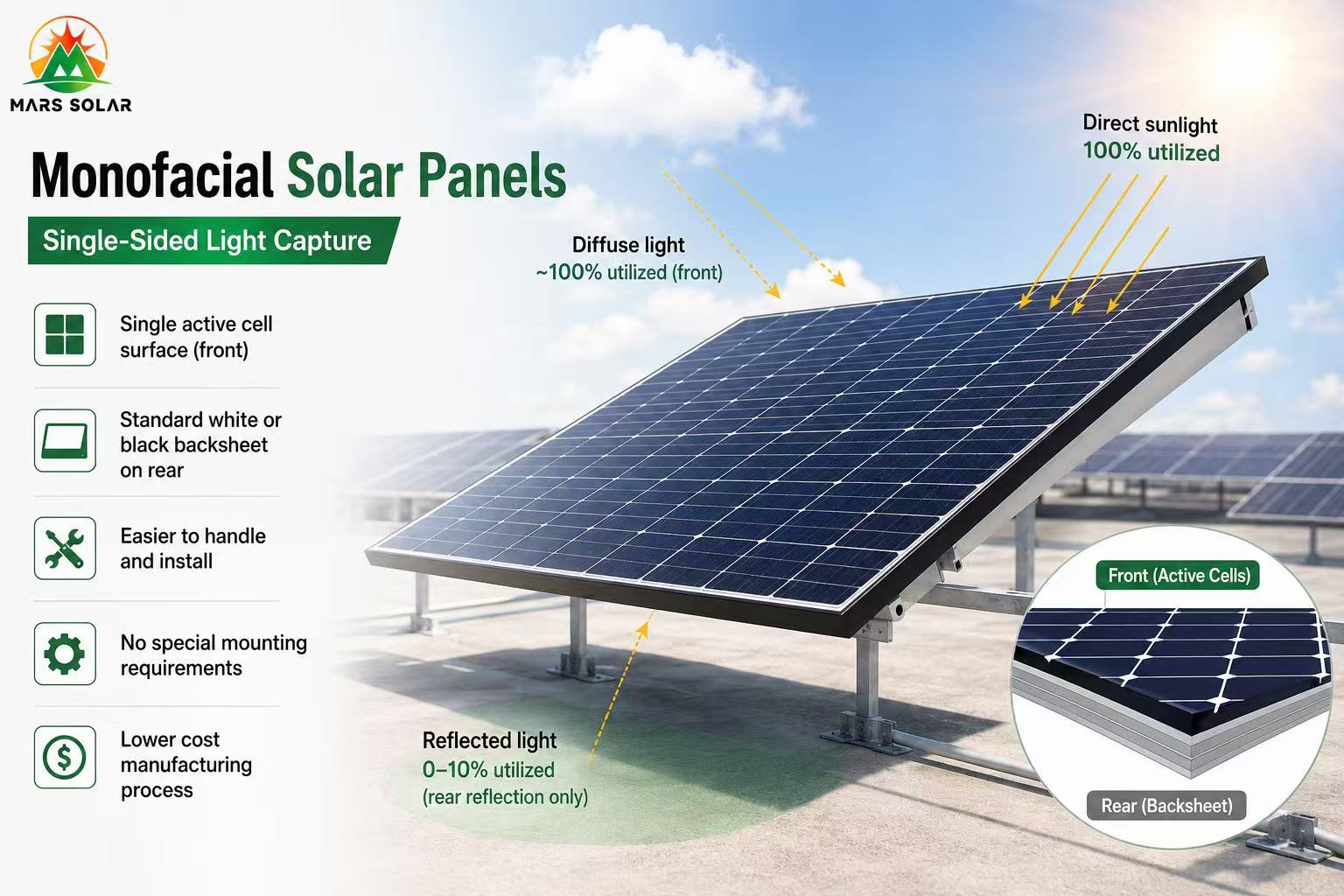
Standard monofacial panels have solar cells only on the front surface. The rear surface is either fully opaque (white backsheet) or lightly reflective.
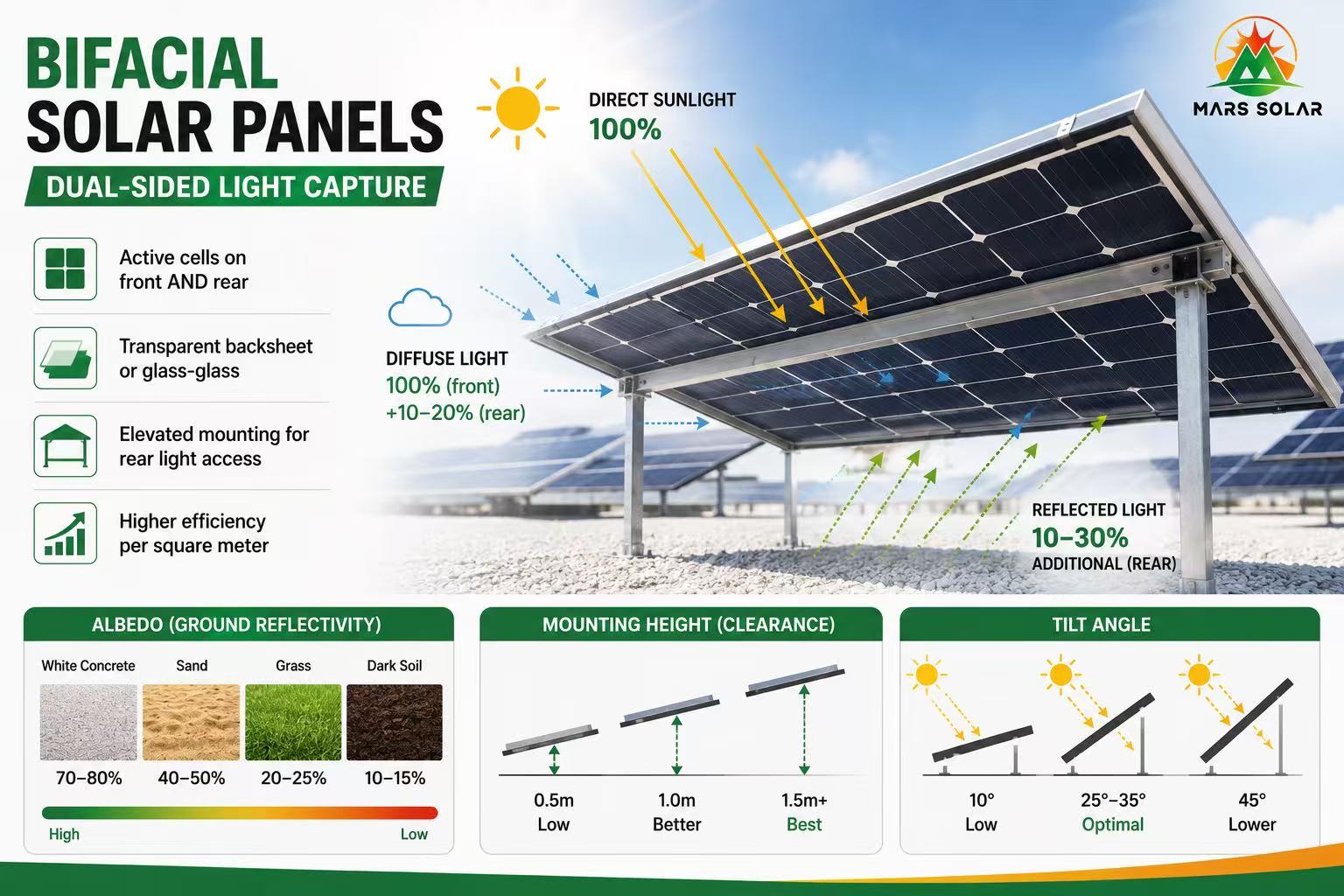
Bifacial panels capture reflected and scattered light that bounces off the ground (called "albedo light").
The bifacial gain depends entirely on:
| Criteria | Monofacial PERC | Bifacial N-Type TOPCon | Winner |
|---|---|---|---|
| Efficiency | 19-22% | 22-26% | Bifacial |
| Power output (typical) | 400-600W per panel | 400-700W per panel | Bifacial |
| FOB price China | $0.10-0.14/W | $0.13-0.18/W | Monofacial |
| Cost per watt | Baseline | +15-25% premium | Monofacial |
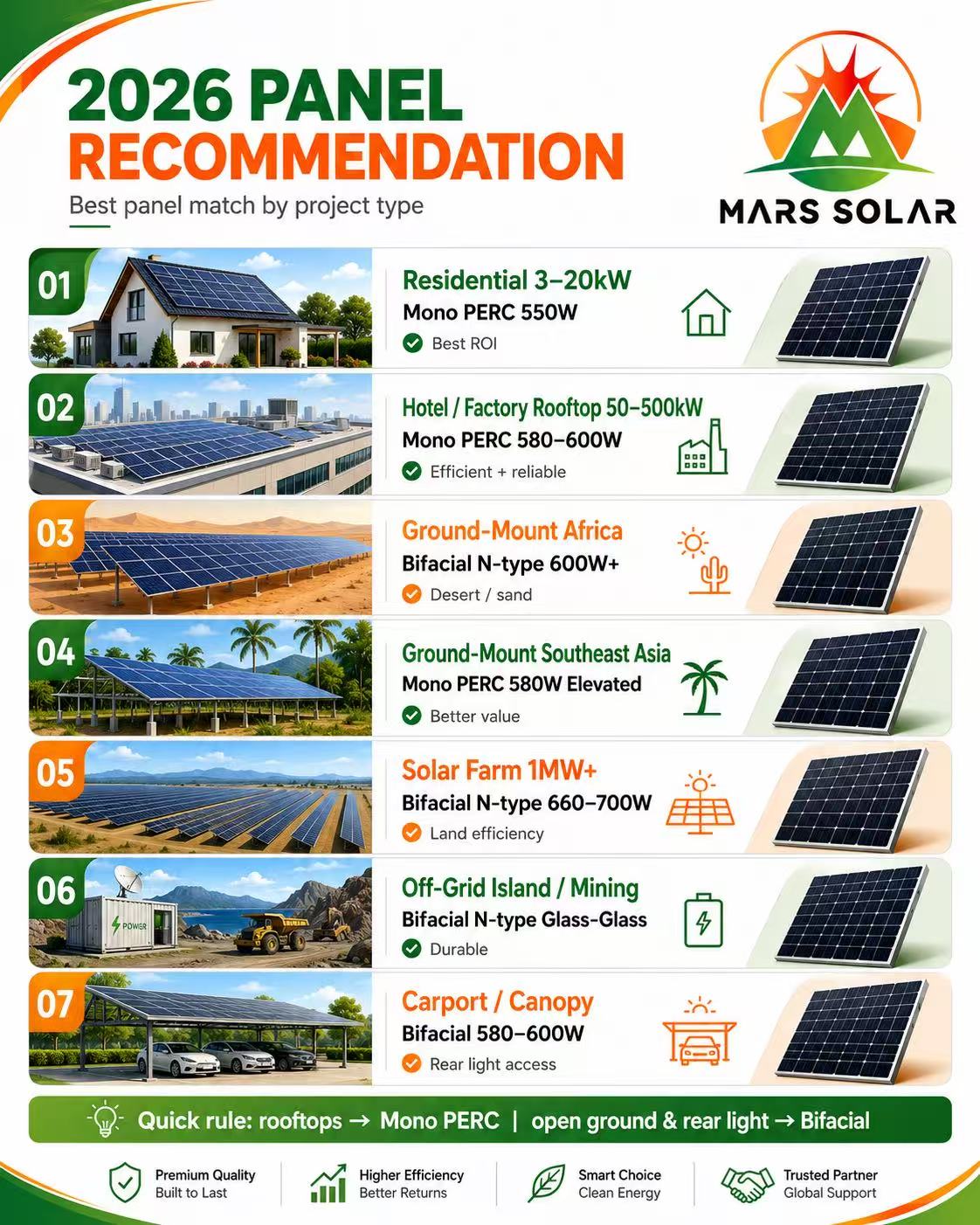
| Bifacial gain | 0% (single-sided) | +10-25% (depends on albedo) | Bifacial |
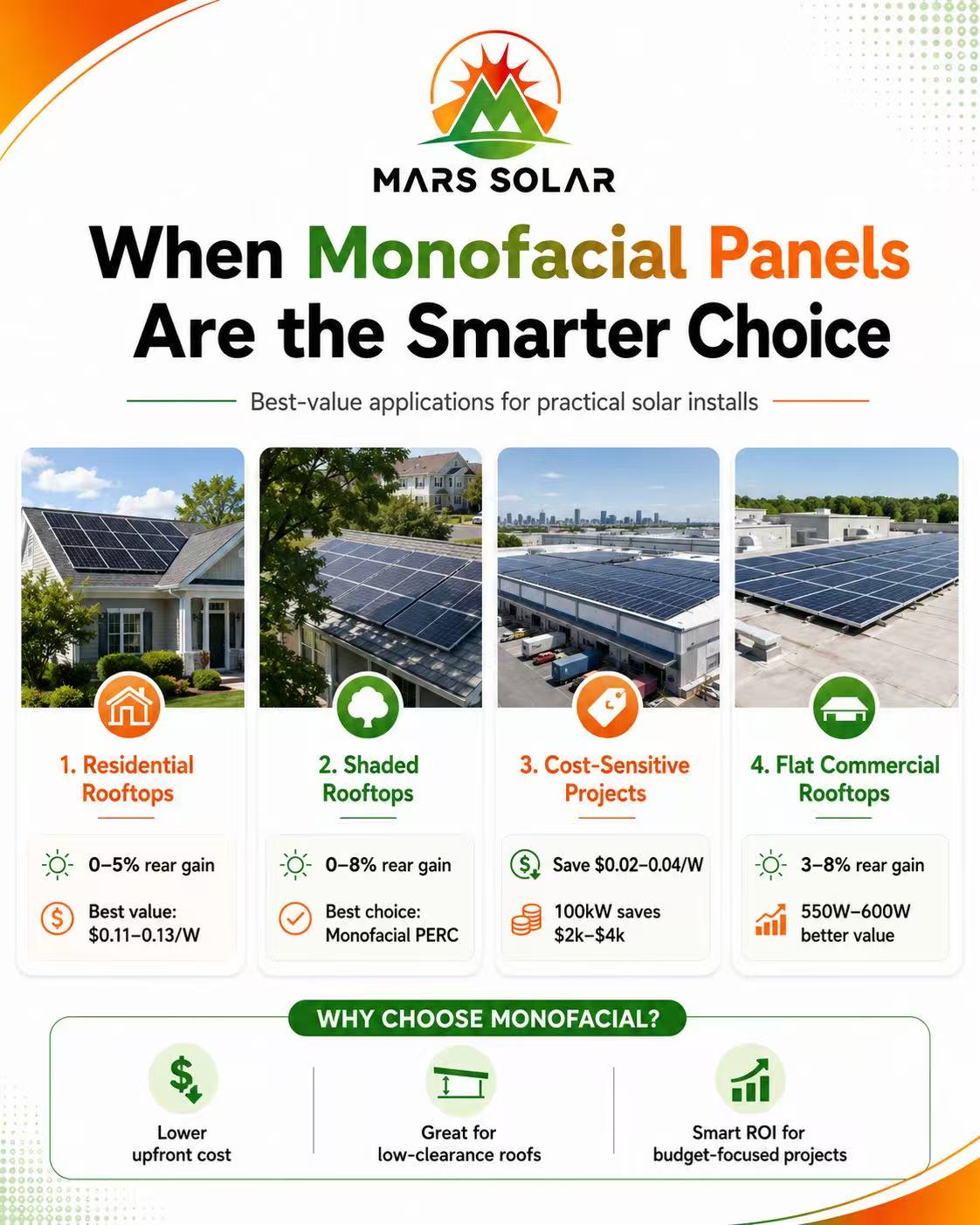
| Mounting height requirement | Any (rooftop/ground) | Minimum 0.5-1m clearance | Monofacial |
| Temperature coefficient | -0.36%/°C | -0.29%/°C | Bifacial |
| Hot climate performance | Good | Better | Bifacial |
| Lifespan | 25-30 years | 25-35 years (glass-glass) | Bifacial |
| Weight | ~23kg (60-cell) | ~26-32kg | Monofacial |
| Best for rooftops | ✅ Perfect | ⚠️ Needs height clearance | Monofacial |
| Best for ground-mount | ✅ Good | ✅ Excellent | Bifacial |
| Best for Africa (desert) | ✅ Good | ✅ Excellent (sand albedo) | Bifacial |
| Project Type | Recommended Panel Type | Why |
|---|---|---|
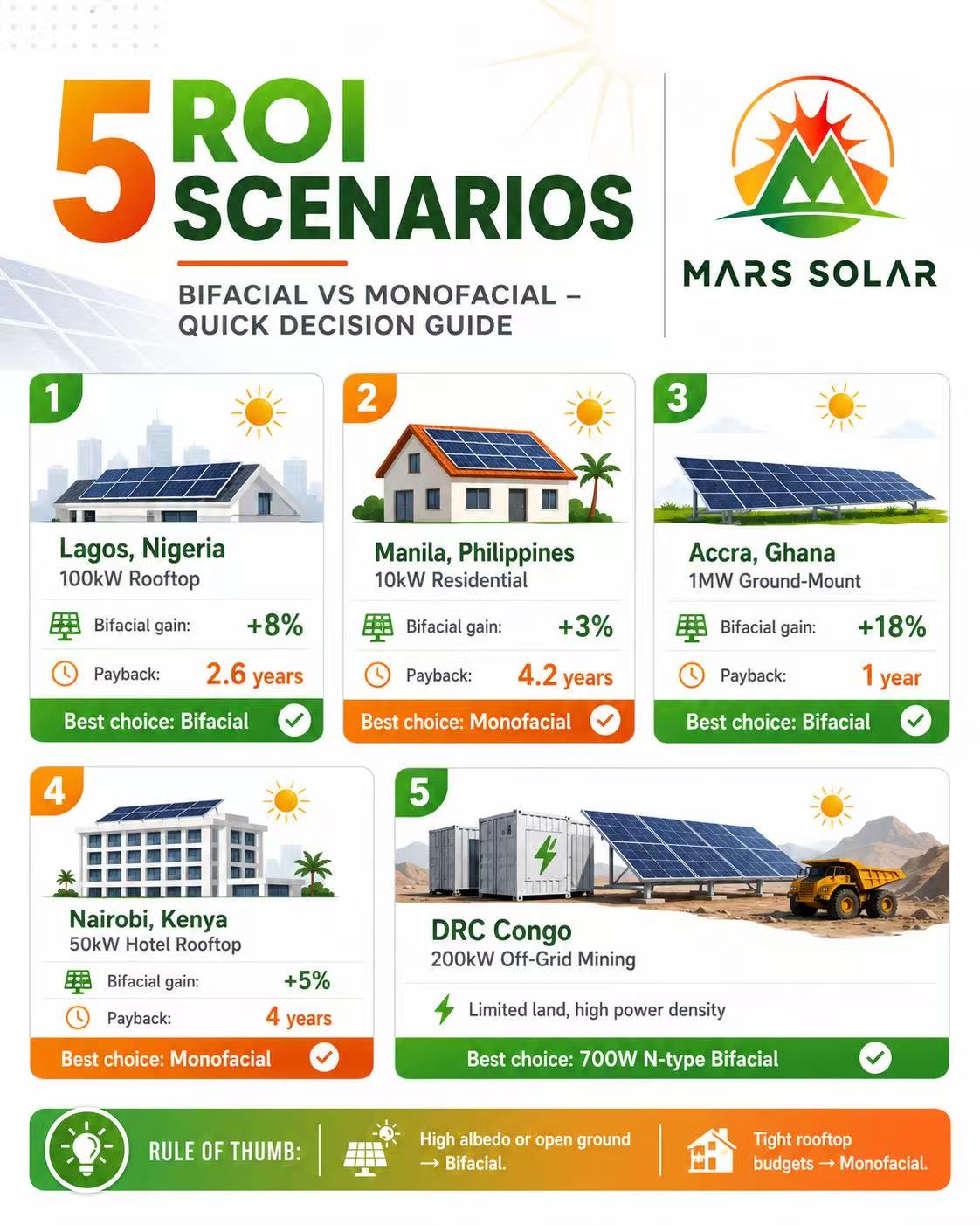
| Residential (3-20kW) | Mono PERC 550W | Best ROI, easy install |
| Hotel/Factory Rooftop (50-500kW) | Mono PERC 580-600W | High efficiency + reliability |
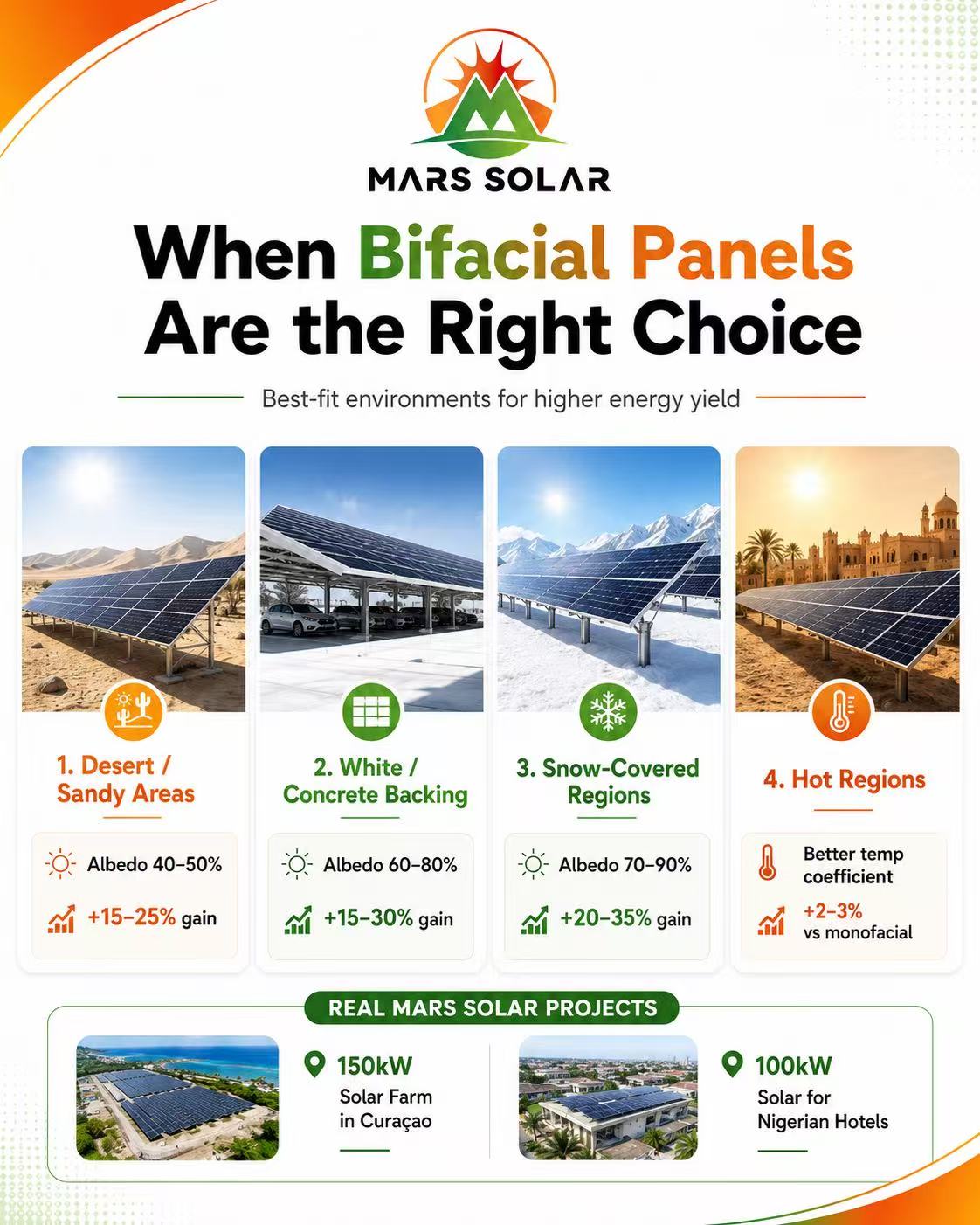
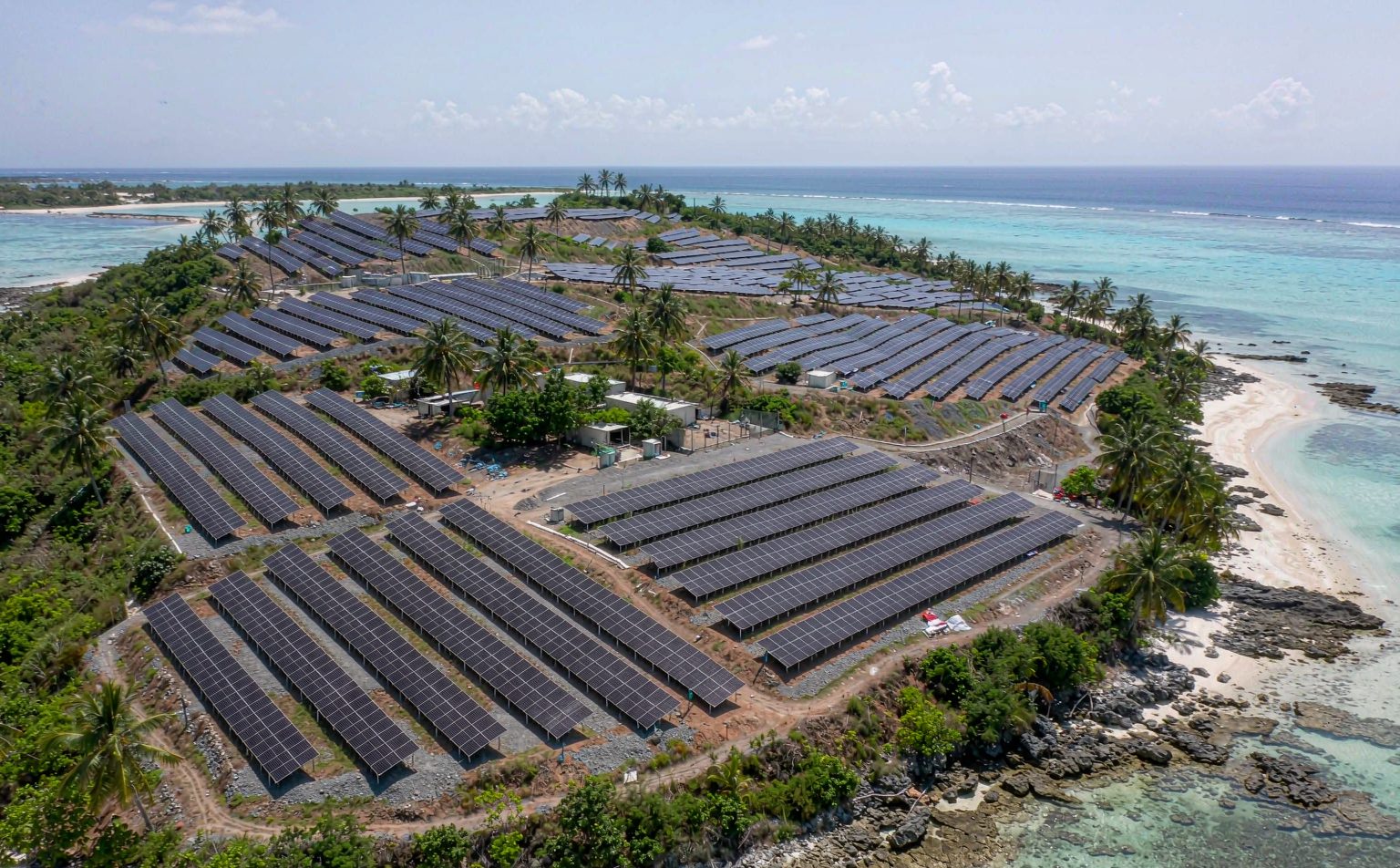
| Ground-Mount Africa (Desert/Sand) | Bifacial N-type 600W+ | Maximize albedo gain |
| Ground-Mount Southeast Asia | Mono PERC 580W elevated | Lower albedo, better value |
| Solar Farm (1MW+) | Bifacial N-type 660-700W | Land efficiency + bifacial gain |
| Off-Grid Island/Mining | Bifacial N-type (glass-glass) | Durability + humidity resistance |
| Carport/Canopy | Bifacial 580-600W | Natural rear light access |
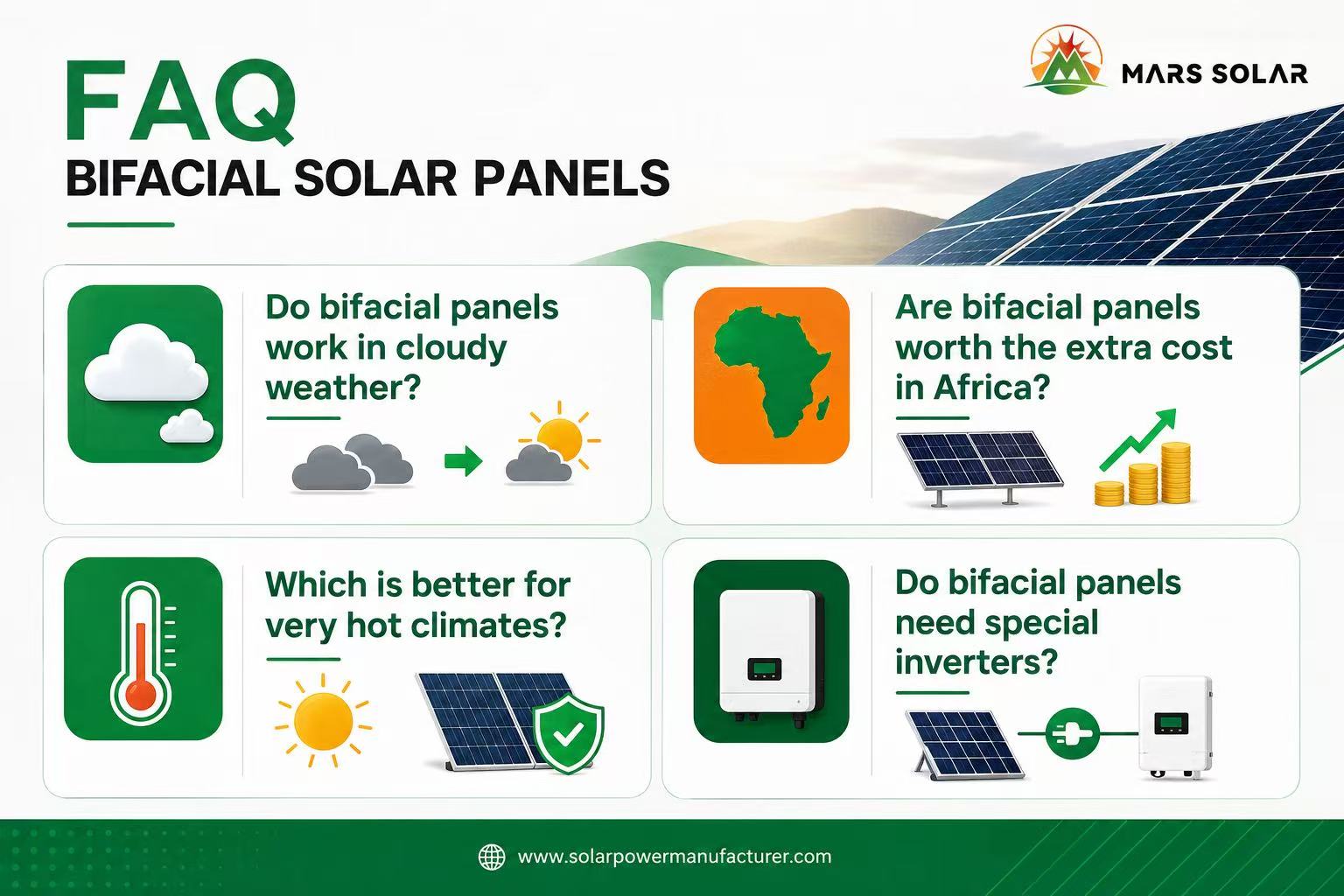
Yes, but the gain is reduced. On cloudy days, diffuse light dominates. Bifacial gain drops from 15-25% to 5-10%. In consistently cloudy regions (Northern Europe, UK), bifacial premium is harder to justify.
For ground-mount: YES. Saharan and sub-Saharan regions have 40-50% albedo from sand. Bifacial gain of 15-25% is well-documented. For rooftop in Africa: usually NO (low mounting height, dark roofs).
Bifacial N-type TOPCon has better temperature coefficient (-0.29%/°C vs -0.36%/°C). In temperatures above 35°C, this means 2-3% less power loss per degree. Bifacial is the best choice for UAE, Saudi Arabia, Nigeria, and similar climates.
No. Bifacial panels work with any standard inverter. The DC input from bifacial panels is identical to monofacial.
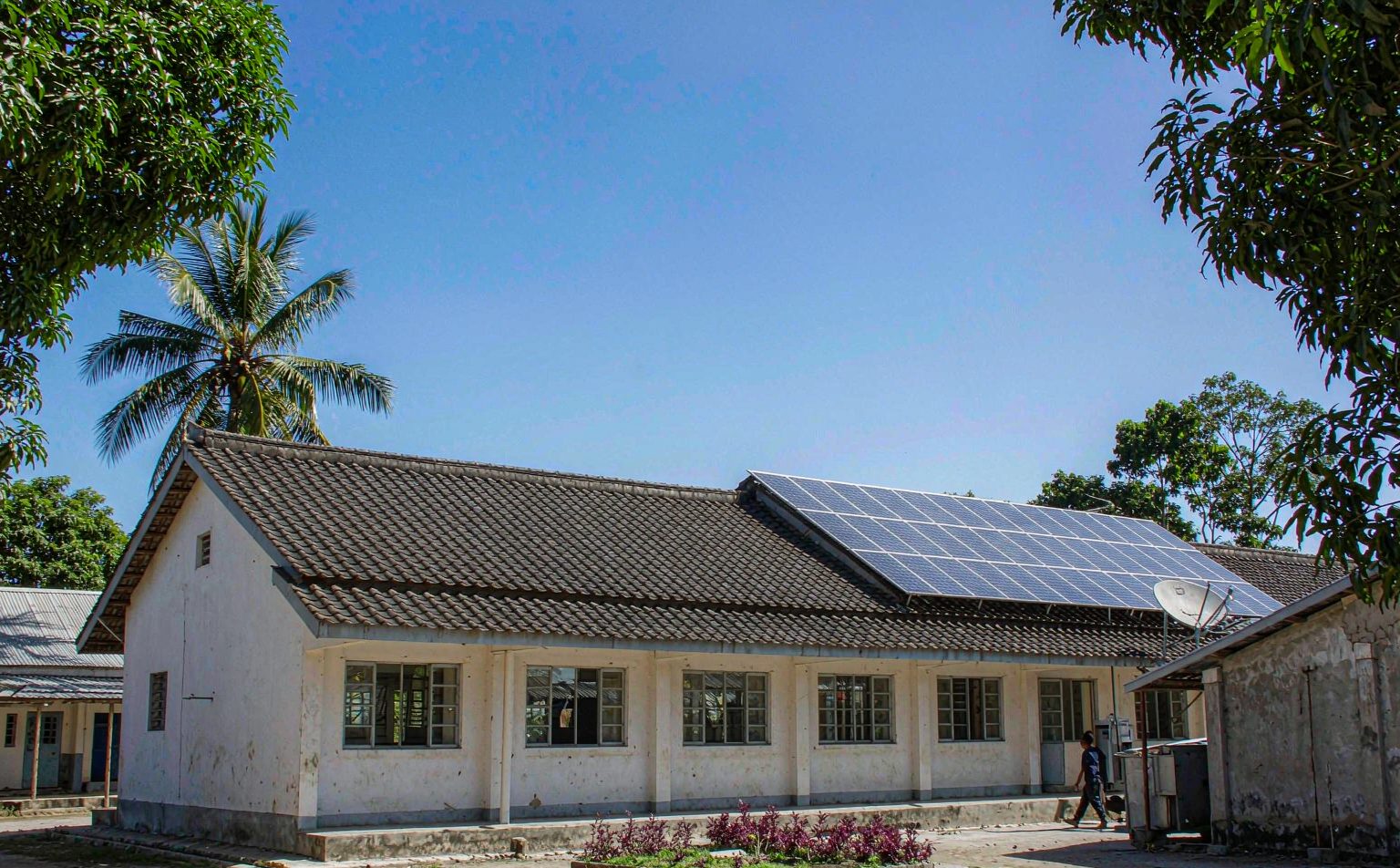
Monofacial, in almost every rooftop case. Bifacial cells need rear-side light and at least a metre of clearance behind the array to capture it, and a flush rooftop gives neither. The choice between bifacial vs monofacial solar panels therefore usually resolves to monofacial on a roof and bifacial on open ground. Where the roof is tilted over a white membrane or a light concrete deck, the gap narrows but rarely closes.
Between 5% and 15% on a well-designed ground-mount, and 20% or more only where the surface albedo is very high — fresh snow, white gravel or a light concrete apron. The gap widens with mounting height, row spacing and reflectance, and collapses to almost nothing over dark soil or dense grass. Any comparison of bifacial vs monofacial solar panels that assumes a flat 20% gain is marketing rather than modelling.
Roughly 0.5 or above. Fresh snow reaches about 0.8, white gravel 0.5–0.6, light concrete 0.3–0.4, dry grass about 0.2 and dark soil about 0.1. On the lower half of that range the rear-side gain does not repay the module premium, and the bifacial vs monofacial solar panels decision should land on monofacial. Ask for the albedo assumption in writing before you sign.
Yes — bifacial modules typically carry a 5–15% premium per watt and are usually glass-on-glass. Because the premium is paid on day one while the extra output arrives over 25 years, a proper bifacial vs monofacial solar panels comparison has to be run on cost per kWh delivered, not cost per watt. The photovoltaic module specification sheet is where the bifaciality factor and the temperature coefficient are declared.
A bifacial array wants about a metre behind the lowest row and a structure that does not shade the rear face; a monofacial table can sit far closer to the ground. That structural requirement is the second cost inside the bifacial vs monofacial solar panels question, and it is why 1 MW ground-mount comparisons come out closer than the module premium alone would suggest.
Yes, but on separate strings and ideally separate MPPT channels. Bread on one string, the weaker operating point wins and the bifacial modules are pulled down to the monofacial voltage. If you are phasing an upgrade, keep the two technologies on their own inputs. Mixing them carelessly is the most common way a bifacial vs monofacial solar panels plan loses the gain it was built to capture.
Less than the marketing suggests. Rear-side exposure helps a little, but the temperature coefficient of the module decides output in Accra, Nairobi or Dubai conditions far more than bifaciality does. When you compare bifacial vs monofacial solar panels for a hot site, compare the temperature coefficient and the degradation curve first, and treat the rear-side gain as the smaller term.
Three inputs decide the answer: the module's bifaciality factor, usually 0.7–0.8; the surface albedo of the site; and the geometry — mounting height, tilt and row spacing. A bifacial vs monofacial solar panels model that omits any one of the three is guessing. Ask your supplier to hand over those assumptions alongside the modelled yield.
Comparable, and often better for bifacial: glass-on-glass bifacial modules are frequently warranted for 30 years against performance, against 25–30 years for a typical monofacial module. That does not settle the bifacial vs monofacial solar panels question by itself, because a longer warranty on a module that generates less over its life is not a saving. Model the energy first.
On a high-albedo ground-mount the bifacial array usually pays back one to two years sooner across a 25-year life. On a dark-surfaced site, a rooftop or a shaded yard, monofacial wins outright and the bifacial premium is money spent on a feature the site cannot use. That is the honest answer to the bifacial vs monofacial solar panels question: it is a site-specific advantage, not a generational improvement.
Usually bifacial, and this is the scale where the choice pays. At 1 MW the structure is engineered anyway, so mounting height is nearly free, and row spacing is set by the layout rather than the roof. On light ground, a bifacial vs monofacial solar panels comparison at this scale typically returns the module premium inside three to four years. On dark laterite or dense grass, monofacial remains the correct answer.
Mars Solar's 30+ engineers can recommend the optimal panel type for your specific project. We supply both monofacial PERC and bifacial N-type TOPCon panels — and we'll always recommend the type that gives your project the best ROI.
Mars Solar (Foshan Mars Solar Technology Co., Ltd.) has been manufacturing and engineering solar systems since 2008. With 17+ years of experience, 30+ engineers, and 3,000+ successful projects in 130+ countries, we help distributors and EPC contractors choose the right solar equipment for their specific conditions.
Last Updated: July 2026
Keywords: bifacial vs monofacial solar panels, best solar panel type 2026, mono PERC vs TOPCon, solar panel comparison, Mars Solar panel recommendation
 English English
  Arabic
 Spanish
 French
 Dutch
Dutch
 Portuguese