
Idioma
¿Elegir entre paneles solares bifaciales y monofaciales?
Esta guía de 2026 compara la eficiencia, el costo y el retorno de la inversión real. Basándonos en más de 3000 proyectos solares en África, el sudeste asiático y Oriente Medio, le brindamos los datos para que tome la decisión correcta. Los paneles solares bifaciales y monofaciales se ven casi idénticos desde el frente.
Pero en el fondo funcionan de manera diferente, y elegir el tipo incorrecto puede costarle a su proyecto entre 15 y 251 TP3T en rendimiento energético anual, o agregar 201 TP3T a su costo inicial innecesariamente.
Este artículo va más allá del ruido publicitario. Basándonos en datos de rendimiento reales de proyectos de Mars Solar en África, el sudeste asiático y Oriente Medio, ofrecemos una comparación objetiva entre paneles bifaciales y monofaciales.
| Especificación | PERC monofacial | TOPCon bifacial tipo N |
|---|---|---|
| Rango de eficiencia | 19-22% | 22-26% |
| Rango de potencia | 400-600 W | 400-700W+ |
| Precio FOB típico | $0.10-0.14/W | $0.13-0.18/W |
| Garantía | Rendimiento a 12-15 años / 25 años | Rendimiento a 15-25 años / 30 años |
| Coeficiente de temperatura | -0,36%/°C | -0,29%/°C (mejor en calor) |
| Mejor caso de uso | Azoteas, residenciales | Montaje en tierra, a escala industrial |
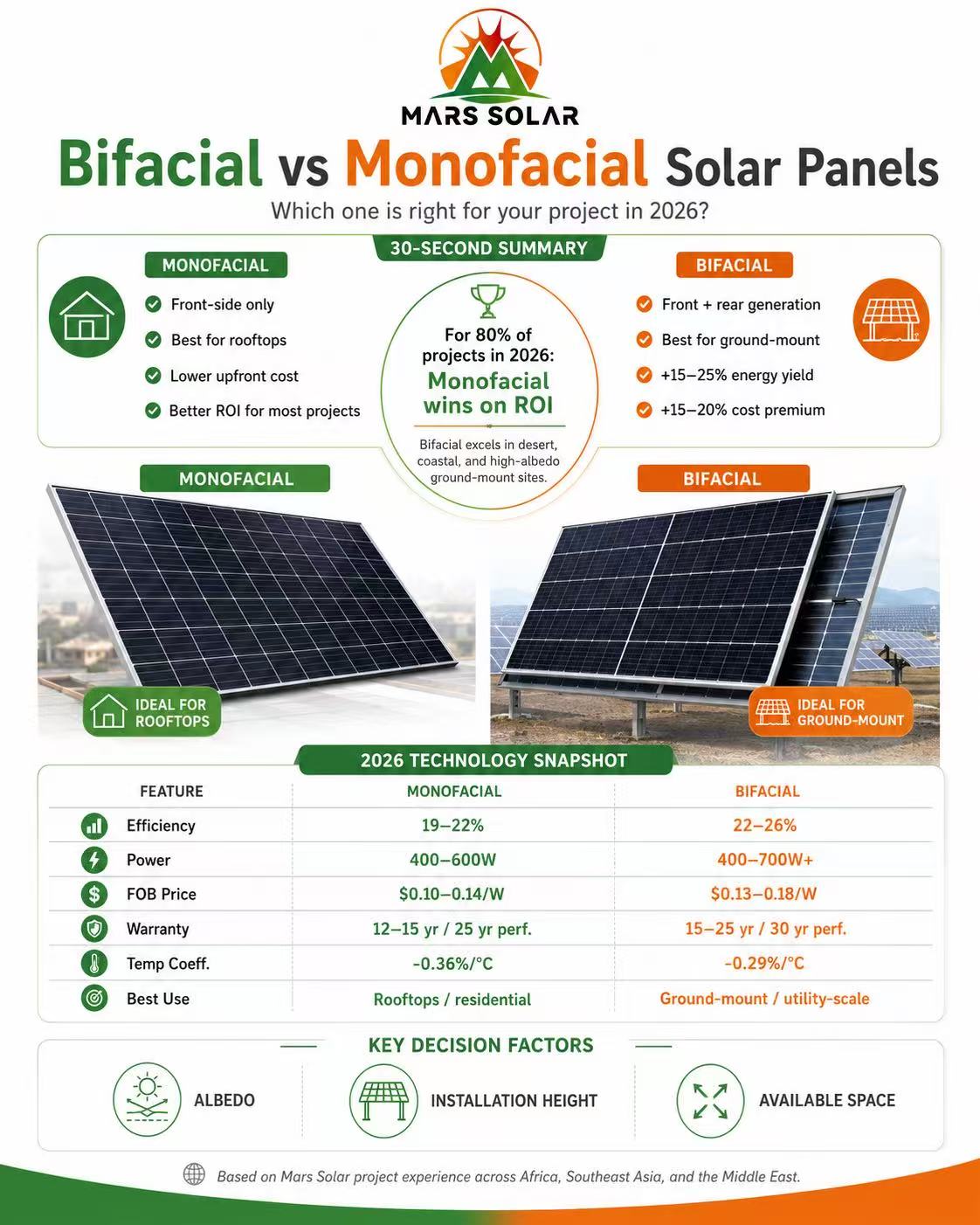
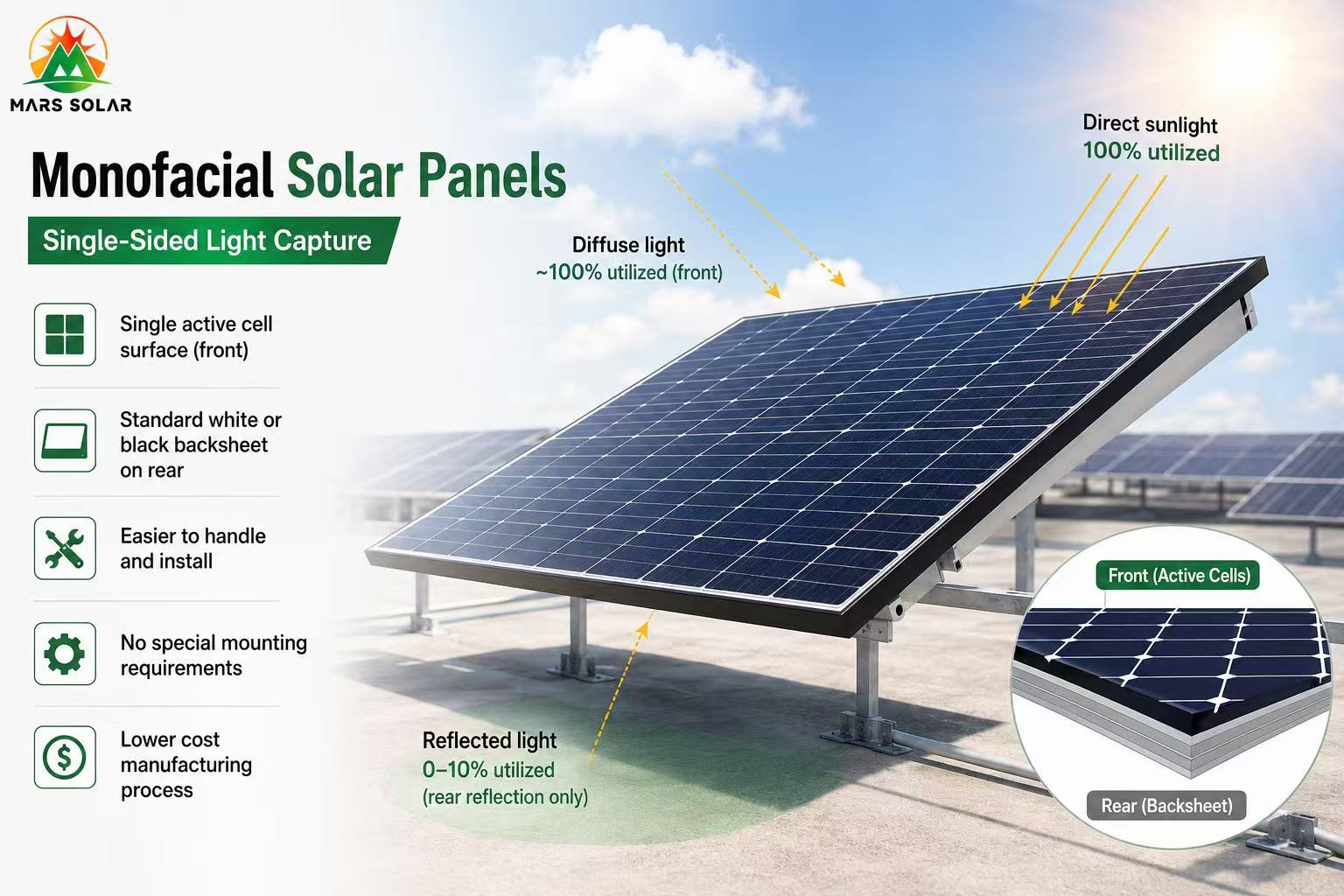
Los paneles monofaciales estándar tienen células solares únicamente en la superficie frontal. La superficie posterior es totalmente opaca (lámina posterior blanca) o ligeramente reflectante.
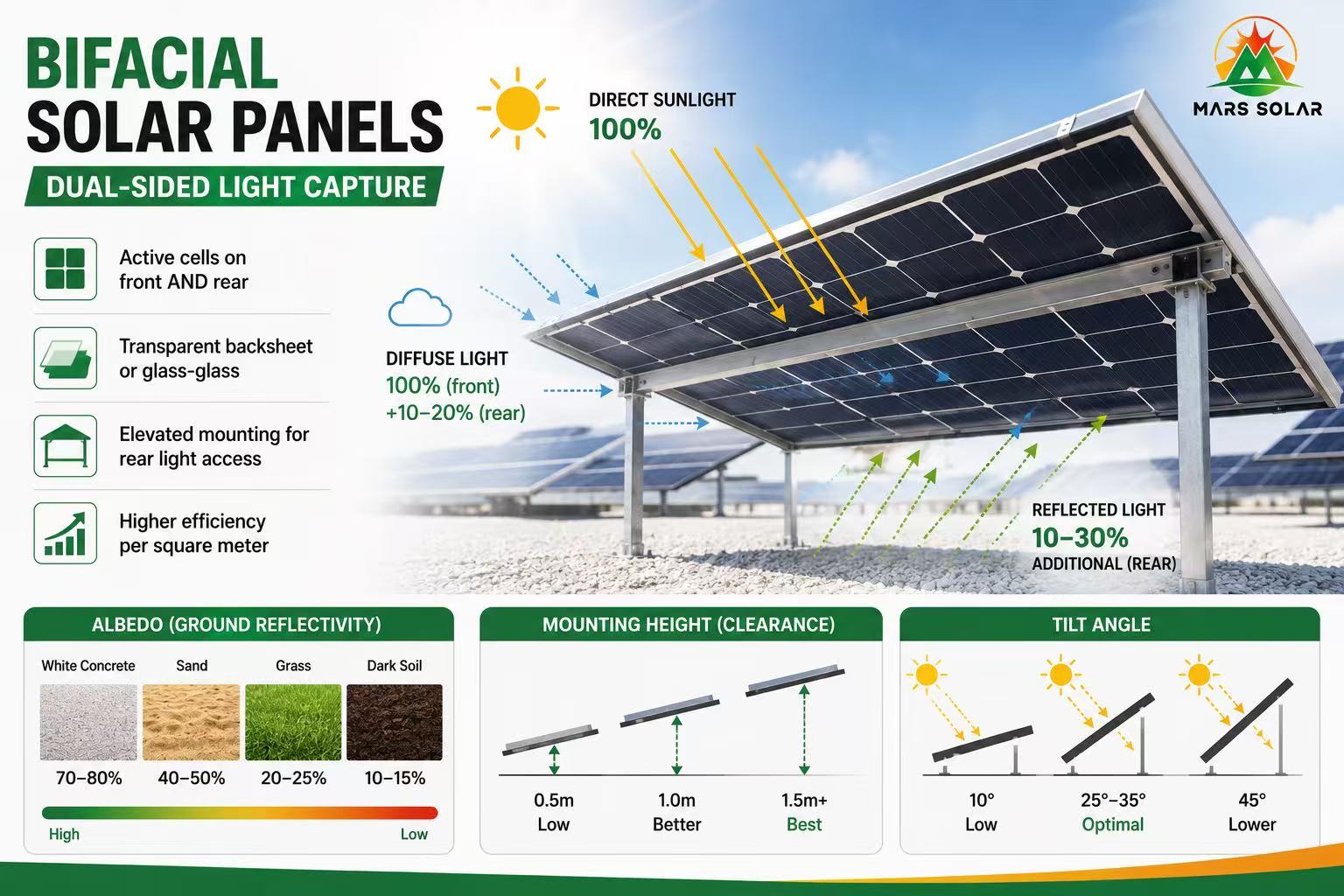
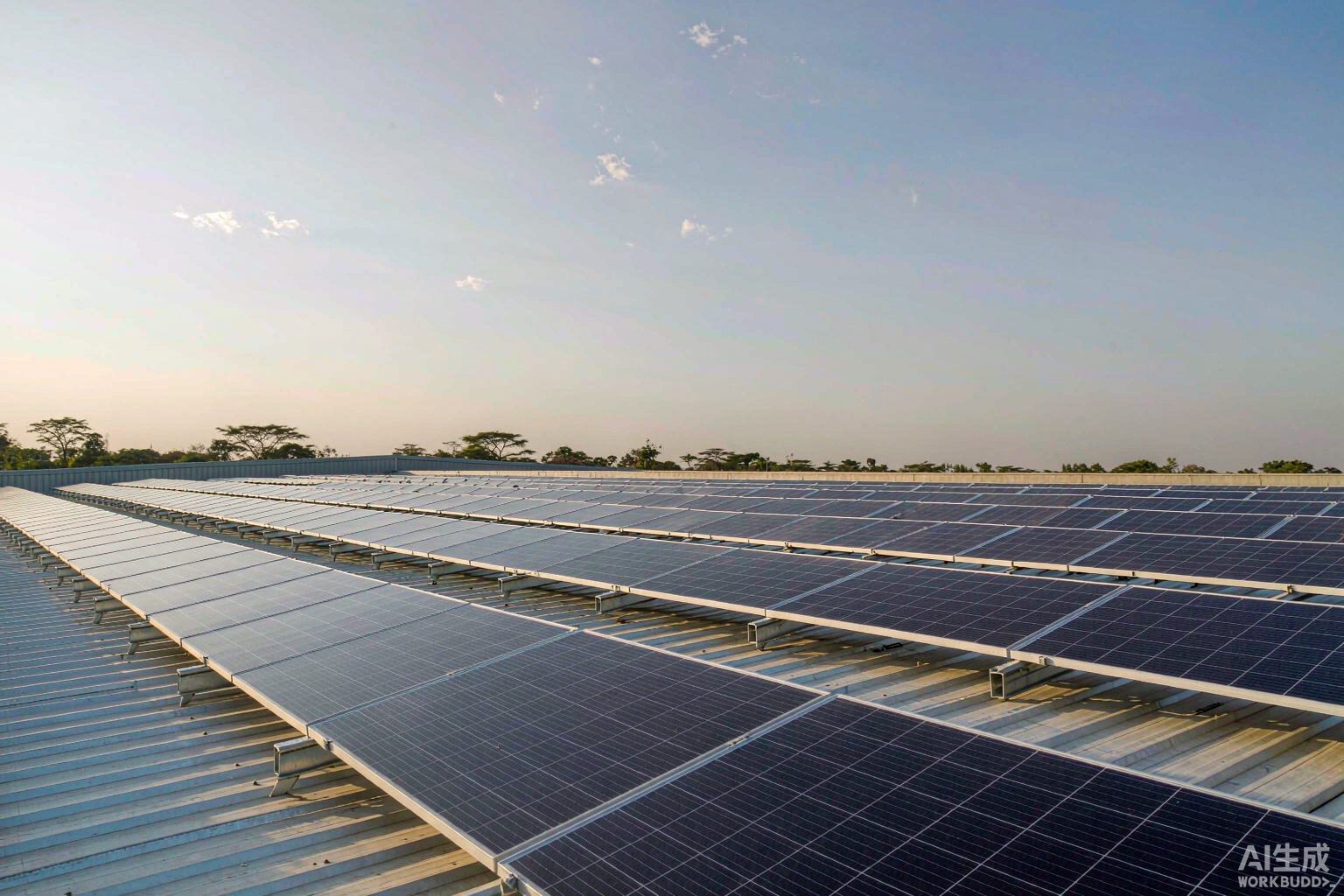
Los paneles bifaciales capturan la luz reflejada y dispersa que rebota en el suelo (lo que se denomina "luz albedo").
La ganancia bifacial depende completamente de:
| Criterios | PERC monofacial | TOPCon bifacial tipo N | Ganador |
|---|---|---|---|
| Eficiencia | 19-22% | 22-26% | Bifacial |
| Potencia de salida (típica) | 400-600 W por panel | 400-700 W por panel | Bifacial |
| Precio FOB China | $0.10-0.14/W | $0.13-0.18/W | Monofacial |
| Coste por vatio | Base | +15-25% premium | Monofacial |
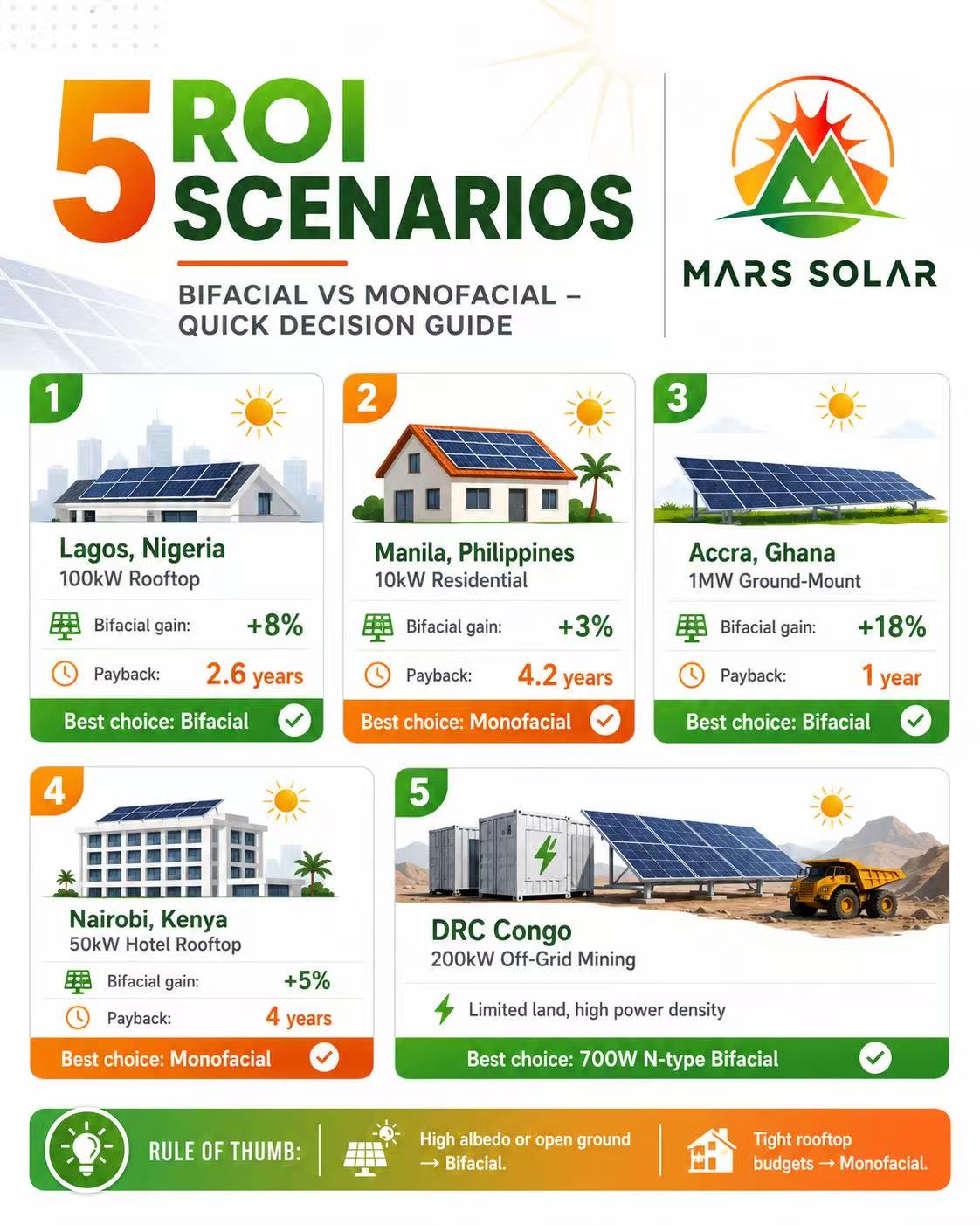
| Ganancia bifacial | 0% (una sola cara) | +10-25% (depende del albedo) | Bifacial |
| Requisito de altura de montaje | Cualquiera (azotea/suelo) | Espacio libre mínimo de 0,5 a 1 m | Monofacial |
| Coeficiente de temperatura | -0,36%/°C | -0,29%/°C | Bifacial |
| Rendimiento en climas cálidos | Bien | Mejor | Bifacial |
| Esperanza de vida | 25-30 años | 25-35 años (vidrio-vidrio) | Bifacial |
| Peso | ~23 kg (60 celdas) | ~26-32 kg | Monofacial |
| Ideal para azoteas | ✅ Perfecto | ⚠️ Requiere espacio libre en altura | Monofacial |
| Ideal para montaje en el suelo. | ✅ Bueno | ✅ Excelente | Bifacial |
| Ideal para África (desierto) | ✅ Bueno | ✅ Excelente (albedo arena) | Bifacial |
| Tipo de proyecto | Tipo de panel recomendado | Por qué |
|---|---|---|
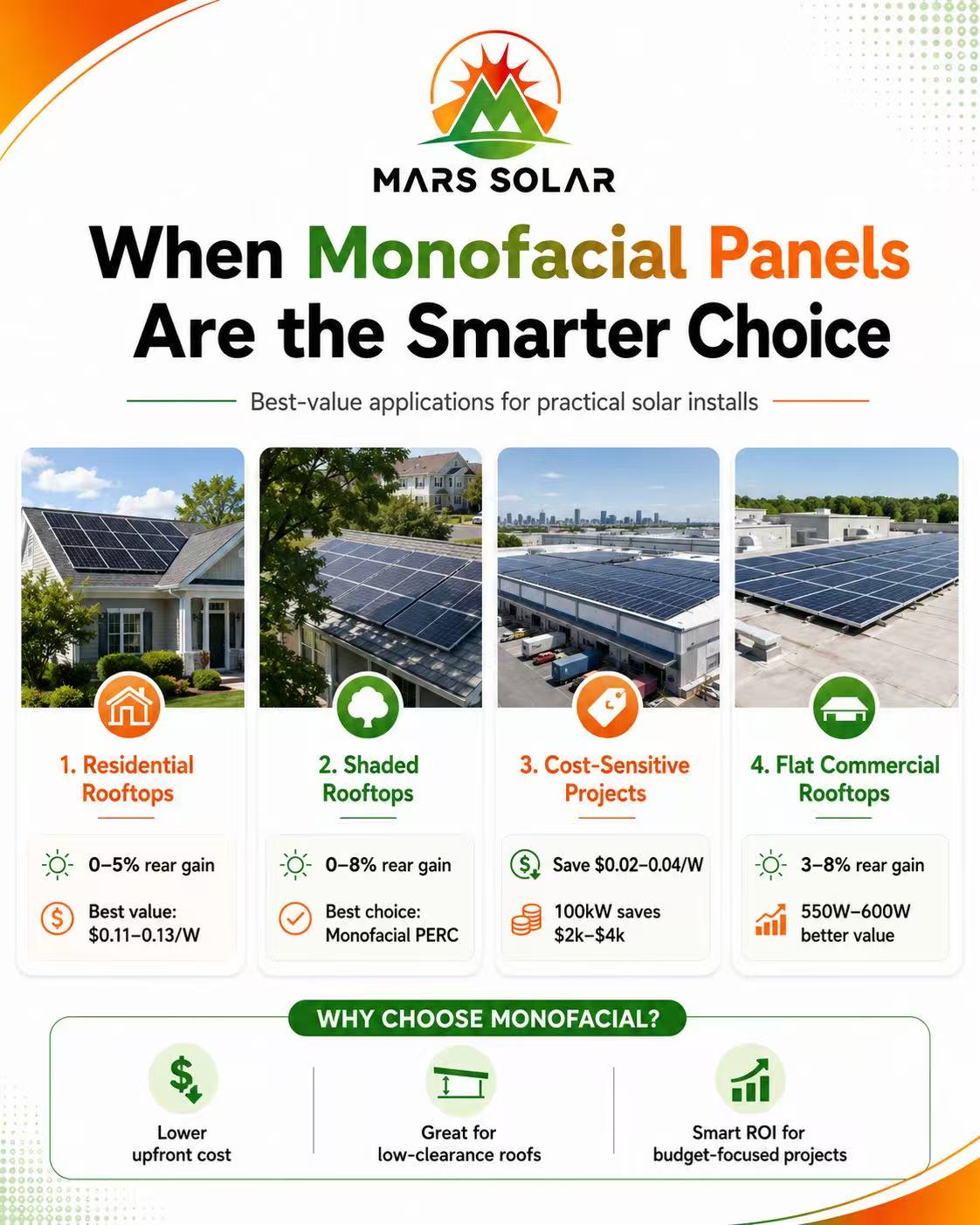
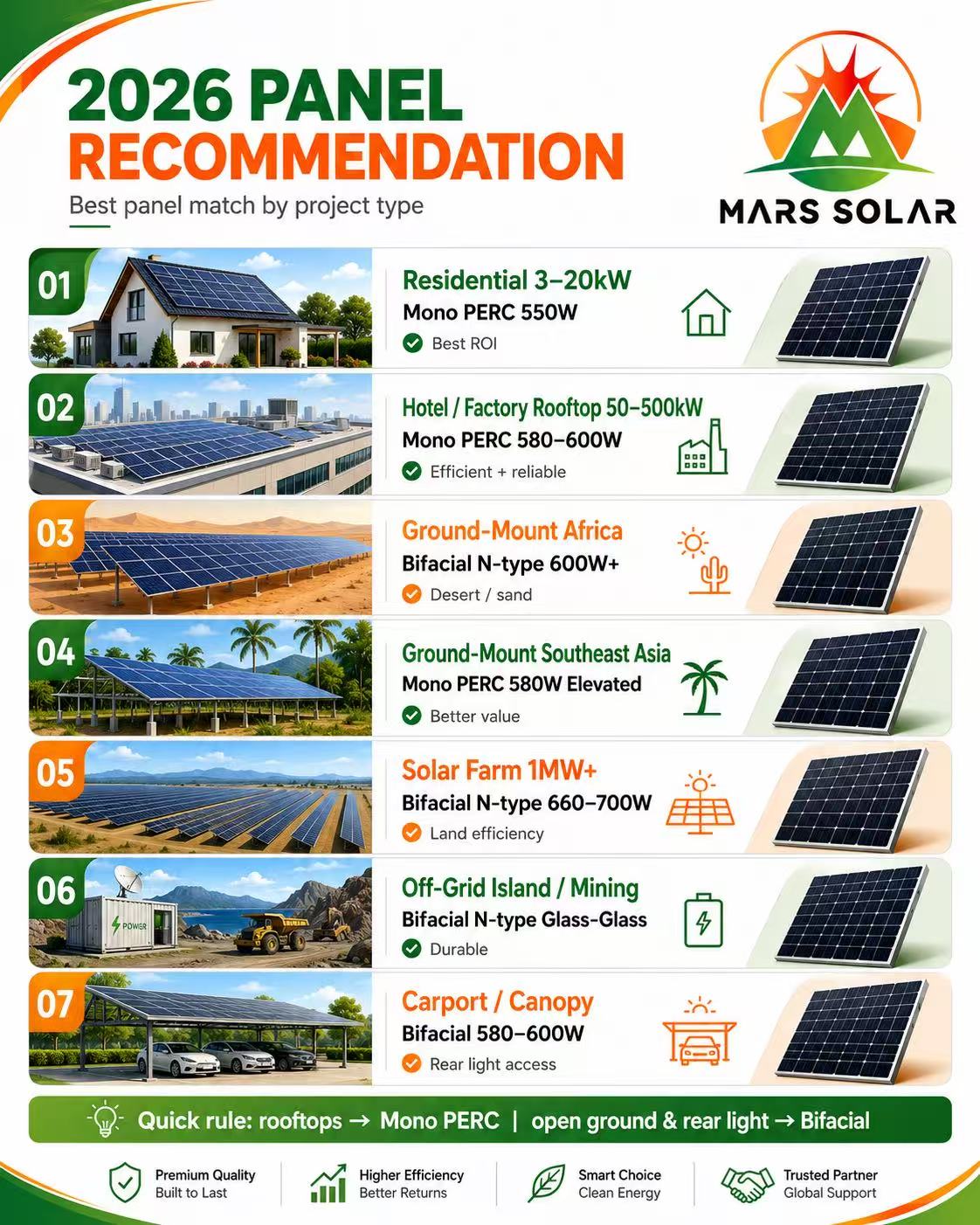
| Residencial (3-20 kW) | Mono PERC 550W | Máxima rentabilidad, fácil instalación. |
| Azotea de hotel/fábrica (50-500 kW) | Mono PERC 580-600W | Alta eficiencia + fiabilidad |
| África terrestre-montaña (desierto/arena) | Bifacial tipo N 600W+ | Maximizar la ganancia de albedo |
| Monte terrestre del sudeste asiático | Mono PERC 580W elevado | Menor albedo, mejor relación calidad-precio. |
| Parque solar (1 MW+) | Bifacial tipo N 660-700W | Eficiencia de la tierra + ganancia bifacial |
| Isla aislada/Minería | Bifacial tipo N (vidrio-vidrio) | Durabilidad + resistencia a la humedad |
| Cochera/Toldo | Bifacial 580-600W | Acceso a la luz natural trasera |
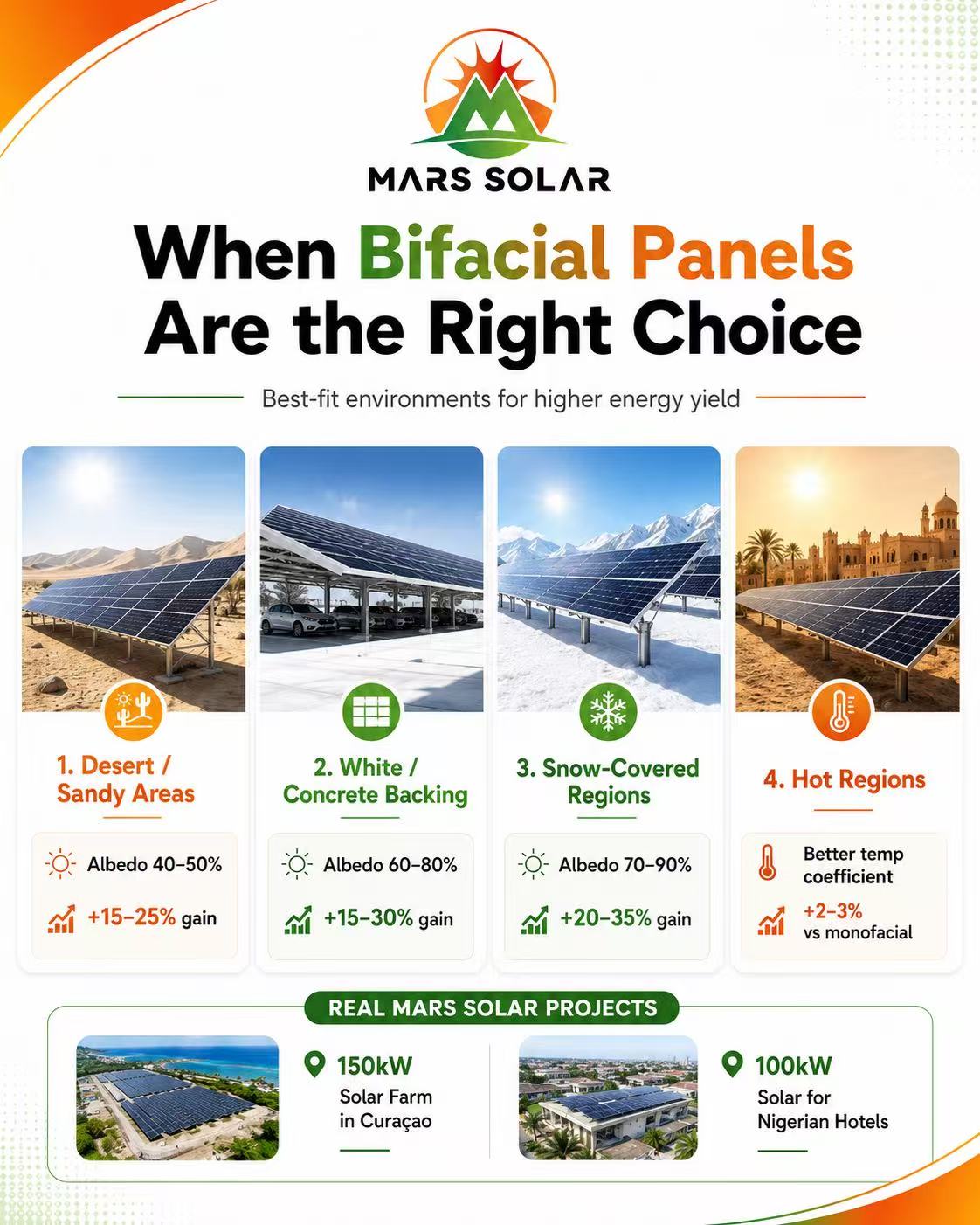
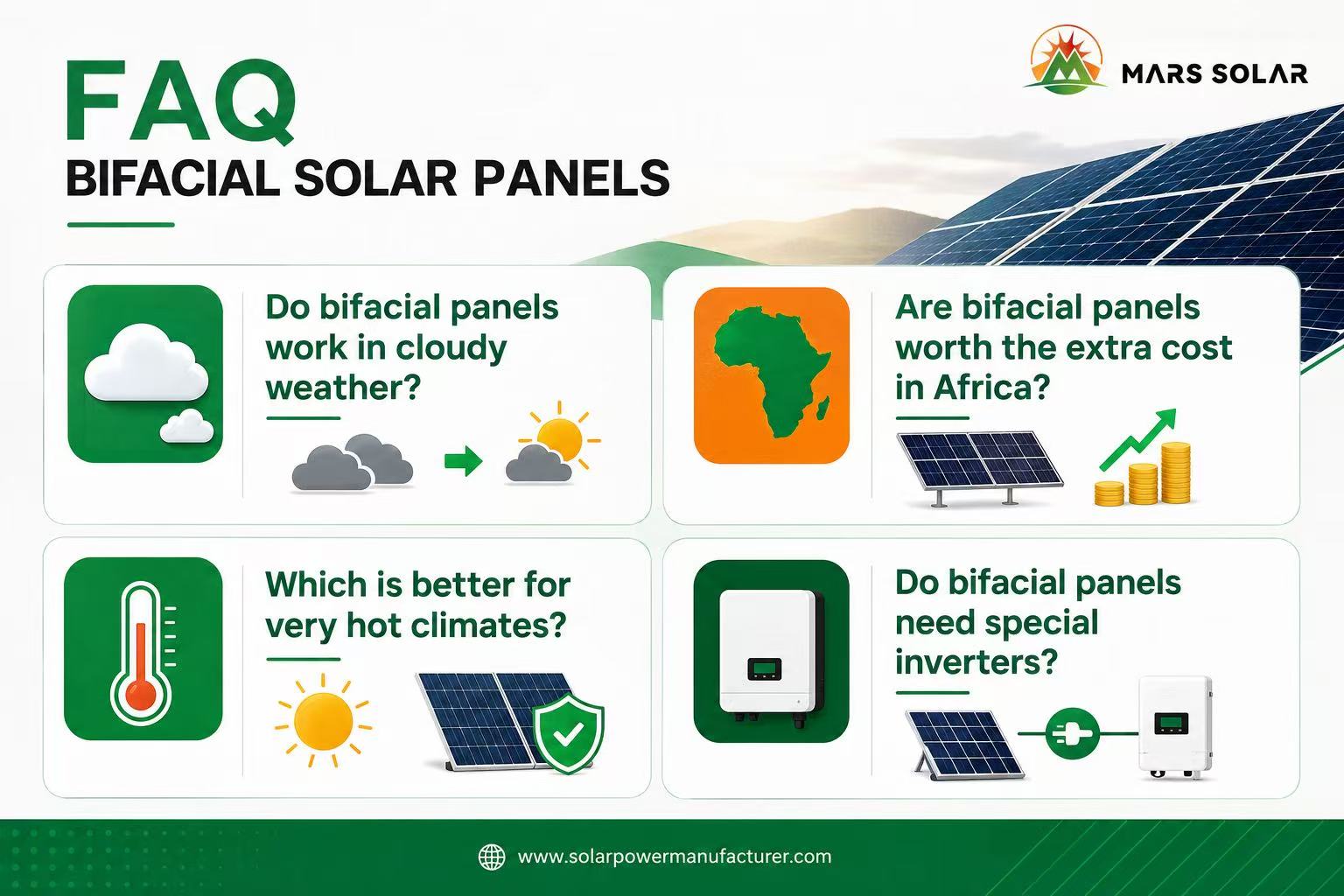
Sí, pero la ganancia se reduce. En días nublados, predomina la luz difusa. La ganancia bifacial disminuye de 15-25% a 5-10%. En regiones con nubosidad constante (norte de Europa, Reino Unido), el precio superior de un sistema bifacial es más difícil de justificar.
Para montaje en suelo: SÍ. Las regiones saharianas y subsaharianas tienen un albedo de 40-501 TP3T debido a la arena. La ganancia bifacial de 15-251 TP3T está bien documentada. Para tejados en África: generalmente NO (baja altura de montaje, techos oscuros).
El TOPCon bifacial tipo N presenta un mejor coeficiente de temperatura (-0,29%/°C frente a -0,36%/°C). A temperaturas superiores a 35 °C, esto se traduce en una menor pérdida de potencia por grado, de 2 a 3%. El diseño bifacial es la mejor opción para Emiratos Árabes Unidos, Arabia Saudita, Nigeria y climas similares.
No. Los paneles bifaciales funcionan con cualquier inversor estándar. La entrada de CC de los paneles bifaciales es idéntica a la de los monofaciales.
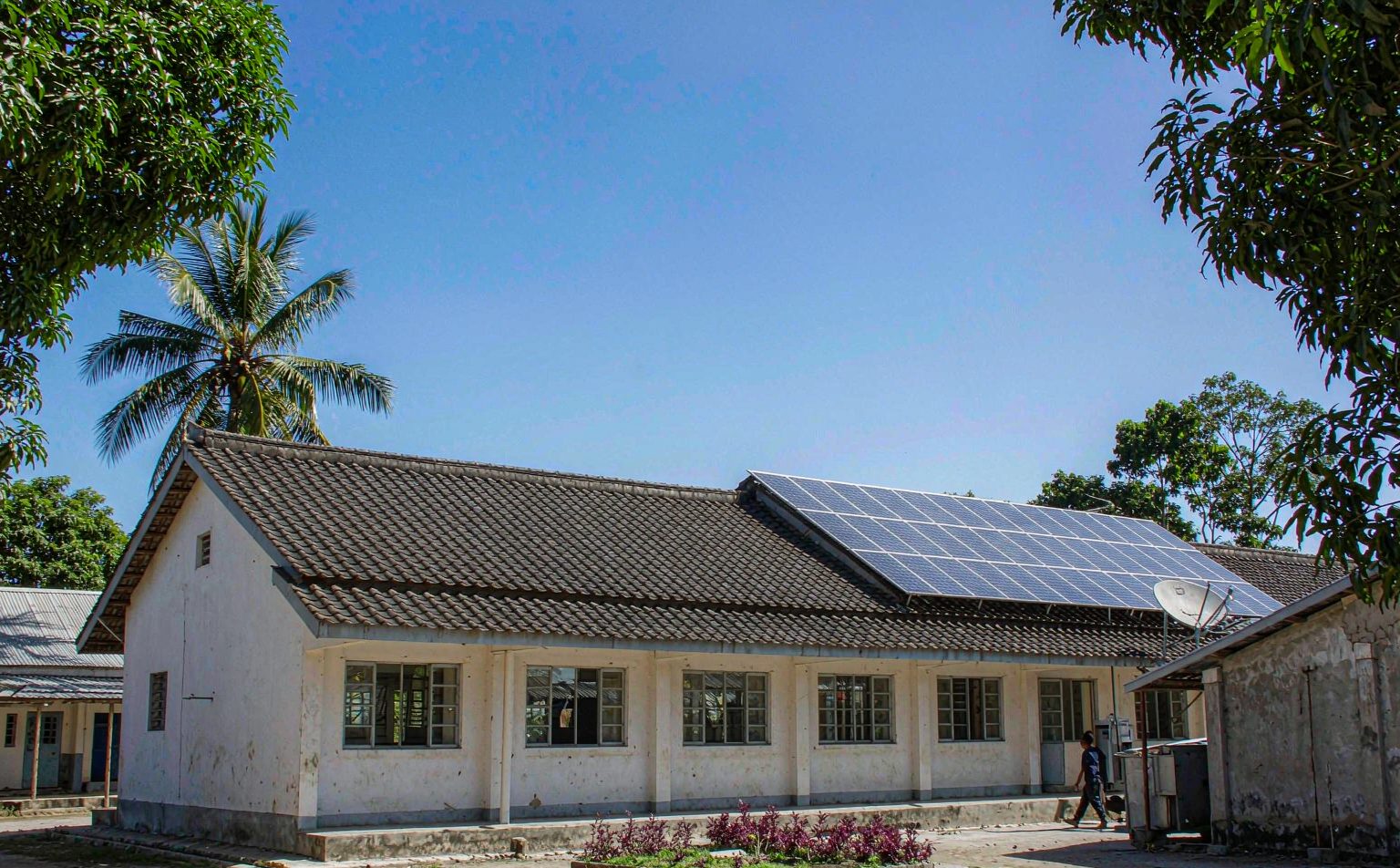
Monofacial, in almost every rooftop case. Bifacial cells need rear-side light and at least a metre of clearance behind the array to capture it, and a flush rooftop gives neither. The choice between bifacial vs monofacial solar panels therefore usually resolves to monofacial on a roof and bifacial on open ground. Where the roof is tilted over a white membrane or a light concrete deck, the gap narrows but rarely closes.
Between 5% and 15% on a well-designed ground-mount, and 20% or more only where the surface albedo is very high — fresh snow, white gravel or a light concrete apron. The gap widens with mounting height, row spacing and reflectance, and collapses to almost nothing over dark soil or dense grass. Any comparison of bifacial vs monofacial solar panels that assumes a flat 20% gain is marketing rather than modelling.
Roughly 0.5 or above. Fresh snow reaches about 0.8, white gravel 0.5–0.6, light concrete 0.3–0.4, dry grass about 0.2 and dark soil about 0.1. On the lower half of that range the rear-side gain does not repay the module premium, and the bifacial vs monofacial solar panels decision should land on monofacial. Ask for the albedo assumption in writing before you sign.
Yes — bifacial modules typically carry a 5–15% premium per watt and are usually glass-on-glass. Because the premium is paid on day one while the extra output arrives over 25 years, a proper bifacial vs monofacial solar panels comparison has to be run on cost per kWh delivered, not cost per watt. The photovoltaic module specification sheet is where the bifaciality factor and the temperature coefficient are declared.
A bifacial array wants about a metre behind the lowest row and a structure that does not shade the rear face; a monofacial table can sit far closer to the ground. That structural requirement is the second cost inside the bifacial vs monofacial solar panels question, and it is why 1 MW ground-mount comparisons come out closer than the module premium alone would suggest.
Yes, but on separate strings and ideally separate MPPT channels. Bread on one string, the weaker operating point wins and the bifacial modules are pulled down to the monofacial voltage. If you are phasing an upgrade, keep the two technologies on their own inputs. Mixing them carelessly is the most common way a bifacial vs monofacial solar panels plan loses the gain it was built to capture.
Less than the marketing suggests. Rear-side exposure helps a little, but the temperature coefficient of the module decides output in Accra, Nairobi or Dubai conditions far more than bifaciality does. When you compare bifacial vs monofacial solar panels for a hot site, compare the temperature coefficient and the degradation curve first, and treat the rear-side gain as the smaller term.
Three inputs decide the answer: the module's bifaciality factor, usually 0.7–0.8; the surface albedo of the site; and the geometry — mounting height, tilt and row spacing. A bifacial vs monofacial solar panels model that omits any one of the three is guessing. Ask your supplier to hand over those assumptions alongside the modelled yield.
Comparable, and often better for bifacial: glass-on-glass bifacial modules are frequently warranted for 30 years against performance, against 25–30 years for a typical monofacial module. That does not settle the bifacial vs monofacial solar panels question by itself, because a longer warranty on a module that generates less over its life is not a saving. Model the energy first.
On a high-albedo ground-mount the bifacial array usually pays back one to two years sooner across a 25-year life. On a dark-surfaced site, a rooftop or a shaded yard, monofacial wins outright and the bifacial premium is money spent on a feature the site cannot use. That is the honest answer to the bifacial vs monofacial solar panels question: it is a site-specific advantage, not a generational improvement.
Usually bifacial, and this is the scale where the choice pays. At 1 MW the structure is engineered anyway, so mounting height is nearly free, and row spacing is set by the layout rather than the roof. On light ground, a bifacial vs monofacial solar panels comparison at this scale typically returns the module premium inside three to four years. On dark laterite or dense grass, monofacial remains the correct answer.
Los más de 30 ingenieros de Mars Solar pueden recomendarle el tipo de panel óptimo para su proyecto específico. Suministramos paneles PERC monofaciales y TOPCon bifaciales de tipo N, y siempre recomendaremos el tipo que ofrezca el mejor retorno de la inversión para su proyecto.
Mars Solar (Foshan Mars Solar Technology Co., Ltd.) lleva fabricando y diseñando sistemas solares desde 2008. Con Más de 17 años de experiencia, Más de 30 ingenieros, y Más de 3000 proyectos exitosos en más de 130 países., Ayudamos a distribuidores y contratistas EPC a elegir el equipo solar adecuado para sus condiciones específicas.
Obtén una recomendación gratuita de un panel | Sobre nosotros | Vea nuestros casos
Última actualización: julio de 2026
Palabras clave: paneles solares bifaciales vs monofaciales, mejor tipo de panel solar 2026, mono PERC vs TOPCon, comparación de paneles solares, recomendación de paneles solares Mars

 English English
  Arabic
 Spanish
 French
 Dutch
Dutch
 Portuguese