Bifacial vs Monofacial Solar Panels: Which Should You Buy
Qual escolher entre painéis solares bifaciais e monofaciais?
Este guia de 2026 compara eficiência, custo e retorno sobre o investimento (ROI) no mundo real. Com base em mais de 3.000 projetos de energia solar na África, Sudeste Asiático e Oriente Médio, fornecemos os dados necessários para você fazer a escolha certa. Os painéis solares bifaciais e monofaciais são quase idênticos vistos de frente.
Mas, na prática, funcionam de maneira diferente — e escolher o tipo errado pode custar ao seu projeto de 15 a 25% em rendimento energético anual, ou adicionar 20% ao seu custo inicial desnecessariamente.
Este artigo vai direto ao ponto, sem rodeios. Com base em dados reais de desempenho de projetos da Mars Solar na África, Sudeste Asiático e Oriente Médio, apresentamos uma comparação objetiva entre painéis bifaciais e monofaciais.
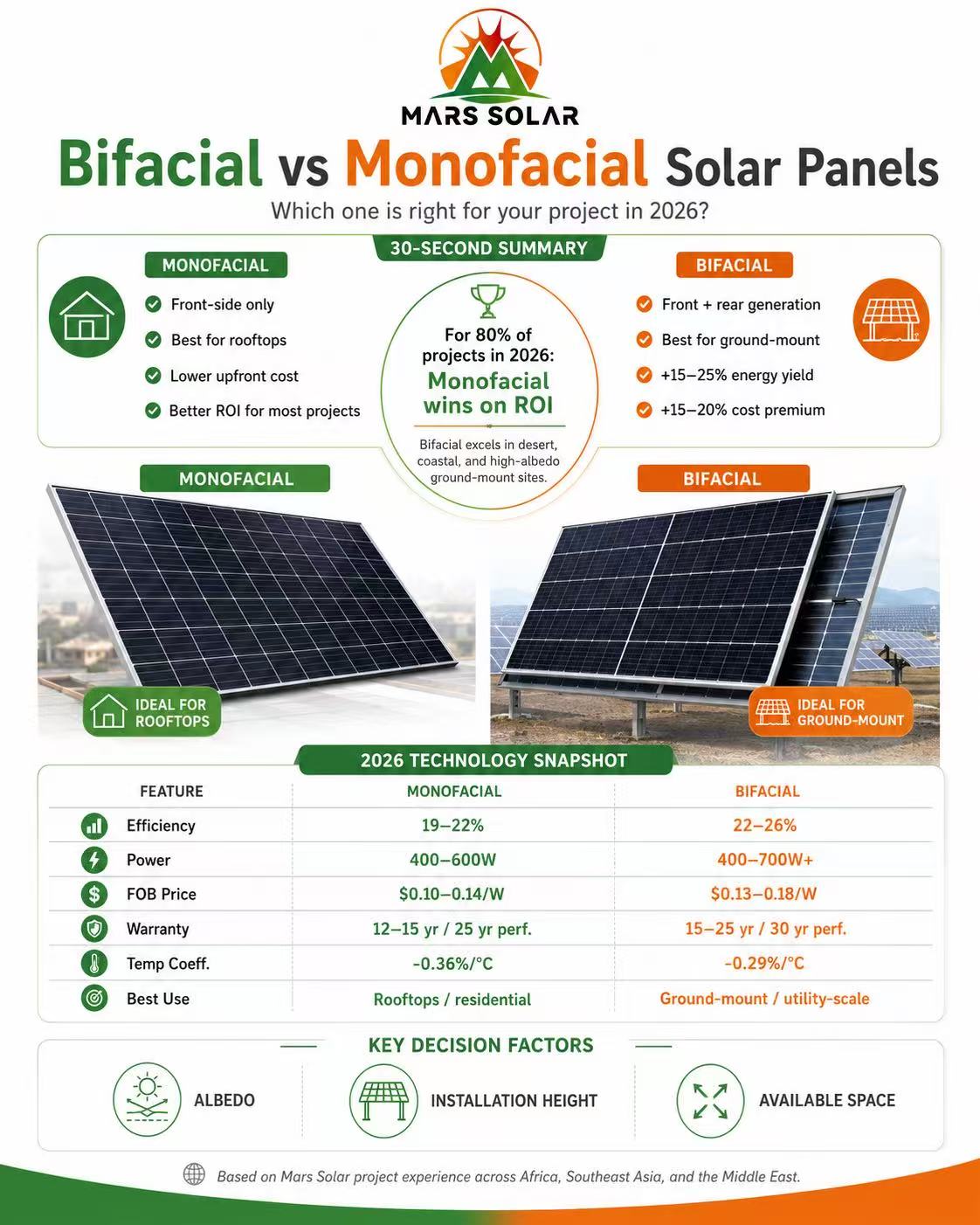
Resumo em 30 segundos:
- Painéis bifaciais: Captura luz da frente E da traseira. Ideal para montagem no solo, superfícies de neve/areia e instalações elevadas. Ganho de rendimento energético +15-25%. Custo adicional +15-20%.
- Painéis monofaciais: Somente para instalação frontal. Ideal para telhados, espaços limitados e projetos com orçamento restrito. Preço padrão.
- Para 80% de projetos em 2026: A tecnologia monofacial ainda oferece o melhor retorno sobre o investimento. Para instalação no solo em áreas desérticas/costeiras, a tecnologia bifacial justifica seu preço mais elevado.
- Fator decisivo chave: Albedo (refletividade do solo) + altura de instalação + espaço disponível.
Panorama tecnológico de 2026:
| Especificação | PERC monofacial | TOPCon bifacial tipo N |
|---|---|---|
| Faixa de eficiência | 19-22% | 22-26% |
| Faixa de potência | 400-600W | 400-700W+ |
| Preço FOB típico | $0,10-0,14/W | $0,13-0,18/W |
| Garantia | Desempenho de 12 a 15 anos / 25 anos | Desempenho de 15 a 25 anos / 30 anos |
| Coeficiente de temperatura | -0,36%/°C | -0,29%/°C (melhor em altas temperaturas) |
| Melhor caso de uso | Telhados residenciais | Montagem em solo, escala de utilidade pública |
1. Como funciona cada tecnologia de painel na prática
Painéis solares monofaciais — Captação de luz em um único lado
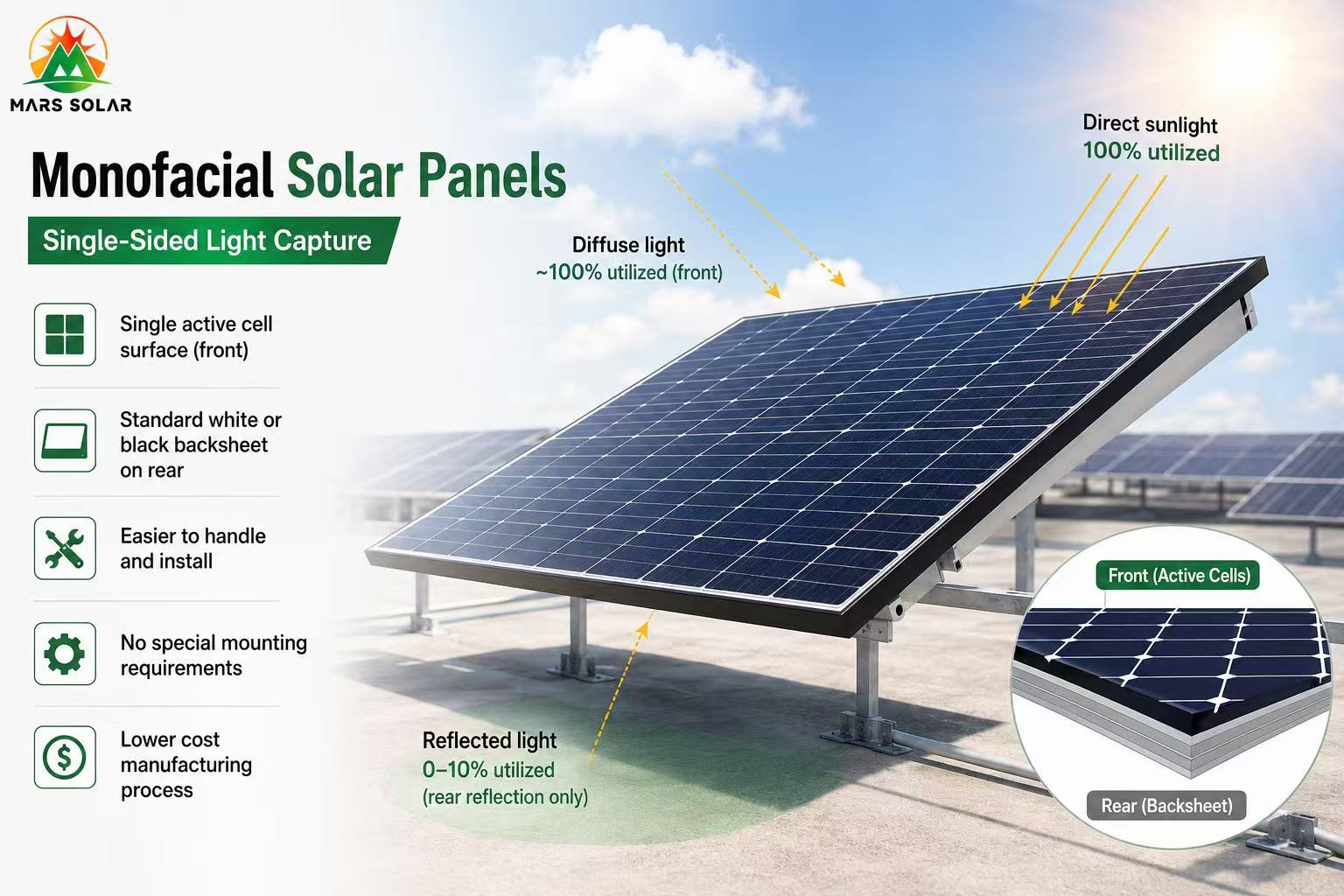
Os painéis monofaciais padrão possuem células solares apenas na superfície frontal. A superfície traseira é totalmente opaca (folha traseira branca) ou levemente refletora.
Características principais:
- Superfície celular ativa única (frente)
- Folha traseira padrão branca ou preta
- Mais fácil de manusear e instalar.
- Não há requisitos especiais de montagem.
- Processo de fabricação de menor custo
Como a luz é utilizada:
- Luz solar direta: 100% utilizado (frontal)
- Luz difusa (nuvens): ~100% utilizado (frente)
- Luz refletida (solo): 0-10% (apenas reflexão traseira)
Painéis solares bifaciais — Captação de luz em ambos os lados
Os painéis bifaciais captam a luz refletida e dispersa que ricocheteia no solo (chamada de "luz de albedo").
Características principais:
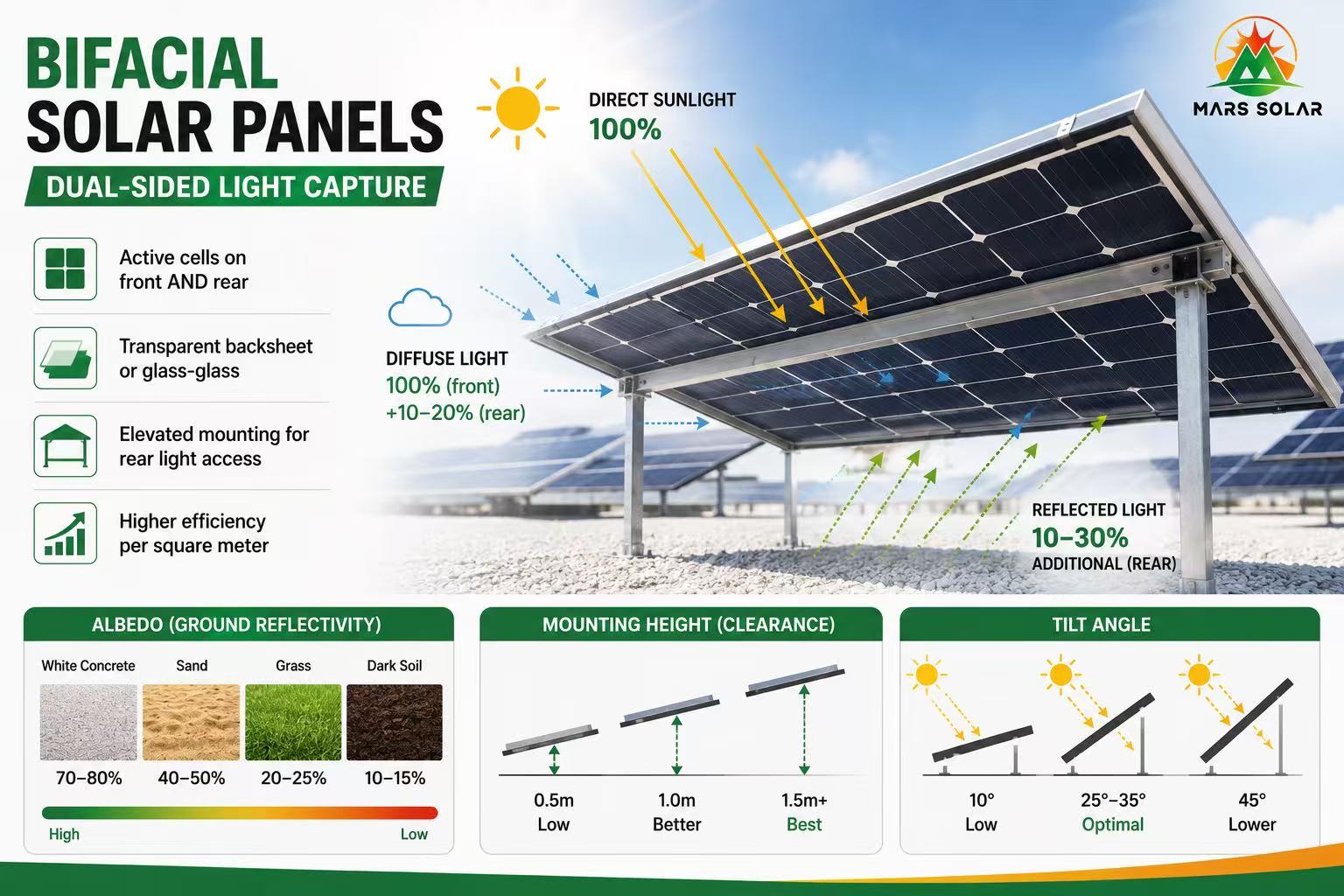
- Superfície celular ativa na frente E na parte traseira
- Construção com folha traseira transparente ou vidro-vidro
- Requer montagem elevada ou em rack aberto para permitir o acesso à luz traseira.
- Maior eficiência por metro quadrado
Como a luz é utilizada:
- Luz solar direta: 100% utilizado (frontal)
- Luz difusa: 100% (frontal) + 10-20% (traseira)
- Luz refletida (albedo do solo): 10-30% adicional (traseiro)
O ganho bifacial depende inteiramente de:
- albedo do solo — Concreto branco: 70-80%, areia: 40-50%, grama: 20-25%, solo escuro: 10-15%
- Altura de montagem — Maior altura livre do solo = maior acesso às luzes traseiras
- ângulo de inclinação — A inclinação ideal maximiza a captura traseira
2. Comparação lado a lado: Bifacial vs. Monofacial
| Critérios | PERC monofacial | TOPCon bifacial tipo N | Ganhador |
|---|---|---|---|
| Eficiência | 19-22% | 22-26% | Bifacial |
| Potência de saída (típica) | 400-600 W por painel | 400-700 W por painel | Bifacial |
| Preço FOB China | $0,10-0,14/W | $0,13-0,18/W | Monofacial |
| Custo por watt | Linha de base | +15-25% premium | Monofacial |
| Ganho bifacial | 0% (face única) | +10-25% (depende do albedo) | Bifacial |
| Requisito de altura de montagem | Qualquer (telhado/solo) | Espaço livre mínimo de 0,5 a 1 m | Monofacial |
| Coeficiente de temperatura | -0,36%/°C | -0,29%/°C | Bifacial |
| Desempenho em climas quentes | Bom | Melhorar | Bifacial |
| Vida útil | 25-30 anos | 25-35 anos (vidro-vidro) | Bifacial |
| Peso | ~23kg (60 células) | ~26-32kg | Monofacial |
| Ideal para telhados | ✅ Perfeito | ⚠️ Necessita de espaço livre em altura | Monofacial |
| Ideal para montagem no solo. | ✅ Bom | ✅ Excelente | Bifacial |
| Ideal para África (deserto) | ✅ Bom | ✅ Excelente (albedo da areia) | Bifacial |
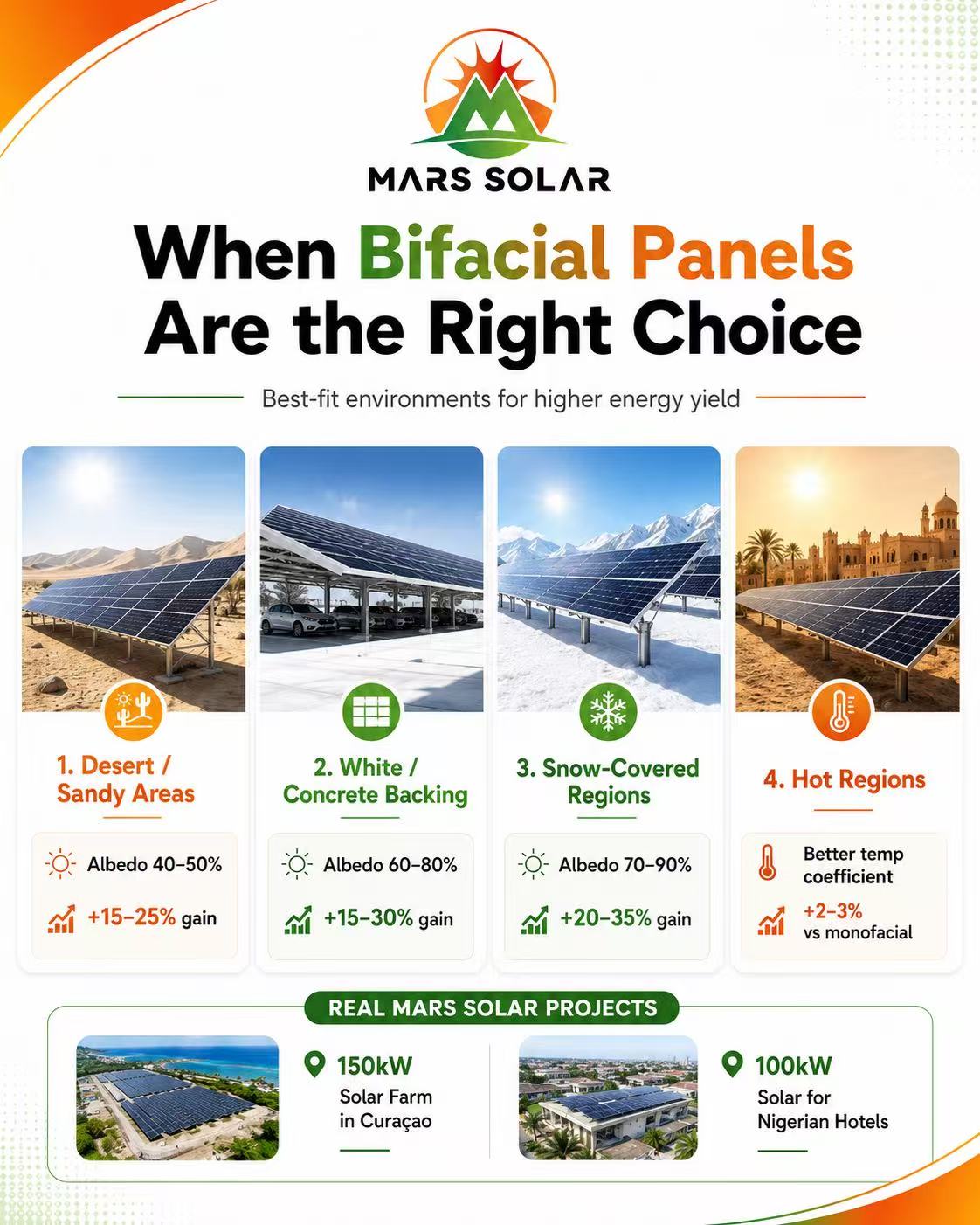
3. Quando os painéis bifaciais são a escolha certa
Cenário A: Montagem no solo em áreas desérticas/arenosas
- Albedo: 40-50% (a areia reflete 40-50% da luz solar para cima)
- Ganho bifacial típico: Saída de potência adicional +15-25%
- Exemplo real: Sistema de geração distribuída de 500 kW instalado no solo em Dubai com cabeamento bifacial elevado → produção anual adicional de 75 a 125 kW.
- Retorno do investimento em prêmios: 2 a 3 anos em locais de alta irradiação
Cenário B: Montagem no solo com base branca/de concreto
- Albedo: 60-80% (concreto branco, cascalho, telhados de cor clara)
- Ganho bifacial típico: +15-30%
- Ideal para: Parques solares em concreto, instalações de estacionamento coberto
Cenário C: Regiões cobertas de neve
- Albedo: 70-90% (neve fresca)
- Ganho bifacial típico: +20-35% nos meses de inverno
Cenário D: Regiões de Alta Temperatura (África, Oriente Médio)
- O tipo N bifacial apresenta melhor coeficiente de temperatura (-0,29%/°C vs -0,36%/°C).
- Em temperaturas de 40°C, a tecnologia bifacial produz de 2 a 3% mais potência por grau em comparação com a monofacial.
Projetos reais de energia solar em Marte usando bifaciais:
- Fazenda solar de 150 kW em Curaçao — Montagem no solo sobre superfície de coral branco
- Energia solar de 100 kW para hotéis nigerianos — Cobertura comercial, mistura híbrida
4. Quando os painéis monofaciais são a escolha mais inteligente
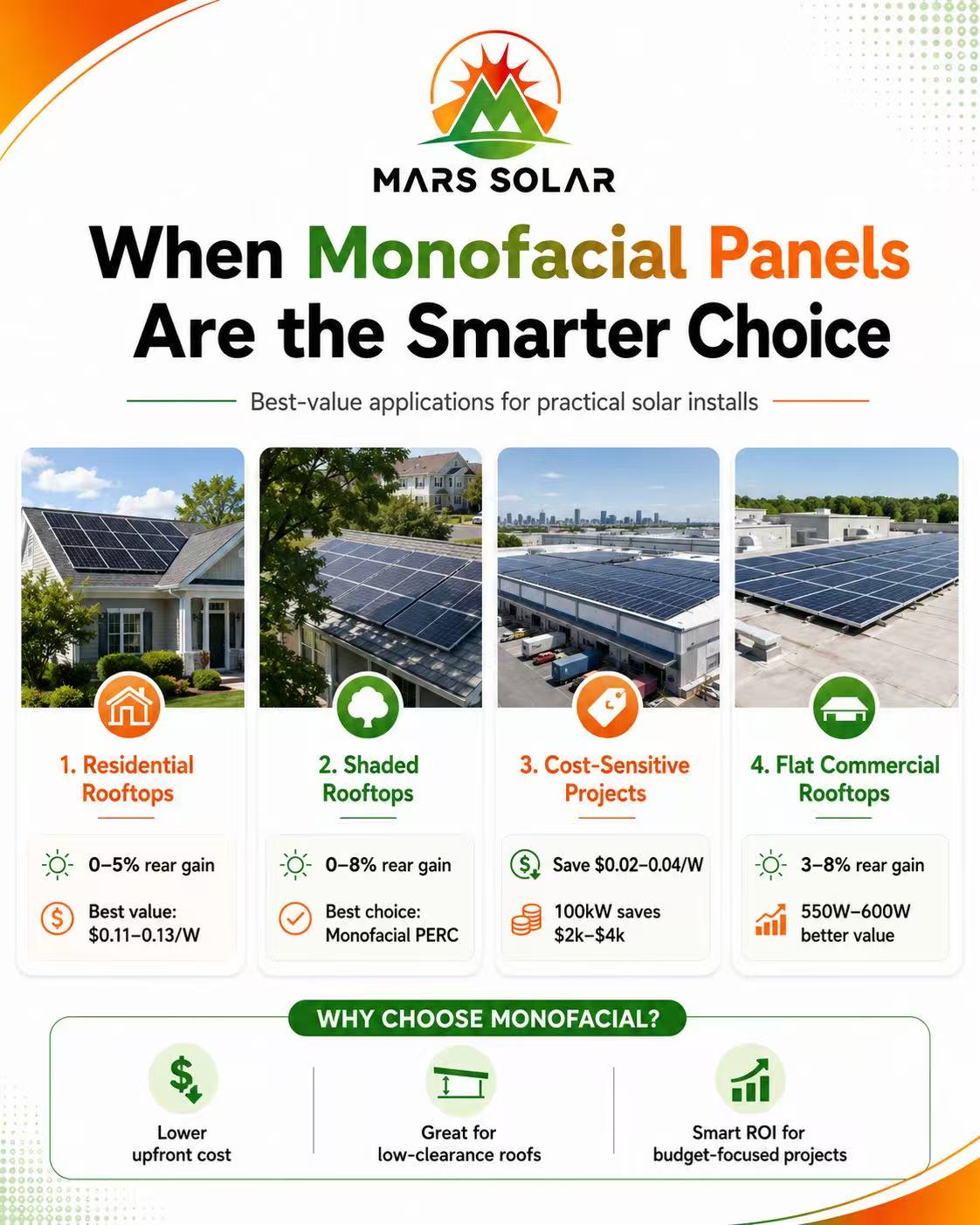
Cenário A: Telhados residenciais (qualquer país)
- Problema: Altura de montagem limitada, geralmente rente às telhas.
- Ganho bifacial: 0-5% (sem acesso à luz traseira)
- Veredicto: A solução monofacial com $0,11-0,13/W vence sempre.
Cenário B: Telhados sombreados ou parcialmente obstruídos
- Problema: Baixo albedo, edifícios/árvores próximos bloqueando a luz.
- Ganho bifacial: 0-8% (mínimo)
- Veredicto: PERC monofacial padrão
Cenário C: Projetos sensíveis a custos
- Bifacial premium: $0,02-0,04/W extra
- Em 100 kW: $2.000-4.000 extras para ganho marginal
- Veredicto: Se o orçamento estiver apertado, a terapia monofacial é a escolha certa.
Cenário D: Telhados comerciais planos sem altura livre
- Ganho bifacial: 3-8% (limitado)
- Veredicto: A tecnologia PERC monofacial de alta eficiência (550 W a 600 W) oferece melhor custo-benefício.
5. Análise de ROI: 5 Cenários de Projetos Reais
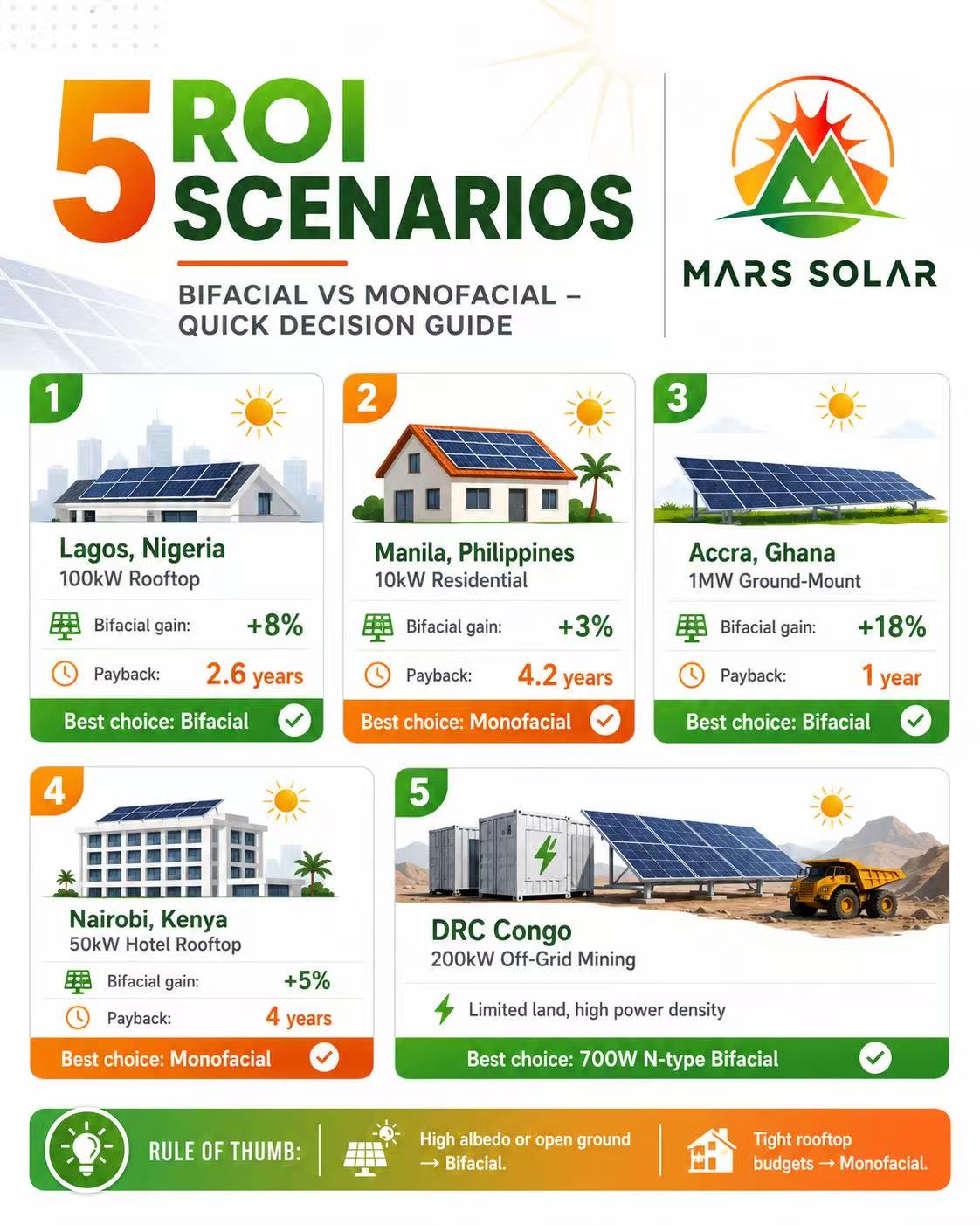
Projeto 1: Sistema elétrico comercial de 100 kW em telhado, Lagos, Nigéria
- Superfície: Telhado plano de concreto, albedo de aproximadamente 25%
- Monofacial: 550W × 182 painéis = 100,1kW. Custo: $12.000
- Bifacial: 600W × 167 painéis = 100,2kW. Custo: $14.500 (+$2.500)
- Ganho bifacial: +8% = +8kW/ano. Benefício anual: $960
- Retorno do investimento: 2,6 anos ✅ O tratamento bifacial vale a pena
Project 2: 10kW Residential, Manila Philippines
- Superfície: Telhado inclinado com telhas, sem folga, albedo de aproximadamente 10%
- Monofacial: $1,200. Bifacial: $1,580 (+$380)
- Ganho bifacial: +3% = +0,3kW/ano. Benefício anual: $90
- Retorno do investimento: 4,2 anos (marginal). Veredito: Monofacial ✅
Projeto 3: Central elétrica de 1 MW instalada no solo, Accra, Gana
- Superfície: Terreno aberto, base de cascalho leve, albedo ~40%
- Monofacial: $130.000. Bifacial: $148.000 (+$18.000)
- Ganho bifacial: +18% = +180kW/ano. A $0,10/kWh: benefício de 18.000kW/ano.
- Retorno do investimento: 1 ano ✅ O tratamento bifacial oferece excelente custo-benefício
Projeto 4: Sistema elétrico de 50 kW na cobertura de um hotel em Nairóbi, Quênia.
- Superfície: Telhado de metal ondulado, albedo ~15%
- Monofacial: $6.500. Bifacial: $7.800 (+$1.300)
- Ganho bifacial: +5%. Benefício anual: $325. Retorno do investimento: 4 anos.
- Veredito: Lâmpada monofacial PERC de alta eficiência de 580 W ✅
Projeto 5: Local de mineração isolado da rede elétrica de 200 kW, RDC Congo
- Superfície: Solo vermelho, albedo ~12%
- Necessidade crítica: Densidade máxima de potência (terreno limitado)
- Decisão: Lâmpada bifacial tipo N de alta eficiência (700 W) apesar do baixo albedo (a economia de espaço justifica o preço mais elevado).
6. Recomendação de painéis solares da Mars Solar para 2026 por tipo de projeto
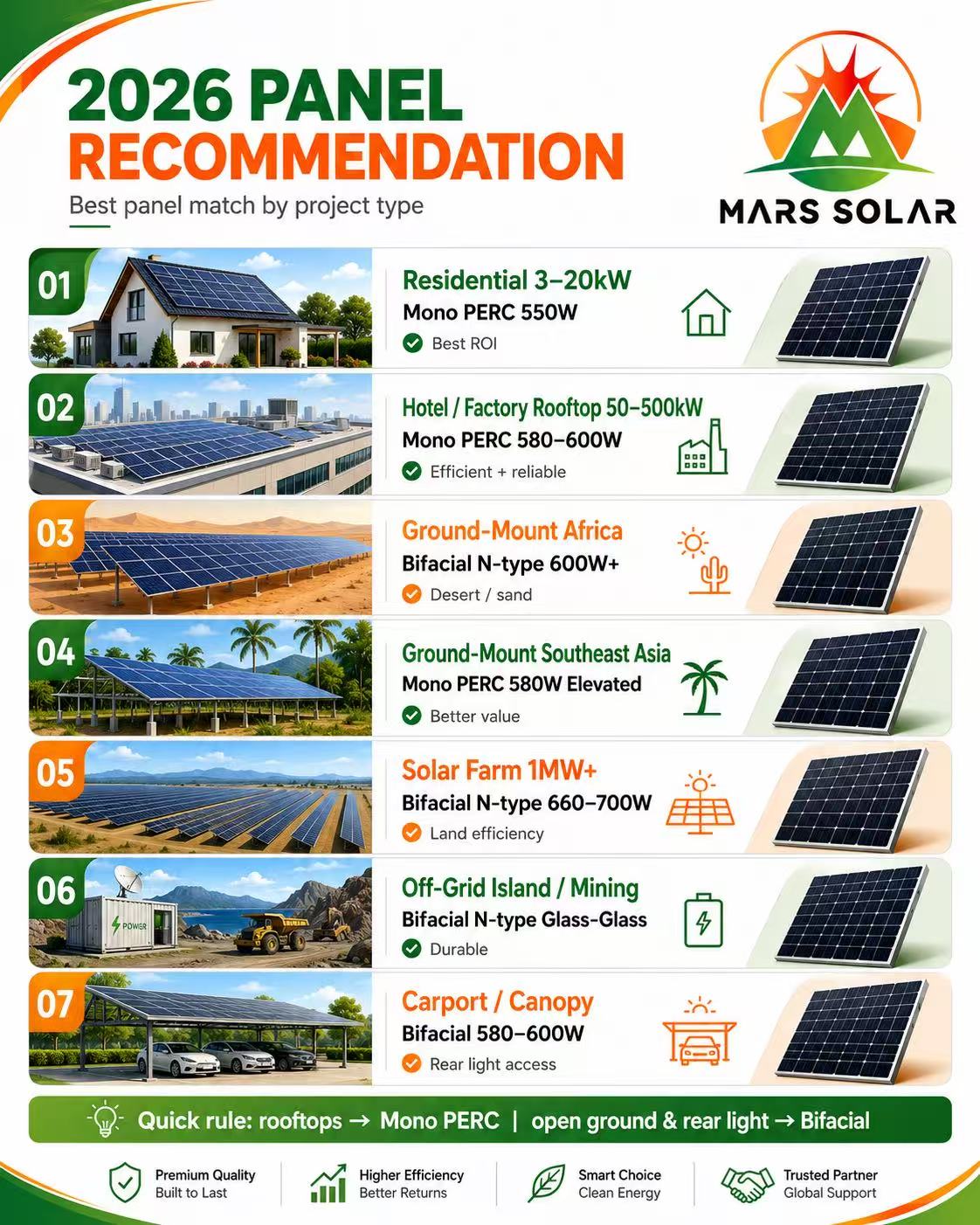
| Tipo de projeto | Tipo de painel recomendado | Por que |
|---|---|---|
| Residencial (3-20kW) | Mono PERC 550W | Melhor retorno sobre o investimento, fácil instalação. |
| Telhado de hotel/fábrica (50-500kW) | Mono PERC 580-600W | Alta eficiência + confiabilidade |
| Solo-Monte África (Deserto/Areia) | Bifacial tipo N 600W+ | Maximize o ganho de albedo |
| Montagem no solo no Sudeste Asiático | Mono PERC 580W elevado | Menor albedo, melhor custo-benefício |
| Parque solar (1MW+) | Bifacial tipo N 660-700W | Eficiência do uso da terra + ganho bifacial |
| Ilha isolada/Mineração | Bifacial tipo N (vidro-vidro) | Durabilidade + resistência à umidade |
| Garagem coberta/cobertura | Bifacial 580-600W | Acesso à luz traseira natural |
7. Frequently Asked Questions: Bifacial vs Monofacial Solar Panels
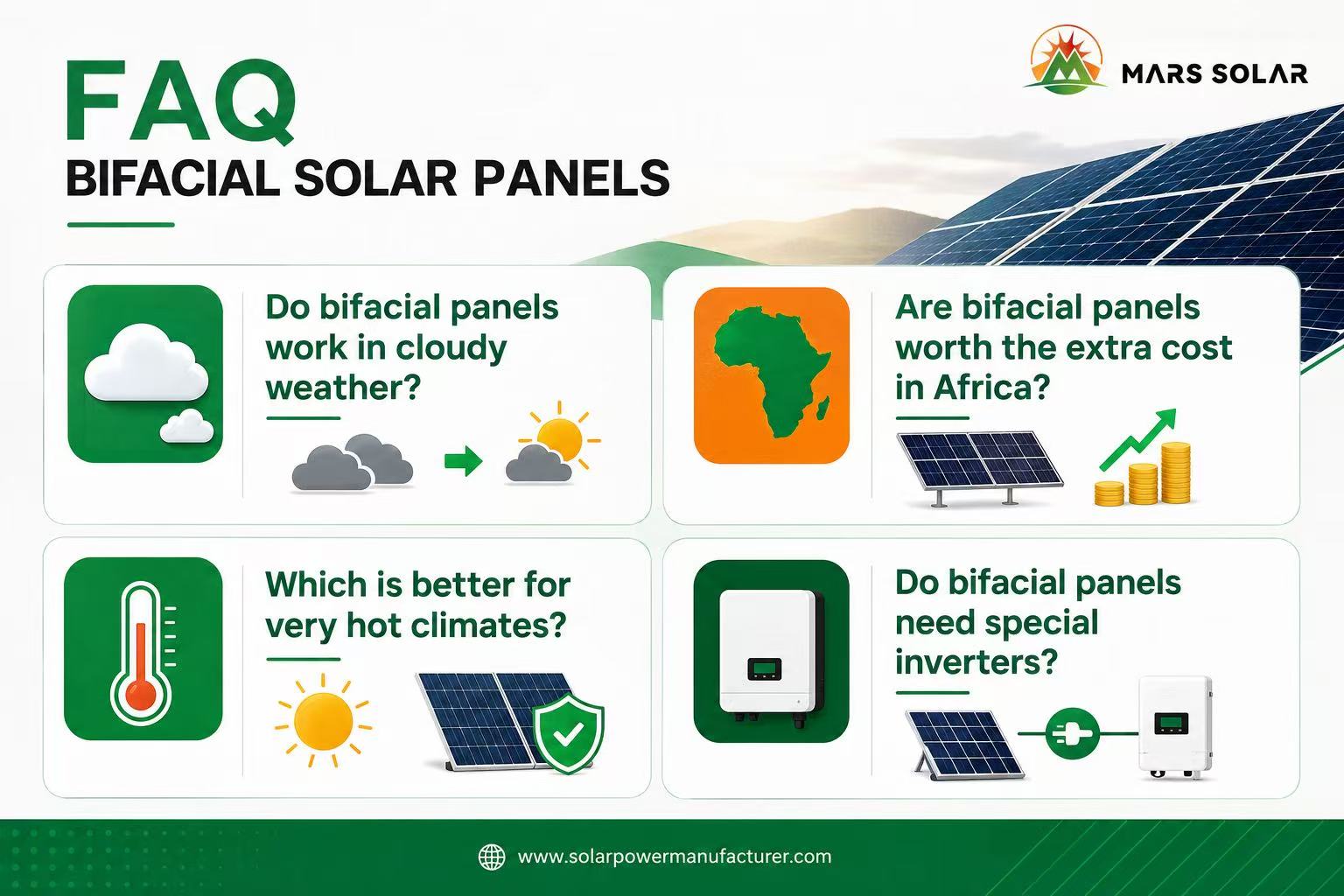
Os painéis bifaciais funcionam em dias nublados?
Sim, mas o ganho é reduzido. Em dias nublados, a luz difusa predomina. O ganho bifacial cai de 15-25% para 5-10%. Em regiões consistentemente nubladas (Norte da Europa, Reino Unido), o custo adicional do bifacial torna-se mais difícil de justificar.
Vale a pena o custo adicional dos painéis bifaciais na África?
Para instalação no solo: SIM. Regiões do Saara e da África Subsaariana apresentam albedo de 40-50% devido à areia. O ganho bifacial de 15-25% está bem documentado. Para instalação em telhados na África: geralmente NÃO (baixa altura de instalação, telhados escuros).
Qual é a melhor opção para climas muito quentes?
Bifacial N-type TOPCon has better temperature coefficient (-0.29%/°C vs -0.36%/°C). In temperatures above 35°C, this means 2-3% less power loss per degree. Bifacial is the best choice for UAE, Saudi Arabia, Nigeria, and similar climates.
Os painéis bifaciais precisam de inversores especiais?
Não. Os painéis bifaciais funcionam com qualquer inversor padrão. A entrada CC dos painéis bifaciais é idêntica à dos monofaciais.
Which is the better choice, bifacial vs monofacial solar panels, for a rooftop?
Monofacial, in almost every rooftop case. Bifacial cells need rear-side light and at least a metre of clearance behind the array to capture it, and a flush rooftop gives neither. The choice between bifacial vs monofacial solar panels therefore usually resolves to monofacial on a roof and bifacial on open ground. Where the roof is tilted over a white membrane or a light concrete deck, the gap narrows but rarely closes.
How much extra output do bifacial vs monofacial solar panels actually deliver?
Between 5% and 15% on a well-designed ground-mount, and 20% or more only where the surface albedo is very high — fresh snow, white gravel or a light concrete apron. The gap widens with mounting height, row spacing and reflectance, and collapses to almost nothing over dark soil or dense grass. Any comparison of bifacial vs monofacial solar panels that assumes a flat 20% gain is marketing rather than modelling.
What surface albedo justifies bifacial panels over monofacial solar panels?
Roughly 0.5 or above. Fresh snow reaches about 0.8, white gravel 0.5–0.6, light concrete 0.3–0.4, dry grass about 0.2 and dark soil about 0.1. On the lower half of that range the rear-side gain does not repay the module premium, and the bifacial vs monofacial solar panels decision should land on monofacial. Ask for the albedo assumption in writing before you sign.
Do bifacial vs monofacial solar panels differ in price per watt?
Yes — bifacial modules typically carry a 5–15% premium per watt and are usually glass-on-glass. Because the premium is paid on day one while the extra output arrives over 25 years, a proper bifacial vs monofacial solar panels comparison has to be run on cost per kWh delivered, not cost per watt. The photovoltaic module specification sheet is where the bifaciality factor and the temperature coefficient are declared.
How much mounting clearance do bifacial vs monofacial solar panels need?
A bifacial array wants about a metre behind the lowest row and a structure that does not shade the rear face; a monofacial table can sit far closer to the ground. That structural requirement is the second cost inside the bifacial vs monofacial solar panels question, and it is why 1 MW ground-mount comparisons come out closer than the module premium alone would suggest.
Can bifacial and monofacial panels be mixed on one inverter?
Yes, but on separate strings and ideally separate MPPT channels. Bread on one string, the weaker operating point wins and the bifacial modules are pulled down to the monofacial voltage. If you are phasing an upgrade, keep the two technologies on their own inputs. Mixing them carelessly is the most common way a bifacial vs monofacial solar panels plan loses the gain it was built to capture.
Do bifacial vs monofacial solar panels behave differently in hot climates?
Less than the marketing suggests. Rear-side exposure helps a little, but the temperature coefficient of the module decides output in Accra, Nairobi or Dubai conditions far more than bifaciality does. When you compare bifacial vs monofacial solar panels for a hot site, compare the temperature coefficient and the degradation curve first, and treat the rear-side gain as the smaller term.
How should bifacial vs monofacial solar panels be modelled in a yield calculation?
Three inputs decide the answer: the module's bifaciality factor, usually 0.7–0.8; the surface albedo of the site; and the geometry — mounting height, tilt and row spacing. A bifacial vs monofacial solar panels model that omits any one of the three is guessing. Ask your supplier to hand over those assumptions alongside the modelled yield.
Do bifacial vs monofacial solar panels carry the same warranty?
Comparable, and often better for bifacial: glass-on-glass bifacial modules are frequently warranted for 30 years against performance, against 25–30 years for a typical monofacial module. That does not settle the bifacial vs monofacial solar panels question by itself, because a longer warranty on a module that generates less over its life is not a saving. Model the energy first.
What is the payback difference between bifacial vs monofacial solar panels?
On a high-albedo ground-mount the bifacial array usually pays back one to two years sooner across a 25-year life. On a dark-surfaced site, a rooftop or a shaded yard, monofacial wins outright and the bifacial premium is money spent on a feature the site cannot use. That is the honest answer to the bifacial vs monofacial solar panels question: it is a site-specific advantage, not a generational improvement.
Should a 1 MW ground-mount use bifacial vs monofacial solar panels?
Usually bifacial, and this is the scale where the choice pays. At 1 MW the structure is engineered anyway, so mounting height is nearly free, and row spacing is set by the layout rather than the roof. On light ground, a bifacial vs monofacial solar panels comparison at this scale typically returns the module premium inside three to four years. On dark laterite or dense grass, monofacial remains the correct answer.
Precisa de ajuda para escolher o painel certo para o seu projeto?
Os mais de 30 engenheiros da Mars Solar podem recomendar o tipo de painel ideal para o seu projeto específico. Fornecemos painéis monofaciais PERC e bifaciais TOPCon tipo N — e sempre recomendaremos o tipo que ofereça o melhor retorno sobre o investimento para o seu projeto.
Como obter uma recomendação gratuita de painel sensorial:
- Descreva seu projeto: localização, tamanho (kW), tipo de superfície, orçamento.
- Nossos engenheiros enviarão uma recomendação técnica em até 24 horas.
- Oferecemos preços FOB/CIF/DDP de acordo com os Incoterms de sua preferência.
Opções de fornecimento de painéis solares para Marte:
Contate a Mars Solar:
- WhatsApp: +86-15302966051
- E-mail: info@marssolargroup.com
- Site: Solicite um orçamento gratuito
Sobre Marte Solar
A Mars Solar (Foshan Mars Solar Technology Co., Ltd.) fabrica e desenvolve sistemas solares desde 2008. Mais de 17 anos de experiência, Mais de 30 engenheiros, e Mais de 3.000 projetos bem-sucedidos em mais de 130 países., Ajudamos distribuidores e empreiteiras EPC a escolher o equipamento solar certo para suas condições específicas.
Receba uma recomendação de painel gratuita | Sobre nós | Veja nossos casos de sucesso.
Última atualização: julho de 2026
Palavras-chave: painéis solares bifaciais vs. monofaciais, melhor tipo de painel solar em 2026, mono PERC vs. TOPCon, comparação de painéis solares, recomendação de painéis solares da Mars Solar

 English
  Arabic
  Spanish
  French
  Dutch
Dutch  Portuguese