
Language
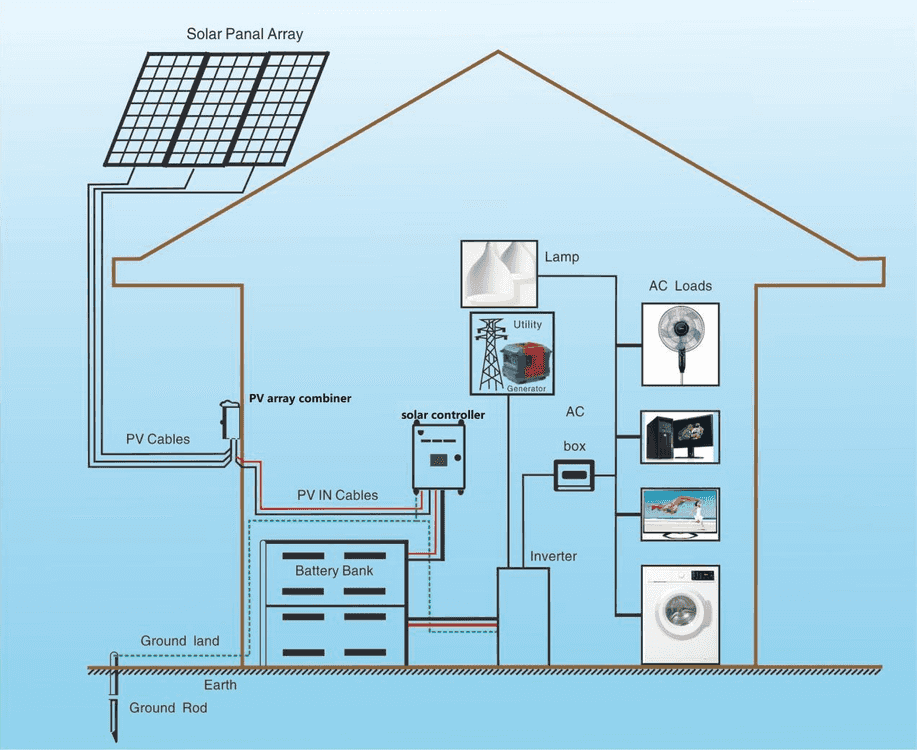
Early-installed PV systems generally fail to meet the growing energy demands of modern households and enterprises. Compared with replacing the entire system, expansion is a more economical option—but the core question remains: Can new and old PV technologies work synergistically? This guide, integrating the latest technical solutions, details the simplified path for system expansion, methods to improve compatibility, and economic benefits.
The global demand for PV system expansion is growing rapidly, mainly driven by four core factors:
According to data from the Global Solar Council (2024), the global newly installed PV capacity in 2024 increased by 33% year-on-year to 197 GWdc, of which 62% came from the expansion of existing systems (rather than new projects). Users tend to maximize the return on initial investment.
| Core Barriers | Specific Problem Description | Practical Solutions |
| PV Panel Mismatch | Efficiency loss of the entire system caused by power/voltage differences between new and old panels | Install string optimizers (e.g., SolarEdge) or microinverters to dynamically balance the voltage/current of each panel, reducing losses to less than 5% |
| Inadequate Inverter Capacity | The original inverter cannot handle the input power of newly added panels | Upgrade to hybrid or multi-MPPT (Maximum Power Point Tracking) inverters, supporting the connection of 3-4 strings of panels with different specifications |
| Outdated Communication Protocols | The old system monitoring platform cannot be compatible with data from new equipment | Deploy a unified monitoring gateway (e.g., Mars Smart Gateway) that supports multi-protocol conversion such as Modbus and WiFi |
| Incompatible Wiring/Connectors | The old system uses non-standard interfaces (e.g., T4) | Uniformly replace with MC4 standard connectors, or have a professional team perform rewiring to ensure IP67 waterproof rating |
| Year | Newly Installed Capacity (GWdc) | Cumulative Installed Capacity (GWdc) | Expansion Share (of New Installations) | Data Source |
| 2021 | ~400 | 1840 (estimated) | 45% (estimated) | Global Solar Council |
| 2022 | +228 | ~630 (regional statistics) | 51% | IEA Renewable Energy Report |
| 2023 | +446 | 2350 (estimated) | 58% | BloombergNEF |
| 2024 | ~197 (33% year-on-year growth) | ~597 (regional statistics) | 62% | Global Solar Council 2024 Annual Report |
2025-2027 Forecast: The demand for expansion will maintain an annual growth rate of 28%. The core driver will be integrated "PV + energy storage" expansion (accounting for over 70%). Avoiding full-system replacement can reduce costs by 40%-60%.
| Parameter | Before Expansion (5kW System) | After Expansion (5kW + 3kW Added) | Change Analysis |
| Total System Capacity | 5kW (polycrystalline panels) | 8kW (old polycrystalline + new TOPCon) | 60% capacity increase |
| Inverter Type | Traditional single-MPPT inverter | Hybrid multi-MPPT inverter | Supports dual-panel string access |
| Energy Storage Configuration | None | 15kWh lithium iron phosphate battery | Enables 3-4 hours of off-grid power supply at night |
| Annual Power Generation | 7,200 kWh | 11,520 kWh | 60% increase (including energy storage charge-discharge optimization) |
| Self-Consumption Rate | ~35% | ~65% | Energy storage reduces grid power purchase demand |
| Annual Electricity Cost Savings | $864 | $2,160 | 150% increase (California electricity price: $0.30/kWh) |
| Initial Expansion Cost | - | $3,840 (including equipment + installation) | Actual cost after California subsidy: $2,688 |
| Payback Period | 10 years (original system) | 7 years (entire system after expansion) | 3-year reduction |
Key Conclusion: Currently, the price of PV panels has dropped to 0.08-0.10 USD/Wdc. Combined with regional subsidies, the average payback period of expansion projects has been reduced to 3-5 years, which is better than that of new systems (5-8 years).
PV system expansion has become the optimal solution to cope with growing energy demand and reduce costs. Compatibility barriers have been completely solved through technologies such as string optimizers and multi-MPPT inverters, and the ROI of expansion projects is better than that of new systems.
Action Recommendations:

Whether a PV system expansion is worthwhile comes down to three checks: inverter headroom, string voltage compatibility,
and whether the roof or ground area still has usable space. A PV system expansion that ignores any one of those three
usually underperforms its modelled output, because the new array is throttled by a constraint elsewhere in the system.
The first check is inverter capacity. Most modern inverters tolerate 20 to 30 percent DC oversizing, which means a
PV system expansion can often add panels without replacing the inverter at all. Where the existing inverter has no
headroom, a second unit or a like-for-like replacement is cheaper than it sounds once you account for the panels being retained.
The second check is string voltage and current matching. Mixing panel generations on one string drags the whole string toward the
weakest module, which is why a PV system expansion normally puts new panels on their own strings feeding a separate
MPPT input. Multi-MPPT inverters make this straightforward; single-MPPT units may need an optimiser per panel.
The third check is physical space and structural capacity. Panels have grown substantially, so a
PV system expansion often fits more capacity into the same footprint than the original array occupied, but the added
dead load and wind uplift still need verifying.
Where the site also wants outage protection or evening self-consumption, pairing a PV system expansion with battery
storage is usually the better single project rather than a second visit later. See our
rack mounted energy storage battery and
15kWh battery options, or the
100kW hybrid system for commercial sites.
The U.S. Department of Energy's Solar Energy Technologies Office
publishes the equipment and interconnection standards that a compliant PV system expansion should meet, and our
engineers size every PV system expansion against the site's logged consumption rather than a nameplate estimate.
Is PV system expansion cheaper than installing a second system?
Yes, in almost every case. A PV system expansion reuses the existing mounting, cabling, protection and often the inverter enclosure, so the money goes into generation capacity instead of into a second set of fixed costs. Published comparisons put the saving from a PV system expansion at 40-60% against a full replacement, and the payback period of a PV system expansion is shorter than that of a new system because the original capital is already sunk.
Can new panels be added to an older array without losing efficiency?
Only if the mismatch is managed. Adding a 450W N-type module to a string of 270W polycrystalline panels drags the whole string toward the weaker panel. The fix is not to avoid the PV system expansion but to split it: string optimisers or microinverters isolate each panel, and a multi-MPPT hybrid inverter lets the new array run on its own channel. Handled that way, a hybrid PV system expansion typically recovers 12-18% of array efficiency compared with naive series connection.
What is the first step of any PV system expansion?
A system audit, not a purchase order. Before quoting a PV system expansion we record the peak power, open-circuit voltage, short-circuit current and measured degradation of the existing panels, the inverter's MPPT count and voltage window, the cable cross-section and the age of the protection. A PV system expansion specified from the nameplate alone is the most common cause of underperformance we see.
How much can a PV system expansion increase self-consumption?
Substantially, once storage is included. In the California case above, the PV system expansion took annual generation from 7,200 kWh to 11,520 kWh, but the bigger change was the self-consumption rate — from roughly 35% to 65% — because the added battery moved generation into the evening. A PV system expansion that adds panels without storage mostly adds export, not savings.
Does a PV system expansion affect the grid connection or warranty?
It can affect both, which is why a PV system expansion should be documented. A larger array may need a revised interconnection approval, and adding third-party equipment to an existing string can void the original inverter warranty unless the PV system expansion is designed within its permitted input window. Ask the installer for the revised single-line diagram and the updated warranty position in writing.
How long does a PV system expansion take to install?
A residential PV system expansion in the 3-5 kW range is typically a one to two day job once the audit is complete and the equipment has arrived. A commercial PV system expansion is staged around production hours, with the new strings energised on a separate MPPT channel first so the existing array keeps generating throughout.
Mars Solar sizes every PV system expansion against the site's logged consumption rather than a nameplate estimate, and matches the added PV system expansion to the inverter's spare MPPT capacity before any hardware is quoted.
 English English
  Arabic
 Spanish
 French
 Dutch
Dutch
 Portuguese