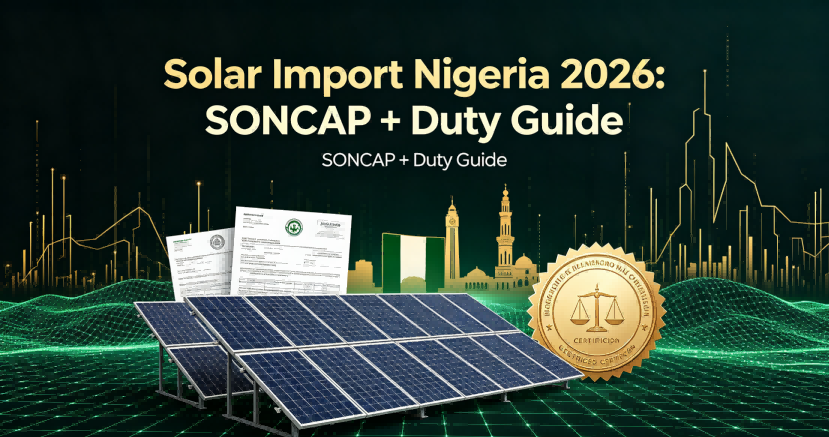
Solar Import Nigeria 2026: SONCAP + Duty Guide
Solar import Nigeria in 2026 has two facts that most importers learn too late: solar panels and batteries enter at 0% duty under the ECOWAS Common External Tariff, and nothing clears Apapa without a SONCAP certificate issued in China before the vessel sails. Zero duty does not mean zero compliance. A container that lands in Lagos with the wrong PC grade or a missing Form M sits at the port accruing demurrage at a rate that erases the margin on the entire order.
This guide is the practical counterpart to our diesel vs solar cost guide for Nigeria: that article proves the economics, this one gets your equipment through customs. It covers the real duty and VAT position by HS code, the SONCAP two-tier structure (PC + SC) and the PC1/PC2/PC3 grade that applies to your shipment volume, the Form M and PAAR workflow, port-specific clearance realities at Apapa, Tin Can Island, and Port Harcourt, and the eight mistakes that cost Nigerian importers the most money in 2026.
Who this is for: Nigerian solar distributors and EPC contractors, mini-grid and off-grid developers funded under the World Bank NEP programme, C&I end users importing a 100 kW to 5 MW system directly from China, and procurement officers comparing CIF Lagos against DDP. All regulatory references are current as of September 2026. Sources: Standards Organisation of Nigeria SONCAP Conformity Assessment Programme, Nigeria Customs Service HS 8541 tariff schedule, Central Bank of Nigeria Form M / PAAR trade documentation, ECOWAS Common External Tariff, Nigeria Trade Hub 2026 procedure.
Solar Import Nigeria: Duty and VAT in 2026: What You Actually Pay by HS Code
Getting solar import Nigeria duty treatment right starts with accepting that the headline "zero duty" applies to the module, not to the whole system. A 500 kW hybrid project ships as four or five different HS classifications, and only one of them is duty-free.
The 0% story is real — and narrow. Under the ECOWAS Common External Tariff, fully assembled solar PV modules classified under HS 8541.43 face 0% import duty. Batteries and storage cabinets sit at 0–5% depending on whether they enter as cells, modules, or complete assemblies. But inverters, charge controllers, mounting structures, DC cabling, and switchgear all carry duty, some of it at 10–20%. On a mixed container, the blended effective rate typically lands between 3% and 8% of CIF — not zero.
VAT is 7.5% and it is not waived for ordinary importers. Solar equipment does not carry a blanket VAT exemption for resellers. VAT is assessed on the CIF value plus duty plus levies, and it is charged at the point of customs assessment. A VAT-registered Nigerian company recovers input VAT on its returns; a company outside the VAT net simply absorbs it as cost.
Effective landed cost example: 500 kW hybrid system from China
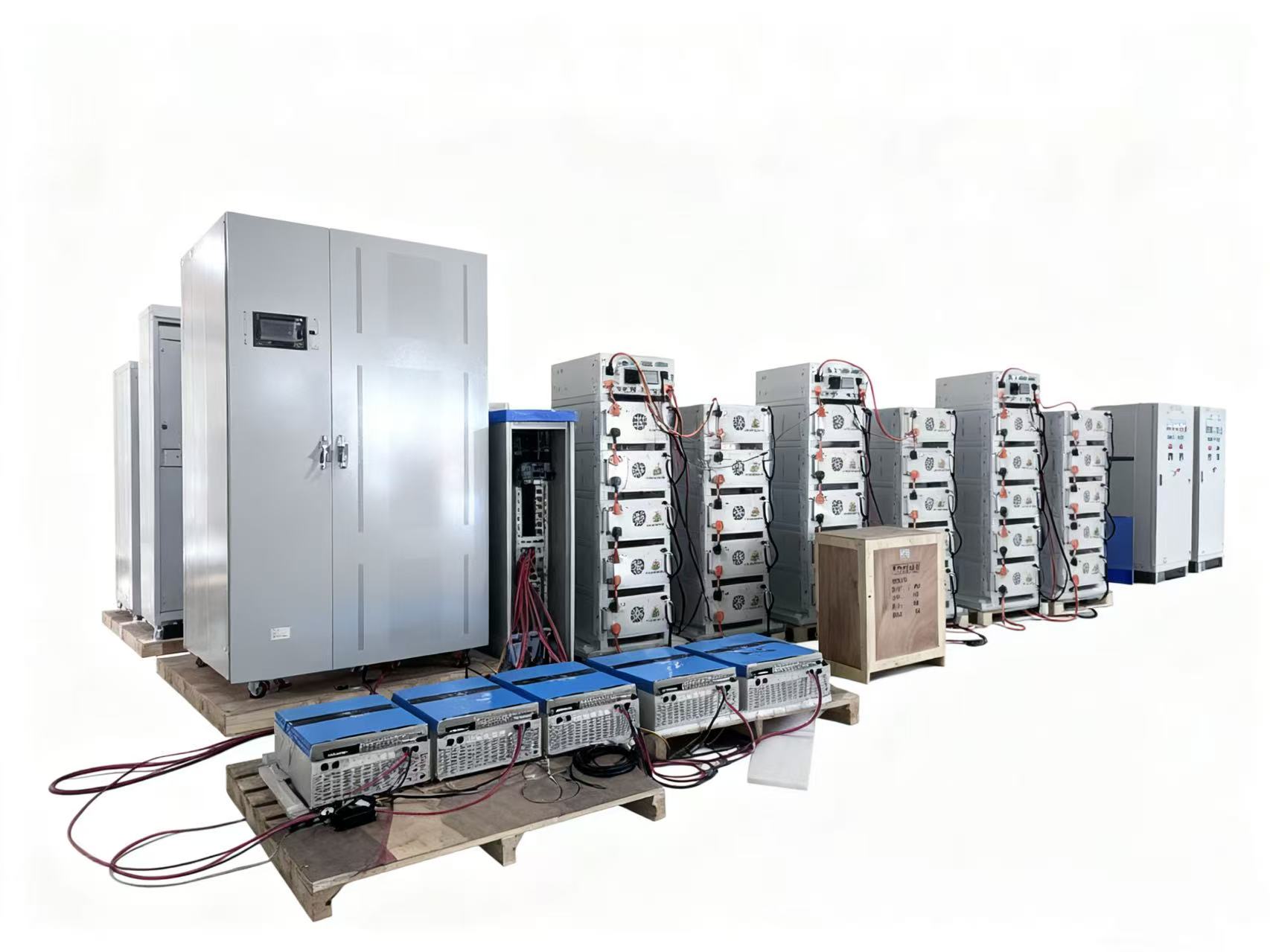
A realistic 2026 build for a Lagos commercial site: 900 × 585 W TopCon modules, 5 × 100 kW hybrid inverters, 1 × 500 kWh rack-mounted LFP cabinet, plus mounting, DC cable, and switchgear. At CIF Lagos of USD 145,000, the blended duty across the classification mix comes to roughly USD 7,000–11,000, VAT adds roughly USD 11,400–11,700, and port charges, clearing agent fees, and haulage add USD 4,000–7,000. Total landed cost lands around USD 168,000–175,000, or roughly 16–21% above the CIF invoice. Budget for that gap before you sign the purchase order.
Duty and VAT by product category (2026)
| Product | HS code | Import duty | VAT | Required docs |
|---|---|---|---|---|
| Solar PV modules | 8541.43 / 8541.40 | 0% (ECOWAS CET) | 7.5% | SONCAP SC + PC (IEC 61215 / IEC 61730) + Certificate of Origin |
| Lithium battery cells (LFP/NMC) | 8507.60 | 0–5% | 7.5% | SONCAP + UN38.3 + MSDS + IEC 62619 |
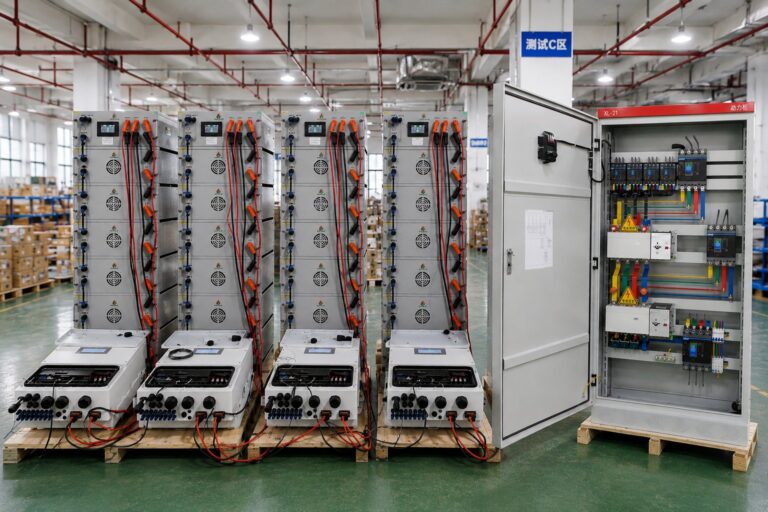
| Battery energy storage system (BESS) | 8507.60 / 8537.20 | 0–5% | 7.5% | SONCAP + IEC 62619 + IEC 63056 + UN38.3 |
| Solar inverter (string / hybrid) | 8504.40 | 5–10% | 7.5% | SONCAP + IEC 62109-1/2 |
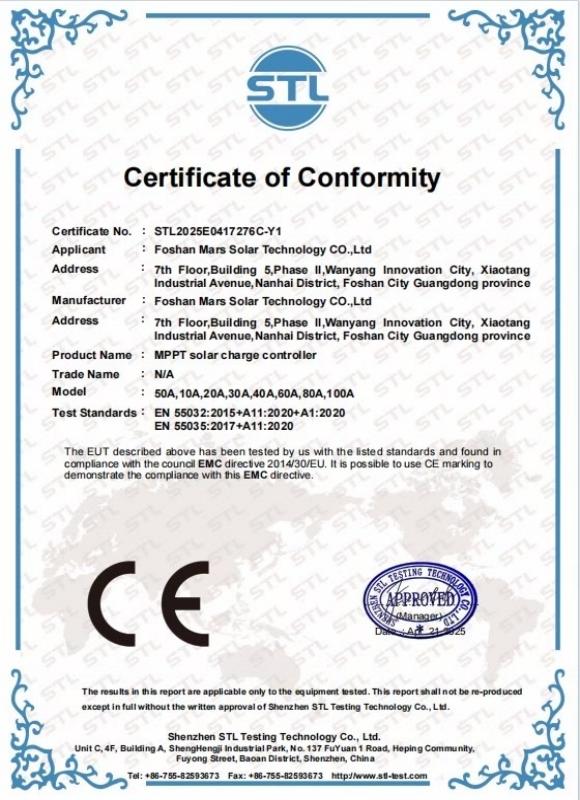
| MPPT charge controller | 8537.20 | 5–10% | 7.5% | SONCAP + IEC 62109 |
| Solar mounting structure | 7610.90 / 7308.90 | 10–20% | 7.5% | Nil SONCAP (not regulated) |
| PV DC cable | 8544.49 | 10–20% | 7.5% | SONCAP (electrical) |
| LV switchgear / protection board | 8537.10 | 5–10% | 7.5% | SONCAP + IEC 61439 where applicable |
Note: HS 8541 duty treatment has generated conflicting guidance in the market — some brokers quote 0%, others 5%. The 0% ECOWAS CET position applies to the module classification; a 5% rate is sometimes applied when a shipment is entered under a broader electrical-goods heading. The fix is to insist that your clearing agent classifies each line item explicitly and, for high-value shipments, to obtain a written classification position before the goods ship. Misclassification is the most common trigger for a post-clearance audit and a retroactive duty assessment.
Source: ECOWAS Common External Tariff 2022–2026 schedule, Nigeria Customs Service tariff database, HS 8541 / 8507 / 8504 classification notes.
SONCAP Certification for Solar: The PC + SC Two-Tier System Explained
SONCAP is not a single document. It is a two-tier conformity programme run by the Standards Organisation of Nigeria, and in 2026 photovoltaic modules, inverters, batteries, and energy storage systems are formally in scope as regulated products. Importers who treat SONCAP as "a certificate the supplier sends" discover the structure only when a container is already on the water.
Tier one — the Product Certificate (PC). Registered against the product and the manufacturer, not against a shipment. It is the formal admission that the product has been tested against Nigerian Industrial Standards (NIS) or an accepted international equivalent, by a laboratory operating under ISO/IEC 17025. This is the tier that takes real time: at least 2–4 months should be reserved, and PC3 grade adds a factory audit on top.
Tier two — the Shipment Certificate (SC). Applied for per shipment, after the PC exists and after Form M is opened. The SC is issued only following a pre-shipment physical inspection at the loading port in China, where an authorised inspector verifies model numbers, quantities, nameplate ratings, and packaging against the PC. The SC certificate is then synced to the Nigeria Single Window and becomes the direct legal basis for customs release.
Which PC grade applies to your shipment volume
| Grade | Validity | Typical use case | Inspection intensity | Requirement |
|---|---|---|---|---|
| PC1 | 6 months, single shipment | Trial orders / one-off shipments | Inspection on every batch | Testing report only |
| PC2 | 1 year, unlimited shipments | 3–10 shipments per year | Sampling rate ≥ 40% | Testing report + periodic factory check |
| PC3 | 1 year, unlimited shipments | More than 10 shipments per year | Lowest sampling rate | Testing report + full factory audit |
New energy products are treated as a higher-risk category, which means PC3 is frequently the applicable grade for anyone shipping regularly — and PC3 requires a documented factory quality-system audit. If you are buying from a Chinese manufacturer who has never exported to Nigeria, assume you are starting from PC1 and plan the timeline accordingly. Ask the supplier one question before you negotiate price: "What is your current SONCAP PC status, grade, and expiry date?" A supplier who cannot answer immediately is quoting you a shipment that will not clear.
The full certificate chain, step by step
| Step | Action | Owner | Timing and notes |
|---|---|---|---|
| 1 | Register the product with SON and obtain a Product Certificate (PC) | Exporter / manufacturer in China | 4–12 weeks depending on PC grade. PC3 requires a factory audit. |
| 2 | Buyer opens Form M through a Nigerian authorised dealer bank | Nigerian importer | Mandatory for any single import over USD 20,000. Must be opened before shipment. |
| 3 | Submit SC application with PC, Form M, invoice, packing list, BL | Exporter, via SON-authorised body (SGS, Intertek, Cotecna) | Per shipment. Allow 7–10 working days minimum. |
| 4 | Pre-shipment physical verification at the Chinese loading port | SON-authorised inspector | Model, quantity, and nameplate data verified against the PC. |
| 5 | SC certificate issued and synced to the Nigeria Single Window | SON / authorised body | This is the legal basis for customs release. No SC, no clearance. |
| 6 | PAAR generated from the Form M and shipping documents | Importer's bank → Nigeria Customs Service | Pre-Arrival Assessment Report. Without it, the container cannot be cleared. |
Three myths that strand containers in Lagos
- "Zero duty means no SONCAP needed." Wrong. Duty and conformity are separate regimes. PV modules can be duty-free and still be refused clearance without an SC certificate and a Certificate of Origin.
- "The buyer can arrange SONCAP in Nigeria after arrival." Wrong. SONCAP is a pre-shipment conformity assessment. It must be completed before the cargo leaves the Chinese port. It cannot be obtained at Apapa, and a container without an SC cannot be regularised after the fact.
- "Our CE and IEC certificates are enough." Partly wrong. IEC 61215 and IEC 61730 test reports are the right technical foundation, but they must be issued by an ISO/IEC 17025 accredited laboratory and accepted against the NS/NIS standard set. A CE declaration of conformity on its own is not accepted.
Product details SON inspectors check on site
- Nameplate voltage and frequency matching Nigeria's 230 V / 50 Hz supply
- Plug and connector standards compliant with BS 1363 where applicable
- Model numbers consistent across the nameplate, PC certificate, invoice, and packing list
- No altered or overwritten documents — in 2026 customs scrutiny of SONCAP documentation authenticity has tightened, and any mismatch between the SC, the bill of lading, and the commercial invoice voids the file
Source: SON SONCAP Conformity Assessment Programme guidelines 2026, SONCAP expanded scope covering PV / BESS / inverters, Nigeria Single Window integration procedure, ISO/IEC 17025 laboratory accreditation requirements.
Form M, PAAR and Port Clearance: The 12-Step Nigeria Import Workflow
The documentation chain in Nigeria is sequential and unforgiving. Each document depends on the one before it, and the two that stop shipments most often are Form M and the SONCAP SC — in that order.
Form M is the first hard gate. For any single import above USD 20,000, the buyer must open a Form M through a Nigerian authorised dealer bank before the supplier ships. Form M is the formal declaration of intent to import; it requires a pro-forma invoice with itemised FOB value, freight, and insurance, plus cargo insurance purchased from a Nigerian insurer. There is no workaround. Cargo that arrives against an unopened or mismatched Form M cannot be cleared, no matter how much duty is offered.
PAAR is the second hard gate. Once the goods are in transit, the bank processes the shipping documents to the Nigeria Customs Service, which generates the Pre-Arrival Assessment Report. The PAAR tells Customs what is arriving and at what declared value. Without it, the clearing agent cannot file the entry. The practical benefit of getting the PAAR early is that duty assessment and payment can be completed while the vessel is still at sea, which is the single biggest lever on port dwell time.
The full workflow
| Step | Action | Timing | Key requirement |
|---|---|---|---|
| 1 | Register with the Corporate Affairs Commission and obtain a TIN | Before any import | CAC certificate + active Tax Identification Number linked to the business |
| 2 | Open a corporate account with an authorised dealer bank | Before any import | Only authorised dealer banks can process Form M and trade documents |
| 3 | Confirm the supplier's SONCAP PC status and grade | Before ordering | PC1 / PC2 / PC3. Budget 2–4 months for a first-time PC3 application |
| 4 | Obtain a Pro-forma Invoice showing FOB, freight, and insurance | Before ordering | FOB value, freight, and insurance must be itemised, not lumped |
| 5 | Purchase insurance from a Nigerian insurer | Before Form M | Local insurance is a legal pre-condition for opening Form M |
| 6 | Open Form M through the bank | Before shipment | Mandatory above USD 20,000 per single import. Missing Form M = no clearance, at any duty level |
| 7 | Apply for the SC certificate | 7–10 working days before departure | Requires valid PC + Form M + commercial invoice + packing list + bill of lading |
| 8 | Complete pre-shipment inspection at the Chinese port | Before vessel departure | Model, quantity, and nameplate verification by a SON-authorised inspector |
| 9 | Bank generates the PAAR and transmits it to Customs | In transit | Pre-Arrival Assessment Report — the document that lets clearance begin |
| 10 | Appoint a licensed clearing agent and file the entry | On vessel arrival | Duty assessed by HS code, paid at the bank, inspection scheduled |
| 11 | Customs physical examination and final release | On arrival | Expect 100% examination on first-time importers and on battery cargo |
| 12 | Haulage to site and retain records | Post clearance | Keep the full document set — post-clearance audits run up to 5 years |
Ports and transit times from Shanghai
| Port | Sea transit | Character | Best for |
|---|---|---|---|
| Apapa (Lagos) | 32–40 days | Highest volume, deepest congestion. Yard dwell times spike without pre-lodgement. | Established importers with a reliable agent |
| Tin Can Island (Lagos) | 32–40 days | Slightly faster release than Apapa for containerised project cargo. | Containerised solar and BESS shipments |
| Port Harcourt (Onne) | 35–45 days | Preferred for South-South and South-East project sites. Less congested. | Niger Delta and eastern project cargo |
What customs actually examines on solar and battery cargo
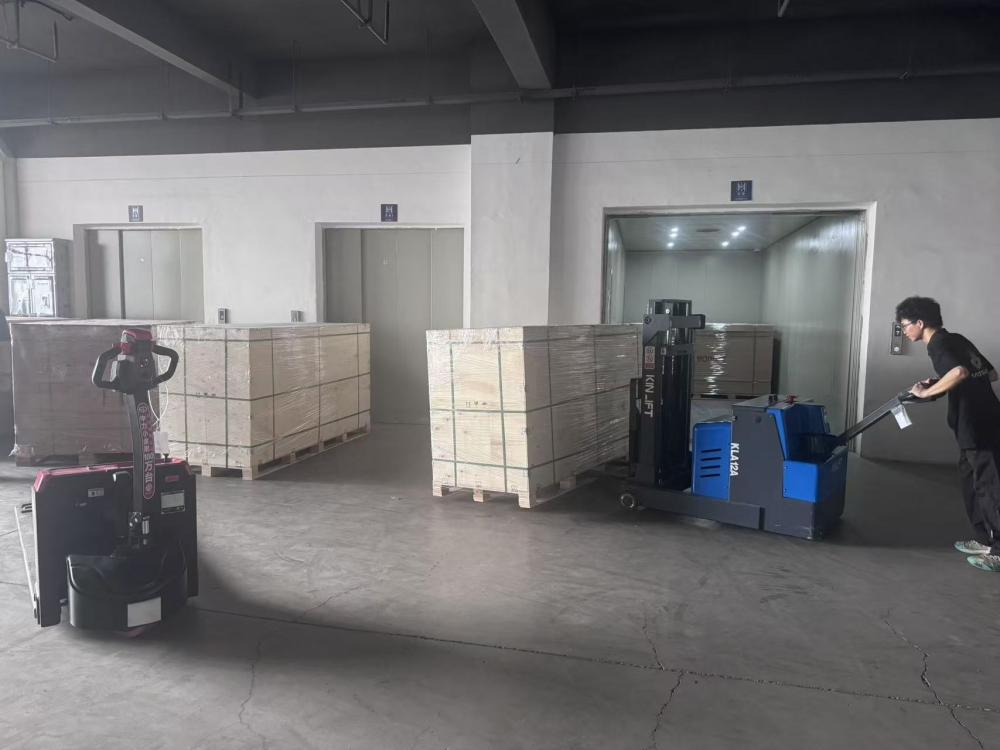
First-time importers and lithium battery shipments attract close to 100% physical examination at Lagos ports. Inspectors verify model numbers and quantities against the SC certificate and packing list, check nameplate ratings against the declared technical specification, and confirm the declared CIF value against the invoice. For battery energy storage, the UN38.3 test report, MSDS, and dangerous goods packaging documentation are checked as part of the same examination. A mismatch between the SC and the physical goods is the fastest route to a detention order.
Payment terms and the naira question
Letters of credit for Chinese suppliers must be denominated in USD or EUR — naira LCs are not accepted by Chinese manufacturers. Nigerian banks with established China correspondent relationships include GTBank, Access, Zenith, and First Bank. For first orders, most Chinese solar manufacturers work on 30% deposit and 70% against the bill of lading copy, or 100% telegraphic transfer before shipment. Confirm the exact terms in the formal pro-forma invoice, not in a chat message.
Source: Central Bank of Nigeria Form M guidelines, Nigeria Customs Service PAAR procedure, Nigeria Trade Hub 2026 import workflow, NCS physical examination policy for regulated and dangerous goods cargo.
Landed Cost Stack, Hidden Fees, and the 8 Mistakes That Cost Nigerian Importers Most
The CIF invoice is not the cost. Duty, VAT, certification, port charges, and clearing fees add a real percentage that has to be in the budget before the order is placed — and the mistakes below are the ones that turn a manageable cost into a stranded container.
Full landed cost stack for a 500 kW hybrid system
| Cost component | Amount | Notes |
|---|---|---|
| CIF Lagos value (equipment) | USD 145,000 | Reference 500 kW hybrid system, 900 modules + 5 inverters + 500 kWh LFP |
| Import duty (blended 3–8%) | USD 7,000–11,000 | Only modules are 0%. Inverters, structures, and cabling carry duty |
| VAT at 7.5% | USD 11,400–11,700 | Charged on CIF + duty + levies. Recoverable only if VAT-registered |
| SONCAP PC + SC fees | USD 1,500–3,500 | PC grade dependent. PC3 with factory audit sits at the top of the range |
| Port charges, agent, haulage | USD 4,000–7,000 | Terminal handling, examination, clearing agent, transport to site |
| Total landed cost | USD 168,000–175,000 | Roughly 16–21% above the CIF invoice |
Where hidden cost accumulates
- Demurrage and storage. Lagos yards are congested. A week of avoidable dwell time on a 40HQ container runs into hundreds of thousands of naira per day, and it is entirely preventable by pre-lodging the entry and having the PAAR ready before berthing.
- Under-declared CIF value. Declaring below the invoice to reduce duty invites a valuation dispute, a longer examination, and a retroactive assessment with penalties. The savings are illusory and the exposure is real.
- PC3 factory audits that were never budgeted. If your supplier needs PC3 and the factory has never been audited, the audit timeline can push your shipment past a project deadline. Build 2–4 months of contingency into the schedule for first-time suppliers.
- Battery cargo handling surcharges. Lithium batteries are Class 9 dangerous goods. Expect a dangerous goods surcharge on freight, and expect the port examination to take longer than for module-only containers.
- Split shipments to stay under thresholds. Deliberately fragmenting an order to avoid Form M is treated as evasion. One Form M covering the true transaction is the only defensible route.
The 8 mistakes that cost Nigerian importers the most money
| Mistake | Consequence | Fix |
|---|---|---|
| Assuming zero duty means no SONCAP | Container refused clearance at Apapa with no local remedy | Confirm the supplier's SONCAP PC grade before signing the PO |
| Shipping before Form M is opened | Cargo cannot be cleared at any duty level | Open Form M through the bank for every import above USD 20,000 |
| Trying to obtain SONCAP in Nigeria after arrival | Not possible — it is a pre-shipment assessment | Complete SC certification before the vessel leaves China |
| Using CE / IEC reports as a substitute for SONCAP | Certificate rejected, shipment held | Ensure test reports come from an ISO/IEC 17025 lab accepted against NIS |
| Splitting a large order into sub-USD 20,000 shipments | Customs treats it as evasion; penalties and holds | Declare the true transaction value and open one Form M |
| Mixing regulated and unregulated items without separate classification | Whole container pulled for examination, duty misassessed | Classify each line item by HS code before the entry is filed |
| Mismatched documents between SC, BL, and invoice | Detention order; 2026 scrutiny of document authenticity is strict | Proofread model numbers, quantities, and values across every document |
| Booking a forwarder with no Nigeria or DG experience | Booking refusal, or a BESS container stuck at origin | Use a forwarder who regularly ships Class 9 cargo to Lagos |
Source: Nigeria Customs Service examination and valuation policy, SON SONCAP fee schedule, Lagos port terminal handling charges, Class 9 dangerous goods freight surcharges.
Nigeria Solar Import 2026: Frequently Asked Questions
Do I pay import duty on solar panels in Nigeria in 2026?
Solar PV modules classified under HS 8541 face 0% import duty under the ECOWAS Common External Tariff. However, inverters, charge controllers, mounting structures, DC cabling, and switchgear all carry duty — typically 5–20% depending on classification. On a mixed project container the blended effective duty rate usually lands between 3% and 8% of CIF. VAT of 7.5% applies on top of the CIF value plus duty, and it is not waived for resellers.
What is the total landed cost of importing a 500 kW solar system into Nigeria?
On a CIF Lagos value of roughly USD 145,000, budget USD 168,000–175,000 landed — about 16–21% above the invoice. That includes blended duty of USD 7,000–11,000, VAT of roughly USD 11,400–11,700, SONCAP fees of USD 1,500–3,500, and port, agent, and haulage charges of USD 4,000–7,000. Request a landed-cost breakdown for your specific configuration.
Do I need SONCAP to import solar panels into Nigeria?
Yes. SONCAP is mandatory for photovoltaic modules, inverters, batteries, and energy storage systems, which are treated as regulated products. The programme works in two tiers: a Product Certificate (PC) registered against the product and manufacturer, and a Shipment Certificate (SC) applied for per shipment after pre-shipment inspection. Zero duty on modules does not exempt them from SONCAP — duty and conformity are separate regimes.
Can SONCAP be arranged in Nigeria after the goods arrive?
No. SONCAP is a pre-shipment conformity assessment. The Product Certificate must exist before the goods ship, and the Shipment Certificate is issued only after a physical inspection at the loading port in China. The SC is synced to the Nigeria Single Window and is the direct legal basis for customs release. A container that arrives without a valid SC cannot be regularised at the port.
What is Form M and when do I need it?
Form M is the formal declaration of intent to import, opened through a Nigerian authorised dealer bank before the supplier ships. It is mandatory for any single import above USD 20,000. It requires a pro-forma invoice with itemised FOB value, freight, and insurance, plus cargo insurance purchased from a Nigerian insurer. Cargo arriving against a missing or mismatched Form M cannot be cleared regardless of the duty paid.
How long does SONCAP certification take for solar products?
A first-time Product Certificate application should be started 2–4 months before the intended shipment, particularly if PC3 grade applies — new energy products are treated as higher risk and PC3 requires a factory quality-system audit. The Shipment Certificate itself takes 7–10 working days once the PC, Form M, commercial invoice, packing list, and bill of lading are all in hand. Build the longer lead time into your project schedule, not the shorter one.
Which port should I use for solar imports into Nigeria?
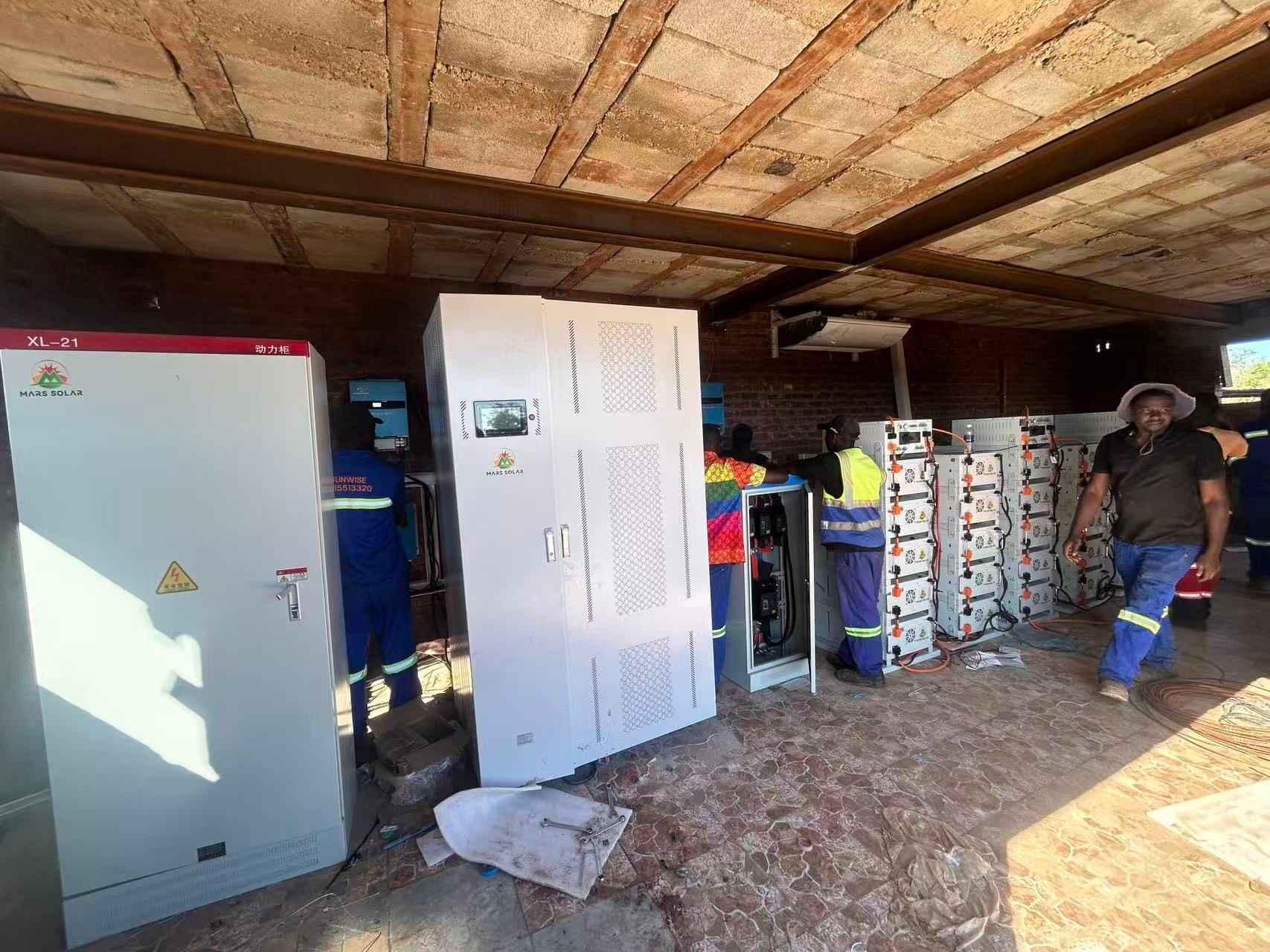
Apapa and Tin Can Island in Lagos handle the vast majority of containerised solar cargo, with 32–40 days transit from Shanghai. Tin Can Island often releases slightly faster than Apapa for project cargo. Port Harcourt (Onne) is the better choice for South-South and South-East project sites, with less congestion but a longer 35–45 day transit. Explore the BESS range built for African port and logistics conditions. For utility-scale reference, study our 6MW 20MWh solar storage deployment in Nigeria.
Because SONCAP is charged per shipment, importers often consolidate one container around a single system size — a 30kW off-grid system, a 200KW system, a 400KW system or a 1MW containerised plant all clear as multiple units in one entry. Our off-grid B2B buyer’s guide for Africa sets out the documentation and duty treatment behind each of those shipments.
Importers who intend to resell rather than self-consume should also read our explainer on the role of independent power producers in solar energy before committing to a container volume.
The bill of lading is both the carrier's receipt and the document of title to the cargo, which is why holding it until the CoC or SONCAP number is issued is a legitimate control on a solar import Nigeria shipment.
Do I pay import duty on a solar import Nigeria shipment in 2026?
On panels, no. Under the ECOWAS Common External Tariff, fully assembled PV modules under HS 8541.43 enter a solar import Nigeria at 0% duty, while batteries and storage cabinets sit at 0 to 5%. A solar import Nigeria is never uniformly duty-free.
Is VAT waived on a solar import Nigeria?
No. VAT is 7.5% and it is not waived for ordinary importers, including resellers. A solar import Nigeria is assessed on CIF plus duty plus levies at the point of customs valuation. That line is why a solar import Nigeria landed cost always exceeds the CIF figure.
What is SONCAP and why does it block a solar import Nigeria?
SONCAP is the Standards Organisation of Nigeria's two-tier conformity programme, and modules, inverters, batteries and storage systems are formally in scope. A solar import Nigeria without a SONCAP certificate issued in China before the vessel sails does not clear Apapa. That is the hardest gate in any solar import Nigeria.
What are the PC and SC tiers of SONCAP for a solar import Nigeria?
PC is the Product Certificate obtained before shipment; SC is the Shipment Certificate issued per consignment against it. A solar import Nigeria needs both, in that order. Importers who arrange the solar import Nigeria SC after arrival are already late.
Which certifications accompany SONCAP on a solar import Nigeria?
IEC 61215 and IEC 61730 for modules, plus a Certificate of Origin. A solar import Nigeria is assessed on the certificate pack as a whole, not on the panels alone. Mismatched model numbers between certificate and invoice stop a solar import Nigeria at inspection.
What is Form M and why does it matter for a solar import Nigeria?
It is the import declaration that must be registered before the goods ship. A solar import Nigeria without a correctly registered Form M cannot proceed to PAAR or clearance. Sequence matters more than price in a solar import Nigeria timeline.
How does a solar import Nigeria proceed once the vessel arrives?
PAAR, then customs assessment, then duty and VAT payment, then release and inland delivery. A solar import Nigeria that is complete on paper moves through in days, while an incomplete one adds storage. Budget storage risk into every solar import Nigeria plan.
Why do brokers disagree about duty on a solar import Nigeria?
Because the 0% applies to the module classification, not to a whole system. A solar import Nigeria can be assessed at 5% when equipment is entered under a broader electrical code. Get the classification in writing before the solar import Nigeria is shipped.
What does a real solar import Nigeria landed cost look like?
Take a 500 kW hybrid: 900 × 585 W TopCon modules, five 100 kW hybrid inverters and a 500 kWh rack-mounted LFP cabinet at CIF Lagos of USD 145,000. Blended duty across those classifications plus 7.5% VAT sets the real solar import Nigeria landed cost.
Which mistakes cost Nigerian importers most on a solar import Nigeria?
Shipping before SONCAP is issued, mismatched HS codes between invoice and entry, incomplete dangerous-goods paperwork for batteries, and an under-declared value. Each turns a solar import Nigeria into a storage bill. Those four checks protect the margin on any solar import Nigeria.
How long does a solar import Nigeria take?
The paperwork sets the pace. SONCAP, Form M and PAAR all precede clearance, so a solar import Nigeria planned backwards from the sailing date clears faster than one planned backwards from the order date. Most solar import Nigeria delays are documentation delays.
What sizes are commonly handled on a solar import Nigeria basis?
Nigerian distributors, EPC contractors and mini-grid developers typically bring in 100 kW to 5 MW directly. A solar import Nigeria at that scale ships as several HS classifications, which is why blended duty beats headline duty. Treating a solar import Nigeria as one line item misreads the cost.
Does a solar import Nigeria need special handling for batteries?
Yes. Lithium is Class 9 dangerous goods, requiring a UN 38.3 summary per cell and pack model, Class 9 labelling and state-of-charge documentation. A solar import Nigeria with storage is a documentation project first and a freight project second.
Can I reduce the cost of a solar import Nigeria legitimately?
By classifying correctly, registering SONCAP early and shipping on terms that suit your cash flow. A solar import Nigeria has very little room for price negotiation at the duty line. Efficiency in a solar import Nigeria comes from paperwork rather than from asking for a discount.
Who should handle a first solar import Nigeria?
A supplier who has cleared Lagos before, plus a broker you brief before the vessel sails. A solar import Nigeria run by an inexperienced broker on a first order is where most avoidable cost appears. Ask for the classification and the SONCAP route in writing.
Where do I start with a solar import Nigeria project?
With the HS classification and the SONCAP pathway for each component you intend to import. Those two answers determine duty, VAT and lead time on a solar import Nigeria before any price is quoted. Mars Solar prepares the pack at origin and quotes a duty-inclusive landed cost.
Is a solar import Nigeria cheaper than buying locally?
Usually yes on equipment, once SONCAP and clearance are handled properly. A solar import Nigeria carries duty, VAT and freight, but the factory-direct price gap still exceeds those costs on commercial volumes. The gap narrows on a solar import Nigeria only when the paperwork goes wrong.
Related Articles & Resources
Continue your research on solar import Nigeria and the wider West Africa market:
- Diesel vs Solar Cost Nigeria 2026 — The economics case: why generator power costs ₦300–₦450 per kWh against ₦55–₦150 for solar, and how fast a commercial system pays back.
- Off-Grid vs Hybrid vs On-Grid Solar in West Africa — Which architecture fits your site load profile, and how that choice changes the equipment list you need to clear.
- BESS Product Range (50 kWh to 6 MWh per cabinet) — Rack-mounted and containerised LFP storage, liquid cooled, cell-brand disclosed, with the UN38.3 and IEC documentation set required for Lagos clearance.
- Solar Subsidy Ghana 2026: SREP & NCEP Application Guide — The Ghanaian analogue, where SREP and NCEP incentives change the payback math.
- Request a Nigeria Landed-Cost Quotation — Send us your load profile and site location; we return a CIF Lagos or DDP quote with the full SONCAP and duty breakdown.
For a factory-direct quotation sized to your site, see our solar system Nigeria page: configurations, 2026 reference pricing to Lagos, and the SONCAP and Form M file set we prepare before the vessel sails.


 English
  Arabic
  Spanish
  French
  Dutch
Dutch  Portuguese