
Solar Power for Factories in Nigeria: 2026 Cut-Cost Guide
Solar power for factories in Nigeria is now cheaper than the grid it is replacing, which was not true three years ago. Band A power is billed at ₦209.50 per kWh under the current NERC multi-year tariff order, while a properly sized hybrid system delivers electricity at ₦55 to ₦80 per kWh levelised over 20 years. Self-generating with diesel sits at ₦350 to ₦450 per kWh once fuel is bought at ₦1,400 to ₦1,800 a litre. The spread of roughly ₦130 to ₦155 on every kilowatt-hour is why solar power for factories in Nigeria stopped being a sustainability line item and became a cost-of-goods decision.
There is a second number that matters more to a plant manager than the tariff. The African Development Bank's 2026 outlook estimates that power outages cost Nigerian businesses about three per cent of annual sales. For a factory running at a 12% net margin, three per cent of sales is a quarter of its profit, and it arrives in unpredictable blocks rather than as a smooth monthly cost. This guide covers how to size solar power for factories in Nigeria against both numbers.
Quick answer: solar power for factories in Nigeria
Solar power for factories in Nigeria typically runs from 100 kWp for a single-shift light manufacturer to 1 MWp or more for a continuous-process plant, and installed cost lands at ₦850,000 to ₦1,250,000 per kW once storage is included. Nigeria yields roughly 1,500 to 1,700 kWh per kWp per year, so each kWp displaces about ₦314,000 to ₦356,000 of Band A electricity annually. Most Nigerian factories should be on a hybrid design with 2 to 4 hours of storage at production load, not a pure grid-tied system, because the grid is the unreliable half of the equation.
- Grid you are avoiding: ₦209.50/kWh on Band A, with MD2 classification above 500 kVA for large industrial customers.
- Diesel you are avoiding: ₦350 to ₦450/kWh at current fuel prices, before generator maintenance and overhaul reserves.
- Tariff you are buying: ₦55 to ₦80/kWh levelised over 20 years for a hybrid system, ₦55 to ₦90 for a system where storage carries night shifts.
- Payback we see: three to four and a half years on a two-shift plant that is genuinely on Band A, faster where diesel currently runs more than four hours a day.
- What kills projects: sizing on monthly kWh, then discovering the night shift, the compressors and the welders were never in the model.
Why Band A at ₦209.50 changed the maths
Nigeria's service-based tariff ties price to guaranteed supply hours. Band A promises at least 20 hours a day and is priced as fully cost-reflective; Bands B to E receive fewer guaranteed hours and remain partly subsidised. For a factory the practical consequence is that the tariff you are quoted depends on which feeder you sit on, not on how much you consume, and being moved to Band A can double your energy cost overnight.
Classification is worth checking before anything else, because it changes the whole business case. A plant moved from Band B to Band A has seen its energy cost roughly triple while supply reliability improved only marginally. That is the situation where solar power for factories in Nigeria delivers the largest single-year saving, and it is also the situation where an owner approves a solar power for factories in Nigeria budget fastest.
The Manufacturers Association of Nigeria has documented exactly this. Members report Band A tariffs rising from roughly ₦68 per kWh to ₦209 to ₦225 per kWh, with individual clusters paying ₦180 million to ₦220 million a month for electricity across a group of plants. Those numbers are why several large manufacturers have publicly described a plan to divest from the grid during daylight hours and keep it only for night production. That is, in one sentence, the business case for solar power for factories in Nigeria.
There is a further reason the comparison has moved so far. Diesel prices are not something a factory can influence, while Band A is reviewed by the regulator against exchange rate, inflation and gas cost. Any plant still running a generator through most of its production hours is carrying an input cost it cannot hedge. Solar power for factories in Nigeria is the only line on that bill fixed at the point of purchase for the next twenty years, and that certainty is worth more to a finance director than the headline saving on solar power for factories in Nigeria.
| Supply option | Cost per kWh | What you actually get |
|---|---|---|
| Band A grid (MD2) | ₦209.50 | 20+ hours promised, routinely short in practice |
| Band B / C grid | ₦57 to ₦80 | 12 to 20 hours; unusable for a continuous process |
| Diesel self-generation | ₦350 to ₦450 | Available on demand, plus maintenance and overhaul |
| Hybrid solar, 20-year LCOE | ₦55 to ₦80 | Daytime energy, with storage covering the peak |
| Solar plus BESS, night included | ₦55 to ₦90 | Energy shifted into evening and night shifts |

An industrial rooftop in Lagos carrying solar power for factories in Nigeria. Large flat roofs are the cheapest mounting surface a plant will ever own, provided the structure is checked first.
What an outage actually costs a Nigerian factory
The tariff is only half the story. The other half is what happens when the supply stops, and it is not a per-kWh number. When a production line halts mid-batch, the losses fall into four buckets that accountants treat differently but the plant manager experiences as one event.
- Lost output. A line running at 80 units an hour loses 80 units an hour. If the order book is full, that is pure revenue deferred, and it usually comes back as overtime later at a premium.
- Scrap and rework. A stopped extrusion, kiln, plating bath or heat treatment cycle produces material that cannot be sold. This is the most expensive bucket and the one most often left out of the business case.
- Restart cost. Motors, compressors and furnaces draw a surge on restart, and process lines take 20 to 90 minutes to return to specification. That is paid in both energy and labour.
- Idle labour and standing costs. Staff are paid whether the line runs or not, and Nigerian manufacturers report that unexplained or extended outages remain routine even on Band A.
The AfDB figure of about three per cent of annual sales captures all four buckets in one number. On a plant turning over ₦2 billion a year, that is ₦60 million a year, which is roughly the installed cost of 60 to 70 kW of solar power for factories in Nigeria. That comparison, not the tariff comparison, is the one to put in front of a board.
Board papers usually fail on the same point: they compare cost per kWh without weighting reliability. A plant losing three per cent of sales carries an effective energy cost far above the tariff, so any technology that removes the outage premium is worth more than its levelised cost suggests. Put the outage number beside the tariff number and a proposal for solar power for factories in Nigeria usually wins in one slide rather than five; the same proposal priced only on kWh often loses to a cheaper-looking tariff.

Generator sets in a factory compound. Every hour these run is billed at ₦350 to ₦450 per kWh, and solar power for factories in Nigeria shows up first as fewer running hours rather than as removed capacity.
Read the shift pattern before you size anything
Two factories with identical monthly consumption can need arrays that differ by a factor of two. What separates them is when the load runs. A single-shift plant operating 08:00 to 17:00 is almost the ideal solar customer, because its entire load sits under the sun and self-consumption can exceed 90% without any storage at all.
A two-shift plant adds an evening block that the array cannot reach, so storage enters the design or the payback lengthens. A three-shift continuous process is the hardest case, because two thirds of the energy demand arrives after dark and the battery becomes the dominant cost line. Before quoting solar power for factories in Nigeria, we ask for interval data from the DisCo meter, or a week of logging on the main incomer if no interval data exists.
Two weeks of logging is the minimum we will design from on any plant above 300 kVA. It costs a fraction of the array and it catches what a bill never shows: the compressor cycling at 03:00, the furnace pre-heat that starts before the shift, and the forklift chargers landing on the peak. Sites that skip this step end up buying solar power for factories in Nigeria that is either too small at the peak or too large on paper, and neither case delivers the payback a properly measured solar power for factories in Nigeria design would have shown.
| Operating pattern | Solar-addressable share | Storage need | Typical payback |
|---|---|---|---|
| Single shift, 8 to 10 hours | 85% to 95% | Minimal, 1 to 2 hours | 2.5 to 3.5 years |
| Two shifts, 16 hours | 60% to 75% | 2 to 3 hours at production load | 3.0 to 4.5 years |
| Continuous, 24 hours | 30% to 45% | 4 to 8 hours, or a PPA structure | 3.5 to 6 years |

A production floor in West Africa. The shift calendar, not the annual kWh total, decides how much of this load solar power for factories in Nigeria can actually reach.
Sizing solar power for factories in Nigeria by peak demand
Why kVA is a better first input than kWh for solar power for factories in Nigeria
Peak demand in kVA is the fastest way to arrive at a first block, because it is the number the DisCo already bills you on and it determines whether you are MD1 or MD2. The table below is the starting point we use before a load study replaces it with measured figures.
| Peak demand | Plant type | PV size | Opslag | Installed cost (₦) |
|---|---|---|---|---|
| 100 to 150 kVA | Light assembly, packaging | 60 to 90 kWp | 60 to 120 kWh | 65M to 110M |
| 200 to 350 kVA | Food processing, plastics | 150 to 250 kWp | 180 to 350 kWh | 160M to 310M |
| 400 to 600 kVA (MD2) | Textiles, steel fabrication | 300 to 450 kWp | 400 to 800 kWh | 310M to 560M |
| 1,000 kVA and above | Cement, beverage, heavy process | 700 kWp to 2 MWp | 1 to 4 MWh | 700M and above |
Installed cost assumes ₦850,000 to ₦1,250,000 per kW including lithium storage and commissioning. At 100 kW a hybrid system lands between ₦85 million and ₦125 million, which is the anchor figure we use for everything above it. Battery adds ₦95 to ₦120 per kWh of capacity at the 100 kWh scale in USD terms, translated at the prevailing rate, and that line item is the one most sensitive to the naira.
There is a hedge available that costs nothing. Ask for the proposal split into a dollar-denominated equipment scope and a naira-denominated installation scope, then fix the exchange rate assumption in writing. A solar power for factories in Nigeria quote that mixes the two into a single per-kW figure hides where the currency risk actually sits, and it makes a fair comparison between two solar power for factories in Nigeria suppliers impossible.

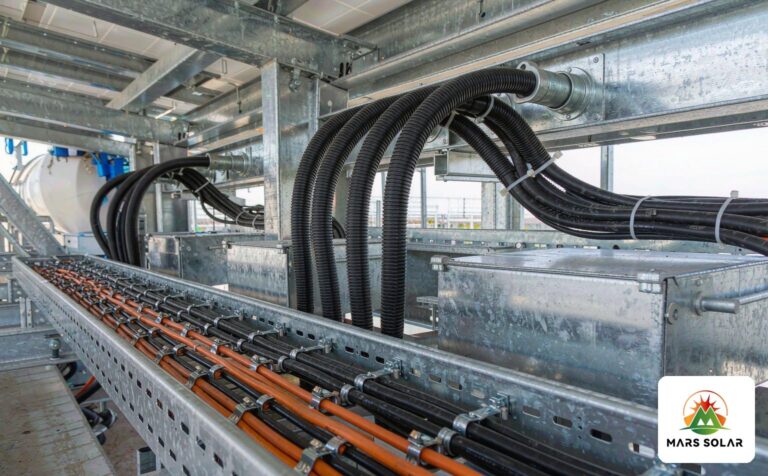
Long parallel rows on a factory roof. Leaving 600 to 900 mm between rows for maintenance access costs about 8% of capacity and prevents the most common avoidable failure on industrial roofs — panels nobody can reach.
The three loads that break a factory PV design
Residential and office sizing logic fails on a factory floor within the first week. Three load categories have to be modelled separately, because each one stresses a different part of the system.
Motors and direct-on-line starting
A 75 kW induction motor started direct-on-line draws five to seven times its rated current for two to ten seconds. If the inverter is sized on steady-state kW, that surge trips it, and the plant learns to dread the moment the main conveyor starts. Two fixes exist: size the inverter for the surge, or fit soft starters or variable frequency drives on the largest motors. The second is almost always cheaper and it also reduces mechanical wear.
Sizing the inverter for surge instead of fitting soft starters is the more expensive of the two routes, and it leaves the plant with an inverter idling at 30% load for most of the day. That idle capacity is paid for once and then depreciates for twenty years. On any solar power for factories in Nigeria design that includes more than two large motors, the soft-starter route usually improves the payback on a solar power for factories in Nigeria system by six to twelve months.
Compressors
Air compressors load and unload in cycles, and a screw compressor can step from 30% to 100% of rating within a second. A bank of three compressors with uncoordinated sequencing produces a demand profile that looks like a sawtooth. Sequencing them with a lead-lag controller smooths the profile and reduces the battery cycling that would otherwise shorten its life.
Welding and induction heating
Welding sets and induction furnaces are the worst power quality offenders on most Nigerian factory floors. They draw non-sinusoidal current, they create harmonics, and they make the load appear larger than it is in kVA terms. Any solar power for factories in Nigeria that includes welding load needs a power quality study, not just a load list. Ignoring this is the fastest route to an inverter that derates itself without explaining why.
The practical fix is to meter the welding and induction circuits separately for a week and hand that data to the inverter supplier. Most manufacturers publish derating curves against total harmonic distortion and against ambient temperature, and both matter here. A design for solar power for factories in Nigeria that assumes a sinusoidal load on a welding floor will under-deliver from the first month, and the gap will be blamed on solar power for factories in Nigeria rather than on the load it was never designed for.

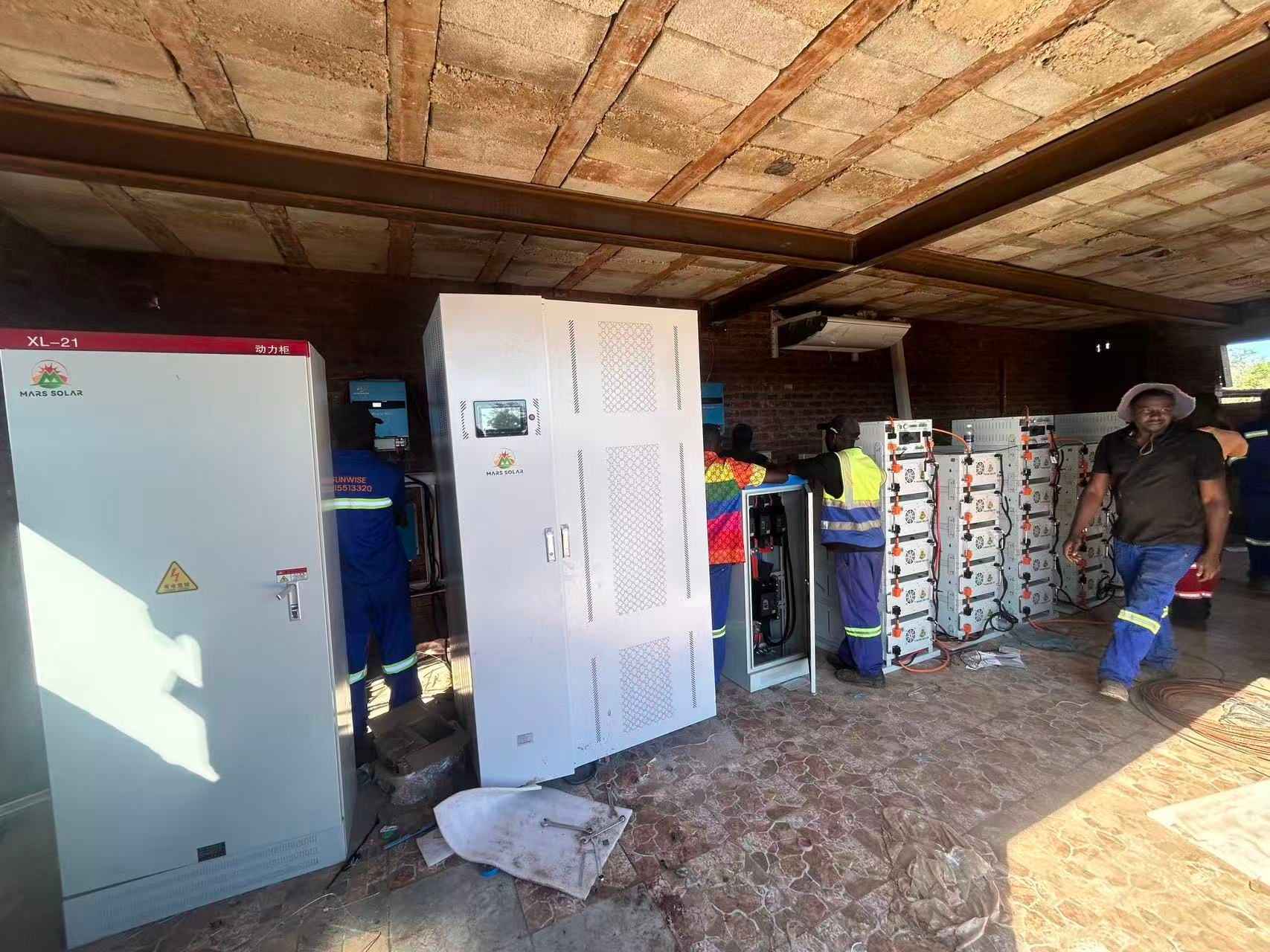
Hybrid inverters and switchgear in a factory electrical room. Leaving 30% spare wall space at commissioning is the cheapest upgrade path a plant will ever buy.
Voltage sag and power quality: the cost you cannot see on the bill
Nigerian industrial feeders deliver voltage that moves. A contactor that drops out at 85% of nominal, a PLC that reboots on a 40-millisecond dip and a variable frequency drive that trips on phase loss all produce the same outcome: a stopped line that costs more than the electricity it was using.
This is where solar power for factories in Nigeria earns money that never appears in a kWh calculation. A hybrid inverter operating as a voltage source holds the local bus steady through a grid dip, so the plant rides through events that would previously have stopped it. On sites where we have measured this, nuisance trips fell from several a week to near zero, and the payback calculation improved by more than the energy saving alone justified.
That ride-through benefit is also the hardest to prove in advance, because it depends on the inverter's control behaviour and on the sensitivity of your own contactors. Ask for a site test rather than a datasheet claim. A supplier who can demonstrate a voltage-source mode on a solar power for factories in Nigeria installation under real load is worth a premium over one who can only quote a specification for solar power for factories in Nigeria equipment.
The engineering requirement is specific: the inverter has to be able to run in a voltage-source mode with the grid present but disturbed, not only in island mode. That is a different capability from simple backup, and it needs to be written into the specification rather than assumed. The architecture question is set out in our comparison of grid-forming versus grid-following inverters, which is the distinction that decides whether a plant rides through or stops.
Where the feeder is weak, the local bus is effectively held by the inverter rather than by the utility, and that changes what the plant can run. On a weak industrial feeder a voltage-source inverter is the difference between a plant that operates through a dip and one that restarts a line. Specify that behaviour explicitly in the tender for solar power for factories in Nigeria instead of assuming the inverter provides it by default, because most grid-tied solar power for factories in Nigeria equipment simply shuts down instead.
On-grid, hybrid or off-grid for a Nigerian factory
Very few Nigerian factories should be fully off-grid, and almost none should be purely grid-tied. The realistic answer is a hybrid that treats the grid as a variable input rather than a baseline.
- Grid-tied with zero export: works only where Band A supply is genuinely continuous. On most industrial feeders this design wastes the asset, because the array is curtailed whenever the grid fails.
- Hybrid with essential-load storage: the standard choice. Solar runs the daytime load, the battery carries short outages and peak clipping, and the grid or generator fills the rest.
- Off-grid: justified only for remote plants beyond a viable connection, or where a dedicated industrial cluster is building its own mini-grid. Battery cost dominates and payback stretches unless diesel is currently running most of the day.
The regulatory framework is straightforward at plant level. Own-use generation does not require a NERC generation licence, but exporting to the grid, selling to a third party, or operating above the embedded-generation threshold does. Interconnection and metering arrangements sit with the DisCo and with NERC, and the detail is set out in our Nigeria solar import guide covering SONCAP and duty. Where a plant is considering a third-party funded model rather than owning the asset, the structure is described in our guide to the independent power producer model.
Whatever the commercial structure, the technical design does not change. Owned, financed or third-party funded, the plant still needs a measured load curve, a power quality study and a protection study. Building those into a tender costs less than 2% of project value and separates solar power for factories in Nigeria that pays back on schedule from the version that needs a second capital round in year three — a pattern common enough that a missing load study is now a reason for us to re-price any solar power for factories in Nigeria proposal.
What solar power for factories in Nigeria costs in 2026
Currency exposure in any solar power for factories in Nigeria budget
Cost is quoted three ways in this market, and the three are not interchangeable: per kWp installed, per kWh of storage, and per kWh delivered under a contract. Comparing a per-kWp quote against a per-kWh power purchase offer is the most common budgeting error we see.
| Line item | 2026 range | Notities |
|---|---|---|
| Complete installed system | ₦850,000 to ₦1,250,000 per kW | Panels, inverters, mounting, cabling, storage, commissioning |
| LFP battery | $95 to $120 per kWh | At 100 kWh scale, delivered FOB China |
| 100 kW hybrid package | ₦85M to ₦125M | Our reference point for scaling to larger plants |
| Landing, clearing, haulage | ₦500,000 to ₦2,000,000 | Port to site, plus rigging on arrival |
| Annual O and M | 1.5% to 2.5% of capex | Higher than European rates because of dust and cleaning frequency |
| Levelised cost | ₦55 to ₦80 per kWh | 20-year life, hybrid configuration |
Currency is the variable nobody controls. Most of the capital cost is denominated in dollars at the factory gate, so a 10% move in the naira moves the naira price of solar power for factories in Nigeria by roughly the same amount within one order cycle. Budgeting in naira without a stated exchange-rate assumption is how projects get approved and then stall at the purchase order.

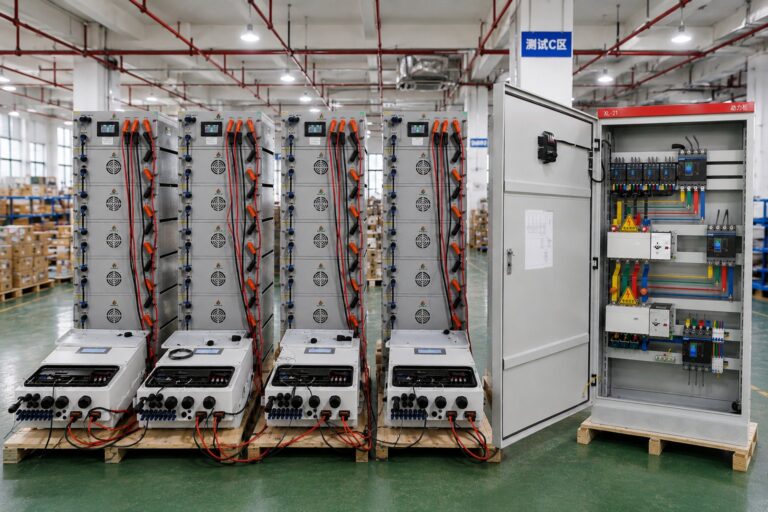
A battery cabinet on an industrial site. Storage is what turns solar power for factories in Nigeria from a daytime saving into protection of the night shift.
Payback maths on a Lagos factory running two shifts
Take a Lagos plant on MD2 with a 400 kW peak, running two shifts 16 hours a day at a load factor of 0.6, so roughly 240 kW average and about 100,000 kWh a month. At ₦209.50 per kWh the energy bill alone is about ₦20.9 million a month, or ₦251 million a year, before diesel.
- Array size. 300 kWp at 1,500 kWh per kWp yields about 450,000 kWh a year, which is 37% of annual consumption and a much larger share of daytime consumption.
- Self-consumption. A 16-hour two-shift load absorbs about 88% of generation on site, so 396,000 kWh of grid electricity is displaced each year.
- Annual saving. 396,000 kWh at ₦209.50 is ₦82.9 million a year from the tariff alone.
- Installed cost. 300 kWp at ₦850,000 to ₦1,250,000 per kW is ₦255 million to ₦375 million, storage included.
- Simple payback. 3.1 to 4.5 years on tariff savings alone, before diesel displacement and before any outage-cost benefit.
The payback shortens sharply when diesel is in the base case. A 250 kVA generator running six hours a day delivers roughly 36,000 kWh a month at ₦420 per kWh, which is ₦15.1 million a month. If solar power for factories in Nigeria displaces half of those running hours, that is another ₦7.6 million a month, and the combined payback drops below three years.
Two sensitivities matter most. If the plant is actually on Band B rather than Band A, the saving per kWh drops by more than half and the payback roughly doubles. If diesel runs eight hours rather than six, the saving rises by about a third. Both should be confirmed before any solar power for factories in Nigeria design is frozen, which is why we ask for a recent DisCo bill and a generator run log alongside any request for solar power for factories in Nigeria pricing.
Diesel displacement is the real cash flow
Most Nigerian factories do not decide on solar because the grid is expensive. They decide because the generator is expensive and the fuel price is not under their control. A plant burning ₦15 million of diesel a month is exposed to every movement in the pump price, and that exposure is what a board actually wants removed.
This is the part of the case that finance teams accept fastest, because the saving lands on a line they already monitor. Fuel is a monthly cash item, it is visible, and it moves without notice. Replacing a third of it with a fixed asset that has a twenty-year life is the trade a Nigerian manufacturer wants to make, and it is why solar power for factories in Nigeria projects get signed even when the tariff case alone looks marginal. If a plant has to choose which case to present, present the fuel case; it is the one that gets a solar power for factories in Nigeria budget approved.
Storage is what makes that possible. Generation alone reduces the daytime diesel hours; generation plus a battery of two to four hours at production load removes the evening and night diesel block as well. On the sites we have commissioned, the pattern is consistent: diesel running hours fall first, the monthly fuel line falls second, and the generator is retained as a rarely used standby rather than a daily workhorse. Where a plant wants to go further, the BESS cost and import structure for Nigeria sets out the battery side in detail, and our 6 MW / 20 MWh project in Nigeria shows what the model looks like at scale.
The same pattern scales. At 6 MW with 20 MWh of storage the saving reached roughly $108,000 a month on a site that had been running generators 16 to 20 hours a day, and the control philosophy is identical to a 300 kWp plant. What changes is the interconnection study, the protection coordination and the need for a dedicated operations contract — the part most first-time buyers of solar power for factories in Nigeria underestimate.
Six mistakes in Nigerian factory tenders
- Sizing on the monthly bill. Interval data, not the invoice, tells you whether the load is under the sun or after dark.
- Leaving the night shift out. A two-shift plant with no storage will show a payback that cannot be delivered, and the shortfall appears in year one.
- Sizing the inverter on steady-state kW. Motor starting, compressors and welders decide the inverter rating, not the average load.
- No power quality study. Welding and induction loads distort the design, and an inverter that derates silently looks like a manufacturing fault.
- Assuming the roof is free. Structural capacity, sheet thickness, wind loading and access all cost money, and retrofitting reinforcement after the array is delivered costs far more.
- Quoting in naira without an FX assumption. Solar power for factories in Nigeria is priced in dollars at the factory, and an unstated exchange rate is a hidden risk in any tender.
Maintenance in Nigerian conditions
Cleaning frequency for solar power for factories in Nigeria
Dust is the dominant loss. Harmattan brings fine particulate that settles on panels and does not wash off with light rain, and industrial estates add cement, flour or soot depending on the neighbours. Cleaning every two to four weeks in the dry season is normal on a Nigerian factory roof, not excessive, and the cost is trivial against the yield recovered.
The second maintenance issue is heat. Ambient temperatures above 35 degrees Celsius reduce panel output and shorten inverter and battery life, which is why plant room ventilation and battery placement matter more here than in Europe. A lithium cabinet installed in a closed metal container on a Lagos roof will lose capacity years earlier than the same cabinet in a ventilated room at ground level. Our commercial solar O&M cost benchmarks give the scope and pricing that a factory contract should cover.
Battery placement is therefore a design decision rather than an installation detail. Shade, cross-ventilation and a roof that reflects rather than absorbs heat are worth more than an extra 10% of storage capacity, and they cost nothing. On the solar power for factories in Nigeria projects we commission, the battery room temperature log is one of the first things we review at the twelve-month service, because it predicts a capacity warranty claim better than any other single measurement on a solar power for factories in Nigeria installation.
Frequently asked questions: solar power for factories in Nigeria
How much does solar power for factories in Nigeria cost?
Installed cost runs from ₦850,000 to ₦1,250,000 per kW including lithium storage, so a 100 kW hybrid lands at ₦85 million to ₦125 million and a 300 kWp system at ₦255 million to ₦375 million. Levelised cost over 20 years is ₦55 to ₦80 per kWh, against ₦209.50 on Band A and ₦350 to ₦450 on diesel. That spread is the basis of every solar power for factories in Nigeria business case we build.
How much can a factory save with solar power in Nigeria?
On a two-shift plant at 400 kW peak, a 300 kWp array displaces about 396,000 kWh a year, worth roughly ₦82.9 million at the Band A tariff. Add diesel displacement and the combined figure typically exceeds ₦150 million a year on a plant of that size. Both figures assume a Band A connection; a plant actually on Band B sees less than half the tariff saving from solar power for factories in Nigeria.
Is solar power for factories in Nigeria cheaper than a generator?
Yes, substantially. Diesel generation costs ₦350 to ₦450 per kWh at ₦1,400 to ₦1,800 a litre, against ₦55 to ₦80 per kWh levelised for a hybrid solar system. The generator still earns its place as standby capacity, but not as a daily source of production energy. That distinction is what makes solar power for factories in Nigeria a cost decision rather than a backup purchase.
Do I need a licence for solar power for factories in Nigeria?
Own-use generation does not require a NERC generation licence. You do need the DisCo interconnection and metering arrangement, and licensing applies once you export to the grid, sell to a third party, or operate above the embedded-generation threshold. For most plants solar power for factories in Nigeria is an own-use project, which keeps the approval process short.
What size system does a factory need?
As a first pass, 0.7 to 1.0 kWp per 1 kVA of peak demand for a single-shift plant, falling to 0.6 to 0.8 for a two-shift plant where storage carries more of the load. A measured load curve replaces the estimate, and on any plant above 300 kVA it should be mandatory. A rule-of-thumb size is a budget figure for solar power for factories in Nigeria, not a design.
Can solar power for factories in Nigeria run a night shift?
Yes, with storage sized at 2 to 4 hours of production load for a two-shift plant, or 4 to 8 hours for continuous operation. Without storage the night shift runs on the grid or the generator, and the solar contribution falls to the daytime share only. Storage is what extends solar power for factories in Nigeria into the night shift at all.
What happens when the grid fails during production?
A hybrid inverter with a battery carries the essential load and then the full production load if storage allows, and it can hold the local bus steady through voltage dips that would otherwise trip contactors and drives. A grid-tied-only system shuts down when the grid fails, which is why it is a poor fit for most Nigerian factories. A hybrid is the only configuration that makes solar power for factories in Nigeria useful during an outage.
How long does installation take?
A 300 kWp system with storage is typically eight to twelve weeks on site, including structural works, DC and AC installation, protection testing and commissioning. Import and clearing usually add four to eight weeks before that, so plan the delivery date against the production calendar rather than against the contract signature date. Most of that lead time is import and clearing, which is the stage of a solar power for factories in Nigeria schedule owners consistently underestimate.
Will solar power for factories in Nigeria damage my equipment?
A correctly designed system improves power quality rather than damaging it, because the inverter holds voltage and frequency steadier than the feeder does. Damage comes from bad design: undersized neutral conductors, poor earthing, missing surge protection or harmonic resonance with a large capacitor bank. A protection study and a power quality study prevent all four. Both are standard scope in any solar power for factories in Nigeria design we issue.
How much maintenance does a factory system need?
Panel cleaning every two to four weeks in the dry season, quarterly inspection of connections and inverters, annual thermographic scanning and string testing, and battery state-of-health reporting twice a year. Budget 1.5% to 2.5% of capital cost annually, which is higher than European benchmarks because of Harmattan dust. That range assumes a competent local team; solar power for factories in Nigeria installed with no local service partner usually costs more in lost yield than in service fees.
Data sources and freshness
Tariff figures are taken from the NERC multi-year tariff order and the service-based tariff bands published at nerc.gov.ng, with the Band A cap of ₦209.50 per kWh unchanged since July 2024 as of October 2026. Manufacturer-reported cost pressure, the ₦68 to ₦225 per kWh tariff movement and cluster-level monthly bills come from the Manufacturers Association of Nigeria at manufacturersnigeria.org.
The three per cent of annual sales outage estimate is from the African Development Bank's 2026 outlook, cited through the World Bank energy practice at worldbank.org. Diesel cost per kWh assumes 3.5 kWh per litre and a pump price of ₦1,400 to ₦1,800 per litre. Solar yield assumptions of 1,500 to 1,700 kWh per kWp per year reflect Nigerian irradiation data published at energydata.info. Environmental compliance for battery and inverter installation is governed by NESREA, and equipment safety references are IEC 62109-1, IEC 62109-2, IEC 61215 and IEC 61730.
Reviewed 28 October 2026. Band A tariffs and diesel prices are both under active review; confirm the current figures before finalising any solar power for factories in Nigeria business case.
Send us your load curve and we will size it
Share twelve months of DisCo bills with the MD readings, your shift pattern and a roof photo. We will come back with the PV block, the storage window, the naira payback range and the interconnection steps for solar power for factories in Nigeria at your plant.
Chatten via WhatsAppRelated reading: zonne-energiesysteem voor een fabriek · 2 MW electroplating factory · 2 MW factory case study · 1 MW fruit factory case · 6 MW 20 MWh Nigeria · BESS price guide Nigeria · solar cost in Nigeria · diesel vs solar in Nigeria · off-grid versus hybride versus on-grid · solar system Nigeria · solar company in Abuja · 200 kW rice mill in Abuja · solar for factories in the Philippines · hybrid inverter sizing · grid-forming vs grid-following · commercial solar O&M cost · 1 MW solar system · 100 kW 215 kWh BESS · Africa solar market comparison · Nigeria solar import guide · neem contact met ons op


 English
 Arabic
 Spanish
 French
 Dutch
 Portuguese