
Taal
Ask any factory manager in Lagos, any hotel owner in Abuja, any farmer in Kaduna, and you'll get the same answer: power is the biggest single headache in their P&L.
This guide compares off-grid vs hybrid vs on-grid solar Nigeria options so you can choose the right system for your business.
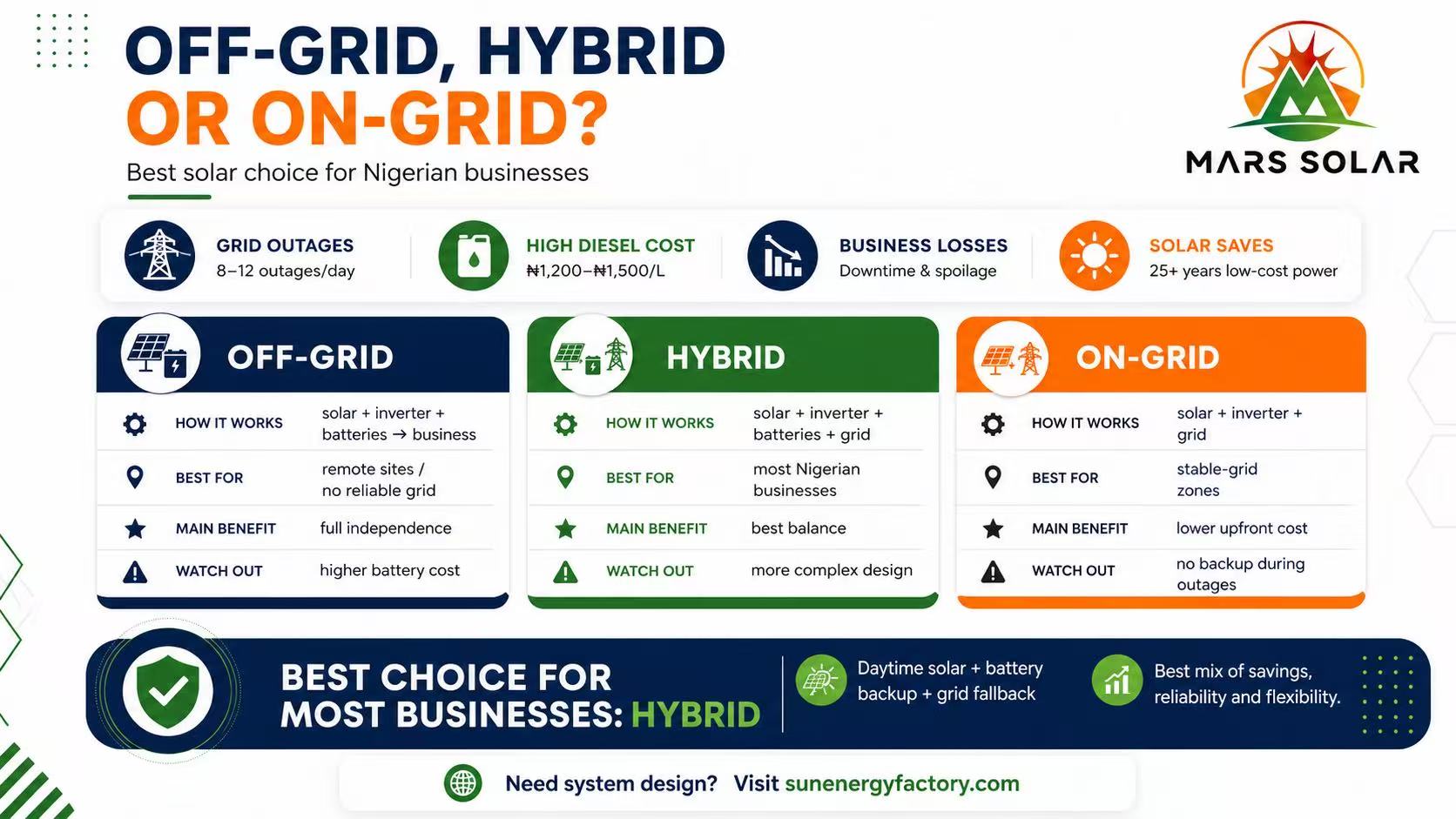
Here is the reality in 2026:
Solar changes the equation: once installed, it produces electricity at near-zero marginal cost for 25+ years.
But here's the question we get asked every single day by Nigerian buyers: "Which system should I buy — off-grid, hybrid, or on-grid?" This guide answers it with a decision framework built for Nigerian grid conditions, Nigerian fuel costs, and Nigerian business realities.
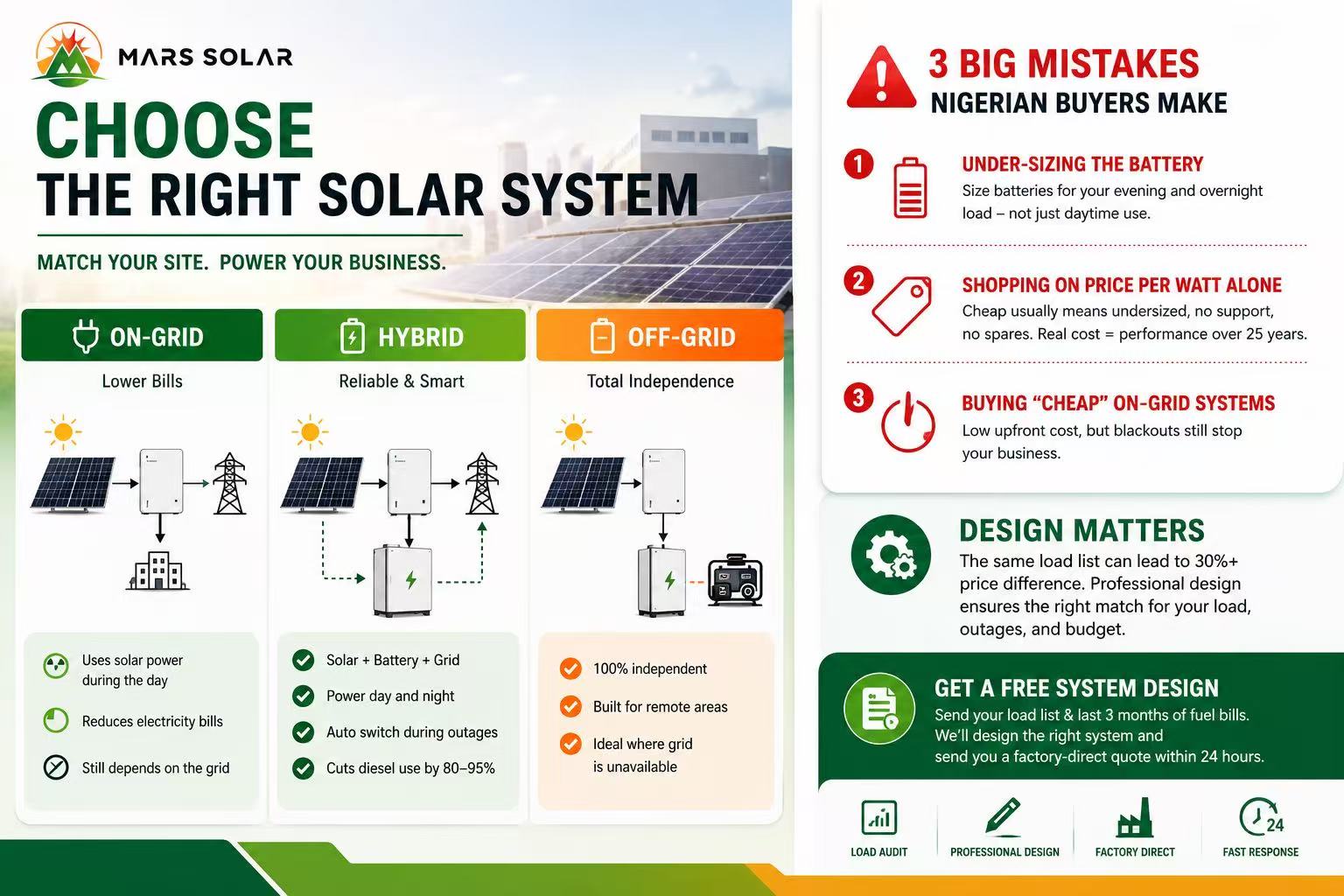
The short answer up front: for the majority of Nigerian commercial businesses, a hybride systeem is the right choice — solar during the day, grid as a fallback, batteries overnight. On-grid only makes sense where your grid is genuinely stable. Off-grid is for sites with no reliable grid at all. If you are new to system design, start with our step-by-step guide on how to configure a solar energy system quickly, then come back to this comparison.
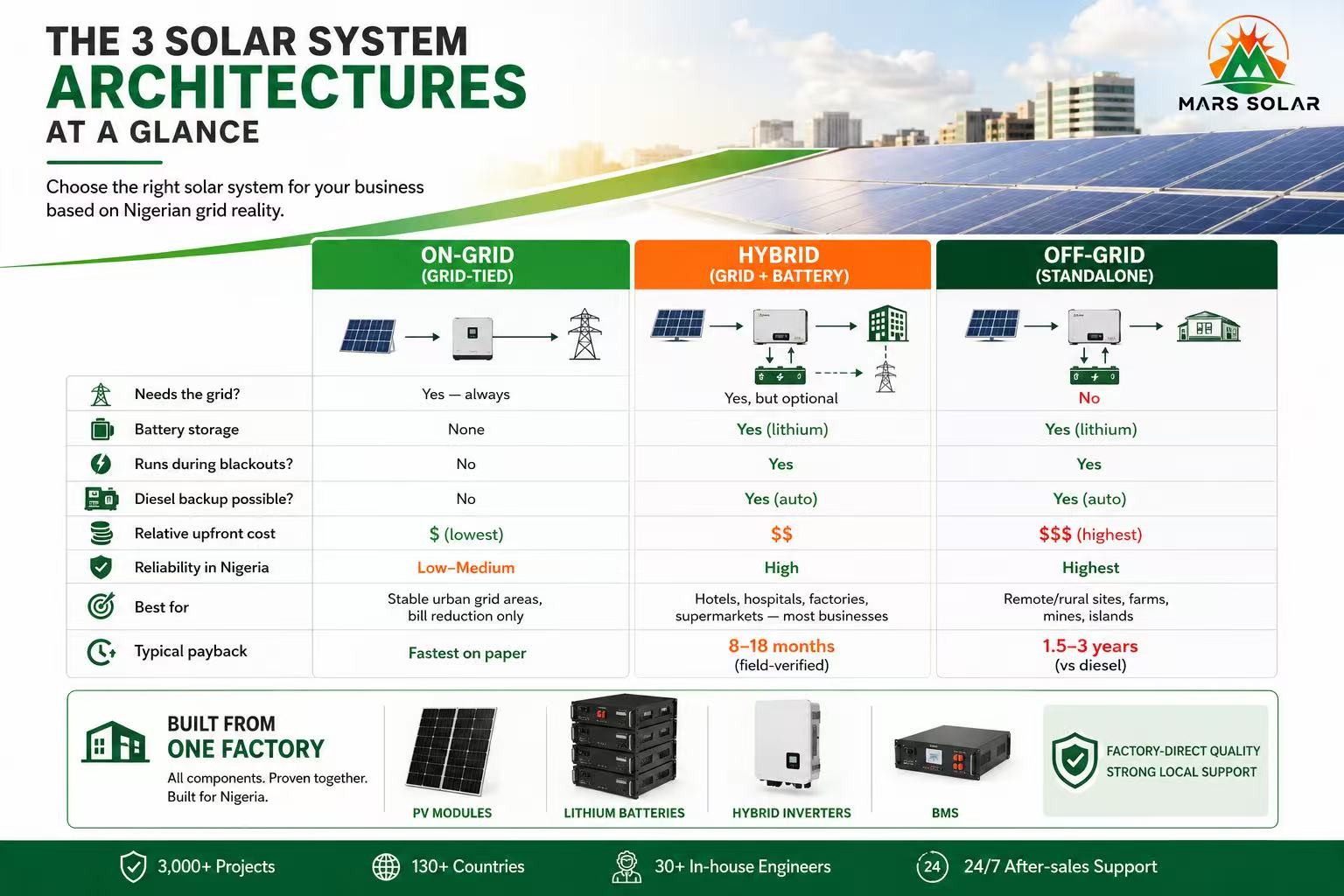
| Feature | On-Grid (Grid-Tied) | Hybrid (Grid + Battery) | Off-Grid (Standalone) |
|---|---|---|---|
| Needs the grid? | Yes — always | Yes, but optional | No |
| Battery storage | Geen | Yes (lithium) | Yes (lithium) |
| Runs during blackouts? | No | Yes | Yes |
| Diesel backup possible? | No | Yes (auto) | Yes (auto) |
| Relative upfront cost | $ (lowest) | $$ | $$$ (highest) |
| Reliability in Nigeria | Low–Medium | High | Hoogste |
| Het meest geschikt voor | Stable urban grid areas, bill reduction only | Hotels, hospitals, factories, supermarkets — most businesses | Remote/rural sites, farms, mines, islands |
| Typical payback | Fastest on paper | 8–18 months (field-verified) | 1.5–3 years (vs diesel) |
All three architectures can be built from our factory-direct solar power system components — PV modules, lithium batteries, hybrid inverters and BMS from one factory.
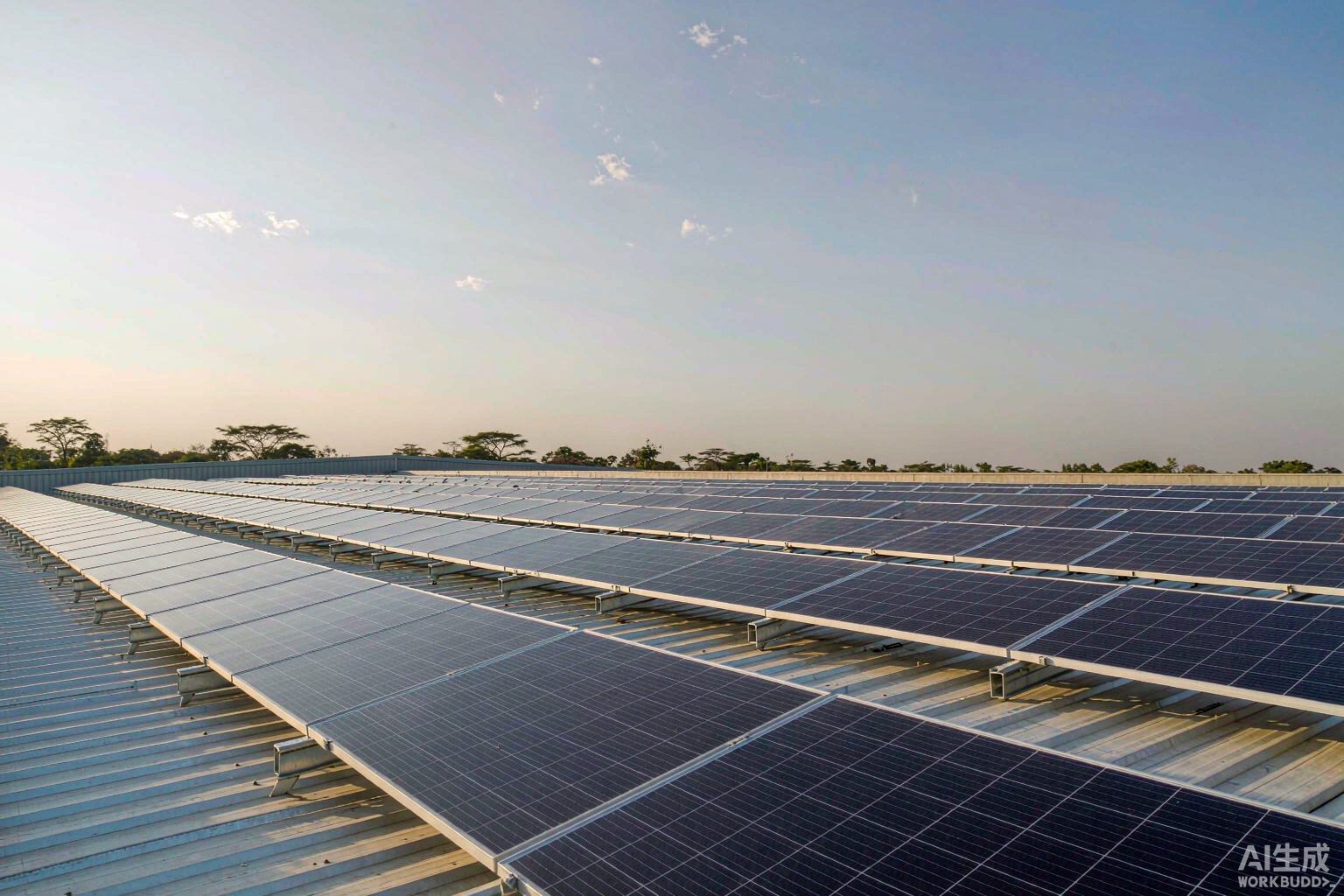
An on-grid system is the simplest architecture: solar panels feed power during daylight hours, and you draw from the grid when the sun isn't shining. No batteries. That's why it's the cheapest per watt.
Where it works in Nigeria: if your site is in an area with genuinely stable grid supply — few interruptions, short outages — grid-tied solar is an excellent way to cut your daytime electricity bill. Every kWh of solar displaces expensive grid power.
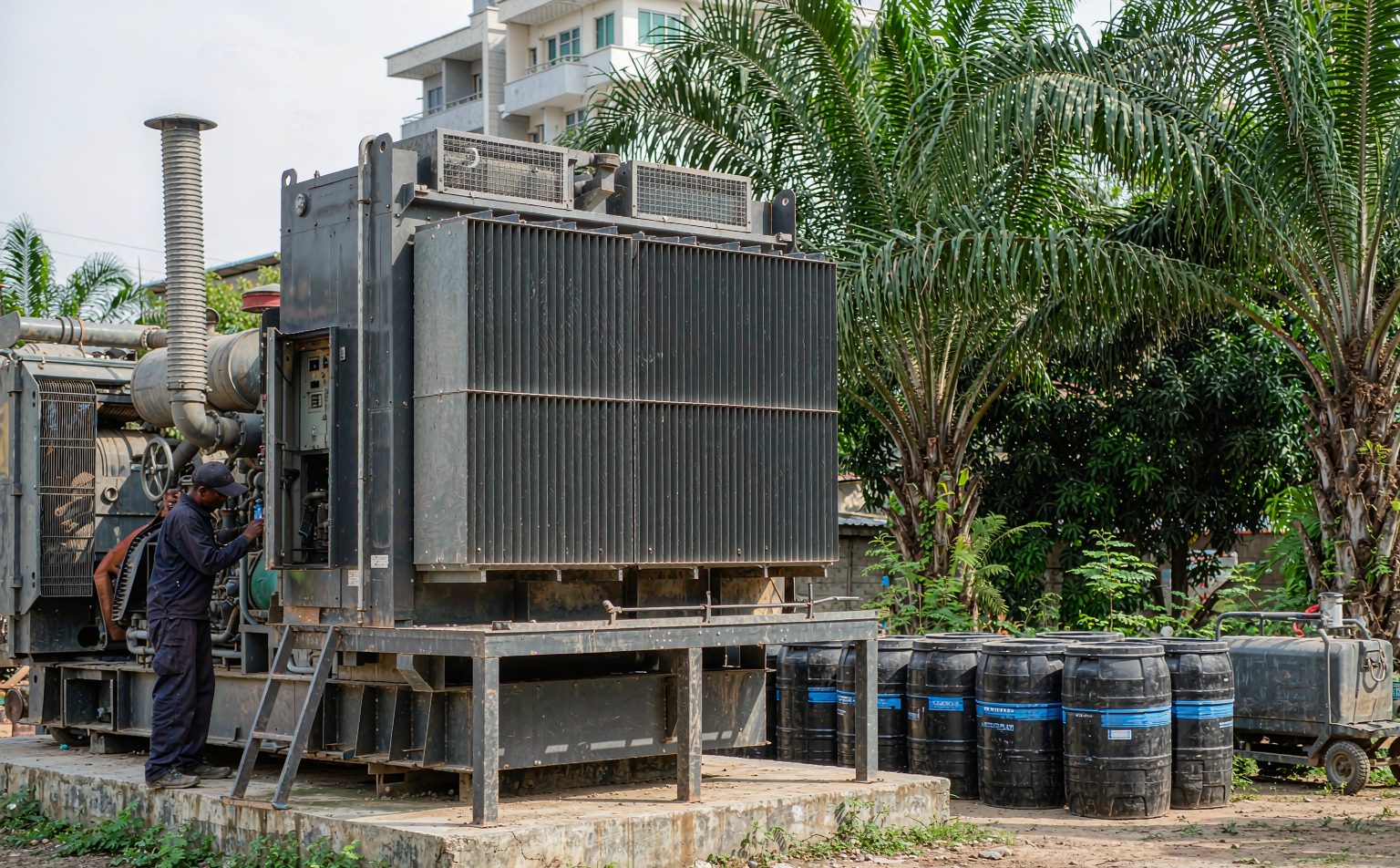
Where it fails in Nigeria: the moment the grid drops — which, for most commercial sites, happens 8–12 times a day — a pure grid-tied system shuts down too. You save money during the day, but your blackout problem is completely unchanged.
Kortom: on-grid is a bill-reduction tool, not a power-reliability solution. Only consider it if outages are genuinely rare at your site — and be honest about that before you buy.
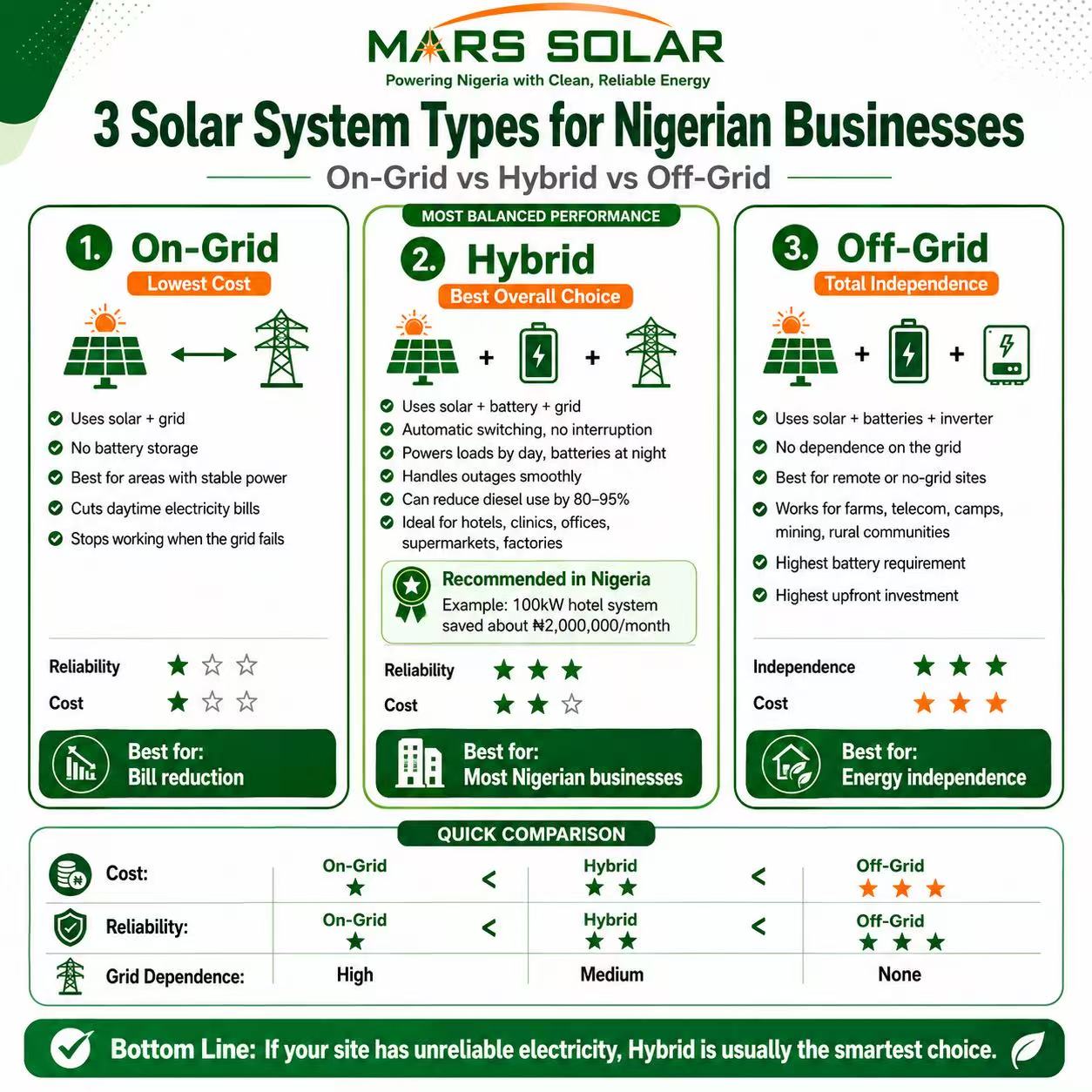
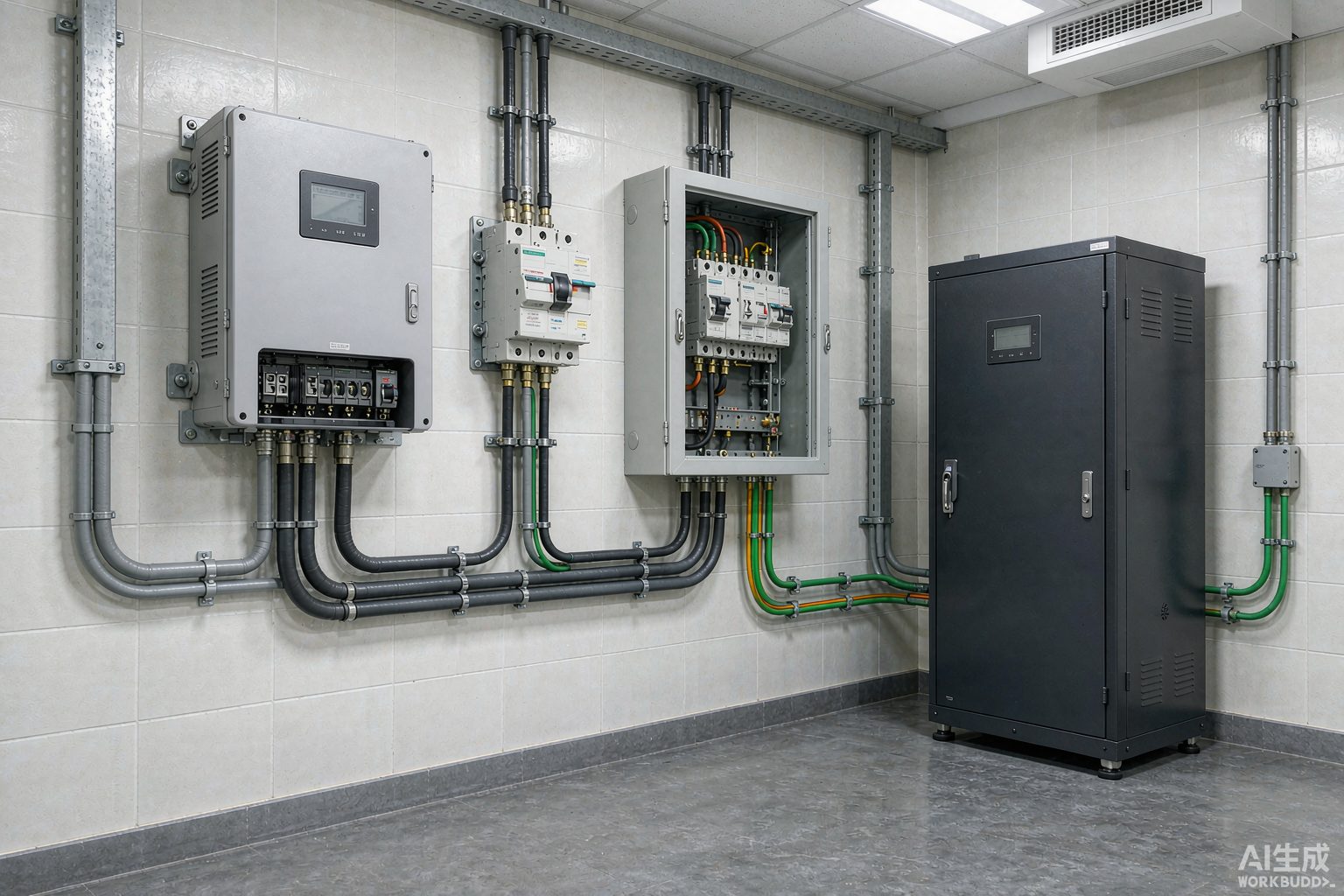
A hybrid system combines solar panels, a hybrid inverter, and lithium battery storage, and keeps a connection to the grid as an optional fallback. The inverter automatically switches between solar, battery, and grid — no manual intervention, no service interruption.
Why hybrid is the sweet spot in Nigeria:
Field proof from our own projects: a 30-room Nigerian hotel running a Hybride zonne-energiesysteem van 100 kW has recorded zero outages and zero equipment failures over 12+ months of continuous operation, saving ₦2,000,000 (~$1,460) per month versus its previous diesel-and-grid setup. Payback: 8–12 months. The same pattern is documented in our 250kW hotel installation in Ghana, which cut electricity costs by 60%.
Who should choose hybrid:
If you're not sure, start with hybrid — it's the most forgiving architecture, and it can be expanded later.
Once the architecture is settled, hybrid inverter sizing is the next decision: the inverter rating decides how much PV and battery the building can actually use, and oversizing it is the most expensive mistake in a Nigerian quotation.
An off-grid system is a complete standalone power plant: solar + batteries + inverter, with zero dependence on the grid. In remote areas, it's often paired with a backup generator for extended cloudy periods.
Where it's the right call:
What it costs: off-grid requires a larger battery bank than hybrid, because the battery is your only source of power at night — not a supplement. That makes it the most expensive configuration per kWh. But when there is no grid to fall back on, it's not a luxury; it's the only option that works.
Field proof: we commissioned a 100kW + 215kWh solar-storage microgrid in Sudan in 7 days — fully off-grid, powering a community with no grid connection at all. The same engineering runs our 200kW solar + storage project for a rice mill in Abuja. For reference pricing and specifications, see our 100kVA/100kW off-grid solar power plant page.
Who should choose off-grid:
Stop comparing spec sheets. Answer these five questions honestly, and the right architecture picks itself.
Q1 — How many outages does your site experience per day?
0–2 short outages: on-grid is viable; hybrid still recommended. 3+ outages: hybrid. Grid essentially non-existent (hours or days of outage): off-grid.
Q2 — What's the longest single outage you've had in the past year?
Under 1 hour: on-grid or hybrid. Several hours: hybrid (size the battery to cover it). More than a day: hybrid with diesel backup, or full off-grid.
Q3 — How much does one hour of downtime cost your business?
This is the question most buyers skip — and it's the most important one. If an outage means lost production, spoiled inventory, or idle staff, you're not buying solar, you're buying insurance against downtime. Hotels, cold chains, and hospitals should never accept an architecture that dies with the grid.
Q4 — What are you spending on diesel today?
Pull your last 3 months of fuel receipts. That number is your monthly savings potential — and the honest basis for your payback calculation.
Q5 — What's your growth plan?
Battery banks and inverters can be expanded, but not every architecture expands cleanly. If you plan to add load in 2–3 years, say so during design — a properly sized hybrid system grows gracefully; a squeezed on-grid system doesn't.
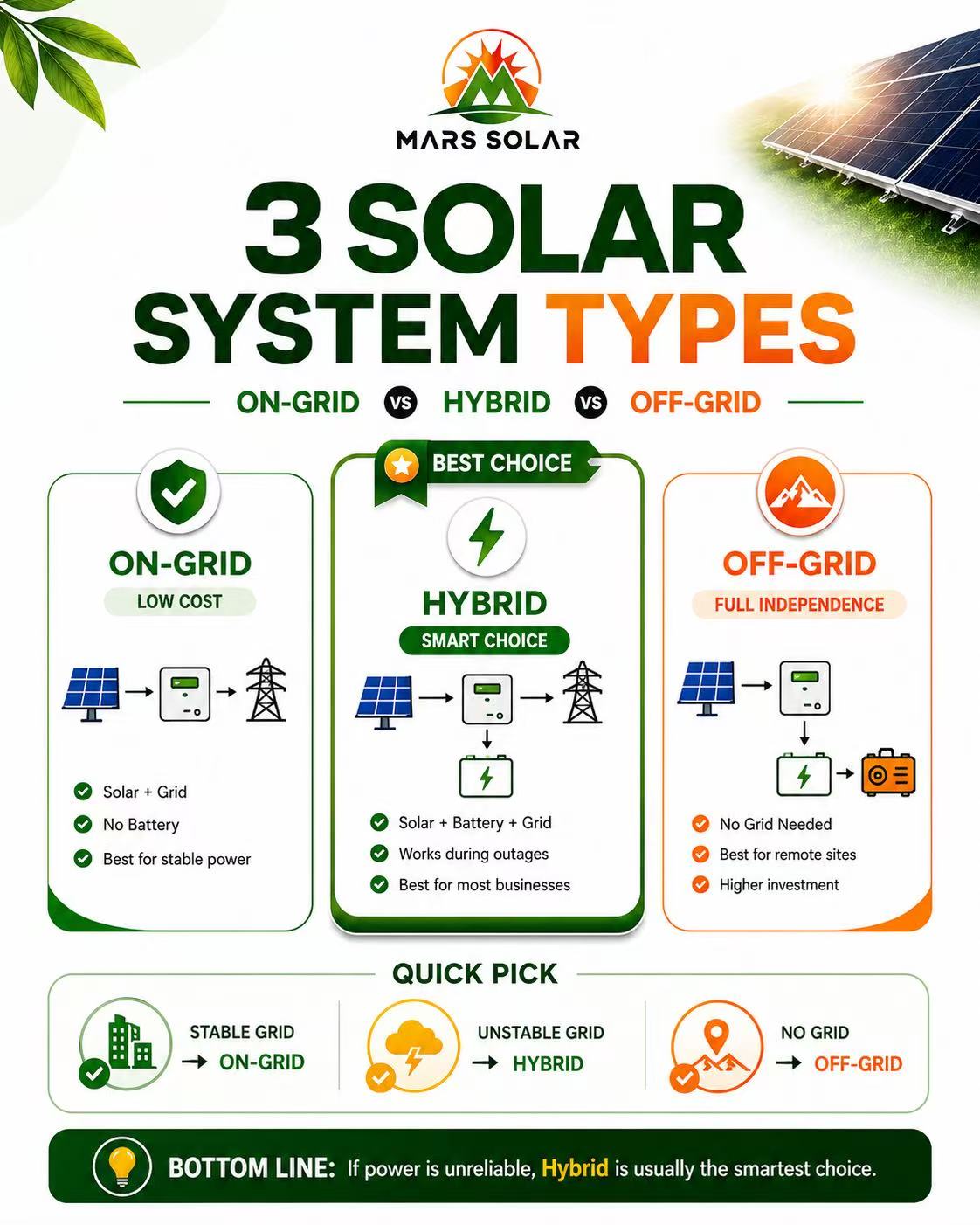
Quick decision map:
| Your situation | Recommended architecture |
|---|---|
| Stable grid, want lower bills, outages rare | On-Grid |
| Unstable grid, cannot afford downtime, have diesel costs | Hybrid (most Nigerian businesses) |
| No grid, remote site, want full independence | Off-Grid |
| Remote site + critical loads + diesel backup for emergencies | Off-Grid + auto generator |
Working through these questions on your own? Our beknopte handleiding voor systeemconfiguratie walks you through the sizing process, and our energy storage systems page explains how to match battery capacity to your night load.
Here's the honest truth: the same load list can produce proposals that differ by 30% or more in price — not because one supplier is "cheaper," but because the systems are engineered differently. The question isn't "who has the lowest price per watt." It's "which design actually matches my load profile, my outage pattern, and my budget — with engineering and after-sales support behind it?"
That's why every Mars Solar project starts with a proper load audit — not a quote off a price list. Our engineers size the system to your site: your loads, your grid history, your diesel spend, your growth plan.
Get a free system design for your site. Send us your load list (appliances, quantities, run-hours) and your last 3 months of generator fuel bills — we'll design the right architecture and send you a factory-direct quotation within 24 hours. No obligation, no pressure. Vraag je gratis ontwerp aan →
Proof beats promises. Here's what we've actually built nearby:
Q: How much cheaper is a hybrid system than an off-grid system?
A: Roughly 20–40% cheaper for the same load, because the battery bank can be smaller — the grid covers the night when it's available. But if your grid is absent or unreliable at night, the "savings" disappear. Let the outage data from Q1–Q2 decide, not the price list.
Q: Can I install hybrid at a site with no grid at all?
A: Yes. A hybrid inverter can run in off-grid mode. In fact, many of our "hybrid" systems in remote areas operate as de-facto off-grid systems — with the option to connect to the grid later if it arrives.
Q: How long do lithium batteries last?
A: Typically 10+ years or 6,000+ cycles — whichever comes first at your usage depth. Battery management systems (BMS) protect against overcharge, over-discharge, and temperature issues. See our energy storage systems for the full battery lineup.
Q: Can I start with on-grid and upgrade to hybrid later?
A: Sometimes — but only if the inverter and wiring were designed for it from day one. That's a conversation to have before you buy, not after. This is exactly the kind of detail a proper design review catches.
Q: Does Mars Solar support installations in Nigeria?
A: Yes. We're a factory-direct manufacturer (Foshan, China, since 2008) with 3,000+ installations across 130+ countries, and our team has deployed and commissioned projects across Nigeria — including on-site engineering and commissioning support, as documented in our Nigerian hotel case study.
Q: What about shipping and customs for imported systems?
A: We handle FOB/CIF shipping and provide full export documentation. Our handleiding voor het laden van vrachtcontainers explains exactly how systems are packed and shipped.
Start with outage frequency and worst-case duration, not with price. Sites seeing zero to two short outages a day can live on-grid; sites seeing eight to twelve outages a day need hybrid; sites with no usable grid at all need off-grid. In Nigerian conditions most commercial sites land on hybrid, which is why the off-grid vs hybrid vs on-grid solar Nigeria question resolves the same way for hotels, factories and clinics.
On the same load, hybrid sits roughly 20–40% below off-grid because the battery bank can be smaller — the grid carries the night when it is available. On-grid is cheapest and least useful in Nigeria, since it shuts down with the grid. That spread is the whole economics of the off-grid vs hybrid vs on-grid solar Nigeria comparison, and it widens as the battery share of the project grows.
On measured performance, yes within its design envelope. A 100 kW hybrid system on a 30-room Nigerian hotel recorded zero outages and zero equipment failures across more than twelve months of continuous operation, cutting diesel use dramatically and saving about ₦2,000,000 a month. Off-grid delivers total independence, but on the off-grid vs hybrid vs on-grid solar Nigeria question the hybrid answer is usually the better-value one for a site that still has some grid.
When the grid is effectively absent — hours or days of outage, or no connection at all. Island resorts, remote plantations, mine sites and clinics outside the distribution network are the clear cases. A 100 kW plus 215 kWh microgrid running fully off-grid was commissioned in seven days at a Sudanese wastewater plant, and the same architecture covers the Nigerian sites where off-grid vs hybrid vs on-grid solar Nigeria has only one workable answer.
Only as a cost-reduction measure on a site whose outages are short and rare, and even then hybrid adds little cost for a large reliability gain. A pure grid-tied array shuts down the moment the grid drops, which on Nigerian commercial sites is eight to twelve times a day. Seen that way, the off-grid vs hybrid vs on-grid solar Nigeria choice is rarely a fair fight — on-grid is the architecture Nigeria penalises hardest.
Size to the hours you cannot afford to lose. On-grid needs none, hybrid typically needs four to eight hours of critical load, and off-grid needs the full overnight block plus a margin. Under-sizing the battery is the single most common error we see, and it is what makes the off-grid vs hybrid vs on-grid solar Nigeria decision look cheaper on paper than it performs in service.
That question decides most of the off-grid vs hybrid vs on-grid solar Nigeria analysis. If an outage means lost production, spoiled inventory or idle staff, you are buying insurance rather than generation, and the architecture should be chosen on the value of unserved energy rather than on the cost per watt. Buyers who skip this step usually buy the cheapest configuration and pay for it again.
As an optional reserve, not a daily source. A hybrid system can auto-start a generator only when the battery runs low, which cuts diesel consumption by 80–95% instead of eliminating it. Keeping that option is what makes hybrid the pragmatic middle of the off-grid vs hybrid vs on-grid solar Nigeria range: the generator becomes a rarely used insurance policy rather than the default response to an outage.
Hybrid, if it was designed for growth. Battery banks and inverters can both be extended, but a squeezed on-grid system cannot accept storage cleanly and an off-grid system has to grow its battery in step with every load addition. Say what you plan to add in two or three years during design, because the off-grid vs hybrid vs on-grid solar Nigeria answer should account for that expansion path.
Twelve months of bills if the grid is present, plus at least seven to fourteen days of logged consumption if you run a generator. Base load, evening peak and motor-start surge all need to be separated. Without that data the off-grid vs hybrid vs on-grid solar Nigeria recommendation is a guess dressed as engineering, which is why many quotations differ by 30% or more for the same load list.
A commercial hybrid installation typically runs six to ten weeks from contract, staged zone by zone so occupied floors are never without power. An off-grid microgrid can be faster on site because more of it is pre-assembled and factory-tested. On the off-grid vs hybrid vs on-grid solar Nigeria question, the schedule difference is usually a matter of factory work rather than site work.
The same set regardless of architecture: modules to IEC 61215 and IEC 61730, inverters to solar inverter standards IEC 62109, and lithium cells to IEC 62619 with a UN 38.3 transport report. SONCAP documentation then applies for clearance into Nigeria. On the off-grid vs hybrid vs on-grid solar Nigeria choice this is the one constant — uncertified components are uninsurable whichever architecture you pick.
Farms behave differently because irrigation is a motor load on a schedule. A hybrid system sized for a farm must cover the pump surge at start-up while climate or cold-storage loads are already running, and the battery energy storage system has to absorb that overlap. For irrigation-heavy sites the off-grid vs hybrid vs on-grid solar Nigeria answer often tips to off-grid, because the pump runs in daylight anyway.
Send two numbers. Your load list with run-hours, and your last three months of generator fuel receipts. From those we can model all three configurations on your own consumption and return a factory-direct quotation. That is the only honest way to settle the off-grid vs hybrid vs on-grid solar Nigeria question, because the answer depends on your site and not on a generic comparison.
Mostly. Off-grid vs hybrid vs on-grid solar Nigeria turns on how often and how long you lose supply: under two short outages a day suits on-grid, three or more suits hybrid, and days without supply suits off-grid. So the off-grid vs hybrid vs on-grid solar Nigeria choice is a reliability decision before it is a price decision.
By 20–40% on the same load. Hybrid shrinks the battery because the grid covers some hours, and in the off-grid vs hybrid vs on-grid solar Nigeria comparison storage is the largest single cost block. That is exactly why most Nigerian commercial sites end on hybrid in the off-grid vs hybrid vs on-grid solar Nigeria evaluation.
It fails at the moment you need it. A grid-tied array without storage shuts down with the grid, so on a site losing supply eight to twelve times a day the off-grid vs hybrid vs on-grid solar Nigeria comparison penalises on-grid hardest. On-grid earns its place on daytime bill reduction, and only there.
None on-grid, four to eight hours of critical load for hybrid, and the full night block for off-grid. Under-sized storage is the commonest failure we see, and it is the reason the off-grid vs hybrid vs on-grid solar Nigeria decision must be made on a logged load profile rather than on a nameplate list.
As reserve rather than routine. Auto-starting a generator only when the battery drops cuts diesel by 80–95%, which is what makes hybrid the pragmatic centre of the off-grid vs hybrid vs on-grid solar Nigeria range. The dieselgenerator stays on site and rarely runs, instead of running every evening.
Hybrid, when it was designed with spare MPPT capacity and rack-mounted storage. Off-grid has to grow its battery with every added load; on-grid cannot accept storage cleanly at all. Planning two or three years ahead is what keeps the off-grid vs hybrid vs on-grid solar Nigeria answer valid as your business grows.
Six to ten weeks from contract for hybrid and off-grid commercial builds, staged so occupied areas never lose supply; on-grid is faster but simpler. On the off-grid vs hybrid vs on-grid solar Nigeria schedule question the difference is factory pre-assembly more than site labour, which is why an off-grid microgrid can be energised in days once the equipment lands.
The same set in every case. Modules to IEC 61215 and IEC 61730, inverters to IEC 62109, lithium cells to IEC 62619 with UN 38.3, plus SONCAP for Nigeria. Certification is the one constant in the off-grid vs hybrid vs on-grid solar Nigeria decision — an uncertified build is uninsurable whichever architecture you choose.
Blijf uw expertise op het gebied van zonne-energiebronnen verder ontwikkelen:
If hybrid is your choice, two sizes cover most first orders: a 20KW 20KVA hybrid system for a large household or small shop, and a 30kW off-grid system that carries essential loads through a full outage day.
Mars Solar is a solar power system manufacturer and OEM in Foshan, China, operating since 2008 — 3,000+ installations across 130+ countries, with daily production of 2MW of solar panels, 500kW of inverters and 5,500kWh of lithium batteries. We deliver factory-direct pricing with OEM/ODM customization for distributors and EPCs.
Get your free system design and quotation: Neem contact op met onze fabriek with your target market, load list and grid situation. We respond within 24 hours with system design, FOB/CIF pricing and certificate copies.

 English English
  Arabic
 Spanish
 French
 Dutch
Dutch
 Portuguese