
Solar System for Hotels in Kenya: 2026 Guide to Cut Bills
A solar system for hotels in Kenya is sized by the evening peak, not by the annual bill. A Kenyan hotel on the CI1 commercial tariff pays somewhere between KSh 18 and KSh 32 per kWh all-in once the fuel cost charge, inflation factor charge, levies and 16% VAT are added to the base energy rate. A well-sized solar system for hotels in Kenya delivers electricity at a levelised KSh 8 to 14 per kWh over 25 years. The gap of KSh 6 to 18 on every self-consumed unit is the entire business case, and it is a bigger gap than most Kenyan hotel owners expect before they see the numbers side by side.
That gap explains why hotels have moved faster than most commercial segments in Kenya. Grid supply in Nairobi and Mombasa is reliable enough that a hotel does not need to island itself, but expensive enough that a rooftop array repays its capital in four to six years. This guide covers the sizing logic, the 2026 cost structure, and the mistakes that show up most often in Kenyan hotel tenders.
Two numbers decide almost everything about a solar system for hotels in Kenya, and neither of them appears on a KPLC invoice. The first is the share of your load that falls between 08:00 and 17:00. The second is the highest 90-minute average after sunset. Get both right and the array and battery sizes follow almost mechanically; get them wrong and no amount of extra capacity will repair the payback on a solar system for hotels in Kenya.
Quick answer: solar system for hotels in Kenya
A solar system for hotels in Kenya usually runs from 20 kWp for a 25-room property up to 250 kWp plus 500 kWh of storage for a coastal resort, costing roughly KSh 1.8 million to KSh 48 million installed. Kenya yields about 1,450 to 1,600 kWh per kWp per year, so every kWp displaces KSh 35,000 to KSh 55,000 of grid electricity annually on a CI1 tariff. Most Kenyan hotels should be on a grid-tied design with a modest battery for the evening peak, not a full hybrid.
- Tariff you are avoiding: KSh 13.44/kWh base plus KSh 4 to 7 fuel cost charge, KSh 1 to 2 inflation factor, about KSh 0.55 in levies, then 16% VAT and a demand charge.
- Tariff you are buying: KSh 8 to 14/kWh levelised over 25 years, before any financing cost.
- Licensing: no EPRA generation licence is required for own-use systems below 1 MW, but KPLC interconnection approval is required before the system is energised.
- Payback we see: four to six years for a cash purchase in Nairobi, three to five under an EPRA-approved power purchase agreement at larger scale.
- What kills projects: sizing to the monthly kWh total instead of the daytime load curve, then discovering the battery cannot carry the 19:00 check-in peak.
Why a solar system for hotels in Kenya pays back faster than most owners expect
The Kenyan commercial tariff is not one number. It is a base energy charge plus three pass-through items plus VAT, and the pass-through items are revised monthly and quarterly. That is why two hotels on the same street can quote different effective rates and both be right. The table below shows the build-up we work from when modelling any solar system for hotels in Kenya.
| Bill component | Typical 2026 value | Why it matters to a hotel |
|---|---|---|
| Base energy charge (CI1) | 13,44 KSh/kWh | Gazetted for the year to June 2026; the only stable part of the bill |
| Fuel cost charge (FCC) | KSh 4 to 7/kWh | Moves monthly with thermal generation and fuel prices |
| Inflation factor charge (IFC) | KSh 1 to 2/kWh | Adjusted quarterly; small but permanent |
| REP, ERC and WRMA levies | About KSh 0.55/kWh | Fixed statutory additions |
| VAT | 16% on the above | Applied after pass-through charges, so it scales with them |
| Demand charge | Per kVA of billing demand | Reduced only by clipping the peak, which is a battery job rather than a panel job |
| All-in effective rate | KSh 18 to 32/kWh | Most Nairobi hotels on CI1 sit at KSh 24 to 32 |

A mid-rise Nairobi hotel with a rooftop solar system for hotels in Kenya. The array sits on the same roof as the plant room, which shortens DC runs and reduces balance-of-system cost.
What a Kenyan hotel actually consumes, and when
Sizing a solar system for hotels in Kenya by annual kWh is the single most common error. The grid sells you energy, but a solar array sells you energy at a specific time of day. What matters is how much of your load falls inside the solar window, roughly 07:30 to 17:30 in Kenya with only small seasonal variation because the country sits on the equator.
For a solar system for hotels in Kenya this has a useful consequence. Unlike a European or North American site, output does not collapse in winter: monthly yield varies by roughly 15% between the best and worst month, so a solar system for hotels in Kenya designed around the annual average performs close to expectation in every month of the year.
Across the hotel audits we run, the load split is remarkably consistent. Guest room air conditioning dominates, laundry and kitchen create sharp morning and midday blocks, and the evening check-in peak lands exactly when the array is producing nothing. That last point is why the battery decision is usually made on a 90-minute window, not on the daily total.
| Load group | Share of hotel kWh | When it runs | Solar-addressable |
|---|---|---|---|
| Guest room air conditioning | 35% to 45% | Afternoon and night | Partly, with storage |
| Water heating | 15% to 25% | Morning and early evening | Better served by solar thermal |
| Kitchen | 10% to 15% | Three meal peaks | Yes, midday strongly |
| Laundry | 5% to 10% | Morning block | Yes, nearly fully |
| Public areas, lighting, lifts | 10% to 15% | All day, peaking at night | Partly |
| Pumps, pool, borehole | 3% to 6% | Daytime if scheduled | Fully, if you schedule them |
Two cheap operational moves follow directly from this table. Move laundry start-up and pool pump runs into the 10:00 to 15:00 window, and the same solar system for hotels in Kenya will cover a noticeably larger share of the bill with no extra capital. We have seen a 6% to 9% improvement in self-consumption from scheduling alone on Kenyan hotel sites, which is the highest return per shilling of anything in this article.

Guest room cooling is the largest single load on the property. Splitting room air conditioners across two service boards lets a daytime array cover far more of it directly.
Sizing a solar system for hotels in Kenya by room count
Room count is a crude but useful first pass, because Kenyan hotel consumption per room is reasonably predictable once you know whether the property has a full kitchen and a laundry. The table below is the starting block we use before a load study replaces it with measured numbers.
Room count alone will not give you the array size, because two 60-room hotels can differ by 40% in consumption depending on whether the kitchen is in-house and whether towels are laundered on site. What room count does predict reliably is the night air conditioning load, and that is the figure which sets the battery for a solar system for hotels in Kenya. Measure the guest room board for one week before committing to a solar system for hotels in Kenya budget, then size the solar system for hotels in Kenya from measured kWh rather than from a per-room rule of thumb.
| Rooms | Typical annual kWh | PV size | Battery | Installed cost (KSh) |
|---|---|---|---|---|
| 20 to 30 | 110,000 to 190,000 | 20 to 25 kWp | 40 to 60 kWh | 1.8M to 3.2M |
| 40 to 70 | 280,000 to 460,000 | 45 to 60 kWp | 80 to 130 kWh | 4.5M to 7.5M |
| 80 to 130 | 520,000 to 800,000 | 80 to 110 kWp | 160 to 260 kWh | 9.0M to 15M |
| 200+ or resort | 1,300,000 and above | 200 to 300 kWp | 400 to 700 kWh | 38M to 48M |
Costs assume KSh 90 to 150 per watt for panels, inverter and mounting, plus KSh 35,000 to 70,000 per kWh of lithium storage. A solar system for hotels in Kenya at the top of each range includes a monitoring gateway, surge protection and commissioning tests. Coastal sites add 8% to 15% for corrosion-grade mounting and IP-rated enclosures, which is not optional in Mombasa or Diani.

Tilted rows on a white membrane roof. Leaving walkway gaps for cleaning and membrane maintenance costs about 5% of array capacity and saves far more in roof repairs.
Morning and evening peaks decide the battery, not the daily total
A Kenyan business hotel has two peaks. The first arrives around 06:30 when the kitchen, laundry and water heating start together while the array is still producing very little. The second arrives at check-in, between 18:30 and 20:30, when room air conditioning, lighting and restaurant load all rise at once and the array produces nothing at all.
Both peaks are short. That is good news for storage, because the battery only has to carry a two-hour window, not a whole night. Sizing a solar system for hotels in Kenya on kWh alone will produce a battery that is too small for the evening ramp and too large for the middle of the day. Size it on the highest 90-minute average of the evening peak, then check that the state of charge at 18:00 is still above the reserve you set for outage ride-through.
Storage sizing is where most Kenyan hotel quotes diverge. Two suppliers can both offer a solar system for hotels in Kenya at the same kWp and still differ by a factor of three on storage, which moves the price by 40% and self-consumption by 25 percentage points. Ask for the 24-hour state-of-charge profile of the proposed solar system for hotels in Kenya before comparing totals.
There is also a demand-charge argument for the battery that has nothing to do with energy. If your billing demand is set by a 30-minute peak, discharging during that window lowers the kVA you are billed for the whole month. On a 200 kVA hotel with a demand charge component, that alone can be worth KSh 15,000 to KSh 40,000 a month.
How much storage is enough
A practical rule for Kenyan hotels is 1.5 to 2.5 kWh of usable storage per kWp of PV, weighted towards the higher end for coastal resorts with heavy night air conditioning and towards the lower end for Nairobi business hotels where guests are out during the day. Below 1.0 kWh per kWp, most of the midday generation gets exported or curtailed and the solar system for hotels in Kenya underperforms its own model.
What a solar system for hotels in Kenya cannot fix
No array will reduce a load that runs only at night, and no battery will make an oversized air conditioning system efficient. Before spending on a solar system for hotels in Kenya, replace the oldest room units and put timers on the pool pumps. Efficiency first lowers the size of the solar system for hotels in Kenya you have to buy, which is the only way to improve two line items on the same budget.
Solar water heating is the cheapest kWh in a Kenyan hotel
Hot water is 15% to 25% of a hotel's electricity bill and it is the one load a solar thermal collector serves better than a photovoltaic panel. A flat-plate or evacuated-tube array converts 50% to 70% of incident solar energy into heat, against 18% to 22% for a PV panel feeding a resistive element. For a 60-room hotel drawing 3,500 to 5,000 litres of hot water a day, a thermal array typically displaces 55% to 70% of the water-heating energy.
The right sequence for a solar system for hotels in Kenya is therefore thermal first, then PV. Thermal collectors cost less per unit of delivered heat, they carry no inverter, and their payback on a Kenyan hotel is usually two to four years. Keep the PV array for the loads that need electricity — air conditioning, refrigeration, lighting and pumps — and let the roof do both jobs. Where roof area is tight, put thermal on the kitchen and laundry block and PV on the guest room block.
Coastal properties need this sequencing even more than Nairobi hotels, because air conditioning runs all night and hot water demand is larger. A solar system for hotels in Kenya on the Kenyan coast without thermal collectors usually carries 30% more battery than it needs, purely to heat water electrically after dark. Size the thermal array first and the solar system for hotels in Kenya storage figure falls immediately.
There is a second reason to pair the two technologies. Thermal collectors have no inverter and almost no electronics, so their failure modes are limited to leaks and pumps. A solar system for hotels in Kenya carries power electronics whose service life depends heavily on plant room temperature. Keeping the thermal work on the roof and the electronics in a cool, ventilated room is what lets a solar system for hotels in Kenya reach its full 25-year design life on a Kenyan site.

Thermal collectors and PV sharing one roof. Separating them onto different roof planes avoids shading and keeps each array at its own optimal tilt.
Kitchen and laundry: where a solar system for hotels in Kenya is won or lost
Kitchen and laundry together are 15% to 25% of consumption but a much larger share of the peak, because they are motor-heavy and they start together. A commercial laundry with eight 10 kg machines can pull 60 kW at start-up while running at 25 kW steady state. A hotel kitchen with combi ovens, dishwashers and extraction adds another 30 to 50 kW of short-duration demand.
Two consequences follow. First, the inverter has to be sized for the coincident peak, not the average, and that is often what pushes a hotel from a 50 kW unit to a 100 kW unit. Second, motor starting is the most common cause of nuisance tripping we see after commissioning, because the surge is brief but deep. Soft starters on the largest laundry motors cost a fraction of upsizing the inverter and solve the problem at source.

Kitchen and laundry on the same service block. Metering these two boards separately for a week is the cheapest way to size the inverter correctly.
Grid-tied, hybrid or off-grid for a Kenyan hotel
Most Kenyan hotels should be grid-tied with a modest battery, not hybrid. The distinction matters because the price difference is large and the benefit is situational. Grid-tied without storage gives the lowest cost per kWh but exports or curtails midday surplus; a hybrid adds the evening peak; off-grid removes the grid entirely and usually triples the battery.
One practical test settles the architecture in ten minutes. Ask what the hotel does during a two-hour outage at 20:00. If the answer is that everything keeps running, you need a solar system for hotels in Kenya with enough storage to carry the full evening load. If the answer is reception, corridor lighting, fridges and one lift, the solar system for hotels in Kenya can carry half the storage at a third of the price, and the design becomes far easier to justify on payback.
- Nairobi and Mombasa, grid reasonably stable: grid-tied with a 40 to 90 minute battery for peak clipping and outage ride-through. This is the default solar system for hotels in Kenya design.
- Regional towns and properties with frequent outages: hybrid with 2 to 4 hours of essential-load storage, covering reception, lighting, fridges and one lift.
- Safari lodges and remote coastal properties: off-grid or grid-forming hybrid, because the connection does not exist or cannot carry the load.
On the regulatory side, own-use generation below 1 MW needs no EPRA generation licence, but the KPLC interconnection application must be approved before the system is energised. Exporting under the net metering framework requires a bidirectional meter and a signed agreement; without it, export protection must be set to prevent back-feed. Getting this wrong is the one delay that reliably costs a Kenyan hotel two to three months, so submit the application before the equipment ships. The procedural detail is set out in our guide to buying power directly in Kenya and the Kenya solar import guide on duty, KEBS and PVoC.

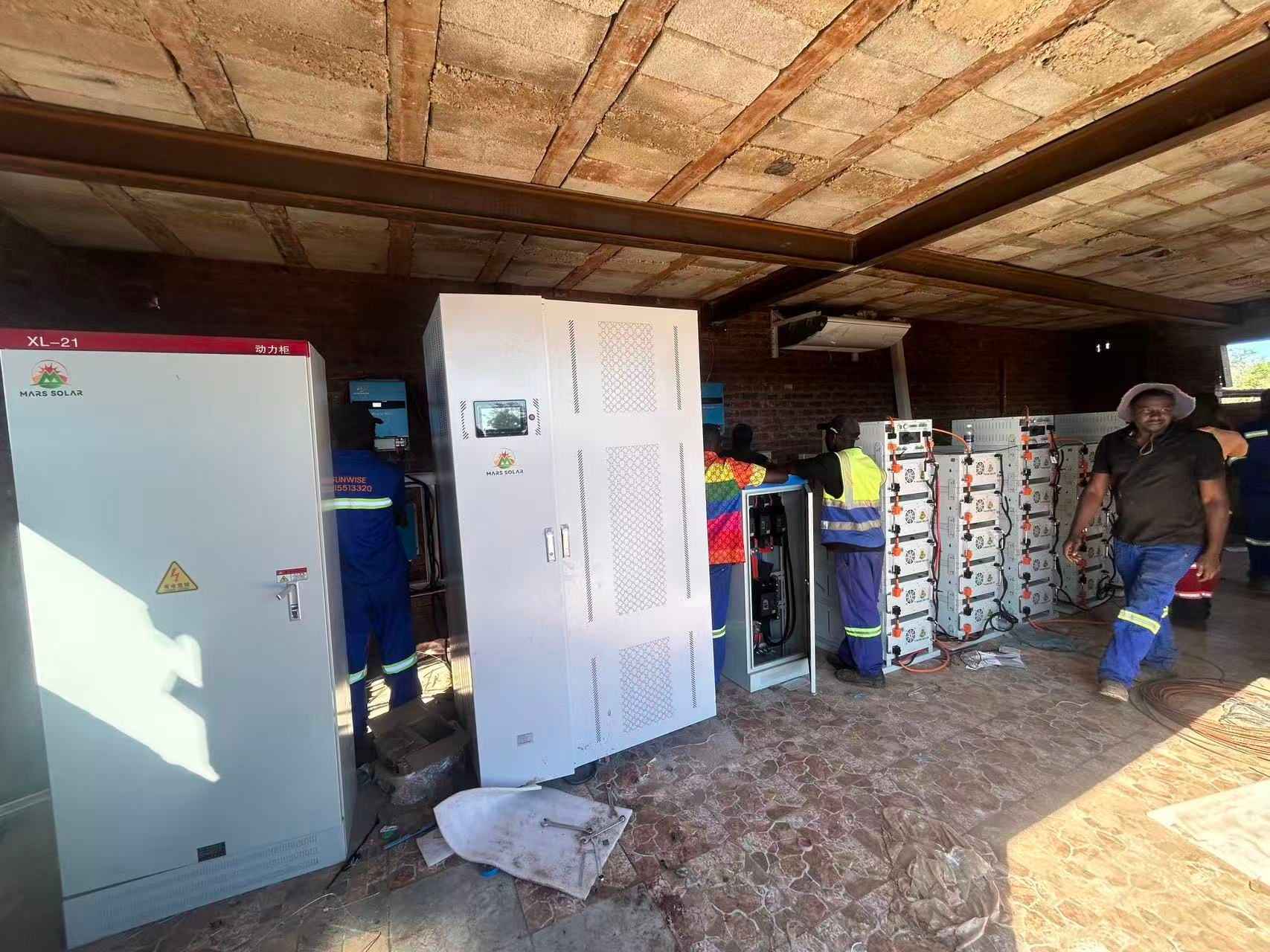
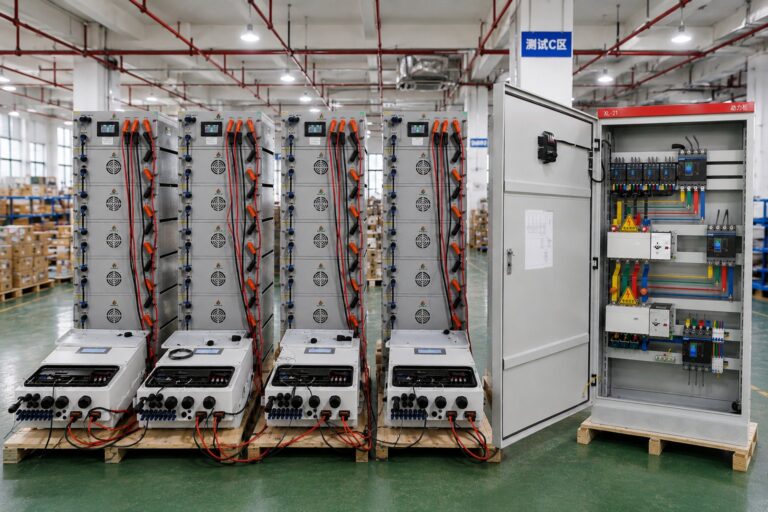
Inverter and battery cabinet in a hotel plant room. Keeping the battery above 10 degrees Celsius and below 35 degrees Celsius is the single biggest lever on its service life in Kenya.
What a solar system for hotels in Kenya costs in 2026
Prices in Kenya are quoted either per watt installed or per kWh of storage, and comparing the two formats is where budgets go wrong. Use the per-watt figure for the generation side and treat storage as a separate line, because the ratio between them changes with the design.
| Line item | 2026 range | Notities |
|---|---|---|
| Tier-1 mono panels | KSh 33 to 62 per watt | N-type TopCon at the top of the range for coastal humidity |
| Complete installed system | KSh 90 to 160 per watt | Panels, inverter, mounting, cabling, commissioning |
| LFP storage add-on | KSh 35,000 to 70,000 per kWh | Rack-mounted, above the per-watt figure |
| Hybrid inverter, 100 kW class | KSh 1.2M to 2.0M | Three-phase with storage interface |
| Coastal corrosion package | +8% to +15% | Aluminium rails, stainless fasteners, IP65+ enclosures |
| Annual O and M | 1.0% to 2.0% of capex | Cleaning, thermography, inverter service, reporting |
Financing changes the ranking more than the price does. A cash purchase optimises lifetime cost; an EPRA-approved power purchase agreement removes the capital entirely and prices the output at a contracted KSh 9 to 14 per kWh, which is still below the CI1 effective rate. For hotels that would rather preserve capital for refurbishment, the PPA route is often the correct answer even though the headline saving per kWh looks smaller.
Whichever route you take, insist on a single-line diagram and a protection study before signing. Those two documents are what a solar system for hotels in Kenya is really judged on when something fails two years later. They cost almost nothing at design stage and are consistently the first thing missing from the cheapest solar system for hotels in Kenya quotation you will receive.
Payback maths on a 60-room Nairobi hotel
Take a 60-room Nairobi hotel on CI1 with a full kitchen and laundry, consuming 420,000 kWh a year, about 7,000 kWh per room. At an all-in KSh 26 per kWh that is roughly KSh 10.9 million a year on electricity. It is a realistic mid-market profile, not an outlier.
- Array size. 90 kWp at 1,450 kWh per kWp gives about 130,500 kWh a year, comfortably inside the daytime load of a property that runs laundry, kitchen and pool pumps.
- Self-consumption. With scheduling and a 160 kWh battery, 75% of generation is consumed on site, so 97,900 kWh of grid electricity is displaced.
- Annual saving. 97,900 kWh at KSh 26 is KSh 2.55 million a year, before the demand-charge reduction of roughly KSh 0.3 million.
- Installed cost. 90 kWp at KSh 90 to 150 per watt plus 160 kWh of storage lands at KSh 13.7 million to KSh 24.7 million.
- Simple payback. 5.0 to 8.7 years on energy savings alone, falling to 4.3 to 7.4 years once the demand-charge saving is included.
A larger array would improve the ratio only if the daytime load can absorb it. Sizing a solar system for hotels in Kenya to cover the whole annual bill rather than the daylight share is how hotels end up exporting power they are not paid for, and it is the most expensive mistake in this article.
That is why a measured load curve has to come before any quotation. A solar system for hotels in Kenya designed from twelve months of KPLC bills but no interval data is a guess dressed up as an engineering design. Once interval data exists the solar system for hotels in Kenya can be modelled hour by hour, and the payback range narrows from a factor of two to a few months.
Six sizing mistakes we see in Kenyan hotel tenders
- Sizing to the monthly bill. The monthly kWh total says nothing about when the load occurs, and the solar window is only ten hours long.
- Ignoring the check-in peak. An 18:30 ramp with no storage means the array contributes nothing to the most expensive half hour of the day.
- Undersizing the inverter for motor starting. Laundry and kitchen surges, not steady load, set the inverter rating in most hotels.
- Skipping the roof structural check. A ballasted array adds 15 to 25 kg per square metre; older Kenyan roofs and lightweight canopies often need reinforcement first.
- Kopen op basis van alleen de prijs per watt. A solar system for hotels in Kenya awarded on the lowest per-watt quote usually arrives without commissioning tests, string-level monitoring or a protection study.
- Leaving the KPLC interconnection application until the end. Approval is a precondition for energising, not paperwork to tidy up afterwards.
Maintenance and uptime: what a hotel cannot afford
A hotel cannot tolerate a silent failure, because guests notice an air conditioner that stops at 23:00 long before the owner notices a flat generation curve. The practical minimum for a solar system for hotels in Kenya is string-level monitoring with an alert threshold, quarterly cleaning in the dry seasons, an annual thermographic scan, and a documented inverter service interval.
Soiling is the dominant loss in Kenya. Nairobi dust reduces yield by 3% to 6% between cleanings; coastal salt mist and dust together can reach 8% to 12% on a roof that goes six weeks without attention. Cleaning every two to four weeks in the dry season is cheap and recovers most of it. Target a performance ratio of 78% to 85% for a Kenyan hotel system and treat anything below 75% as a fault worth investigating rather than a normal seasonal dip. Our commercial solar O&M cost benchmarks set out the scope and pricing that a hotel contract should include.
Frequently asked questions: solar system for hotels in Kenya
How much does a solar system for hotels in Kenya cost?
Installed cost runs from about KSh 1.8 million for a 20 kWp system on a 25-room property to KSh 38 to 48 million for 250 kWp with 500 kWh of storage on a resort. The generation side is priced at KSh 90 to 160 per watt and storage is added at KSh 35,000 to 70,000 per kWh.
How many kW does a hotel need in Kenya?
As a first pass, 1 kWp per room for small properties with limited facilities, falling to 0.6 to 0.9 kWp per room above 80 rooms as kitchen and public area loads are shared. A load study replaces the estimate; the room-count figure is only a budget placeholder. Treat it as a budgeting number and nothing more, because a solar system for hotels in Kenya sized from room count alone is the most common reason a first quote misses on a Kenyan property.
Is a battery necessary for a solar system for hotels in Kenya?
Not for the energy saving, but usually for the evening peak. A Kenyan hotel's check-in ramp falls entirely outside the solar window, so a 40 to 90 minute battery typically lifts self-consumption from around 55% to 75%, which is the difference between a marginal and a strong payback.
Do I need an EPRA licence for a solar system for hotels in Kenya?
No generation licence is required for own-use systems below 1 MW. You do need KPLC interconnection approval before energising, and a net metering agreement if you intend to export surplus. Above 1 MW, or for any sale of power to a third party, licensing applies.
What is the payback on a solar system for hotels in Kenya?
Four to six years for a cash purchase on a well-sized Nairobi system, and two to three years under an EPRA-approved power purchase agreement at larger scale. Coastal resorts with heavy night air conditioning tend to sit at the upper end because more capital goes into storage.
Can solar run air conditioning in a Kenyan hotel?
Yes, and air conditioning is the largest single load. The constraint is timing: cooling demand peaks in the afternoon and again at night. A daytime-facing array covers the afternoon directly, and a battery or a modest load shift covers the night. Splitting the room air conditioners across two service boards makes the daytime match much better, and it is the single cheapest change that improves how well a solar system for hotels in Kenya tracks the cooling load.
Does solar water heating beat PV for hotel hot water?
For pure water heating, yes. A thermal collector converts 50% to 70% of incident solar energy into heat against 18% to 22% for a PV panel driving a resistive element. The right design for a solar system for hotels in Kenya puts thermal on the hot water load and PV on everything that needs electricity.
What happens at night or in cloudy weather?
At night the hotel runs on the grid, on the battery, or on both. In heavy cloud, Kenyan yields fall to 20% to 35% of clear-sky output rather than to zero, so a grid-tied design keeps operating at reduced output. January and February are typically the weakest months in Nairobi. A grid-tied solar system for hotels in Kenya therefore keeps producing through the long rains rather than switching off, and the battery covers the shortfall instead of the array.
How long does installation take and can the hotel stay open?
A 90 kWp system with storage is normally four to six weeks on site, and the property stays fully operational throughout. The only guest-visible work is the final changeover, which is scheduled overnight in a two to four hour window. A solar system for hotels in Kenya of this size needs roughly 180 to 260 square metres of clear roof, so confirm access and lifting routes before the delivery date is fixed.
What maintenance does a solar system for hotels in Kenya need?
Panel cleaning every two to four weeks in the dry season, quarterly inverter and connection inspection, an annual thermographic scan and string test, and battery state-of-health reporting twice a year. Budget 1% to 2% of capital cost annually and insist on string-level monitoring so a failed string is visible the same day rather than at the next invoice.
Data sources and freshness
Tariff components and the KSh 13.44/kWh CI1 base energy charge were checked against the Energy and Petroleum Regulatory Authority tariff material at epra.go.ke and Kenya Power's published schedule at kplc.co.ke in October 2026. The CI1 and CI2 band structure, the KSh 90 to 160 per watt installed cost range and the lithium storage add-on are taken from the same 2026 schedule and from our own solar panel price guide for Kenya. Yield assumptions of 1,450 to 1,600 kWh per kWp per year reflect Kenyan global horizontal irradiation and a performance ratio of 78% to 85%, consistent with the resource data published at energydata.info and the sector overview at worldbank.org.
Equipment safety and grid-code references are IEC 62109-1, IEC 62109-2, IEC 61215 and IEC 61730, with the national interconnection conditions set by the Ministry of Energy.
Reviewed 28 October 2026. KPLC pass-through charges are revised monthly and quarterly; confirm the current FCC and IFC before finalising any solar system for hotels in Kenya business case.
Want the sizing checked against your own bills?
Send us twelve months of KPLC bills with the demand figures, your room count and a roof photo. We will come back with the PV size, the battery window, the KSh payback range and the interconnection steps for a solar system for hotels in Kenya at your property.
Chatten via WhatsAppRelated reading: solar power system for hotels · commercial solar system Kenya · solar panel price Kenya · solar PPA Kenya · Kenya solar import guide · Africa solar market comparison · hybrid inverter sizing · grid-forming vs grid-following inverters · commercial solar O&M cost · solar for schools and hospitals · 60 kW resort case study · 250 kW hotel in Ghana · 250 kW hotel in Abuja · hotel system in Ghana · power outage cost for hotels · 100 kW 215 kWh BESS · 100 kW hybrid system · neem contact met ons op


 English
 Arabic
 Spanish
 French
 Dutch
 Portuguese