7 belangrijke stappen voor een succesvolle fabrieksaudit
Waarom fabrieksverificatie de #1-stap is bij de inkoop van zonnepanelen uit China
Een audit van een Chinese zonnepanelenfabriek is de allerbelangrijkste stap voordat u geld overmaakt naar een leverancier van zonnepanelen. Deze gids in 7 stappen laat u zien hoe u certificeringen, productiecapaciteit en referenties kunt controleren — op basis van de ervaring van Mars Solar met meer dan 3.000 exportprojecten in meer dan 130 landen.
Fabrieksverificatie is de allerbelangrijkste stap voordat u geld overmaakt. Toch slaan de meeste beginnende importeurs deze stap over, omdat ze vertrouwen op wat de leverancier in zijn e-mails en WhatsApp-berichten zegt.
Deze handleiding biedt een verificatieproces in 7 stappen, gebaseerd op de ervaring van Mars Solar met meer dan 3.000 exportprojecten in meer dan 130 landen. Elke stap gebruiken wij om onze eigen partners te beoordelen – en slimme kopers gebruiken deze stappen om ons te beoordelen.
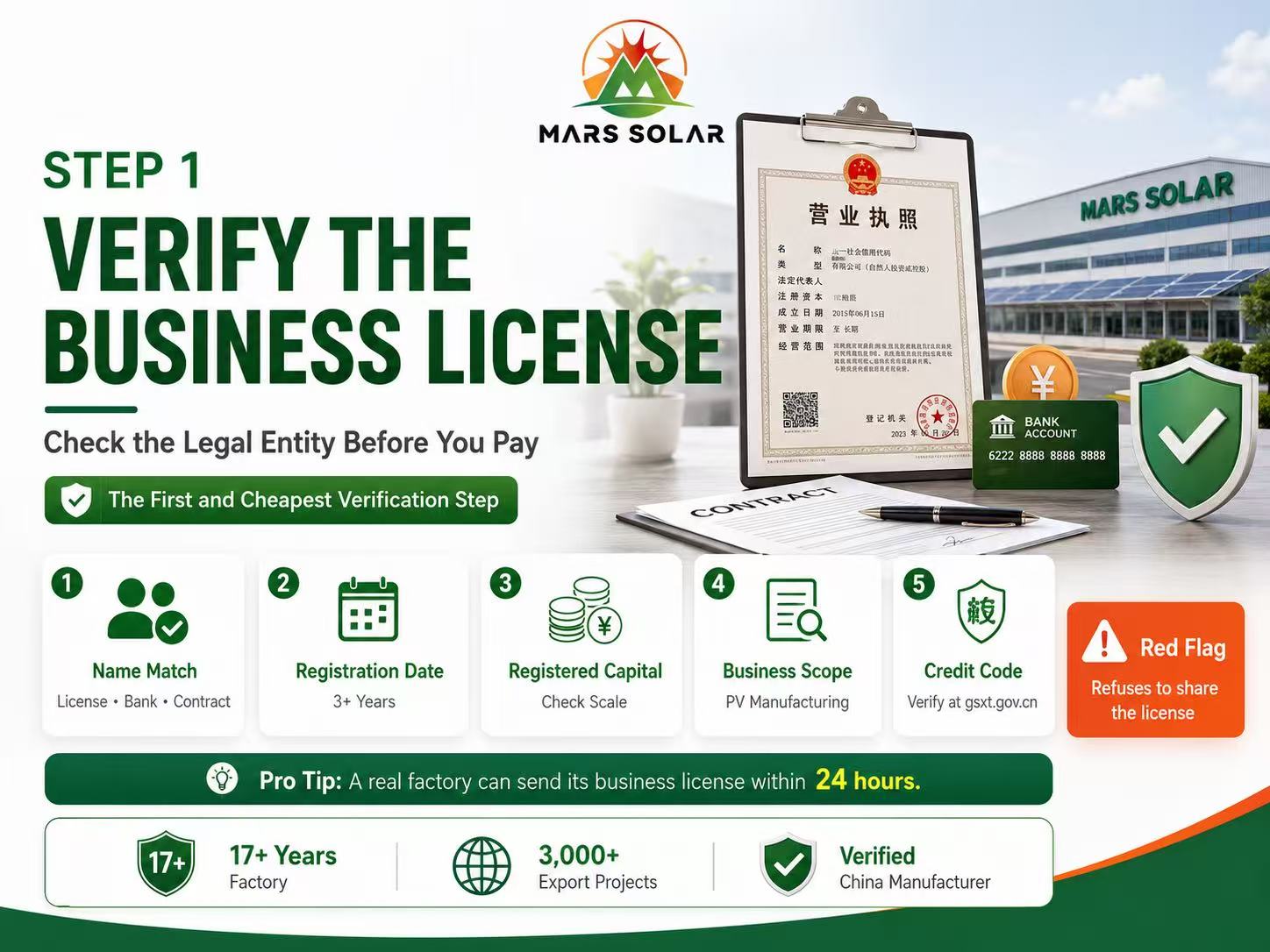
Stap 1: Controleer de bedrijfsvergunning en de rechtsvorm.
De goedkoopste verificatiestap – en de stap die het vaakst wordt overgeslagen. Een echte Chinese zonne-energiefabriek moet een geregistreerde bedrijfsvergunning hebben, afgegeven door de Staatsadministratie voor Marktregulering (SAMR).
Wat te controleren:
- Bedrijfsnaam De bedrijfsvergunning, bankrekening en het contract moeten exact overeenkomen.
- Registratiedatum — Alles wat jonger is dan 3 jaar is een waarschuwingssignaal voor een fabrikant die beweert 17 jaar ervaring te hebben.
- Geregistreerd kapitaal — under ¥1M for a panel factory is almost certainly a trading company.
- Bedrijfsomvang Moet de productie van PV-modules of zonnecelmodules omvatten.
- Uniforme Sociale Kredietcode — controleer dit op het National Enterprise Credit Information Publicity System op gsxt.gov.cn.
Pro-tip: Als de leverancier weigert de bedrijfsvergunning te sturen "vanwege vertrouwelijkheidsredenen", ga dan niet verder met de bestelling. Legitieme fabrieken sturen deze binnen 24 uur op.
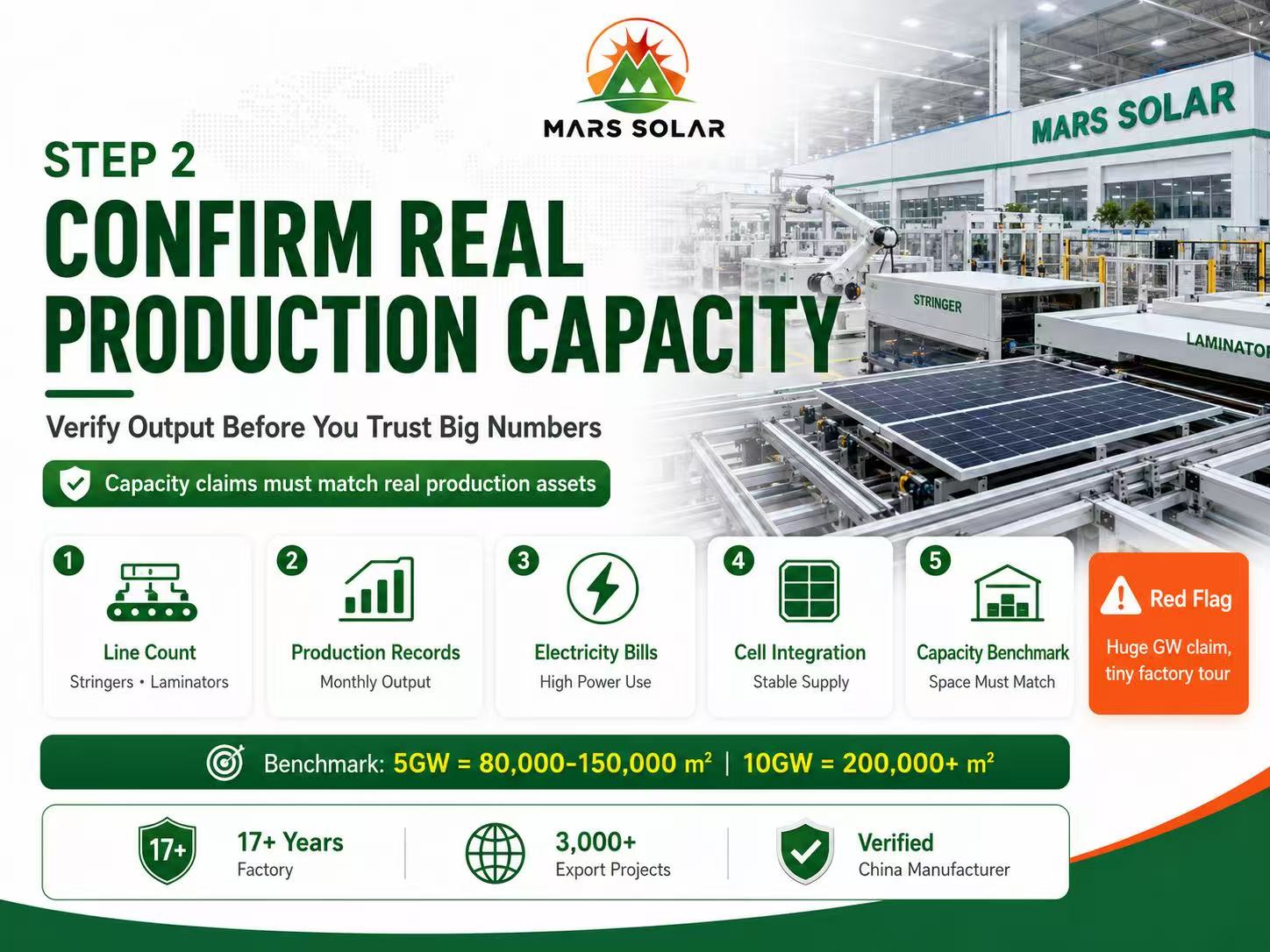
Stap 2: Bevestig de werkelijke productiecapaciteit
De beweringen over de productiecapaciteit zijn de meest overdreven cijfers in de zonne-energiebranche. Een fabriek die beweert "20 GW jaarlijkse capaciteit" te hebben, heeft er in werkelijkheid misschien maar 2 GW – en toch zullen ze je een offerte geven op basis van die 20 GW.
Hoe te verifiëren:
- Vraag naar het aantal productielijnen en de integratie van cellen tot modules. Een echte fabriek met een capaciteit van 5 GW heeft minstens 4-6 stringermachines, 8-10 lamineermachines en een overeenkomstige capaciteit in elke stap nodig. Als het aantal productielijnen niet klopt, is de capaciteit nep.
- Vraag recente productiegegevens op. Een echte fabriek kan maandelijkse productierapporten, elektriciteitsrekeningen (elektriciteit is een grote kostenpost – fabrieken van 5 GW geven 1 tot 4 biljoen dollar per maand uit aan energie) of verzenddocumenten van de afgelopen 3-6 maanden overleggen.
- Raadpleeg BloombergNEF, Wood Mackenzie of InfoLink. Lijsten van eerstelijnsfabrikanten voor een onafhankelijke capaciteitsbenchmark.
- Bevestig de verticaal geïntegreerde celproductie. Producenten die modules assembleren en cellen van derden inkopen, zijn volledig afhankelijk van de beschikbaarheid van cellen, wat een groot risico vormt voor de levertijden.
Referentiewaarden: Een echte fabriek van 5 GW beslaat 80.000 tot 150.000 m² productieoppervlak. Een echte fabriek van 10 GW heeft meer dan 200.000 m² nodig. Als ze beweren een enorme capaciteit te hebben, maar alleen rondleidingen in een klein gebouw aanbieden, kloppen de cijfers niet.
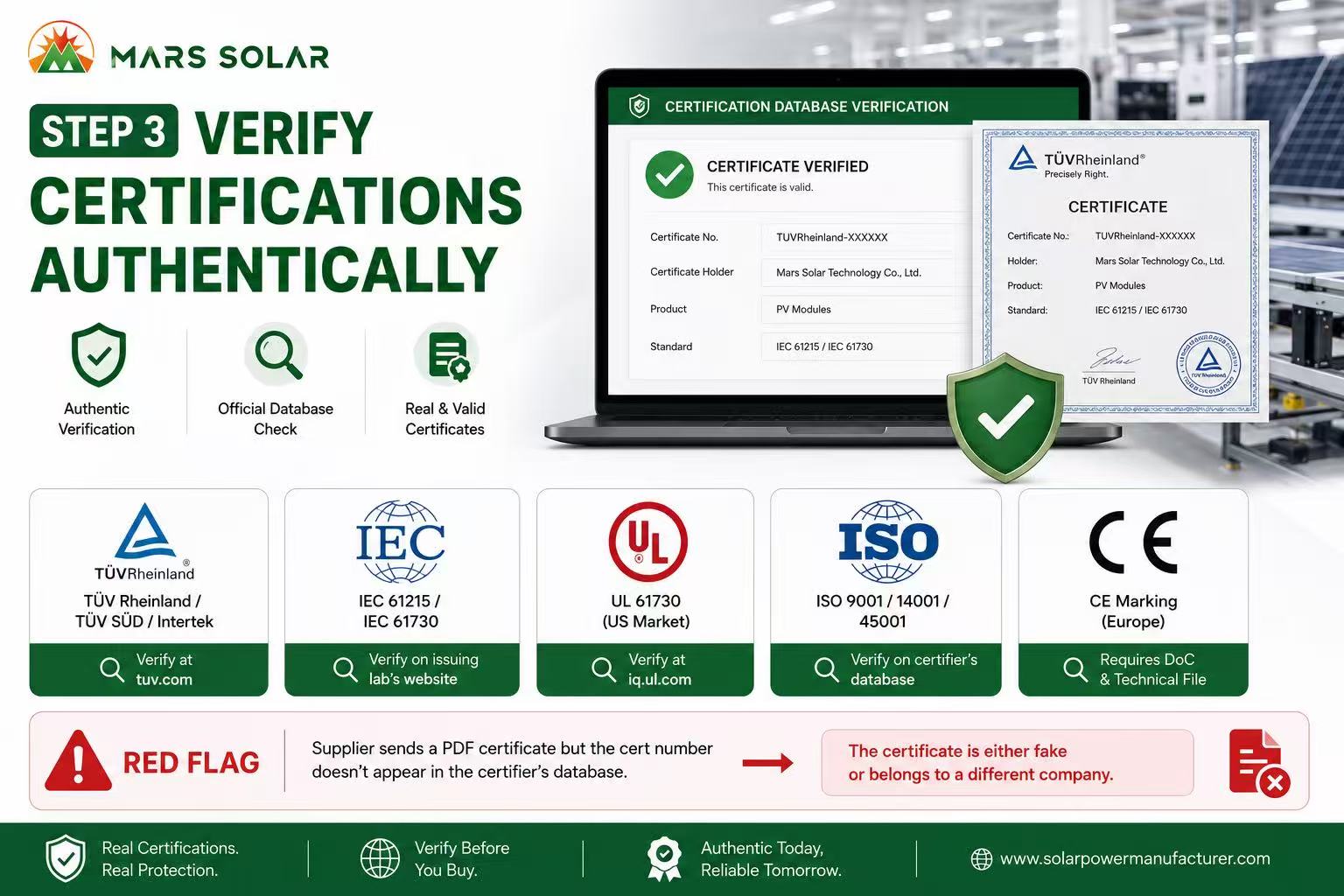
Stap 3: Controleer de echtheid van de certificaten
Certificeringen zijn gemakkelijk te vervalsen op de website van de leverancier zelf, maar moeilijker te vervalsen in de officiële database van de certificeringsinstantie. Elke belangrijke certificering heeft een doorzoekbare openbare database.
Authenticiteitschecklist:
- TÜV Rheinland / TÜV SÜD / Intertek Certificaten — controleer ze in de officiële database van de certificeringsinstantie op tuv.com of intertek.com. De naam van de certificaathouder en het productmodel moeten exact overeenkomen.
- IEC 61215 / IEC 61730 — afgegeven door TÜV, VDE of andere CBTL-laboratoria. Raadpleeg de website van het uitgevende laboratorium voor het certificaat.
- UL 61730 (Amerikaanse markt) — controleer dit in de Product iQ-database van UL op iq.ul.com.
- ISO 9001 / 14001 / 45001 — uitgegeven door DNV, TÜV, SGS, BV of LRQA. Controleer dit in de database van de certificeringsinstantie of op het portaal van de ISO-certificeringsinstantie.
- CE-markering — Voor Europa is een conformiteitsverklaring (DoC) en een technisch dossier vereist. Een CE-logo op het gegevensblad alleen is niet voldoende.
Rode vlag: De leverancier stuurt een pdf-certificaat, maar het certificaatnummer staat niet in de database van de certificeringsinstantie. Dit betekent dat het certificaat vals is of van een ander bedrijf afkomstig is.
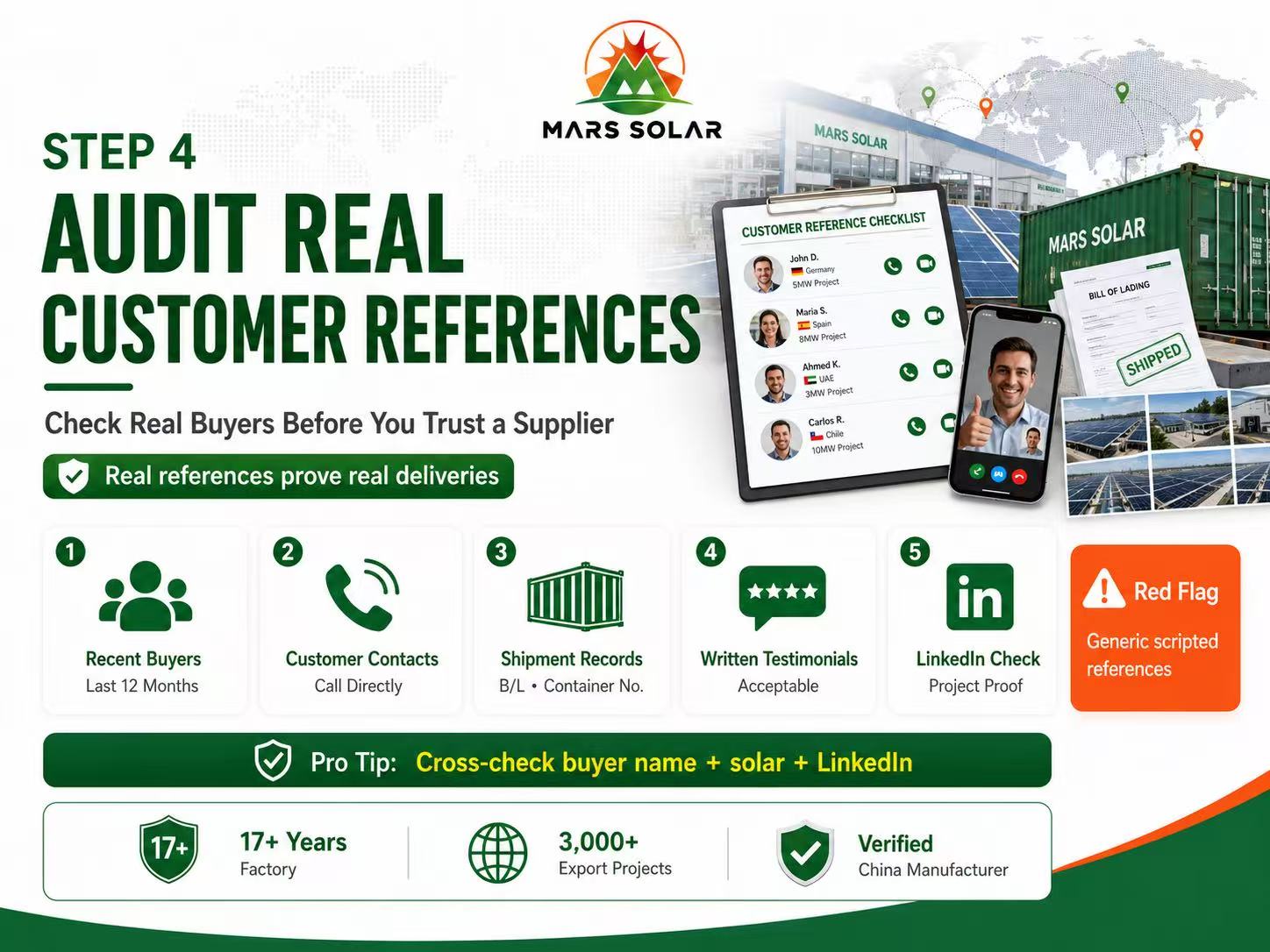
Stap 4: Controleer de referenties van echte klanten
Elke serieuze fabriek heeft naar tientallen landen verzonden en kan 5-10 echte afnemers noemen die de kwaliteit kunnen bevestigen. Als een leverancier geen referenties kan overleggen, is het bedrijf ofwel nieuw (hoog risico) of verbergt het iets (hoger risico).
Wat te vragen:
- 3-5 klantcontacten in uw land of regio die de afgelopen 12 maanden een aankoop hebben gedaan.
- Specifieke verzendgegevens — containernummers, datums van de vrachtbrief, paneelmodel, aantal.
- Of u deze referenties nu direct kunt bellen (het beste) of schriftelijke aanbevelingen kunt verkrijgen (acceptabel).
Hoe herken je valse referenties? Referenties die steeds hetzelfde standaardantwoord geven ("zeer goede kwaliteit, snelle levering"), of waarvan de e-mailhandtekening overeenkomt met het domein van de leverancier, worden niet serieus genomen. Echte referenties kunnen specifieke problemen beschrijven die ze hebben ondervonden en hoe de leverancier deze heeft opgelost.
Controleer dit: Zoek op de bedrijfsnaam van de koper + "zonnepanelen" + LinkedIn. Echte referenties hebben zichtbare zonne-energieprojecten in hun portfolio.
Stap 5: Bezoek de fabriek (of schakel een externe inspecteur in)
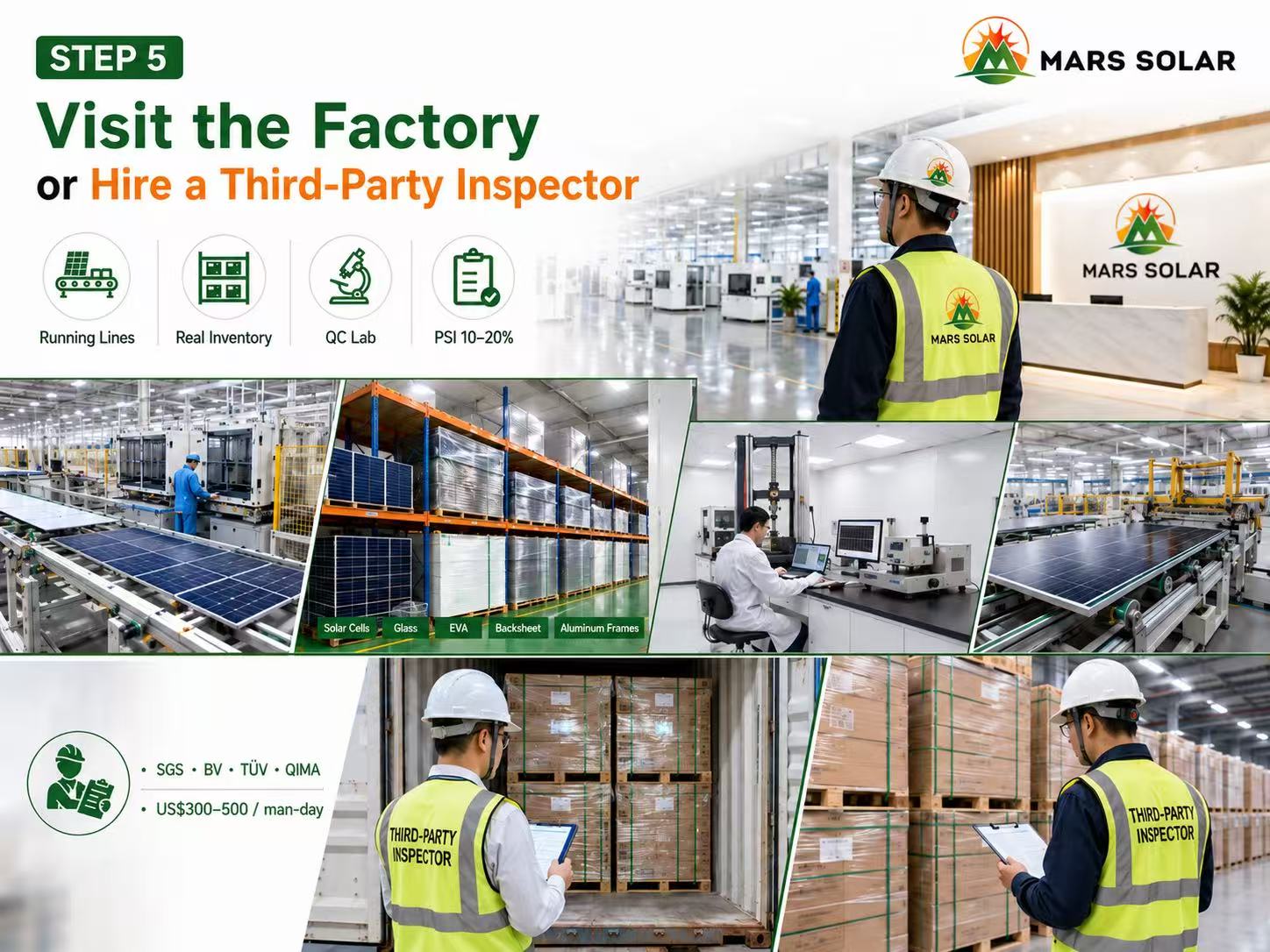
De beste manier om de echtheid te verifiëren is door een fysiek bezoek. Een echte fabriek heeft een receptie, een productiehal waar je doorheen kunt lopen, echte medewerkers, echte voorraad en een kwaliteitscontrolelaboratorium dat je kunt inspecteren.
Waarop te letten tijdens het bezoek:
- Productielijnen die draaien tijdens uw bezoek (niet alleen voor de show de dag ervoor).
- Werkelijke inventaris van cellen, glas, EVA, achterplaat, aluminium frames — niet zomaar lege schappen.
- Werkend kwaliteitscontrolelaboratorium met ten minste: een flitsontladingstester, een EL-tester, een isolatietester, een mechanische belastingstester en een gekalibreerde referentiecel.
- Aanwezig personeel — minstens 200-500 werknemers voor een Tier 2-fabriek, meer dan 1.000 voor een Tier 1-fabriek.
- Kantoorpersoneel — als de teams voor engineering, R&D en export allemaal in één ruimte zitten met in totaal drie mensen, dan is het een handelsonderneming.
Kunt u niet langskomen? Schakel een externe inspectiedienst in — SGS, Bureau Veritas, TÜV, AsiaInspection of QIMA. Kosten: 300-500 per man-dag in China. Bestel een pre-shipment inspectie (PSI) voor minimaal 10-20 containers, willekeurig geselecteerd.
Stap 6: Monstertesten vóór de bulkbestelling
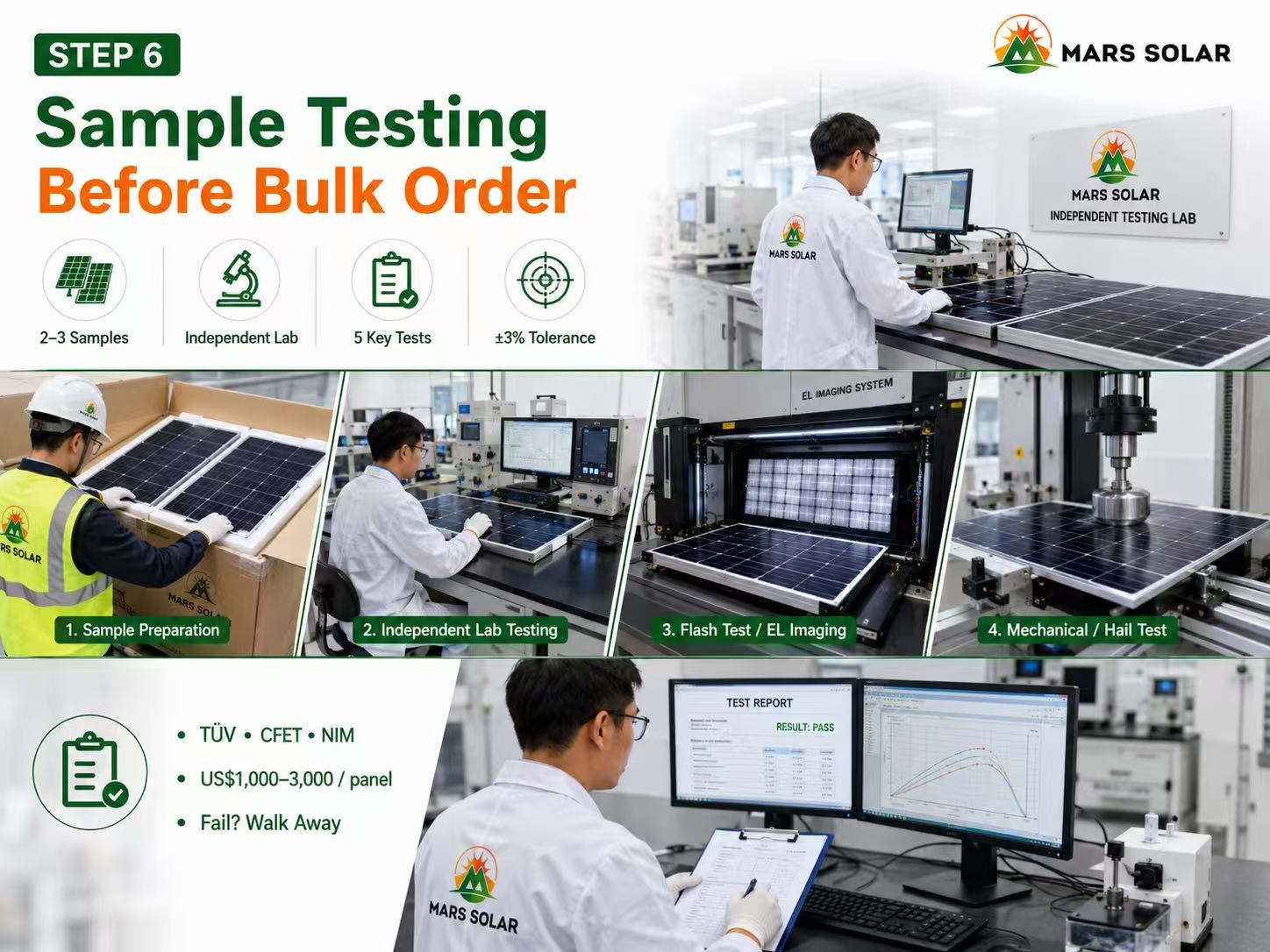
Plaats nooit een bulkbestelling zonder dat er eerst monsters zijn getest door een onafhankelijk laboratorium. Testrapporten van de fabriek zelf zijn niet voldoende; die zijn afkomstig van een laboratorium dat de fabriek zelf beheert.
Voorbeeld testprotocol:
- Bestel 2-3 proefpanelen van exact hetzelfde model dat u in grote hoeveelheden wilt bestellen (zelfde celtype, zelfde vermogen, zelfde materiaallijst).
- Laat de test uitvoeren door een onafhankelijk laboratorium. — TÜV Rheinland Shanghai, CFET (China Photovoltaic Engineering Test Center), of een universitair laboratorium zoals NIM (National Institute of Metrology, China).
- Vereiste tests (kosten: $1.000-3.000 per paneel):
- Flash-test (controleer het werkelijke maximale vermogen ten opzichte van de gegevens in het specificatieblad)
- EL-beeldvorming (controleer op microbarsten, beschadigde cellen)
- Isolatiebestendigheidstest (1000V DC + 1500V DC gedurende 1 minuut)
- Mechanische belastingstest (2400 Pa voor, 1600 Pa achter — IEC-norm)
- Hagelinslagtest (ijsbal van 25 mm met een snelheid van 23 m/s)
- Tolerantiecontrole: Alle panelen moeten een meetbereik hebben van ±3% ten opzichte van het nominale vermogen (een positieve tolerantie heeft de voorkeur, maar ±3% is de industriestandaard).
Wat te doen met de resultaten: Als de proefmonsters niet aan de verwachtingen voldoen, ga dan weg — de fabriek bezuinigt ofwel op de kwaliteit, of heeft een probleem met de kwaliteitscontrole dat elk paneel in uw bulkbestelling zal beïnvloeden.
Stap 7: Controleer de bank- en handelsreferenties
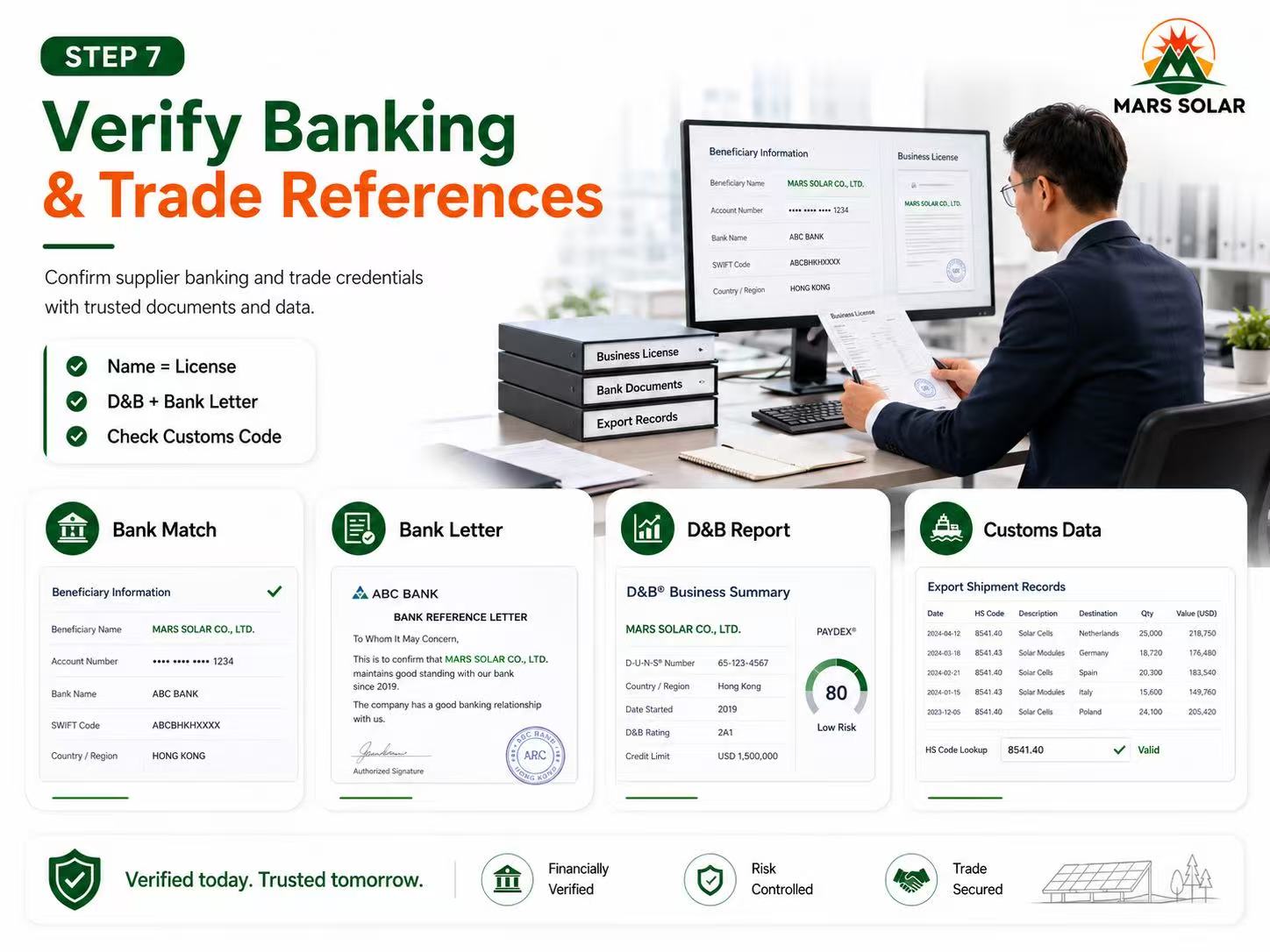
De laatste stap is de financiële verificatie. Een echte fabriek heeft een zakelijke bankrekening, een echte USD/EUR-ontvangstrekening en een onberispelijke handelsgeschiedenis.
Wat te controleren:
- Naam van de begunstigde Het bedrag op de bankrekening moet exact overeenkomen met de gegevens op de bedrijfsvergunning.
- Bankvestiging — moet in dezelfde stad als de fabriek gevestigd zijn, niet in een belastingparadijs.
- Bankreferentiebrief De meeste fabrieken kunnen een bankverklaring overleggen waaruit de duur van de relatie en de kredietstatus blijken.
- Rapport van Dun & Bradstreet ($50-200) — geeft kredietwaardigheid, betalingsgeschiedenis en juridische documenten weer.
- Chinese douane-exportgegevens — via Panjiva, ImportGenius of 52WMB. Toont de werkelijke verzendgeschiedenis per HS-code (8541.40 voor zonnecellen, 8541.43 voor zonnepanelen).
Kritische controle: Vraag naar de douaneregistratiecode (海关编码) van de leverancier en raadpleeg hun exportgegevens. Een fabriek die beweert jaarlijks $50M te exporteren, maar in de douanegegevens slechts $3M laat zien, liegt.
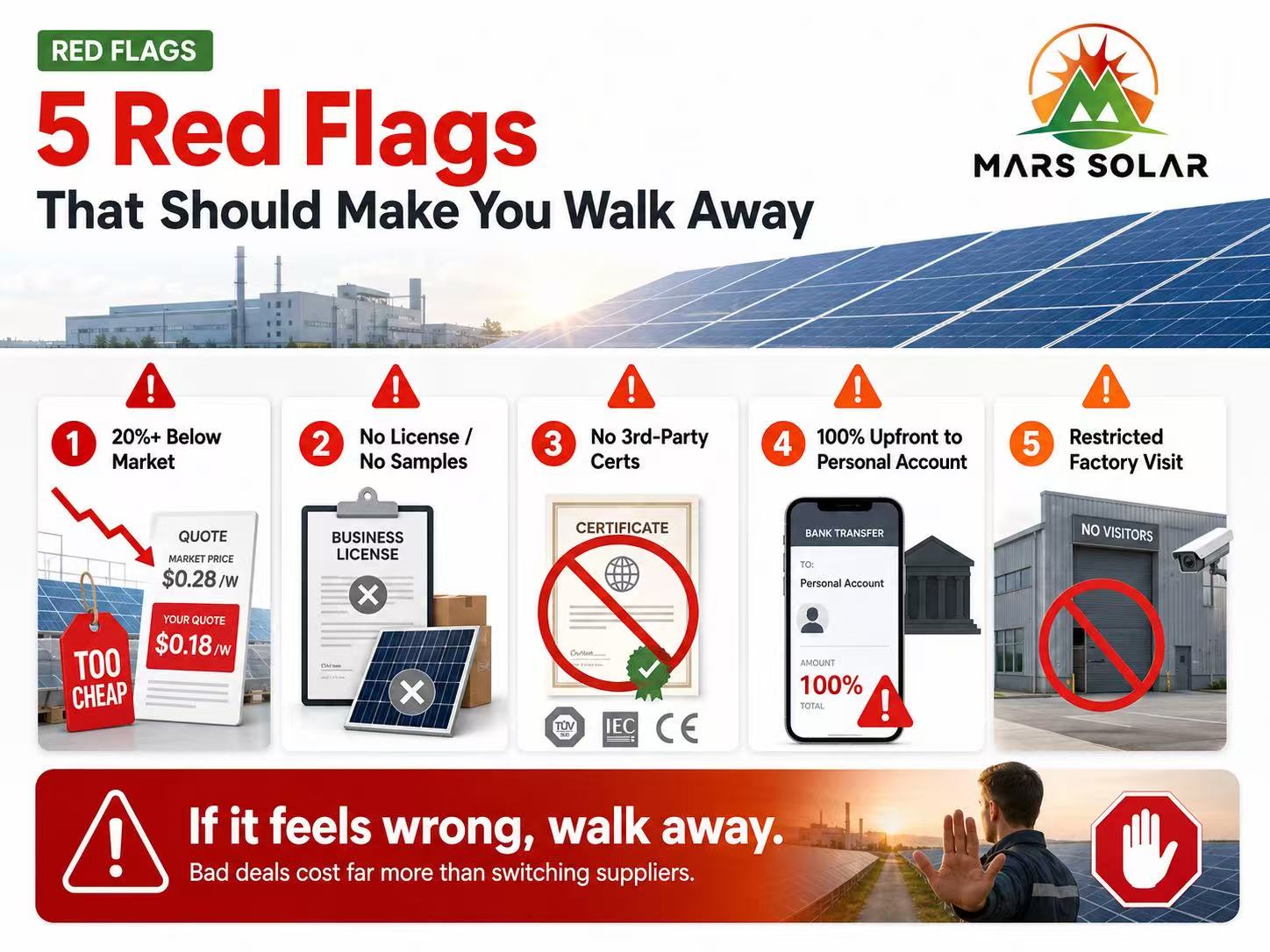
5 waarschuwingssignalen die ervoor zouden moeten zorgen dat je wegloopt.
Zelfs als alle 7 stappen zijn voltooid, let dan op deze specifieke waarschuwingssignalen die kopers van zonnepanelen miljoenen hebben gekost:
- Prijs 20%+ onder de marktwaarde. Als iedereen $0.13/W noemt en één leverancier $0.09/W, dan is daar een reden voor. Het gaat bijna altijd om B-kwaliteit cellen, verouderde productielijnen of fraude.
- Weigert een bedrijfsvergunning of monsters te verstrekken. Legitieme fabrieken hebben niets te verbergen.
- Geen certificeringen van derden. — alleen "fabriekstestrapporten" of "CE-markering" zonder een aangemeld instantienummer.
- Druk om 100% vooraf te betalen via bankoverschrijving naar een individuele rekening of naar een ander land dan waar de fabriek is geregistreerd.
- Fabrieksbezoek is alleen op bepaalde dagen toegestaan. met een "fotoverbod"-regel, of het bezoek vindt plaats in een ander gebouw dan waar de productie daadwerkelijk plaatsvindt.
Herinneren: If anything feels wrong, trust your gut. The cost of a bad solar panel deal is 10-100x the cost of walking away and finding another supplier. For the full step-by-step version, read our guide to choosing reliable solar system suppliers.
Verificatieverslag van Mars Solar
Voor de volledigheid volgt hier hoe Mars Solar presteert op elk van de 7 punten:
- Stap 1 (Bedrijfsvergunning): Geregistreerd in 2008, Foshan, provincie Guangdong. Geverifieerd op gsxt.gov.cn. Maatschappelijk kapitaal: 1 miljoen ¥.
- Stap 2 (Productiecapaciteit): Annual output exceeding 5 GW of solar modules and 800 MWh of lithium battery packs, from a 25,000 m² manufacturing facility in Foshan occupying two adjacent buildings with four automated production lines.
- Stap 3 (Certificeringen): TÜV Rheinland, TÜV SÜD, UL 61730, IEC 61215, IEC 61730, ISO 9001/14001/45001, JIS (Japan), CEC (Australië), INMETRO (Brazilië). Allemaal controleerbaar in de databases van de certificeringsinstanties.
- Stap 4 (Referenties): Meer dan 3000 projecten in meer dan 130 landen. Klantreferenties zijn op aanvraag beschikbaar — naam, land, projectomvang, contactpersoon.
- Stap 5 (Fabrieksbezoeken): U bent altijd welkom, op elk moment van de dag. Loop rond, bekijk het lab en ontmoet de ingenieurs. U hoeft zich niet van tevoren aan te melden.
- Stap 6 (Voorbeelden): 2-3 testpanelen worden binnen 7 dagen verzonden tegen kostprijs (~$150-300 per paneel inclusief DHL). Onafhankelijke keuringsrapporten van TÜV zijn beschikbaar.
- Stap 7 (Bankieren): USD, EUR, RMB, JPY, AUD-ontvangstrekeningen bij Bank of China, HSBC en JPMorgan. D&B-kredietbeoordeling op aanvraag beschikbaar.
Frequently Asked Questions About China Solar Factory Audit
V: Hoe lang duurt de volledige verificatie in 7 stappen?
A: 2-4 weken als je systematisch te werk gaat. Stappen 1-3 en 7 kunnen op afstand in 3-5 dagen worden uitgevoerd. Stappen 4-6 vereisen medewerking van de leverancier en duren 1-3 weken.
V: Is een fabrieksaudit door een externe partij de kosten waard?
A: Ja, voor elke bestelling boven de $50.000. Een $500-audit kan een verlies van $500.000 voorkomen. SGS- en TÜV-audits leveren u ook een schriftelijk rapport op dat u in uw eigen verkoopmateriaal kunt gebruiken.
V: Kan ik het fabrieksbezoek overslaan als ik goede referenties heb?
A: Niet aanbevolen. Referenties kunnen vals zijn. Combineer verificatie op afstand (stappen 1-4, 7) met een externe inspecteur (alternatief voor stap 5) voor bestellingen boven $100.000.
V: Wat is de minimale orderwaarde die een volledige 7-stappen verificatie rechtvaardigt?
A: Elke order boven $10.000. Daaronder moeten minimaal stap 1, 3 en 7 worden uitgevoerd. De kosten van verificatie zijn altijd lager dan de kosten van een foute order.
V: Wat als de leverancier alle 7 stappen doorloopt, maar de panelen toch kwaliteitsproblemen vertonen?
A: Gebruik altijd een Letter of Credit (L/C) met clausules voor kwaliteitscontrole en eis een inspectie vóór verzending (PSI) door SGS of TÜV. Betaal nooit 100% voordat de goederen de PSI hebben doorstaan.
How do I verify the legal entity before a China solar factory audit?
Start with the business licence on gsxt.gov.cn and check three fields: the registration date, the registered capital and the registered scope. A supplier claiming seventeen years of experience against a licence issued three years ago has already failed the first step of the China solar factory audit. Registered capital below ¥5 million is unusual for a panel factory, and below ¥1 million almost always indicates a trading company rather than a manufacturer.
How do I test production capacity claims in a China solar factory audit?
Ask for the line count and the cell-to-module integration, then check the equipment maths. A genuine 5 GW line needs roughly four to six stringer machines and eight to ten laminators in balance; if the numbers do not add up, the capacity figure is inflated. In a China solar factory audit, monthly output reports and electricity bills are the harder evidence — a 5 GW factory spends USD 1–3 million a month on power alone.
How do I confirm certifications during a China solar factory audit?
Look each certificate up on the issuing body's own database, not on the supplier's website. Modules should show IEC 61215 and IEC 61730 through a recognised laboratory; a UL 61730 listing can be checked on UL Product iQ; quality and environmental systems through the certifier that issued them. The step in a China solar factory audit that buyers skip is checking the certificate holder — it must be the entity invoicing you.
How do I validate customer references in a China solar factory audit?
Ask for three to five contacts in your own region who bought within the last twelve months, with company name, project size and a reachable phone number. Then actually call two of them and ask what went wrong, not whether they were satisfied. A China solar factory audit that collects references without verifying them has added paperwork rather than evidence.
Is a third-party inspection worth it in a China solar factory audit?
Above roughly USD 50,000 of order value, yes. A pre-shipment inspection by SGS, Bureau Veritas, TÜV, AsiaInspection or QIMA costs about USD 300–500 per man-day in China and returns a written report you can put in front of your own customers. In a China solar factory audit, the report also gives you a baseline photograph set — useful when a later shipment does not match the sample.
What sample testing belongs in a China solar factory audit?
Order two or three panels of the exact model you intend to buy — same cell type, same power class, same bill of materials — and have them independently tested. A full test panel runs USD 1,000–3,000 and covers flash testing, insulation withstand at 1,000 V and 1,500 V DC, mechanical load at 2,400 Pa front and 1,600 Pa rear, and hail impact. That is the step of a China solar factory audit that catches B-grade cells.
How do I check export history in a China solar factory audit?
Ask for the customs registration code and look up the company's own shipment record through a trade database, filtered on HS 8541.40 for solar cells and 8541.43 for modules. A supplier claiming USD 50 million of annual exports but showing USD 3 million in customs data has failed the China solar factory audit on the financial side. This check takes an afternoon and settles most doubt.
What banking checks complete a China solar factory audit?
Confirm the corporate account name matches the registered entity, that the receiving account is in the same country as the factory, and that multi-currency accounts exist for USD and EUR. A customs duty-adjacent detail that matters here: in a China solar factory audit, payment to a personal account or to a third country is the single clearest sign that the counterparty is not the manufacturer.
How long does a full China solar factory audit take?
Two to four weeks if you work systematically. Steps one to four and the banking check can be completed remotely in three to five days; references and sample testing need supplier cooperation and take one to three weeks. A China solar factory audit should therefore start before you need the goods, not after you have signed a contract with a delivery date.
Which red flags should end a China solar factory audit immediately?
Five patterns. A price 20% or more below the market with no explanation. Pressure to pay 100% upfront to an individual or offshore account. A refusal to send the business licence. Factory tours offered only in a small building inconsistent with the claimed capacity. And certification screenshots instead of certificate numbers. Any two of those together should close a China solar factory audit on the spot.
Does a China solar factory audit matter for a small first order?
Yes, but the depth can scale. Below USD 10,000 an order rarely justifies a site visit, so complete the three checks that cost nothing — business licence, certificate verification and banking details — and insist on a pre-shipment inspection report. Above USD 100,000 a China solar factory audit should include a physical visit or a third-party inspector, because the loss you are insuring against grows with the order.
What if the factory passes a China solar factory audit but the panels fail later?
Then the protection is contractual, not investigative. Use a letter of credit with a quality-inspection clause, require a pre-shipment inspection by an independent laboratory, and write the flash-test tolerance and the warranty issuer into the contract. A completed China solar factory audit is a screening tool; it does not replace a performance warranty held by the entity that actually manufactures the module.
Can a China solar factory audit be done remotely?
Partly. Documents, certificates, customs records and bank details can all be verified remotely, and those checks eliminate most trading companies without a visit. What a remote China solar factory audit cannot confirm is whether the production lines described actually exist at the scale claimed, which is why a live video walk through the floor or a third-party inspector is the usual compromise.
How do I compare a China solar factory audit result across suppliers?
Score them on the same seven dimensions and keep the evidence with the score. A China solar factory audit becomes decision-grade when you can put three suppliers side by side on registration, capacity, certification holder, verified references, inspection outcome, customs record and bank details. Price enters the table last, because price is the variable most easily manufactured.
What documents should I demand during a China solar factory audit?
Seven, in one pack: the business licence, the production line list, the certificate numbers with their issuing laboratories, three verifiable references, a third-party inspection report, the customs registration code, and the bank account details in the factory's own name. A China solar factory audit is complete when that pack arrives without being chased. If any item needs three reminders, treat the silence as the finding.
How much does a bad order cost compared with a China solar factory audit?
Orders of magnitude more. A China solar factory audit of the kind described here costs a few thousand dollars once samples and inspection are included; a container of B-grade modules or an unbranded inverter costs the equipment value, the freight both ways, the installation labour and the customer who never orders again. Treating the China solar factory audit as overhead is the mistake that makes it feel expensive.
Gerelateerde artikelen
Ga verder met je zoektocht naar leveranciers met behulp van deze handleidingen:
- Top 10 fabrikanten van zonnepanelen in China (lijst van 2026) — Bekijk welke fabrieken aan de 7-stappennorm voldoen en welke 5 daar consequent niet aan voldoen.
- Bifaciale versus monofaciale zonnepanelen: een eerlijke vergelijking — Na verificatie van de fabriek is de volgende vraag welk type paneel besteld moet worden.
- Minimale bestelhoeveelheid, levertijd en betalingsvoorwaarden voor zonnepanelen: BOFU-gids — Zodra de fabriek is geverifieerd, kunt u het volgende verwachten qua commerciële voorwaarden.
Audit findings only matter if you can act on them commercially, so it is worth reading how raw material costs and policy shifts are reshaping solar supply before you negotiate price against a completed audit report.
A completed audit is easiest to judge against a real project record — the 2MW electroplating factory system in Malaysia shows the documentation an audited factory actually hands over.
Over Mars Solar
Mars Solar is a verified China solar panel manufacturer with 17+ years of experience, annual output exceeding 5 GW of solar modules, and 3,000+ export projects across 130+ countries. All certifications are verifiable on issuing bodies' databases. We welcome factory visits, sample testing, and third-party inspections.
Ontvang een geverifieerde offerte: E-mail info@marssolargroup.com Geef uw projectomvang, doelmarkt en vereiste certificeringen door. Wij reageren binnen 24 uur met volledige documentatie, referenties en FOB/CIF-prijzen.

 English
  Arabic
  Spanish
  French
  Dutch
Dutch  Portuguese