Language
A China solar factory audit is the single most important step before you wire any money to a solar supplier. This 7-step guide shows you how to verify certifications, production capacity, and references — based on Mars Solar's experience with 3,000+ export projects across 130+ countries.
Factory verification is the single most important step before you wire any money. Yet most first-time importers skip it because they trust what the supplier says in their emails and WhatsApp messages.
This guide gives you a 7-step verification process based on Mars Solar's experience with 3,000+ export projects across 130+ countries. Each step is what we use to qualify our own partners — and what smart buyers use to qualify us.
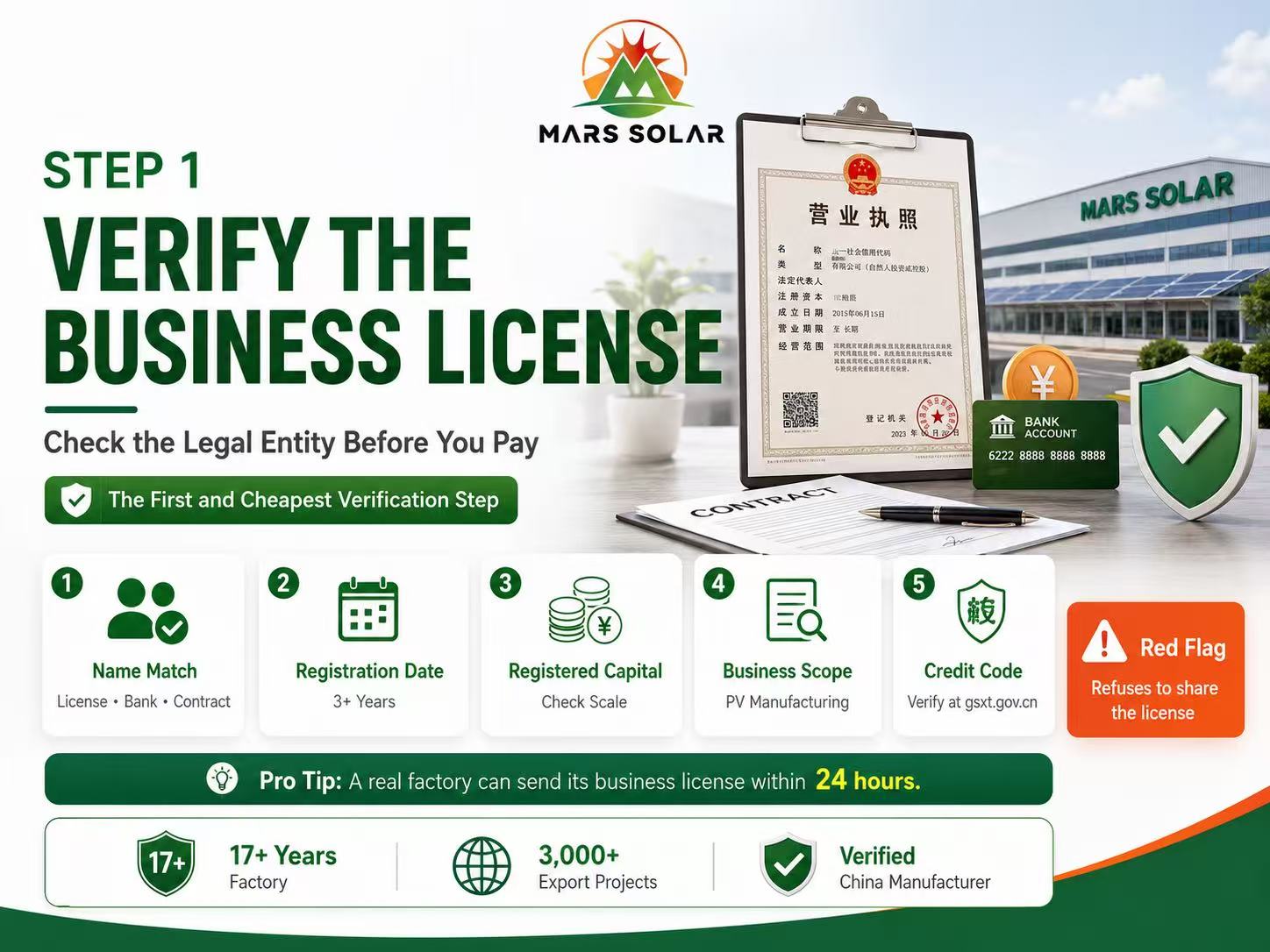
The cheapest verification step — and the most often skipped. A real Chinese solar factory must have a registered business license issued by the State Administration for Market Regulation (SAMR).
What to check:
Pro tip: If the supplier refuses to send the business license "for confidentiality reasons," walk away. Legitimate factories send it within 24 hours.
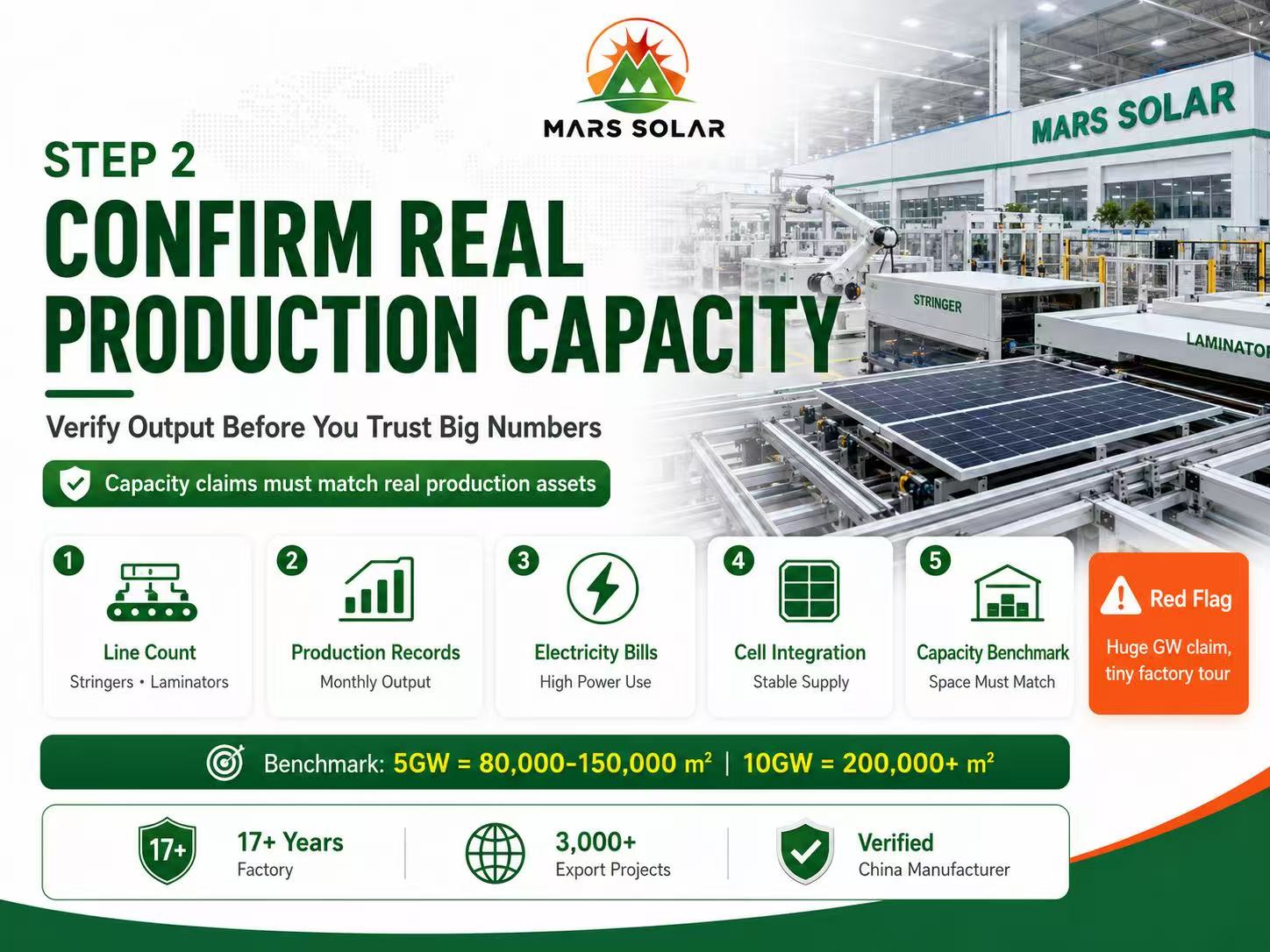
Production capacity claims are the most inflated number in the solar industry. A factory claiming "20 GW annual capacity" might actually have 2 GW — and they'll still quote you based on the 20 GW number.
How to verify:
Benchmark numbers: A real 5 GW factory occupies 80,000-150,000 m² of production space. A real 10 GW factory needs 200,000+ m². If they claim huge capacity but offer factory tours only in a small building, the numbers are wrong.
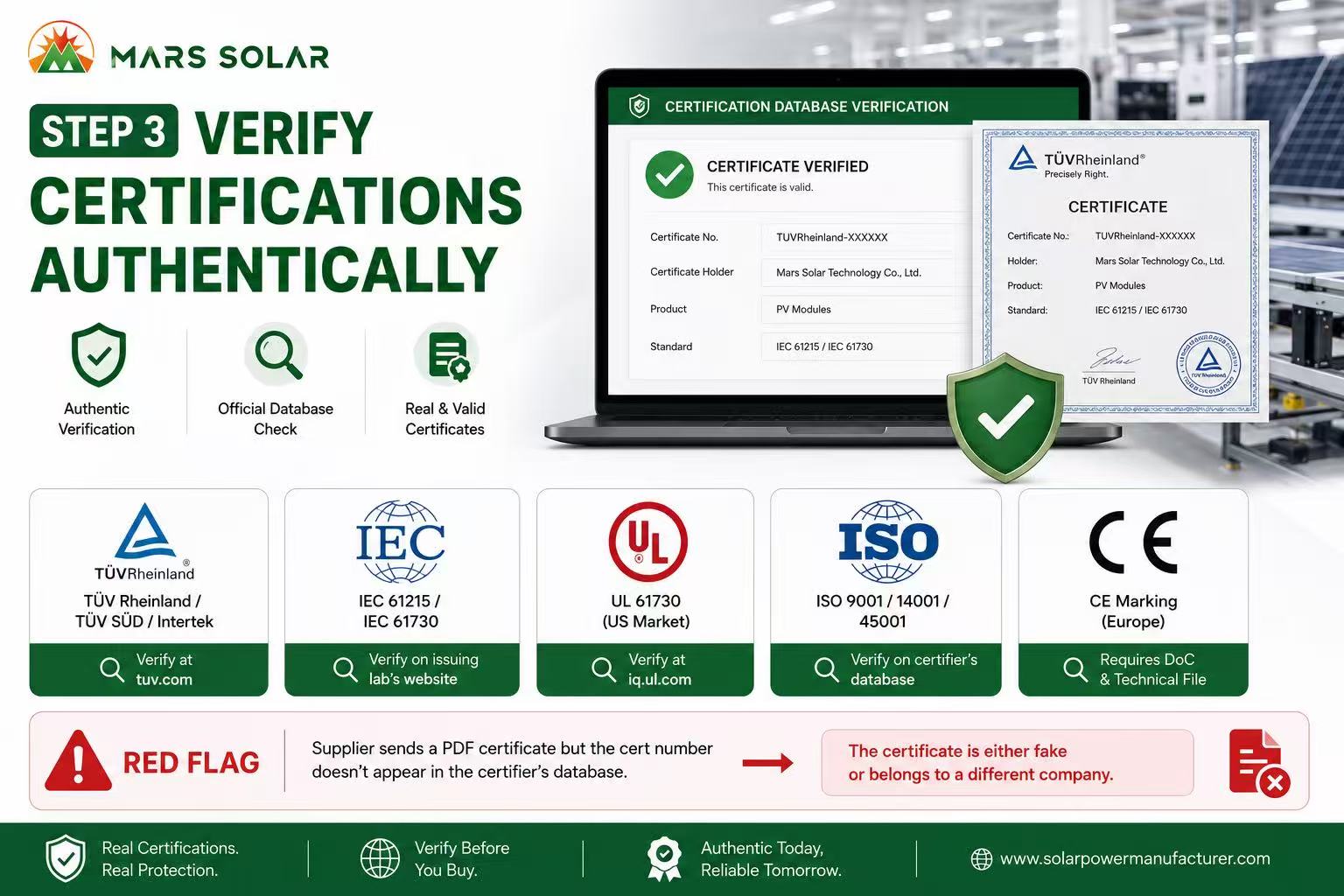
Certifications are easy to fake on the supplier's own website, harder to fake on the certification body's official database. Every major certification has a searchable public database.
Authenticity checklist:
Red flag: Supplier sends a PDF certificate but the cert number doesn't appear in the certifier's database. This means the certificate is either fake or belongs to a different company.
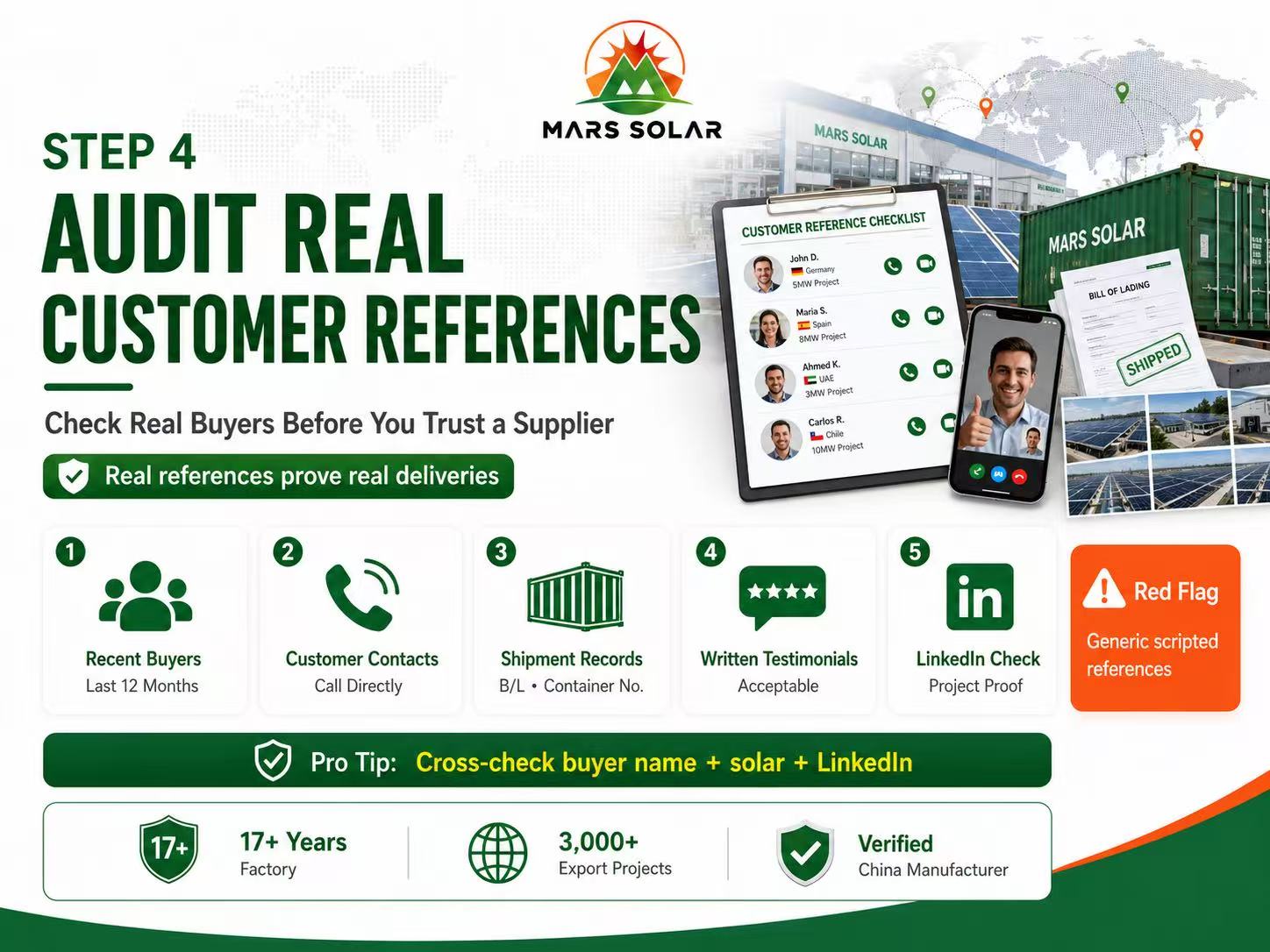
Every serious factory has shipped to dozens of countries and can name 5-10 real buyers who can confirm. If a supplier can't provide references, they're either new (high risk) or hiding something (higher risk).
What to ask:
How to spot fake references: References that answer with the same generic script ("very good quality, fast delivery"), or whose email signature matches the supplier's domain. Real references can describe specific issues they had and how the supplier resolved them.
Cross-check: Search the buyer's company name + "solar" + LinkedIn. Real references will have visible solar projects in their portfolio.
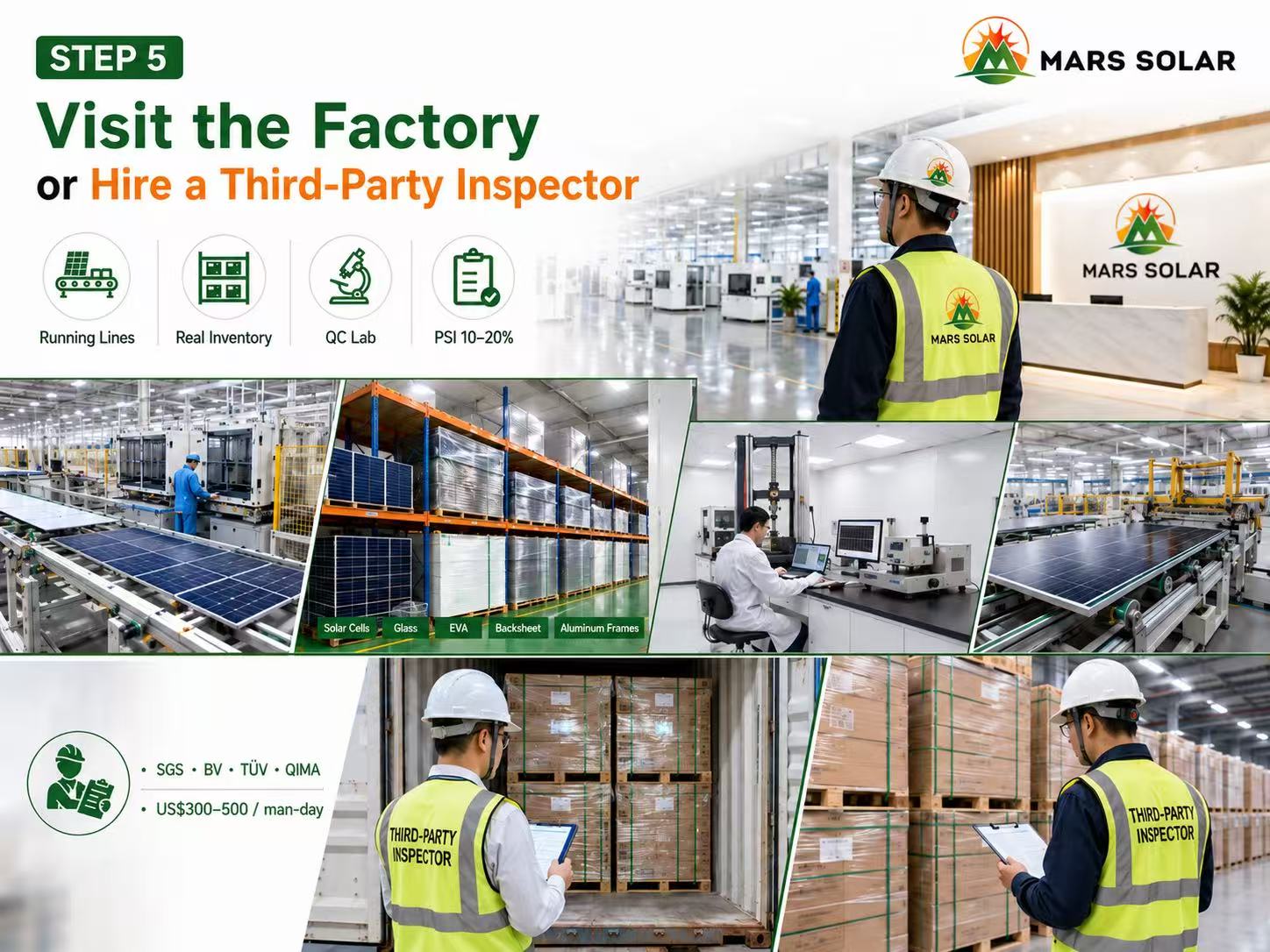
The best verification is a physical visit. A real factory has a reception, a production floor you can walk through, real employees, real inventory, and a quality control lab you can inspect.
What to look for during the visit:
Can't visit? Hire a third-party inspection service — SGS, Bureau Veritas, TÜV, AsiaInspection, or QIMA. Cost: $300-500 per man-day in China. Order a pre-shipment inspection (PSI) on at least 10-20% of containers, randomly selected.
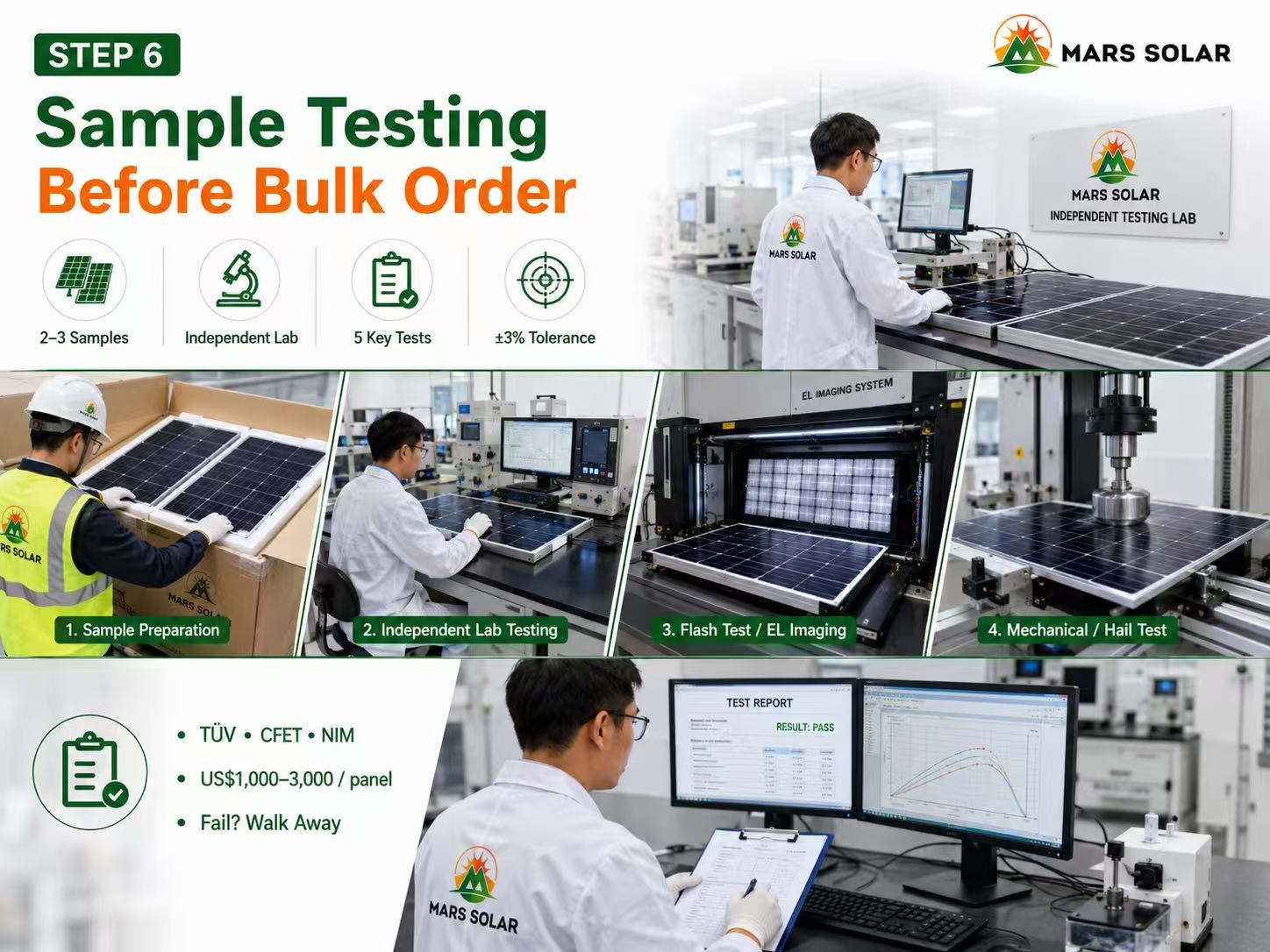
Never place a bulk order without samples tested by an independent lab. A factory's own test reports are not sufficient — they're from a lab the factory controls.
Sample testing protocol:
What to do with results: If samples fail, walk away — the factory is either cutting corners or has a quality control problem that will affect every panel in your bulk order.
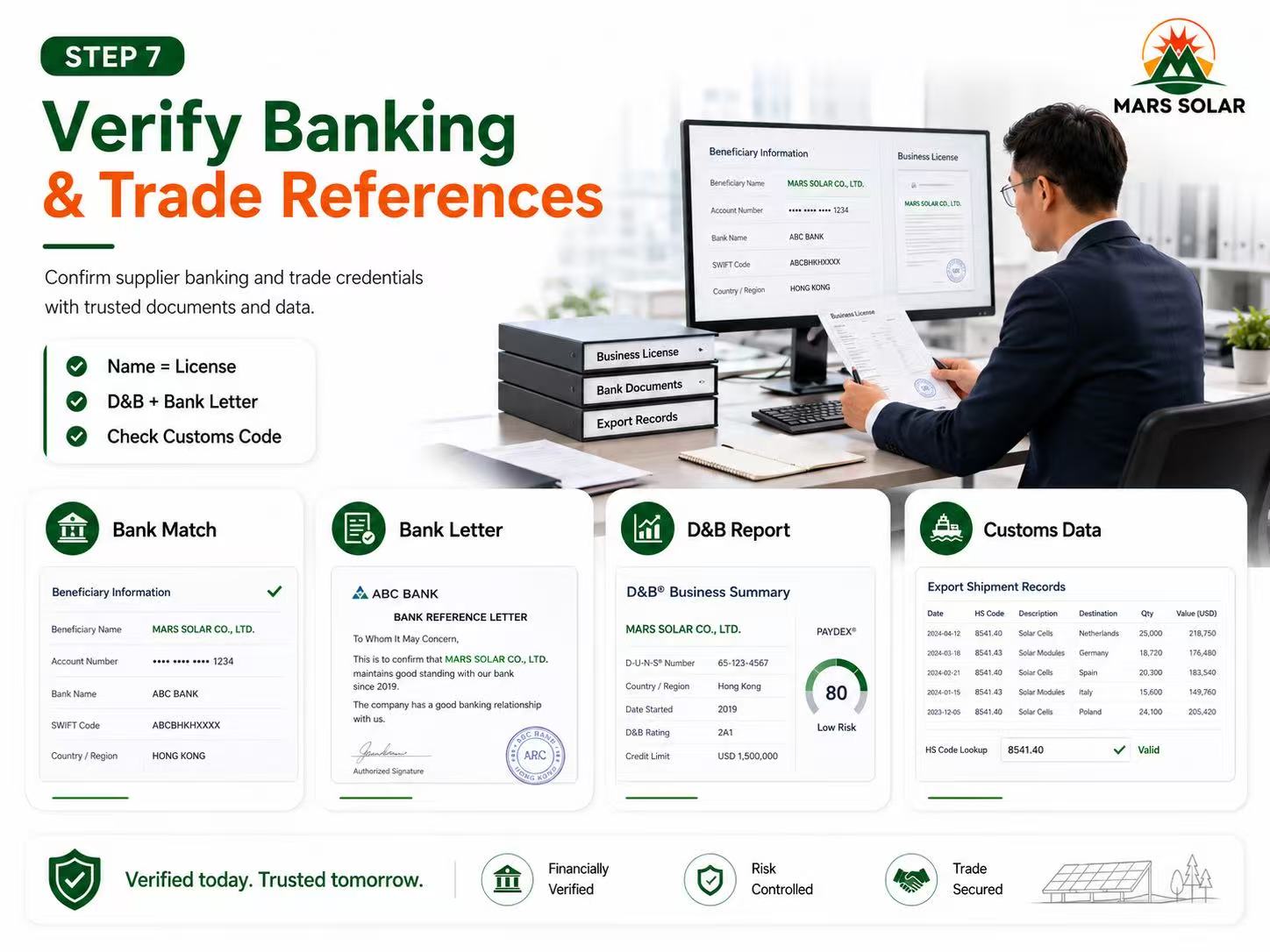
The final step is financial verification. A real factory has a corporate bank account, a real USD/EUR receiving account, and a clean trade record.
What to check:
Critical check: Ask for the supplier's customs registration code (海关编码) and look up their export record. A factory claiming $50M annual exports but showing only $3M in customs data is lying.
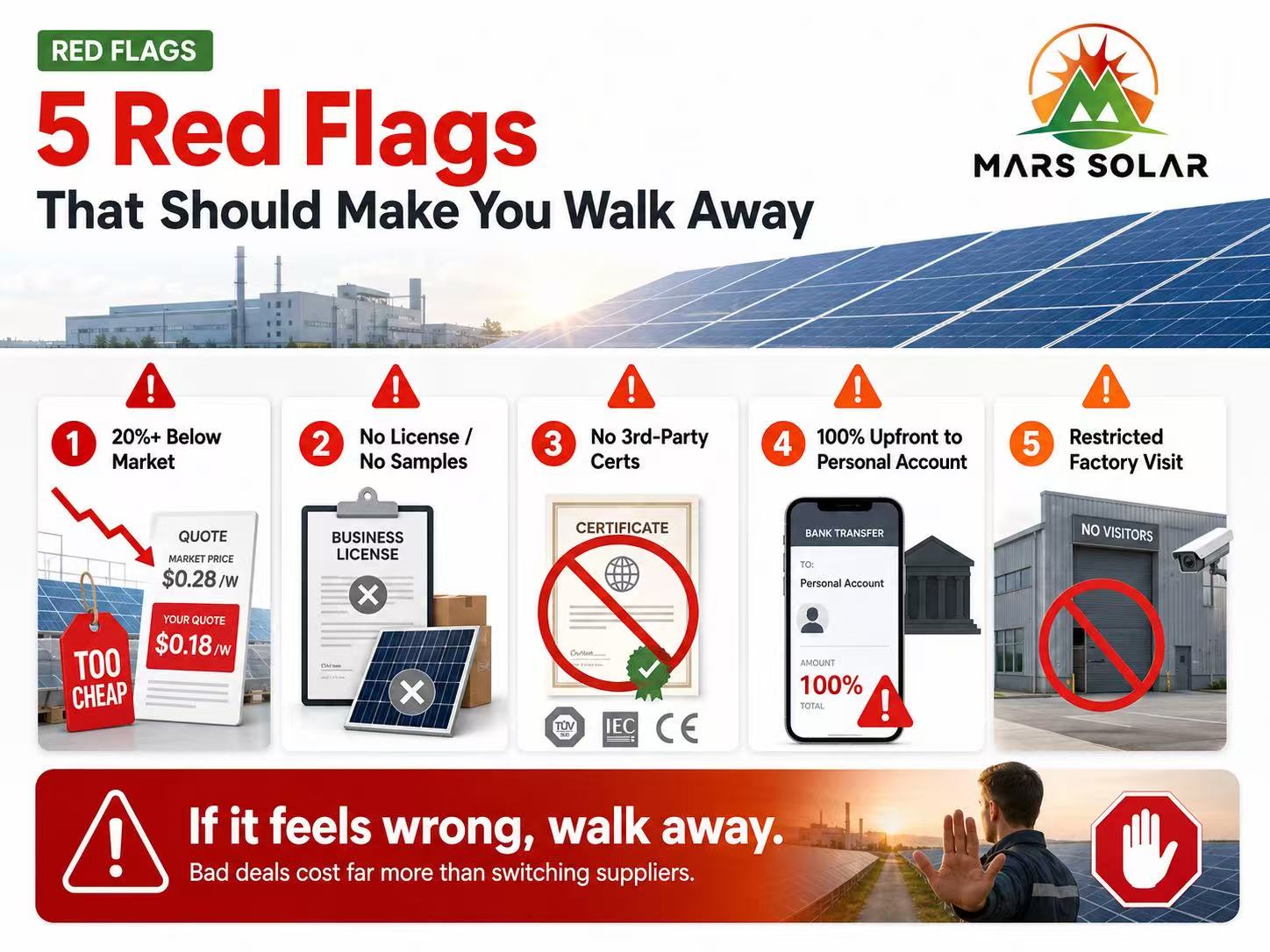
Even with all 7 steps completed, watch for these specific red flags that have cost solar buyers millions:
Remember: If anything feels wrong, trust your gut. The cost of a bad solar panel deal is 10-100x the cost of walking away and finding another supplier. For the full step-by-step version, read our guide to choosing reliable solar system suppliers.
For transparency, here's how Mars Solar stands up to each of the 7 steps:
Q: How long does the full 7-step verification take?
A: 2-4 weeks if you're systematic. Steps 1-3 and 7 can be done remotely in 3-5 days. Steps 4-6 require supplier cooperation and take 1-3 weeks.
Q: Is a third-party factory audit worth the cost?
A: Yes, for any order above $50,000. A $500 audit can prevent a $500,000 loss. SGS and TÜV audits also give you a written report you can use in your own sales materials.
Q: Can I skip the factory visit if I have good references?
A: Not recommended. References can be fake. Combine remote verification (steps 1-4, 7) with a third-party inspector (step 5 alternative) for orders above $100,000.
Q: What's the minimum order that justifies a full 7-step verification?
A: Any order above $10,000. Below that, at minimum do steps 1, 3, and 7. The cost of verification is always less than the cost of a bad order.
Q: What if the supplier passes all 7 steps but the panels still have quality issues?
A: Always use a Letter of Credit (L/C) with quality inspection clauses, and require a pre-shipment inspection (PSI) by SGS or TÜV. Never pay 100% before goods pass PSI.
Start with the business licence on gsxt.gov.cn and check three fields: the registration date, the registered capital and the registered scope. A supplier claiming seventeen years of experience against a licence issued three years ago has already failed the first step of the China solar factory audit. Registered capital below ¥5 million is unusual for a panel factory, and below ¥1 million almost always indicates a trading company rather than a manufacturer.
Ask for the line count and the cell-to-module integration, then check the equipment maths. A genuine 5 GW line needs roughly four to six stringer machines and eight to ten laminators in balance; if the numbers do not add up, the capacity figure is inflated. In a China solar factory audit, monthly output reports and electricity bills are the harder evidence — a 5 GW factory spends USD 1–3 million a month on power alone.
Look each certificate up on the issuing body's own database, not on the supplier's website. Modules should show IEC 61215 and IEC 61730 through a recognised laboratory; a UL 61730 listing can be checked on UL Product iQ; quality and environmental systems through the certifier that issued them. The step in a China solar factory audit that buyers skip is checking the certificate holder — it must be the entity invoicing you.
Ask for three to five contacts in your own region who bought within the last twelve months, with company name, project size and a reachable phone number. Then actually call two of them and ask what went wrong, not whether they were satisfied. A China solar factory audit that collects references without verifying them has added paperwork rather than evidence.
Above roughly USD 50,000 of order value, yes. A pre-shipment inspection by SGS, Bureau Veritas, TÜV, AsiaInspection or QIMA costs about USD 300–500 per man-day in China and returns a written report you can put in front of your own customers. In a China solar factory audit, the report also gives you a baseline photograph set — useful when a later shipment does not match the sample.
Order two or three panels of the exact model you intend to buy — same cell type, same power class, same bill of materials — and have them independently tested. A full test panel runs USD 1,000–3,000 and covers flash testing, insulation withstand at 1,000 V and 1,500 V DC, mechanical load at 2,400 Pa front and 1,600 Pa rear, and hail impact. That is the step of a China solar factory audit that catches B-grade cells.
Ask for the customs registration code and look up the company's own shipment record through a trade database, filtered on HS 8541.40 for solar cells and 8541.43 for modules. A supplier claiming USD 50 million of annual exports but showing USD 3 million in customs data has failed the China solar factory audit on the financial side. This check takes an afternoon and settles most doubt.
Confirm the corporate account name matches the registered entity, that the receiving account is in the same country as the factory, and that multi-currency accounts exist for USD and EUR. A customs duty-adjacent detail that matters here: in a China solar factory audit, payment to a personal account or to a third country is the single clearest sign that the counterparty is not the manufacturer.
Two to four weeks if you work systematically. Steps one to four and the banking check can be completed remotely in three to five days; references and sample testing need supplier cooperation and take one to three weeks. A China solar factory audit should therefore start before you need the goods, not after you have signed a contract with a delivery date.
Five patterns. A price 20% or more below the market with no explanation. Pressure to pay 100% upfront to an individual or offshore account. A refusal to send the business licence. Factory tours offered only in a small building inconsistent with the claimed capacity. And certification screenshots instead of certificate numbers. Any two of those together should close a China solar factory audit on the spot.
Yes, but the depth can scale. Below USD 10,000 an order rarely justifies a site visit, so complete the three checks that cost nothing — business licence, certificate verification and banking details — and insist on a pre-shipment inspection report. Above USD 100,000 a China solar factory audit should include a physical visit or a third-party inspector, because the loss you are insuring against grows with the order.
Then the protection is contractual, not investigative. Use a letter of credit with a quality-inspection clause, require a pre-shipment inspection by an independent laboratory, and write the flash-test tolerance and the warranty issuer into the contract. A completed China solar factory audit is a screening tool; it does not replace a performance warranty held by the entity that actually manufactures the module.
Partly. Documents, certificates, customs records and bank details can all be verified remotely, and those checks eliminate most trading companies without a visit. What a remote China solar factory audit cannot confirm is whether the production lines described actually exist at the scale claimed, which is why a live video walk through the floor or a third-party inspector is the usual compromise.
Score them on the same seven dimensions and keep the evidence with the score. A China solar factory audit becomes decision-grade when you can put three suppliers side by side on registration, capacity, certification holder, verified references, inspection outcome, customs record and bank details. Price enters the table last, because price is the variable most easily manufactured.
Seven, in one pack: the business licence, the production line list, the certificate numbers with their issuing laboratories, three verifiable references, a third-party inspection report, the customs registration code, and the bank account details in the factory's own name. A China solar factory audit is complete when that pack arrives without being chased. If any item needs three reminders, treat the silence as the finding.
Orders of magnitude more. A China solar factory audit of the kind described here costs a few thousand dollars once samples and inspection are included; a container of B-grade modules or an unbranded inverter costs the equipment value, the freight both ways, the installation labour and the customer who never orders again. Treating the China solar factory audit as overhead is the mistake that makes it feel expensive.
Continue your sourcing research with these guides:
Audit findings only matter if you can act on them commercially, so it is worth reading how raw material costs and policy shifts are reshaping solar supply before you negotiate price against a completed audit report.
A completed audit is easiest to judge against a real project record — the 2MW electroplating factory system in Malaysia shows the documentation an audited factory actually hands over.
Mars Solar is a verified China solar panel manufacturer with 17+ years of experience, annual output exceeding 5 GW of solar modules, and 3,000+ export projects across 130+ countries. All certifications are verifiable on issuing bodies' databases. We welcome factory visits, sample testing, and third-party inspections.
Get a verified quote: Email info@marssolargroup.com with your project size, target market, and required certifications. We respond within 24 hours with full documentation, references, and FOB/CIF pricing.
 English English
  Arabic
 Spanish
 French
 Dutch
Dutch
 Portuguese