
Taal
Philippines solar import in 2026 is the best it has ever been on paper — and the most dangerous it has ever been in practice. On paper, solar panels enter at 0% duty and 0% VAT for DOE-registered renewable energy developers under RA 9513 and the CREATE MORE Act. In practice, a new BPS mandatory certification regulation that passed on 30 June 2026 now covers solar panels, inverters, charge controllers, PV cables, and battery energy storage systems, with a 12-month transition window that closes in July 2027. Importers who ship without PS or ICC certification are already being pulled into the Red Lane for full physical inspection at Manila, Batangas, and Cebu.
This guide is the practical counterpart to our 2026 Philippines solar panel price guide: that article tells you what the system costs once it lands, this one tells you how to get it through customs without losing the tax incentives you are entitled to, and without a container stranded at Port of Manila. It covers the 0% duty pathway, the exact certification documents BPS now requires, the lithium battery dangerous-goods file that sinks most BESS shipments, the EVRIS valuation trap, and the eight mistakes that cost importers the most money in 2026.
Who this is for: Philippine EPC contractors, DOE-registered RE developers, PEZA and BOI-registered manufacturers, solar distributors building inventory, and C&I end users importing a 100 kW to 5 MW system directly. All regulatory references are current as of September 2026. Sources: Bureau of Product Standards draft technical regulation (passed 30 June 2026), Bureau of Customs Tariff Finder AHTN 2022, DOE Certificate of Registration guidelines, RA 9513 Renewable Energy Act, RA 12066 CREATE MORE Act, RA 11697 EV Industry Development Act.
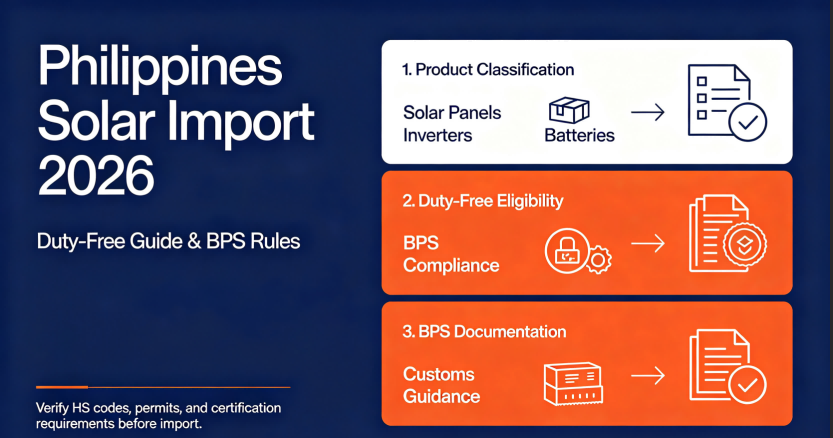
Getting Philippines solar import duty treatment right starts with knowing which category you fall into: DOE-registered renewable energy developer, or ordinary trader. The two paths carry very different landed costs on the same container.
Two laws drive the tax savings, and they stack. The Renewable Energy Act (RA 9513) allows a DOE-registered renewable energy developer to import machinery, equipment, and parts duty-free for the first ten years after registration. The CREATE MORE Act (RA 12066) reinforces 0% VAT on imports that are "directly attributable" to that registered project. Together, they erase both the tariff and the 12% VAT on qualifying solar hardware.
This is not automatic. Four conditions must be satisfied before the vessel sails, and missing any one of them means your cargo lands in the Red Lane or suffers a valuation hold:
Who does NOT get 0% duty
A trader importing panels to resell does not qualify. Without DOE registration, a distributor pays standard duty (roughly 0–5% depending on the sub-classification) plus 12% VAT on the CIF value. That is a real cost delta: on a USD 100,000 panel order, losing the incentive costs roughly USD 12,000 in irrecoverable VAT alone unless the importer is VAT-registered and can claim input tax credit.
Tariff classification by product (AHTN 2022)
| Product | HS code | MFN duty | Incentive-eligible rate | Required certification |
|---|---|---|---|---|
| Zonnepanelen | 8541.40 | 0% | 0% under DOE registration / CREATE MORE; otherwise 0–3% MFN + 12% VAT | BPS PS or ICC + IEC 61215 + IEC 61730 |
| Grid-tie / hybrid inverters | 8504.40 | 0–5% MFN | 0% under DOE registration / CREATE MORE | BPS PS or ICC + IEC 62109 |
| Battery energy storage (BESS) | 8507.60 | 0–5% MFN | 0% under DOE registration / CREATE MORE | BPS PS or ICC + IEC 62619 + IEC 63056 + UN38.3 |
| Battery charge controllers | 8537.20 | 0–5% MFN | 0% under DOE registration / CREATE MORE | BPS PS or ICC |
| PV-specific cables | 8544.49 | 0–7% MFN | 0% under DOE registration / CREATE MORE | BPS ICC + PNS certification |
| Rapid shutdown devices | 8536.50 | 1–5% MFN | 0–5% | BPS ICC |
| Mounting structures (aluminum) | 7610.90 | 1–7% MFN | Standard rate applies (not RE-attributable) | None (structural) |
| LV switchgear / protection | 8537.10 | 0–5% MFN | 0–5% | BPS ICC for covered components |
Note: DTI issued an advance ruling mechanism that locks a tariff classification for five years — strongly recommended for high-value or first-time shipments, since misclassification is one of the most common BOC post-clearance audit triggers and can result in duty assessments and penalties up to three years after the goods were released.
Source: BOC Tariff Finder AHTN 2022, DOE RE Registration Guidelines, RA 9513 Sec. 7, RA 12066 Sec. 6.
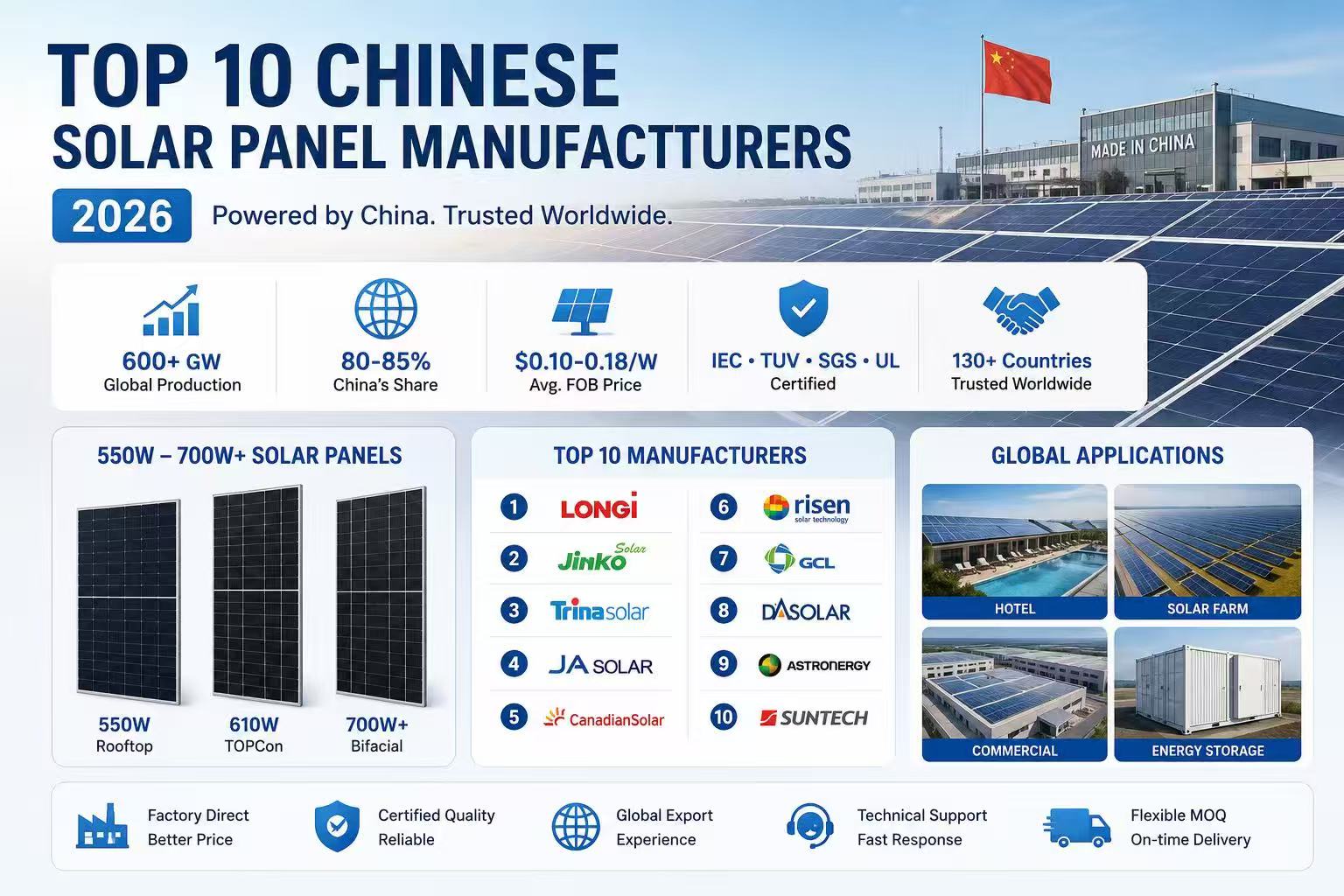
In May 2026, the Bureau of Product Standards (BPS) under the Department of Trade and Industry released a draft technical regulation on mandatory product certification for solar energy systems. The regulation passed on 30 June 2026 and took effect as a binding administrative order in mid-July 2026. It brings battery energy storage systems into scope for the first time.
The transition period is a compliance window, not an exemption. Some Philippine ports have already begun random inspections on uncertified shipments, and the mandatory phase begins within 12 months of effectivity. Importers who start certification now will hold valid documents well before the deadline; those who wait will face a backlog at BPS testing labs and delayed shipments through 2027.
Products now covered by mandatory certification
Two certification pathways — which one you need
| Pathway | Who applies | Validity | Process | Het meest geschikt voor |
|---|---|---|---|---|
| PS Certification (Philippine Standards License) | Manufacturers (local or overseas) | 3 jaar | Factory audit + annual surveillance inspection | Long-term market presence, repeat shipments |
| ICC Certification (Import Commodity Clearance) | Importers (Philippine entity only) | Per shipment | Sample testing per batch (2 units per model) + BPS lab test | Trial orders, small batch, one-off projects |
The critical difference: PS certification belongs to the manufacturer, ICC certification belongs to the importer. A single PS certificate corresponds to one local importer; multiple importers of the same product need separate arrangements. For overseas manufacturers, PS application requires appointing a local Philippine compliance representative to submit on their behalf.
Compliance timeline
| Milestone | What happens |
|---|---|
| 30 June 2026 | BPS technical regulation officially passed, covering solar panels, inverters, charge controllers, PV cables, and BESS. |
| Mid-July 2026 | Regulation takes effect as a legally binding administrative order. Ports may begin random inspections on uncertified shipments. |
| Within 12 months (~July 2027) | Mandatory certification begins. Manufacturers and importers must formally initiate the certification process. |
| ~July 2029 (36 months) | Full enforcement. Uncertified products prohibited from sale; comprehensive market inspections begin. |
The single most common mistake: using CE or IEC certificates as substitutes
The Philippines recognises BPS PS or ICC certification. CE marking, and even IEC test reports on their own, are supporting documents — not substitutes. A supplier that holds CE, TUV, and IEC certificates but no PS or ICC pathway will still have its shipment held at Port of Manila. Requesting the PS/ICC status of a supplier before signing a purchase order is the single highest-value compliance question an importer can ask in 2026.
Source: BPS draft technical regulation on solar energy systems (passed 30 June 2026), DTI Bureau of Product Standards certification guidelines, PNS UL2056 / IEC 62109 / IEC 62619 reference standards.
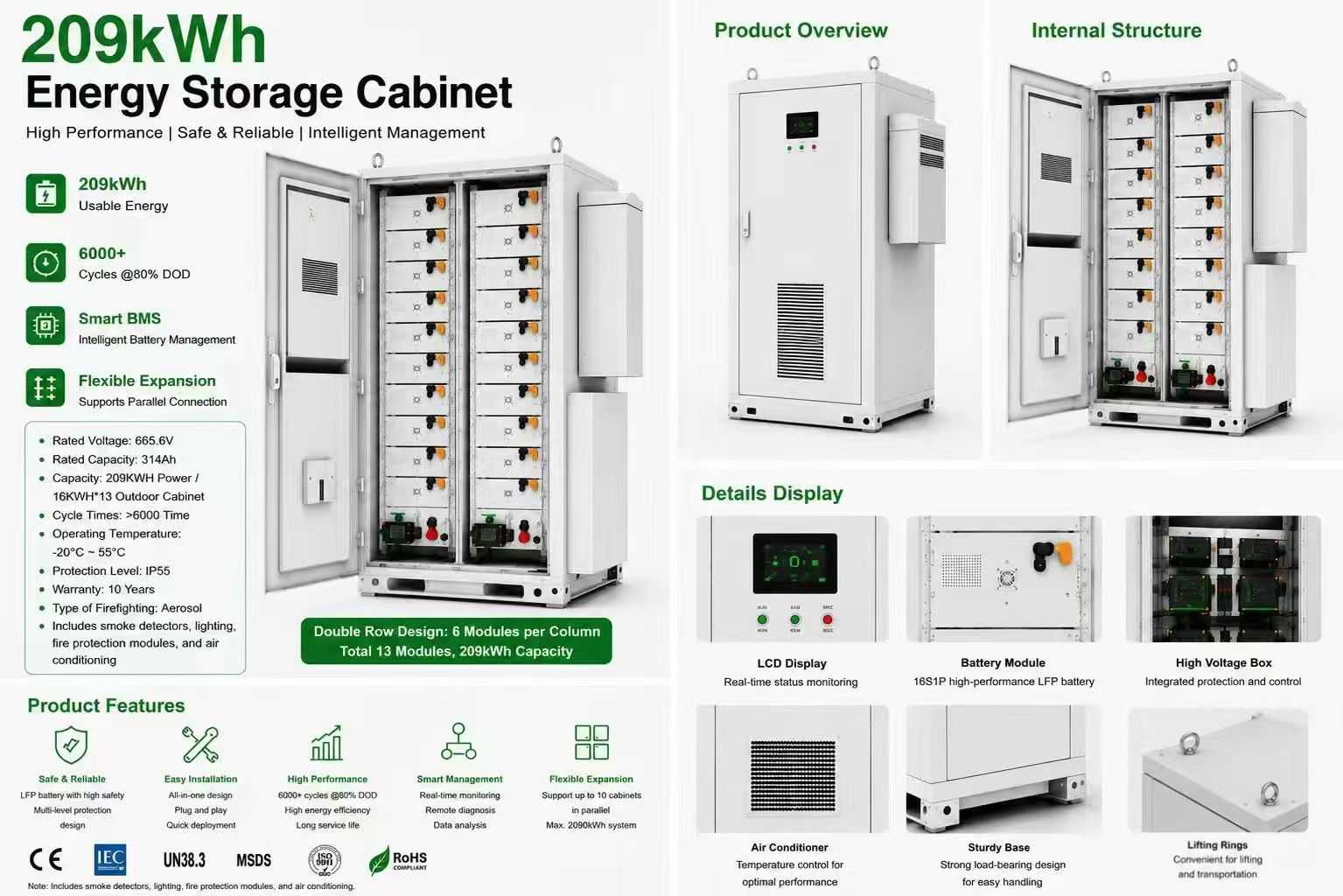
Lithium battery systems are Class 9 dangerous goods, and Philippine ports inspect them more aggressively than any other solar component. Containerised BESS and rack-mounted battery systems face what is called LPSR (pre-shipment inspection), an inspection process with heavier scrutiny than ordinary cargo, longer processing time, and a hard requirement that all safety documentation be complete before the vessel sails.
The BESS import document set
| Document | Purpose | Issuer | Critical notes |
|---|---|---|---|
| UN38.3 test report | Lithium battery transport safety (8 tests: altitude simulation, thermal cycling, vibration, shock, external short circuit, impact, overcharge, forced discharge) | Accredited lab (TUV, UL, SGS, Intertek, CNAS/CMA) | Valid for 1 year. Rev.8 standard applies in 2026. Retest required if cell spec, BMS, or packaging process changes. |
| MSDS (Material Safety Data Sheet) | Battery composition, rated energy in Wh, hazard characteristics, emergency response procedures | Cell or pack manufacturer | English version. 16 sections per GHS format. Must match the exact product model. |
| Dangerous goods packaging certificate | Proof of packaging compliance with UN/DOT and IMDG/IATA dangerous goods rules | Certified packaging supplier with UN mark | Required for booking, export declaration, and customs clearance. Inspectors verify marks and labels on site. |
| LPSR pre-shipment inspection (mandatory 2026) | Third-party inspection at the origin port before vessel departure, verifying model, quantity, and nameplate data | Philippine-authorised third-party inspection body | Issued before departure. No LPSR report means no customs clearance. Allow 10–20 working days for BESS. |
| IEC 62619 test report | Safety of industrial lithium battery systems | Third-party lab per IEC standards | Baseline for grid-connected or industrial storage. Treat absence as a red flag. |
| IEC 63056 test report | Electrical safety for energy storage systems | Testing lab or certification body | May be requested for grid connection or local compliance. |
| Technical dossier | BMS architecture, cell datasheets, thermal management diagrams, risk assessment | System integrator / manufacturer | Increasingly requested by customs for lithium-ion systems due to fire and transport hazards. |
Why LPSR takes longer for BESS than for panels
Philippine LPSR for energy storage focuses on three things beyond standard cargo inspection: deep review of safety documentation, strict verification of packaging and transport conditions, and matching between declared value and technical specification. Because BESS combines electrochemical, electronic, and control technology in one high-value unit, inspectors verify capacity, voltage, brand, and model against the declared value to prevent under-declaration. Typical LPSR processing time for storage systems is 10–20 working days or longer; incomplete safety documents or non-compliant packaging will interrupt the process and extend it substantially.
Supply chain traceability is now an inspection point
Documentation must clearly identify the manufacturer at each level: cell, module, and system integration. The value of the whole chain has to be traceable. For a 500 kWh rack-mounted LFP system, prepare a documentation package that names the cell manufacturer (CATL, BYD, REPT, EVE, Gotion), the module assembler, and the system integrator, with matching model numbers across all three levels.
Use a dangerous goods-qualified forwarder
Not every freight forwarder handles Class 9 cargo. Verify that your forwarder holds dangerous goods qualifications and that the shipment is prepared under IMDG rules before it reaches the export port. For BESS specifically, the combination of LPSR timing, DG documentation, and port inspection means the forwarder choice matters as much as the supplier choice.
Source: Philippine LPSR guidelines for energy storage systems, IMDG Code Class 9 requirements, UN Manual of Tests and Criteria Rev.8, IEC 62619 / IEC 63056.
Clearing solar equipment at a Philippine port is a ten-step process with three points where shipments most commonly fail: certification, valuation, and lane assignment. Here is the full workflow, followed by the mistake list.
Step-by-step clearance workflow
| Stap | Action | Timing | Key requirement |
|---|---|---|---|
| 1 | Register as an importer with BOC | One-time | BIR tax ID, SEC/DTI registration, customs accreditation |
| 2 | Classify each item by AHTN 2022 HS code | Before ordering | Verify against BOC Tariff Finder; consider a 5-year advance ruling |
| 3 | Secure DOE COR + Certificate of Endorsement | Before shipment | For 0% duty + 0% VAT pathway only; requires DOE-registered RE developer status |
| 4 | Confirm PS or ICC certification status | Before shipment | PS = manufacturer (3 yr); ICC = importer (per shipment) |
| 5 | Prepare the dangerous goods file (BESS) | Before shipment | UN38.3 + MSDS + DG packaging cert + LPSR inspection |
| 6 | Appoint a licensed customs broker | Before shipment | Broker files the Import Entry and Internal Revenue Declaration via BOC E2M |
| 7 | File import entry via E2M | Pre-arrival | Commercial invoice, packing list, bill of lading, certificate of origin (Form D or RCEP) |
| 8 | Pay duty + VAT + charges | On assessment | Through BOC authorised banks or online portal; 0% duty still triggers 12% VAT without DOE registration |
| 9 | Lane assignment and release | On payment | Green (no exam), Yellow (document check), Red (physical examination) |
| 10 | Retain records for post-clearance audit | 3 jaar | BOC conducts PCA up to 3 years after import |
The EVRIS valuation trap
The Bureau of Customs uses the Electronic Valuation Reference Information System (EVRIS) to benchmark import prices by HS code. If the declared value for solar modules, inverters, or batteries sits below the current benchmark, customs can hold cargo for a valuation dispute. This is a costly delay on time-sensitive project freight — a seven-day congestion hold can blow a commissioning schedule. The defence is straightforward: submit verifiable proof of payment alongside supplier invoices, and ensure the declared CIF value reflects the actual transaction. Low declaration to reduce duty is the single most common cause of valuation holds in 2026.
Ports and lead times
The 8 mistakes that cost importers the most money
| Mistake | Consequence | Fix |
|---|---|---|
| Using CE or IEC certificates instead of BPS certification | Shipment held at Manila port, which can lead to re-export | Confirm PS/ICC pathway with the supplier before ordering |
| Assuming DOE registration covers everything automatically | Red Lane inspection or valuation hold | Secure the DOE Certificate of Endorsement separately, before shipment |
| Under-declaring CIF value to reduce duty | EVRIS valuation dispute and multi-week hold | Declare true value with verifiable payment proof and supplier invoices |
| Shipping BESS without an LPSR report | Cargo cannot clear customs at all | Schedule LPSR inspection 10–20 working days before departure |
| Mixing uncertified balance-of-system parts into a certified container | A single uncertified breaker can strand a full container | Review the packing list against BPS scope before shipment |
| Using a general forwarder for Class 9 cargo | Booking refusal or DG compliance failure at export port | Select a forwarder with verified dangerous goods qualifications |
| Missing the Certificate of Origin | No FTA duty preference (ATIGA / RCEP / ITA) | Prepare Form D or RCEP certificate of origin before departure |
| Ignoring the July 2027 mandatory certification deadline | Backlog at BPS labs and delayed 2027 shipments | Start the PS or ICC process during the transition window |
Source: BOC E2M filing procedure, BOC EVRIS valuation guidelines, RA 9513, RA 12066, BPS certification regulation (30 June 2026).
Duty treatment does not change with system size, so importers usually test it on a mid-size order first — a 400KW system is typical. For what that size looks like once installed, see our 100 kW cold storage project in the Philippines.
Importers who intend to resell rather than install should read our Philippine solar import business guide alongside the duty rules above.
Do I pay duty on solar panels imported into the Philippines?
Solar PV panels (HS 8541.40) enter at 0% MFN duty and 0% under applicable FTAs. A DOE-registered renewable energy developer importing for its own registered project pays 0% duty plus 0% VAT under RA 9513 and CREATE MORE. A trader importing panels to resell without DOE registration pays 0–3% duty plus 12% VAT on the CIF value.
What is the landed cost of solar panels in Manila in 2026?
Factory-direct CIF Manila pricing for Tier-1 monocrystalline panels sits in the USD 0.08–0.12 per watt range. On a full container (40HQ, roughly 612–720 panels depending on wattage), add freight, insurance, and clearance. For DOE-registered developers the landed cost carries no duty and no VAT; for traders, add 12% VAT and 0–3% duty. See the full Philippines 2026 price guide.
Do I need BPS certification to import solar equipment into the Philippines?
Yes, for products in scope. The BPS technical regulation passed on 30 June 2026 covers solar PV modules, inverters, battery charge controllers, PV cables, rapid shutdown devices, and battery energy storage systems. The transition window closes in July 2027. During the transition, either PS certification (manufacturer-level, 3-year validity) or ICC certification (importer-level, per shipment) satisfies the requirement.
Can I use my CE certificate for Philippine customs?
No. The Philippines recognises BPS PS or ICC certification. CE marking and IEC test reports are supporting evidence, not substitutes. Shipments arriving with only CE documentation have been held at Port of Manila and re-exported. Confirm the PS/ICC pathway with your supplier before signing a purchase order.
What documents do I need to import lithium batteries or BESS into the Philippines?
UN38.3 test report (valid 1 year), MSDS in English matching the exact model, dangerous goods packaging certificate per IMDG, and a mandatory LPSR pre-shipment inspection report issued before vessel departure. For grid-connected or industrial storage, add IEC 62619 and typically IEC 63056, plus a technical dossier covering BMS architecture, cell datasheets, thermal management, and risk assessment. LPSR processing for BESS takes 10–20 working days or more.
What is the most common reason solar shipments get held at Philippine customs?
Three causes dominate: (1) missing or wrong certification — using CE instead of BPS PS/ICC; (2) under-declared CIF value triggering an EVRIS valuation dispute; (3) an uncertified balance-of-system component inside an otherwise certified container, which sends the whole shipment to the Red Lane for physical examination.
How do I qualify for 0% duty and 0% VAT on a solar import in the Philippines?
Four steps: obtain a DOE Certificate of Registration as a renewable energy developer; secure a DOE Certificate of Endorsement for duty-free importation before the goods ship; ensure the equipment is exclusively for the registered RE facility with shipping documents in the developer's name; and verify the correct AHTN 2022 classification for each line item. Contact us for a documents checklist tailored to your project.
For a factory-direct quotation sized to your site, see our solar system Philippines page: configurations, 2026 reference pricing to Manila and Batangas, and the DOE and BPS documents we prepare before the vessel sails.
Import duty is levied on the customs value of goods entering a territory, which is why the exemption route matters far more than the freight rate on a Philippines solar import.
Do I pay duty on a Philippines solar import in 2026?
Only if you are not DOE-registered. A Philippines solar import by a DOE-registered renewable energy developer enters at 0% duty and 0% VAT under RA 9513 and the CREATE MORE Act. Without that registration, the same Philippines solar import pays 0 to 5% duty plus 12% VAT on CIF.
Who qualifies for the tax-free Philippines solar import pathway?
DOE-registered renewable energy developers, PEZA and BOI-registered manufacturers and eligible EPC contractors. A trader importing panels to resell does not qualify for a tax-free Philippines solar import. On a USD 100,000 order, losing that status is the largest single cost in a Philippines solar import.
How long does the duty-free window last on a Philippines solar import?
Ten years from DOE registration under RA 9513. Plan a Philippines solar import around that clock rather than around equipment price, because the exemption is time-limited. Once it closes, a Philippines solar import reverts to standard duty plus 12% VAT.
What tariff classification does a Philippines solar import need?
A correct AHTN 2022 classification for every line item, verified against the BOC Tariff Finder. A Philippines solar import declared under a single broad code loses the module's preferential treatment. Writing the classification down before shipment is the cheapest insurance on any Philippines solar import.
What does BPS certification mean for a Philippines solar import?
Mandatory product certification, passed on 30 June 2026 and taking effect with a transition window that closes in July 2027. A Philippines solar import of modules or inverters without BPS registration will be refused at that deadline. Treat BPS as a fixed date on the Philippines solar import calendar.
What documents does a Philippines solar import of batteries require?
BPS PS or ICC marking, IEC 62619, IEC 63056 and a UN 38.3 test summary. A Philippines solar import carrying lithium storage fails on documentation rather than on hardware. Preparing that file at origin is what keeps a Philippines solar import out of port storage.
How much VAT applies to a Philippines solar import?
Twelve per cent on the CIF value for ordinary importers, and zero for DOE-registered developers. That single distinction moves the landed cost of a Philippines solar import more than any freight negotiation. Confirm registration status before, not after, a Philippines solar import is assessed.
What is the EVRIS valuation issue in a Philippines solar import?
It is the customs valuation step where an under-declared or inconsistent invoice value triggers review. A Philippines solar import assessed above its declared value pays duty and VAT on the higher figure. Keeping invoice, packing list and classification consistent is how a Philippines solar import avoids that.
Which mistakes cost the most on a Philippines solar import?
Misclassification, missing BPS registration, incomplete dangerous-goods paperwork for batteries, and shipment before certification is issued. Each turns a routine Philippines solar import into a storage bill. Checking those four before loading protects the margin on a Philippines solar import.
What system sizes are typically handled on a Philippines solar import?
Most commercial buyers bring in 100 kW to 5 MW directly. A Philippines solar import at that scale ships as four or five HS classifications, so blended duty is what matters. Treating a Philippines solar import as one product line is the commonest analytical error.
Does a Philippines solar import need a Certificate of Origin?
It helps, and consistent classification is what carries the exemption. A Philippines solar import supported by matching origin and classification documents clears faster. When duty treatment is disputed, the paper trail behind the Philippines solar import decides the outcome.
How do I plan the timeline for a Philippines solar import?
Work backwards from the BPS and DOE dates, then from the sailing schedule. A Philippines solar import sequence that starts with certification and ends with booking is faster than one that starts with the order. Most delays on a Philippines solar import come from documents, not from shipping.
Where can I get help with a Philippines solar import?
From a supplier who has cleared Philippine customs before. Mars Solar prepares the classification, certification and dangerous-goods pack at origin, so a Philippines solar import arrives complete. Send your project scope and the Philippines solar import quotation returns with the duty treatment stated.

 English English
  Arabic
 Spanish
 French
 Dutch
Dutch
 Portuguese