
Language
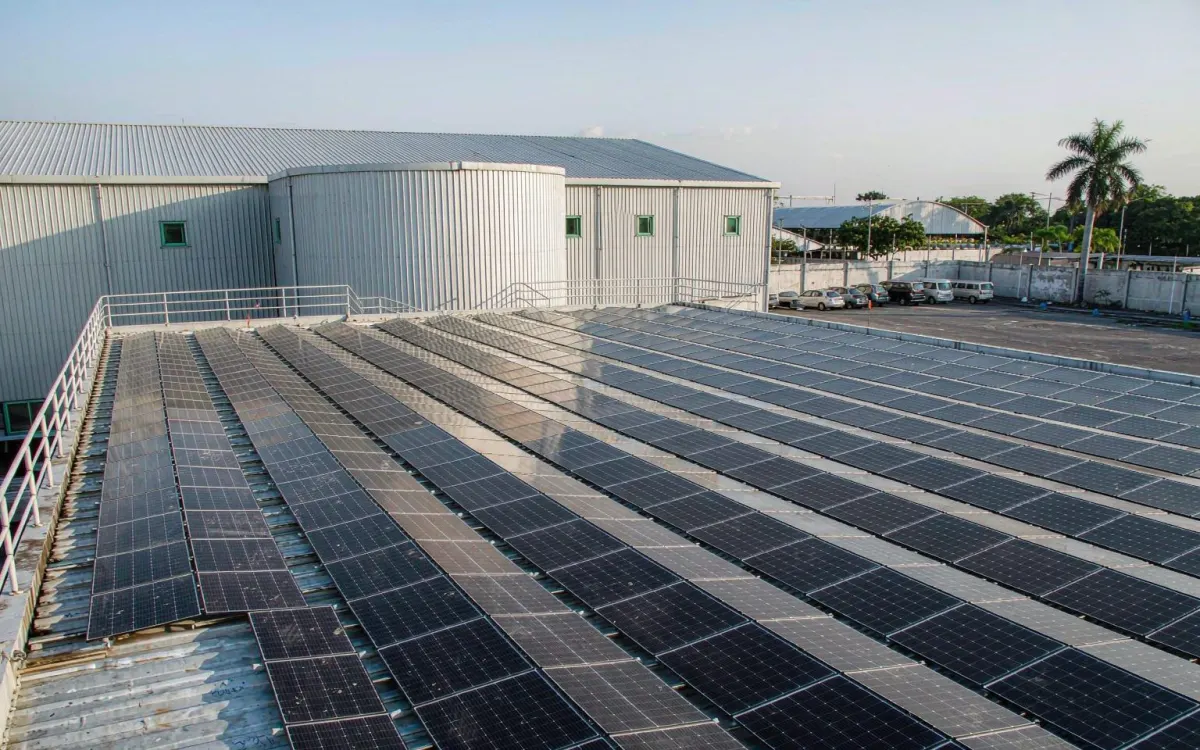
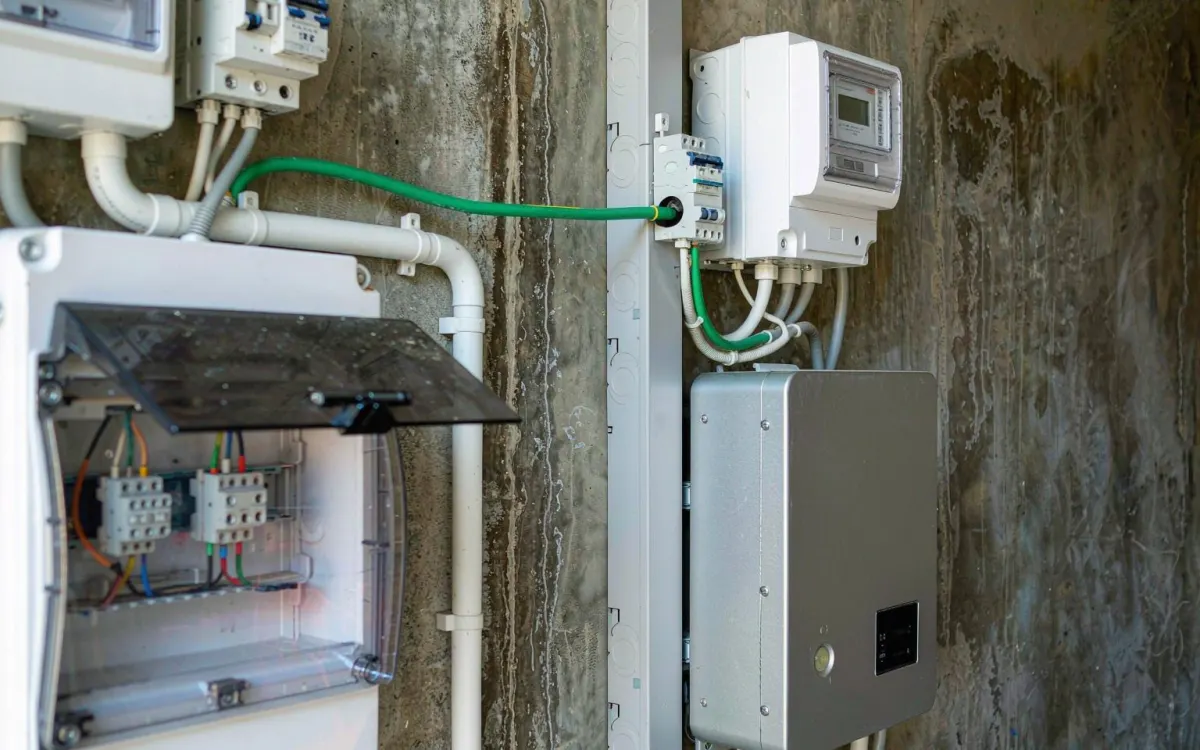
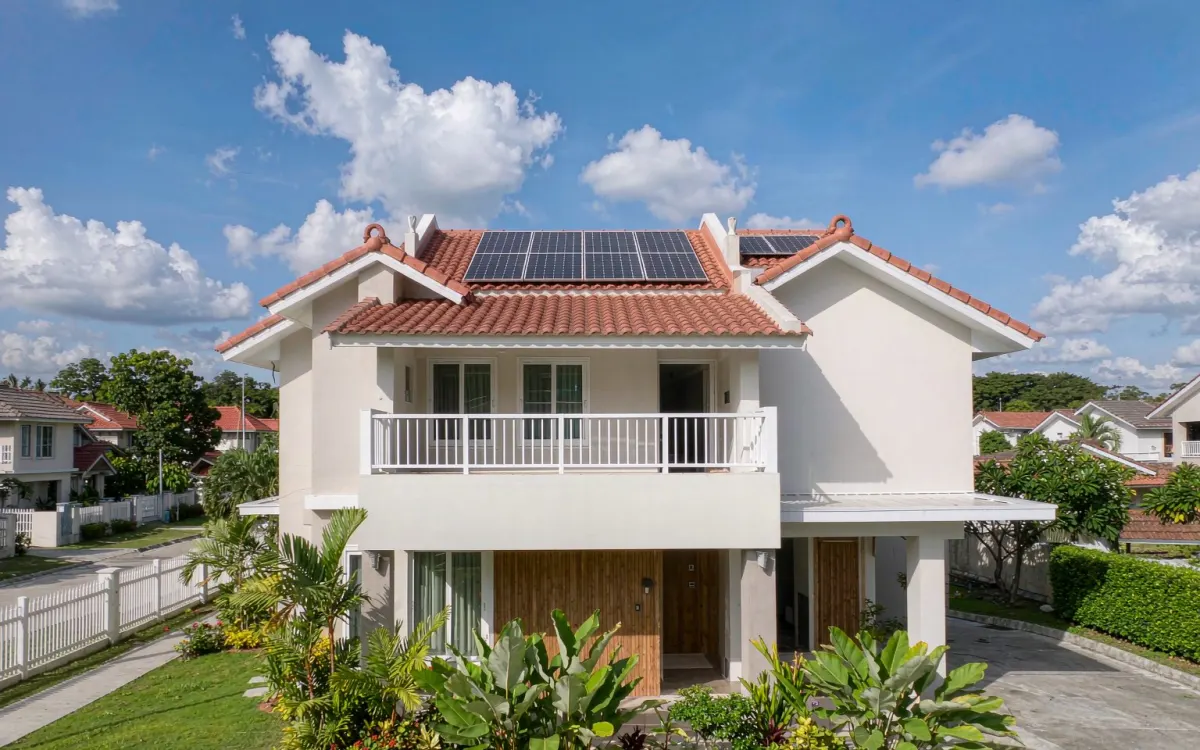
Four solar system Philippines projects delivered by our own engineers — installed, commissioned and photographed on site. Ask for the full photo set and the commissioning report on any of them.
Four things decide whether a solar system Philippines project performs for 25 years or starts failing in year three.
We build the PV arrays, the lithium storage and the power conversion ourselves, so sizing, the bill of materials and the warranty all come from one party. No reseller margin sits between the factory price and your landed cost.
We quote CIF rather than FOB, because freight, insurance and demurrage move your landed cost by 6 to 9 percent on their own. Most solar system Philippines quotations you receive are FOB, which is why two bids can look 15 percent apart before the container even sails.
Every solar system Philippines order is load-tested, BMS-calibrated and grid-tested on the line, then photographed inside the container. Failures surface in our factory, not on your roof in Laguna or Cebu.
Duty-free importation needs a DOE Certificate of Registration and a separate Certificate of Endorsement in hand before the goods ship, plus PS or ICC certification for the hardware. We prepare that file set with you — your licensed broker files it with the Bureau of Customs.
Want the sizing logic behind your own site rather than a catalogue page? Send your monthly kWh and peak demand.
Size my system on WhatsAppMost solar system Philippines enquiries fall into three profiles. Sizing always starts from your load profile and peak demand — not from a catalogue page.
Two numbers matter in any solar system Philippines decision: what a system costs installed here, and what the equipment costs CIF Manila. The installed ranges below come from our own published Philippines cost guide, so you can see where your site should land before you ask for a quotation.
| System size | Typical installed range | Typical site |
|---|---|---|
| 3 kW | ₱165,000 – ₱225,000 | Household on a ₱4,000–6,000 monthly bill |
| 5 kW | ₱190,000 – ₱375,000 | Average home on a ₱7,000–10,000 monthly bill |
| 10 kW | ₱450,000 – ₱700,000 | Large house, retail store, small office |
| 15 – 30 kW | ₱750,000 – ₱1,500,000 | Clinic, school, restaurant, light industry |
| 50 – 100 kW | ₱2,000,000 – ₱4,500,000 | Warehouse, mid-size factory, hotel |
| 100 kW – 1 MW | From ₱4,500,000 | Industrial plant, campus, containerised BESS |
Installed ranges cover the full delivered job — panels, mounting, inverter, battery, wiring, LGU permits and labour. The Philippines price guide breaks the quotation into its five cost blocks, which is where most of the spread between two solar system Philippines bids comes from.
Our own solar system Philippines scope is different: we quote CIF Manila or Batangas for the equipment, and you appoint the local EPC or your own crew for installation and the net metering application. That keeps the factory price visible instead of buried inside a turnkey number.
Meralco’s typical rate climbed roughly 14 percent across eight months in 2026 and peaked near ₱14.83 per kWh. Provincial cooperatives in diesel-dependent areas can charge ₱14 to ₱16 per kWh, which shortens payback further still. Every solar system Philippines payback model should start from the rate you are actually paying today.
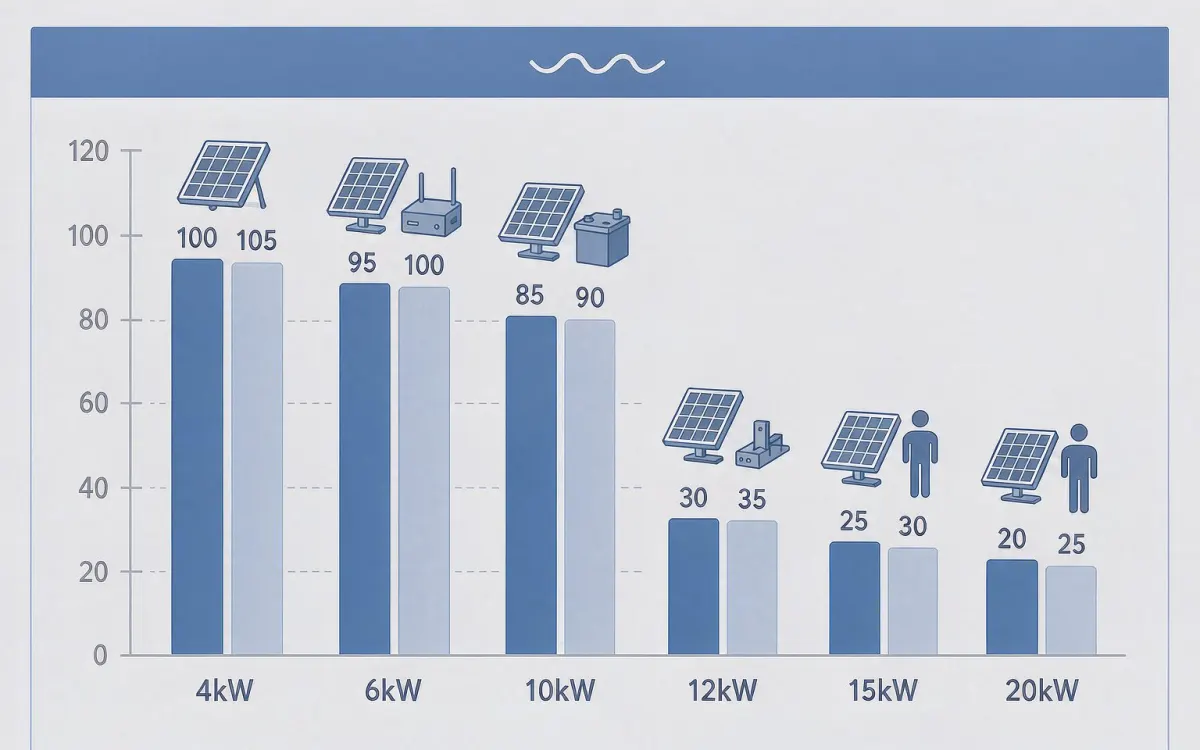
Tariffs, duty treatment and the net metering ceiling all move. Confirm the current energy and demand rate with Meralco, the ERC or your electric cooperative — and the current import treatment with the Philippine Department of Energy — before you finalise a payback model. Every figure above is an indicative 2026 range for comparison only.
Send your load profile and we will come back with an exact CIF Manila price for your solar system Philippines project.
Get my exact priceFour site types carry the strongest solar system Philippines case, and each one is sized on a different line of the bill.
A daytime shift matches PV output almost exactly, so self-consumption stays high. Adding storage also cuts the monthly demand charge, which is usually where the fastest payback sits. This is the classic solar system Philippines warehouse case.
The load runs around the clock, so nearly every kWh generated is consumed on site instead of exported. A hybrid solar system Philippines configuration also keeps compressors alive through brownouts and typhoon interruptions.
The highest commercial tariffs sit in the NCR, and the evening peak is exactly when a solar system Philippines battery displaces the most expensive block of the day.
Daytime load plus a genuine outage requirement. A solar system Philippines installation here replaces diesel hours that cost several times the grid tariff per kWh.
Not sure which of these your site looks like? Send the site type and the monthly bill and we will tell you which line of it solar actually attacks.
Benchmark my site on WhatsAppEvery photo below is a solar system Philippines project we built and shipped. Open the case studies for the sizing, the equipment list and the measured result.
Straight from the solar system Philippines job files — roof arrays, battery rooms and the commissioning walk-through.
We quote CIF Manila and CIF Batangas rather than FOB on every solar system Philippines order, because the freight, insurance and demurrage lines are the ones that move your final number.
Production
15 to 25 working days after deposit, depending on whether storage is rack-mounted or containerised, and on how much of the string wiring is factory-terminated.
Ocean freight
Booked to the Philippine port you nominate, Manila or Batangas. The DOE Certificate of Endorsement and the PS or ICC file have to be complete before the vessel sails — not after it lands.
Clearance
Duty treatment differs between modules, inverters and lithium batteries, and lithium cargo needs UN38.3 documentation. We prepare the solar system Philippines file set; your licensed broker files it with the Bureau of Customs.
Inland delivery
Metro Manila, Laguna, Batangas, Cebu, Davao and Clark are routine. Crated racks ship with lifting points and a commissioning pack.
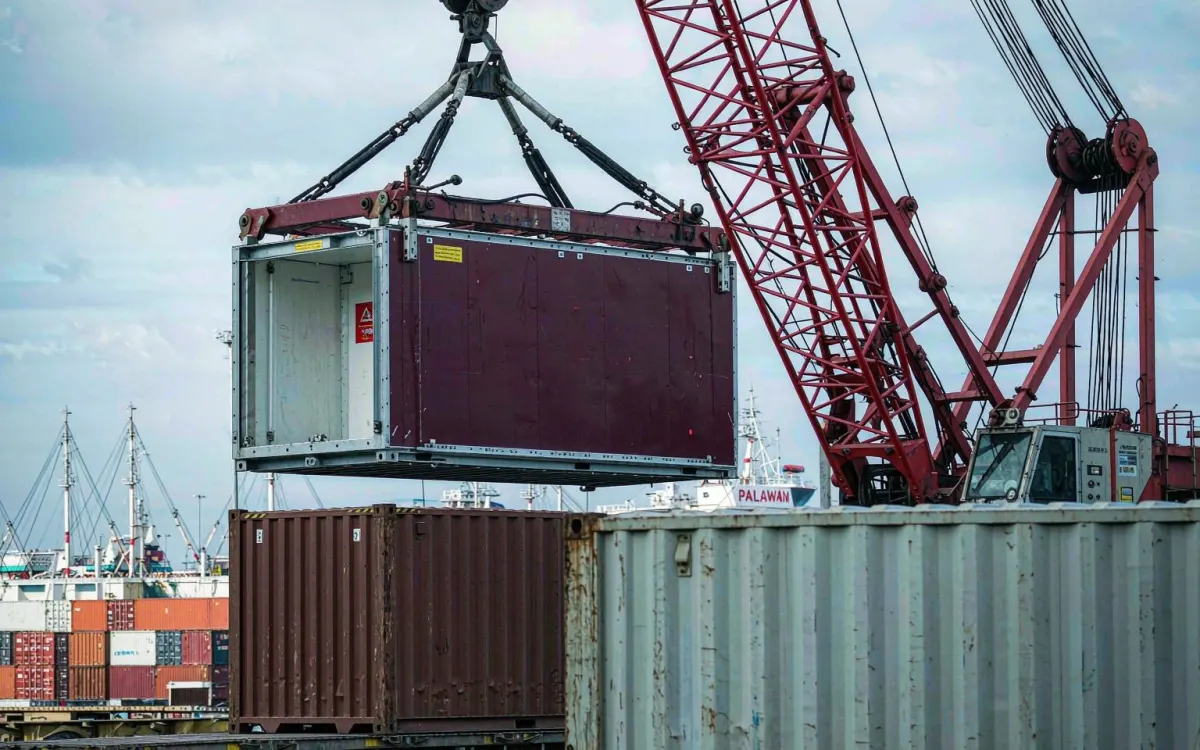
Importers who ship a solar system Philippines order without PS or ICC certification are already being pulled into the Red Lane for full physical inspection at Manila, Batangas and Cebu. That is a demurrage problem before it is a compliance problem, and it is the single most expensive mistake we see on Philippines orders.
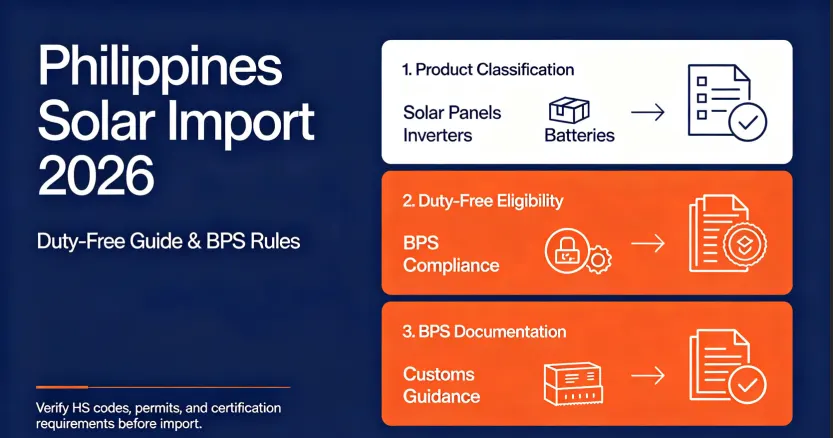
Both the duty schedule and the BPS technical regulation were still moving through 2026. Confirm the current rate and the current certification pathway with the Bureau of Customs and the Bureau of Product Standards before you finalise a landed-cost model — see our Philippines import duty note and the full Philippines import guide.
Need the duty-free pathway rather than the standard one? Tell us who the importing entity is and we will map the document list.
Confirm my import routeThe ten questions that come up in almost every Philippines enquiry. For the storage economics behind them, see our BESS cost note.
Prefer to write rather than chat? Tell us your site type, monthly consumption, backup hours, the importing entity and your target timeline. We come back with a sized system, a component-level breakdown, CIF Manila or Batangas pricing and the DOE document list — usually within one working day.
 English English
  Arabic
 Spanish
 French
 Dutch
Dutch
 Portuguese