Por qué la logística de envío puede determinar el éxito o el fracaso de un acuerdo de importación de paneles solares
Los paneles solares salen de fábrica en perfectas condiciones. Sin embargo, para cuando lleguen a su almacén, entre 3 y 71 toneladas podrían estar dañadas, la entrega podría retrasarse dos semanas y los gastos de demora en el puerto de destino podrían eliminar su margen de beneficio.
El transporte marítimo es donde la mayoría de los importadores novatos de paneles solares pierden dinero, no por culpa de las malas fábricas, sino por las malas decisiones logísticas tomadas incluso antes de que se cargara el contenedor.
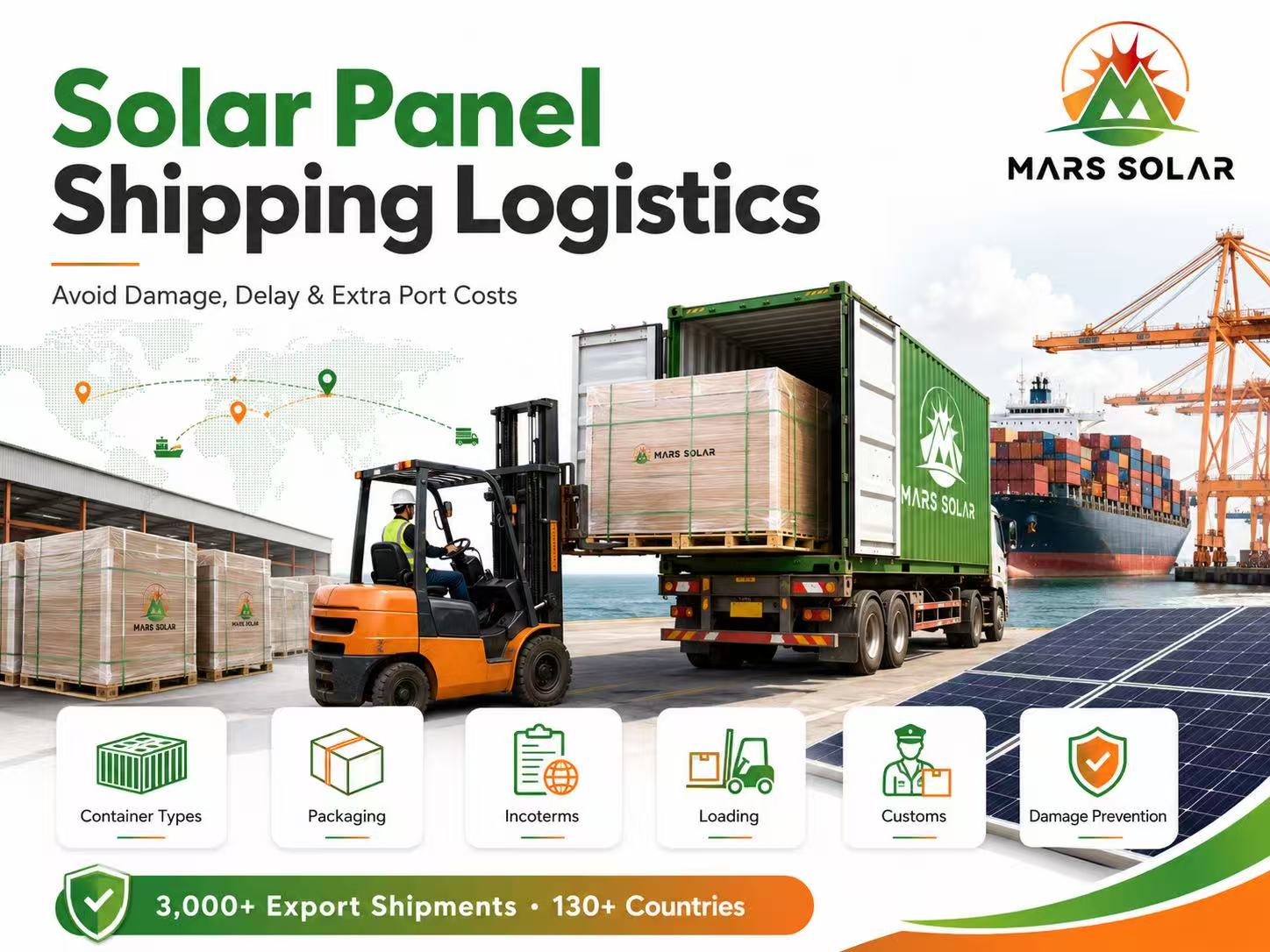
Esta guía abarca todo lo que necesitas saber sobre el envío internacional de paneles solares: tipos de contenedores, embalaje, Incoterms, carga, aduanas y prevención de daños. Se basa en los más de 3000 envíos de exportación realizados por Mars Solar en más de 130 países.
Tipos y capacidad de contenedores: ¿Qué cabe en qué?
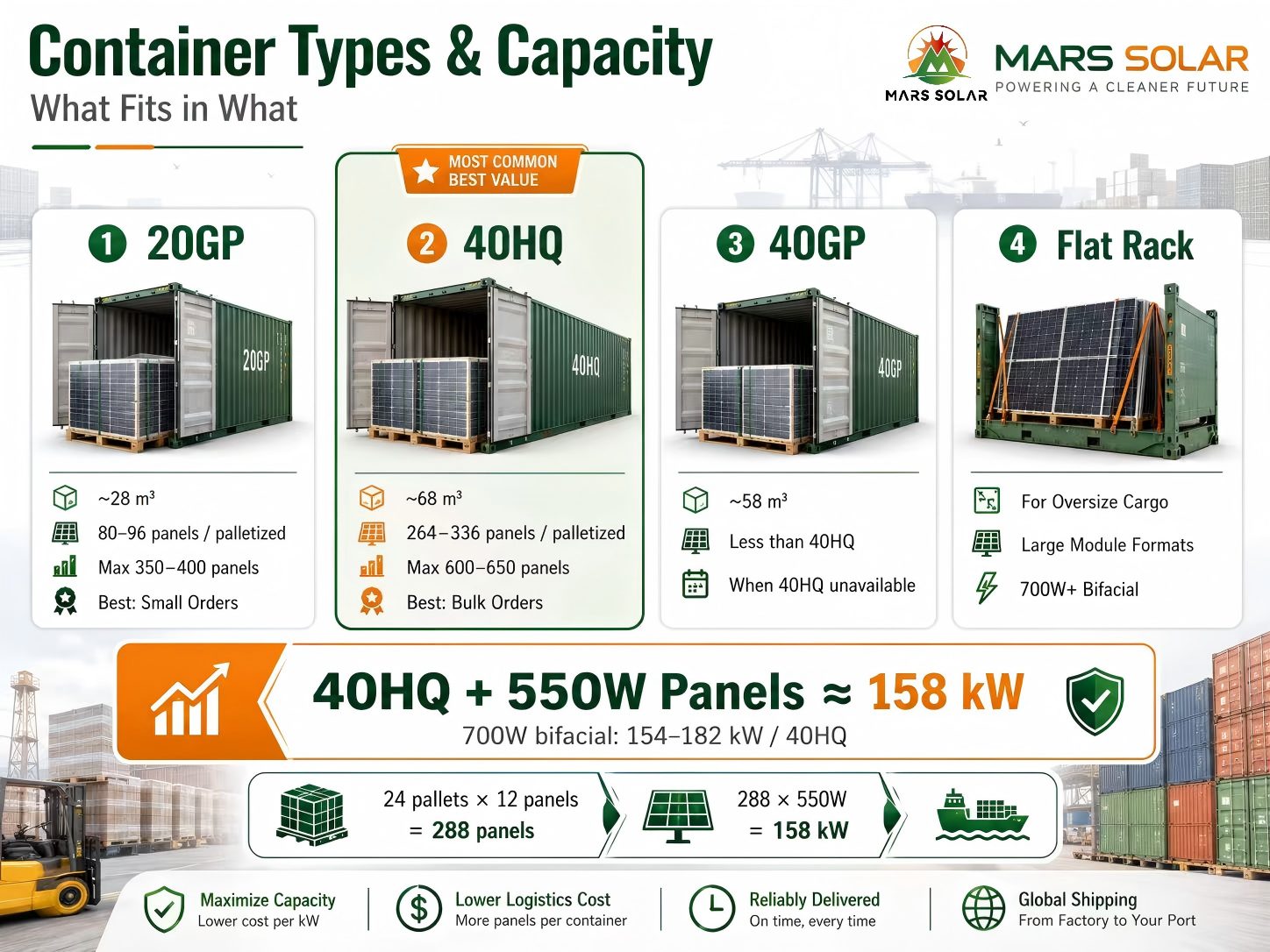
No todos los contenedores son iguales. Elegir el contenedor incorrecto puede significar una subutilización del 30% (pagar por espacio vacío) o, peor aún, paneles que sobresalgan por la puerta y sean rechazados en el puerto.
Capacidad por tipo de contenedor:
- 20GP (uso general de 20 pies): ~28 m³, 8 paneles por palé × 10-12 palés = 80-96 paneles. Máximo 350-400 paneles para módulos de alta eficiencia de 550 W. Ideal para: pedidos pequeños, envíos de muestras, destinos remotos.
- 40HQ (contenedor de 40 pies de altura): ~68 m³, 12-14 paneles por palé × 22-24 palés = 264-336 paneles. Máximo 600-650 paneles para una potencia estándar de 550 W. Ideal para: pedidos al por mayor, proyectos de 50 kW a 5 MW.
- 40GP (uso general de 40 pies): Aproximadamente 58 m³, con una capacidad ligeramente inferior a la de un contenedor de 40 pies (40HQ). Se utiliza cuando no se dispone de un contenedor de 40 pies (40HQ).
- Estante plano (para tamaños extragrandes): Se utiliza para paneles paletizados que superan las dimensiones estándar o para formatos de módulos muy grandes (bifaciales de más de 700 W).
Ejemplo de cálculo (PERC mono de 550 W, 2278 × 1134 × 35 mm):
- Por panel: 2,58 m² × 0,035 m = 0,09 m³
- Por palé (12 paneles apilados): 0,09 × 12 = 1,08 m³ + base del palé 0,6 m³ = 1,68 m³
- Por cada contenedor de 40 pies: 24 palets × 1,68 m³ = 40,3 m³ utilizados de 68 m³ disponibles = 601 TP3T de utilización
- Por cada 40HQ: 24 × 12 = 288 paneles × 550W = 158 kW
En resumen: 158 kW por 40HQ para paneles de 550 W. Para paneles bifaciales de 700 W, se necesitan entre 220 y 260 paneles, lo que equivale a entre 154 y 182 kW por 40HQ (un poco más de paneles, pero mayor peso por metro cúbico).
Normas de embalaje: Cómo se protegen los paneles durante el transporte
Los paneles solares modernos están diseñados para soportar una carga de viento de 2400 Pa y una carga de nieve de 5400 Pa. Sin embargo, esto se refiere al ángulo de instalación. Durante el transporte, los paneles se apilan horizontalmente y son vulnerables a vibraciones, impactos y presión desde arriba.
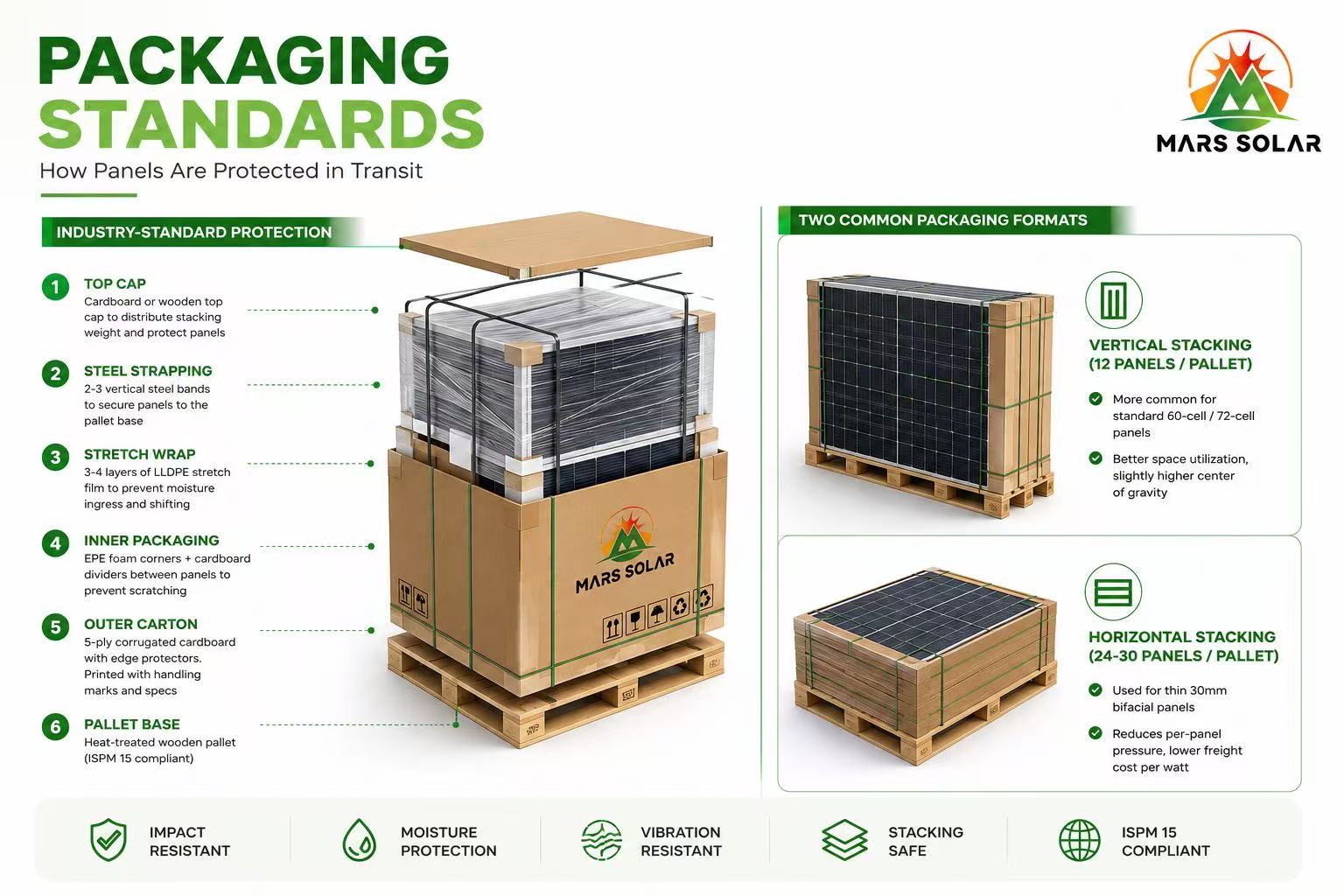
Capas de embalaje estándar de la industria (de afuera hacia adentro):
- Caja exterior: Cartón corrugado de 5 capas, protectores de bordes en las 8 esquinas, revestimiento resistente al agua. Marca, modelo, especificaciones y marcas de manipulación impresas en el lateral.
- Embalaje interior: Esquinas de espuma EPE (4 por panel) + separadores de cartón entre paneles para evitar rayar la superficie.
- Base del palé: Palet de madera tratada térmicamente (cumple con la norma ISPM 15 para envíos internacionales). Tamaño estándar: 1100 × 2300 mm (europeo) o 1100 × 2400 mm (estándar asiático).
- Envoltura elástica: Se colocan de 3 a 4 capas de film estirable de LLDPE alrededor de todo el palé para evitar la entrada de humedad y el desplazamiento durante el transporte.
- Flejes de acero: De 2 a 3 flejes de acero verticales por palé para fijar los paneles a la base del mismo. Necesario para el transporte en contenedores.
- Tapa superior: Tapa superior de cartón o madera para distribuir el peso del apilamiento y proteger los paneles superiores.
Dos formatos de embalaje comunes:
- Apilamiento vertical (12 paneles por palé): Más común en paneles estándar de 60/72 celdas. Mejor aprovechamiento del espacio, centro de gravedad ligeramente más alto.
- Apilamiento horizontal (24-30 paneles por palé): Se utiliza en paneles bifaciales delgados de 30 mm para reducir la presión por panel. Menor coste de transporte por vatio.
Explicación de los Incoterms: FOB vs CIF vs DDP para paneles solares
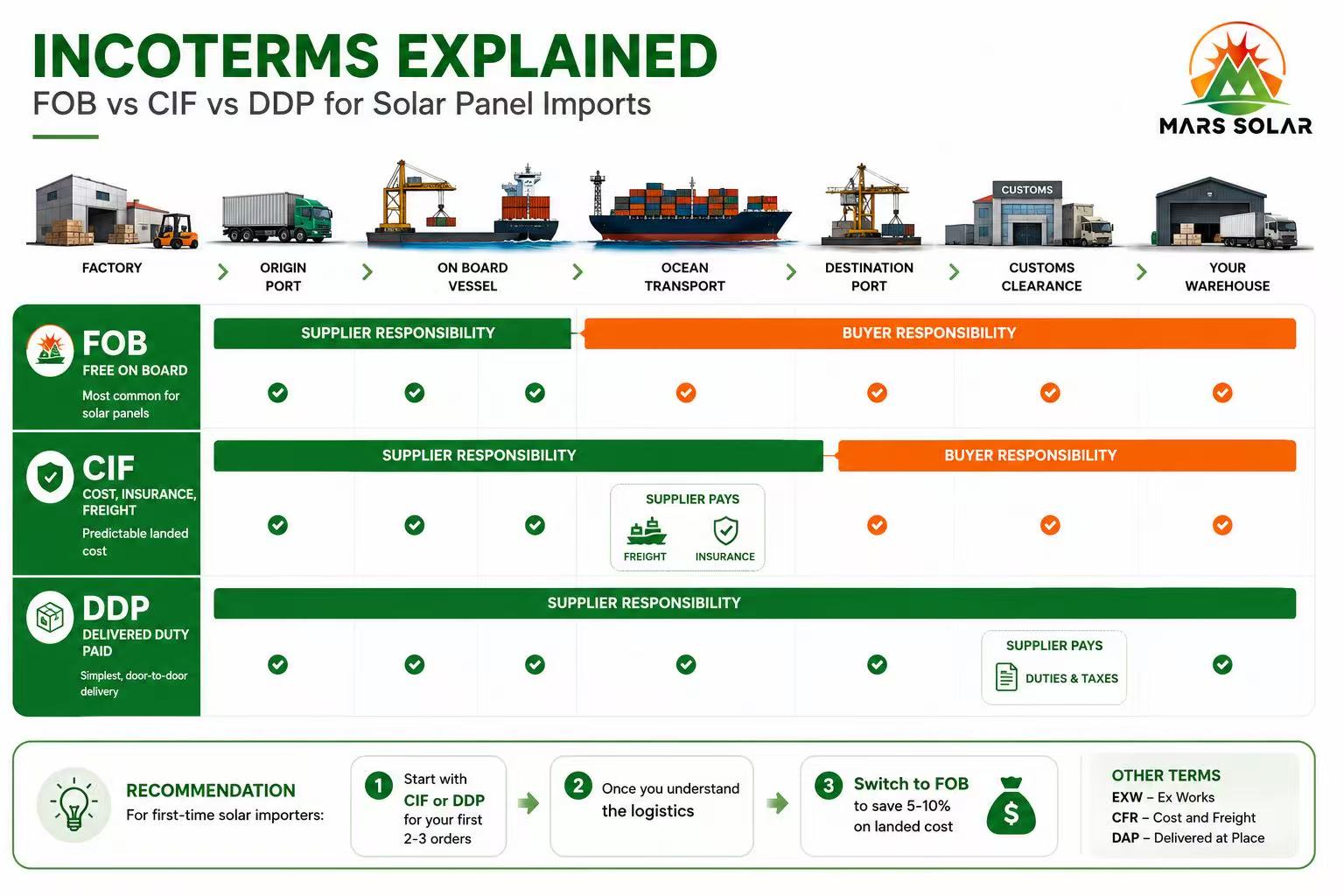
Los Incoterms definen quién es responsable de qué costos y riesgos en cada etapa del proceso de envío. Elegir los Incoterms incorrectos puede costar entre 10 y 30% del valor del pedido en cargos inesperados.
Tres Incoterms comunes para la importación de paneles solares:
- FOB (Free On Board): el término más común para paneles solares. El proveedor entrega la mercancía en el puerto de origen y la carga en el buque. A partir de ese momento, usted es propietario de la mercancía en tránsito, del coste del envío, del seguro y de todos los riesgos. Ideal para: importadores experimentados que cuenten con su propio agente de transporte y seguro.
- CIF (Costo, Seguro, Flete). El proveedor paga el flete y el seguro hasta el puerto de destino, pero usted es el propietario de la mercancía durante el tránsito. El proveedor selecciona al transportista y a la aseguradora, lo que puede generar un conflicto de intereses. Ideal para: importadores principiantes que desean un costo de destino predecible.
- DDP (Entrega con derechos pagados). El proveedor se encarga de todo, incluyendo el despacho de aduanas y los aranceles de importación en destino. Es la opción más cara, pero también la más sencilla. Ideal para: pedidos pequeños, destinos complejos o cuando no se dispone de un agente de aduanas.
Otros términos que podrías ver:
- EXW (Ex Works): Lo recoges en la fábrica. Es la opción más económica, pero también la que conlleva más riesgos y complicaciones.
- CFR (Costo y flete): Similar al CIF pero sin seguro. Poco común en paneles solares.
- DAP (Entregado en el lugar): El proveedor entrega el producto en su almacén, pero usted se encarga de los aranceles de importación.
Recomendaciones para quienes importan paneles solares por primera vez: Para tus primeros 2 o 3 pedidos, empieza con CIF o DDP. Una vez que entiendas la logística, cambia a FOB para ahorrar entre 5 y 101 TP3T en costes de entrega.
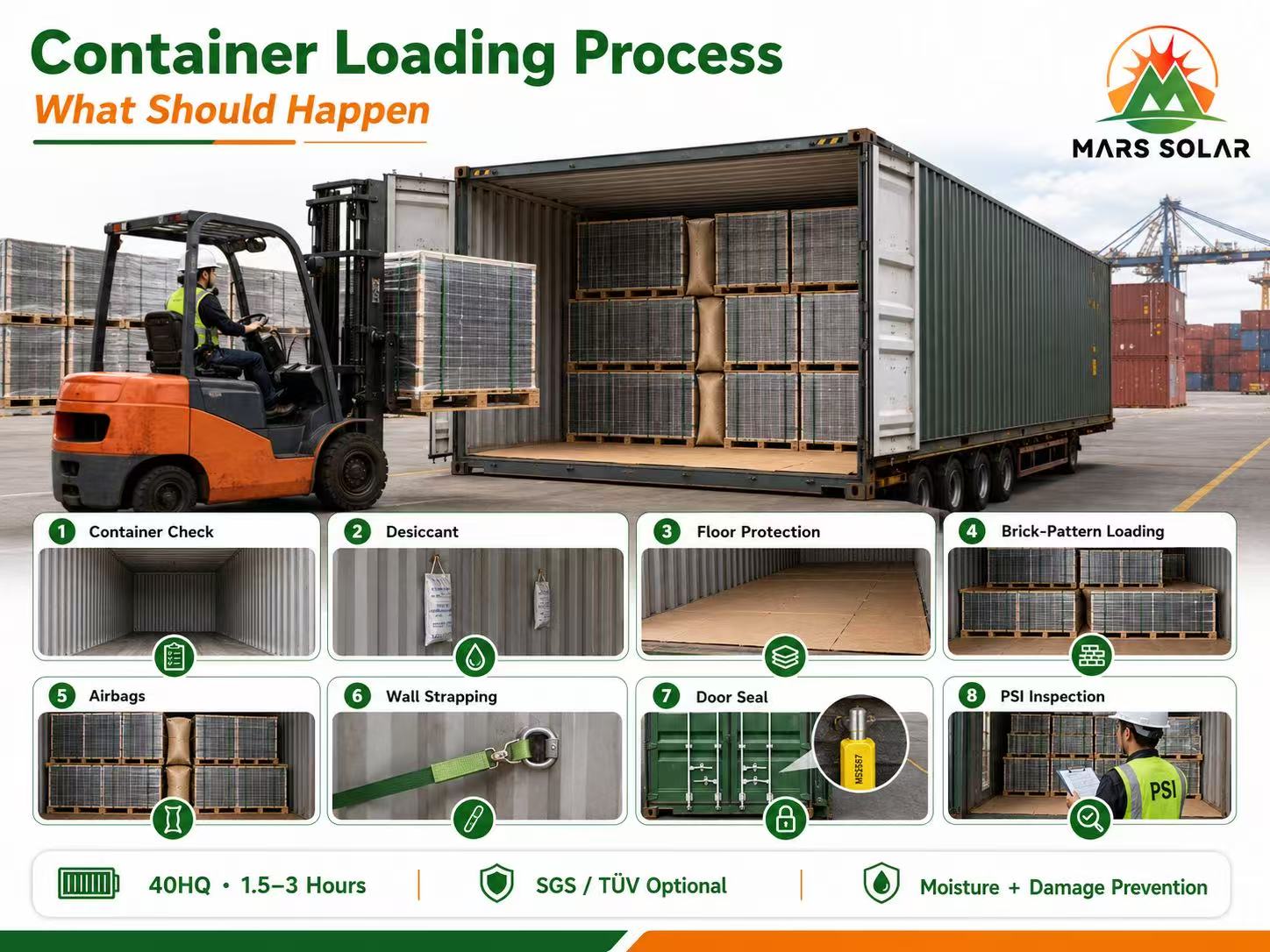
Proceso de carga de contenedores: ¿Qué debería suceder?
Es durante la carga cuando se producen los daños. Un contenedor cargado correctamente llega en perfectas condiciones; uno mal cargado llega con cristales rotos, marcos rayados y daños por agua.
Proceso de carga paso a paso:
- Inspección de contenedores (1 hora antes de la carga). Ingrese al contenedor vacío y verifique si hay: residuos de carga anterior, manchas de agua, agujeros, piso dañado y olores fuertes. El contenedor debe estar limpio, seco y sin olores. Un contenedor libre de humedad reduce el riesgo de daños por agua según la norma 90%.
- Colocación del desecante. Bolsas desecantes de gel de sílice de 10 a 20 kg colgadas en las paredes del contenedor. Fundamentales para el transporte marítimo en climas húmedos (África Occidental, Sudeste Asiático, Sudamérica).
- Protección del suelo. Se utilizan láminas de cartón o listones de madera en el suelo del contenedor para proteger los palés inferiores de la condensación.
- Patrón de carga. Los paneles paletizados se cargan de forma escalonada, como si fueran ladrillos, sin apilarlos directamente unos encima de otros. Esto distribuye el peso y evita que se aplasten.
- Bolsas de aire para rellenar huecos. Bolsas de relleno inflables colocadas entre pilas de palés para evitar que se desplacen durante el transporte marítimo. 1-2 bolsas por contenedor.
- Sujeción a las paredes del contenedor. El primer y el último palé de cada fila se sujetan a las anillas de amarre del contenedor. Esto evita el desplazamiento horizontal durante el balanceo del buque.
- Sellado de puertas. La puerta del contenedor está sellada con un precinto numerado. Anote el número en el conocimiento de embarque para su verificación en destino.
Tiempo requerido: Entre 1,5 y 3 horas por contenedor de 40HQ, dependiendo de si la fábrica dispone de una carretilla elevadora de carga lateral o solo de una carretilla elevadora.
Inspección previa al envío: Para pedidos superiores a 50 000 T/1TP, contrate a SGS o TÜV para inspeccionar el proceso de carga y abrir aleatoriamente 1 o 2 cajas terminadas para verificar la calidad de los paneles. Coste: 200-500 T/1TP por inspección.
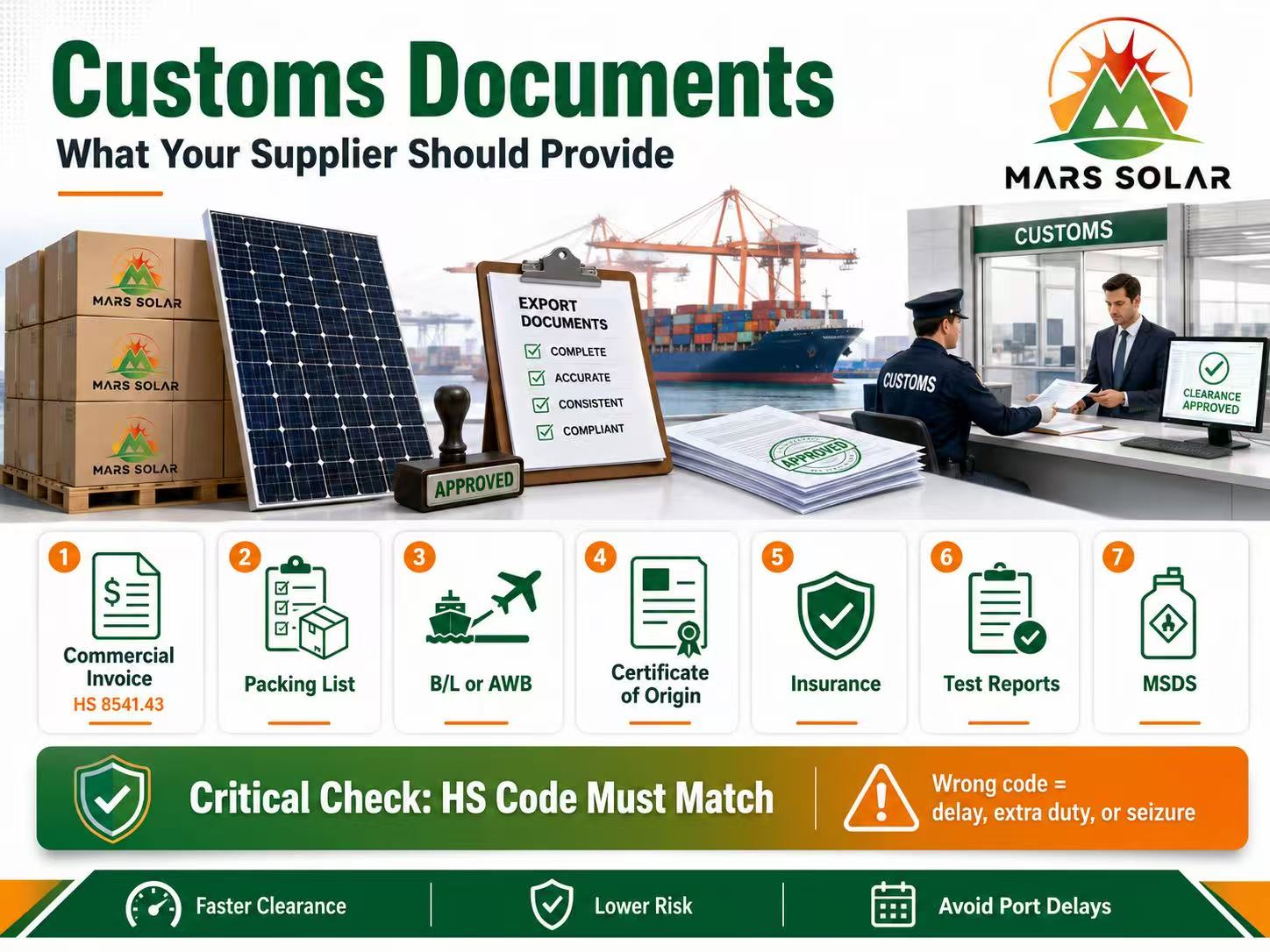
Documentos aduaneros: Lo que su proveedor debe proporcionarle
La falta de documentos aduaneros o la información incorrecta son la causa principal de los retrasos en los puertos (#1). Esto es lo que necesita para una importación sin problemas:
- Factura Comercial (FC). Enumera los productos, el valor, la moneda, el Incoterm, las partes y el código HS (8541.43 para módulos solares).
- Lista de empaque (LP). Lista detallada de cajas, palés, dimensiones, pesos y contenido.
- Conocimiento de embarque (B/L) o guía aérea (AWB). El contrato de transporte entre el transportista y el remitente. El conocimiento de embarque (B/L) también es el documento que acredita la titularidad del flete marítimo.
- Certificado de Origen (C/O). Emitido por la Cámara de Comercio de China o CIQ. Requerido para aranceles preferenciales (por ejemplo, el TLC China-ASEAN reduce el arancel de importación a 0% para muchos países de la ASEAN).
- Certificado de seguro (para CIF/CIP). Cubre todos los riesgos durante el tránsito. Las Cláusulas de Carga del Instituto (A) son el estándar para paneles solares.
- Informes de pruebas. Certificados TÜV, IEC y UL para el modelo de panel específico. Requeridos por algunos países (EE. UU., UE, Australia).
- Hoja de datos de seguridad del material (MSDS). Requerido para algunos destinos (especialmente para la batería en sistemas de almacenamiento). Menos común para paneles solares puros.
Verificación crítica: El código HS de la factura debe coincidir con el arancel aduanero de su país. Las discrepancias en los códigos HS pueden generar aranceles adicionales (10-25%) o la incautación de la mercancía.
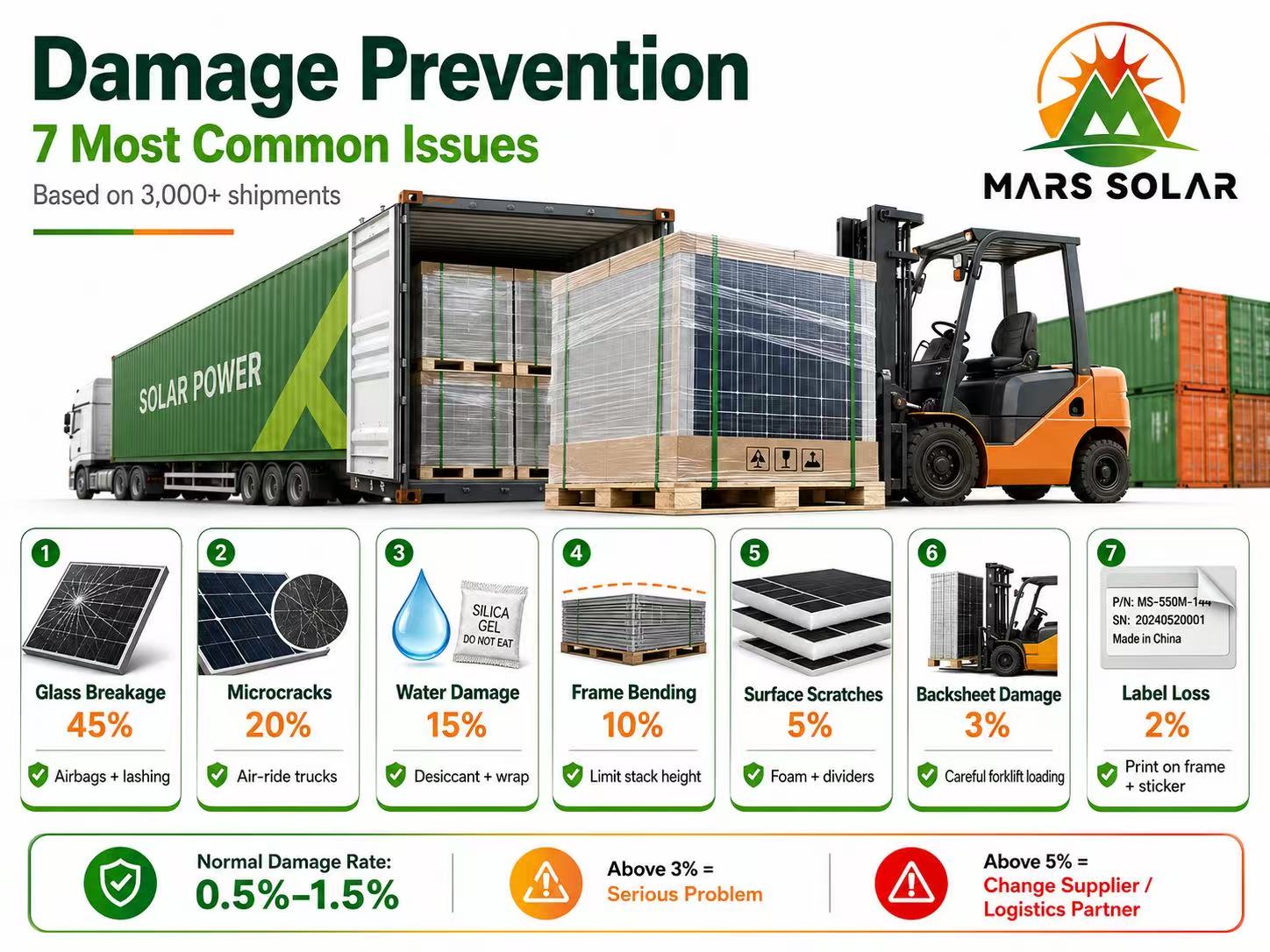
Prevención de daños: Los 7 problemas más comunes
Según los datos de Mars Solar, basados en más de 3000 envíos, estos son los problemas de daños más comunes y cómo prevenirlos:
- Rotura de cristales por desplazamiento de contenedores (45% de casos de daños). Causa: bolsas de aire o sujeción inadecuadas. Prevención: 2-3 bolsas de aire por contenedor, sujeción de los primeros y últimos palets a las paredes.
- Microfisuras celulares por vibración (20%). Causa: transporte por carretera deficiente desde el puerto hasta el almacén. Prevención: solicitar camiones con suspensión neumática y evitar carreteras en mal estado.
- Daños por agua en las cajas de conexiones (15%). Causa: condensación o lluvia dentro del contenedor. Prevención: desecante de gel de sílice, embalaje resistente al agua, film estirable intacto.
- Flexión del bastidor (10%). Causa: apilamiento a altura excesiva. Prevención: máximo 24 paneles por palé para paneles de 35 mm de espesor, 20 paneles para paneles bifaciales de 30 mm.
- Arañazos superficiales (5%). Causa: roce de los paneles dentro de la caja. Prevención: esquinas de espuma EPE + separadores de cartón entre cada panel.
- Daños en la lámina posterior (3%). Causa: pinchazos de montacargas durante la carga/descarga. Prevención: operadores capacitados, se prefiere el uso de montacargas de carga lateral.
- Pérdida de etiqueta/número de serie (2%). Causa: roce durante el transporte. Prevención: las etiquetas con el número de serie también deben estar impresas en la parte posterior del marco del panel, no solo en la pegatina.
Índice de referencia de tasa de daños: Un índice de daños de 0,5 a 1,51 TP3T es normal. Un valor superior a 31 TP3T indica un problema grave de embalaje o logística. Un valor superior a 51 TP3T significa un problema sistémico: cambie de proveedor o socio logístico.
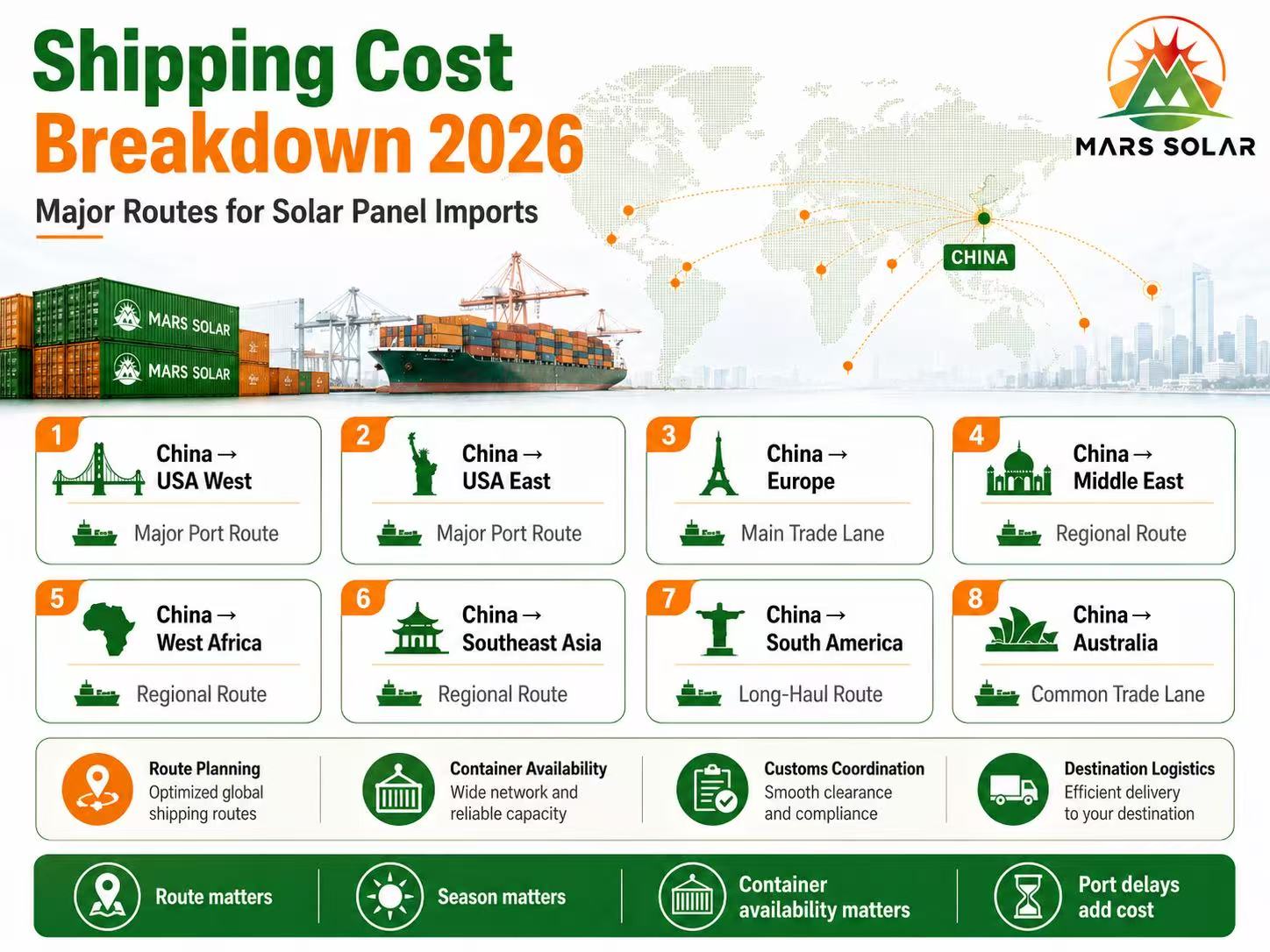
Desglose de los costos de envío 2026: Lo que pagarás
Los costos de envío de paneles solares varían drásticamente según la ruta, la temporada y la disponibilidad de contenedores. A mediados de 2026, estas son las tarifas típicas por contenedor de 40 pies:
- China → Costa Oeste de EE. UU.: $3.500-5.500 (LA/LB), tránsito de 18 a 25 días. Por encima de los niveles previos a 2020 debido a las tensiones en el Mar Rojo.
- China → Costa Este de EE. UU.: $5,500-7,500 (NY/Norfolk), tránsito de 32 a 38 días vía el Canal de Panamá o de 45 a 55 días vía Suez.
- China → Europa (Norte): $4.500-7.000 (Róterdam/Hamburgo), tránsito de 28 a 35 días. Precio más elevado debido a la ruta por el Mar Rojo vía Cabo de Buena Esperanza.
- China → Oriente Medio: $1.800-3.000 (Jeddah/Dubai), tránsito 18-25 días.
- China → África (Occidental): $4.000-6.500 (Lagos/Abidjan), tránsito 35-50 días, más 7-14 días de despacho portuario.
- China → Sudeste Asiático: $800-1.800 (Singapur/Yakarta), tránsito de 7 a 12 días.
- China → Sudamérica (Este): $5.500-8.000 (Santos/Buenos Aires), tránsito 35-45 días.
- China → Australia: $2.500-4.000 (Sídney/Melbourne), tránsito 18-25 días.
Coste por vatio instalado (ejemplo aproximado para 40HQ de paneles de 550 W, 158 kW): Sume el costo de envío al costo del panel FOB. Si FOB = $0.13/W y el envío = $4,000/158kW = $0.025/W, el costo CIF de entrega es de aproximadamente $0.155/W. Agregue un arancel de importación de 5-15% según el país, más una tarifa de agente de aduanas de 1-3%.
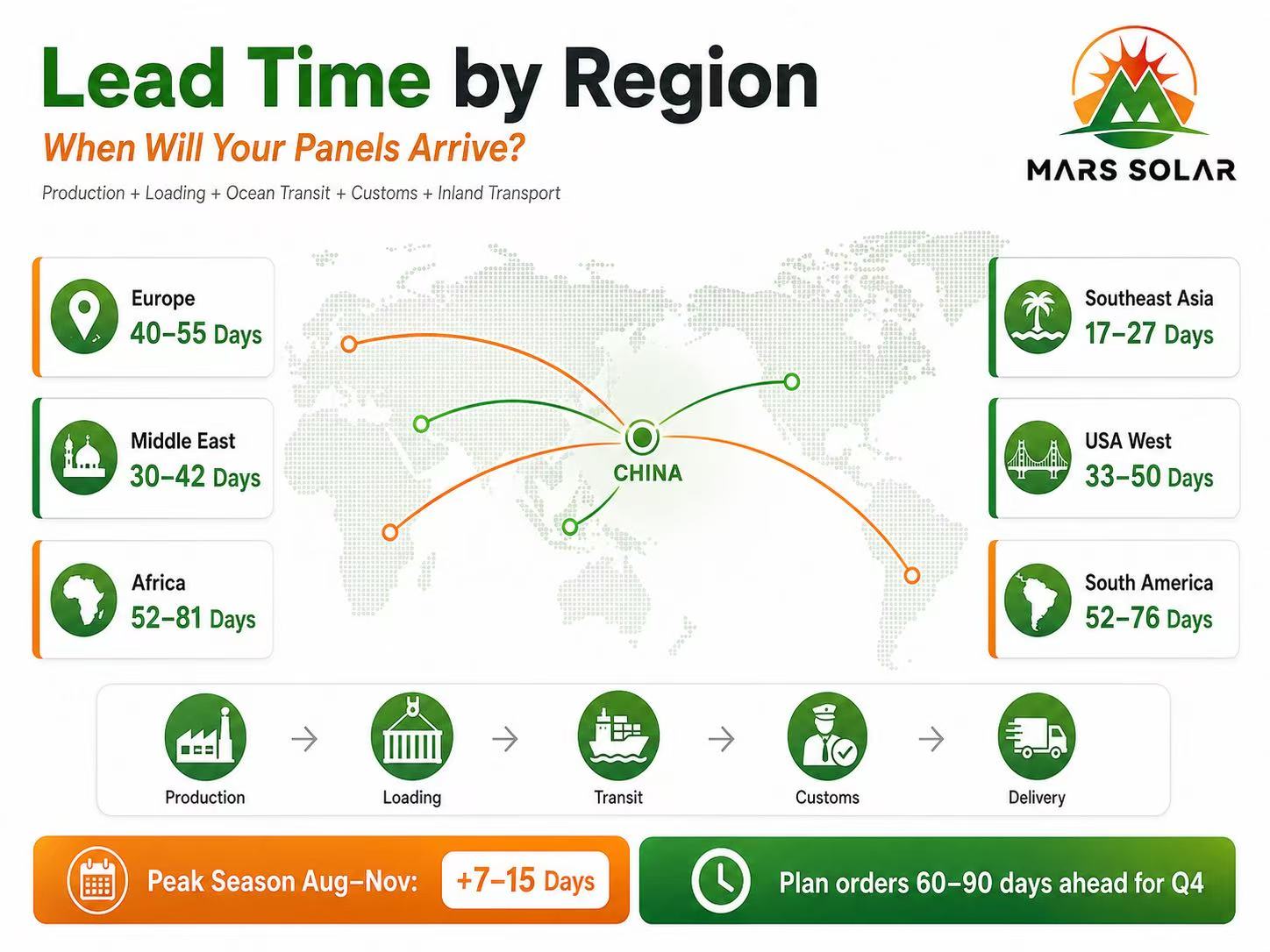
Plazo de entrega por región: ¿Cuándo llegarán sus paneles?
Plazo de entrega = tiempo de producción + tiempo de carga + tránsito marítimo + despacho de aduanas + transporte terrestre. Este es un plazo realista para 2026:
- Sudeste asiático (Singapur, Indonesia, Filipinas, Vietnam): Producción 7-10 días + tránsito 7-12 días + aduanas 3-5 días = 17-27 días en total.
- Oriente Medio (Emiratos Árabes Unidos, Arabia Saudita): Producción 7-10 días + tránsito 18-25 días + aduanas 5-7 días = 30-42 días en total.
- Europa (Alemania, Países Bajos, España): Producción 7-10 días + tránsito 28-35 días + aduanas 5-10 días = 40-55 días en total.
- Estados Unidos (Costa Oeste): Producción 7-10 días + tránsito 18-25 días + aduanas 5-10 días + transporte terrestre 3-5 días = 33-50 días en total.
- África (Nigeria, Kenia, Sudáfrica): Producción 7-10 días + tránsito 35-50 días + aduanas 7-14 días + transporte terrestre 3-7 días = 52-81 días en total.
- América del Sur (Brasil, Chile, Argentina): Producción 7-10 días + tránsito 35-45 días + aduanas 7-14 días + transporte terrestre 3-7 días = 52-76 días en total.
Retrasos en temporada alta: De agosto a noviembre (regreso a clases, Black Friday, proyectos de fin de año) se extienden los servicios de transporte público entre 7 y 15 días, y aumentan las tarifas entre 30 y 50%. Se recomienda hacer los pedidos con 60 a 90 días de anticipación para recibirlos en el cuarto trimestre.
Red de transporte marítimo de Mars Solar
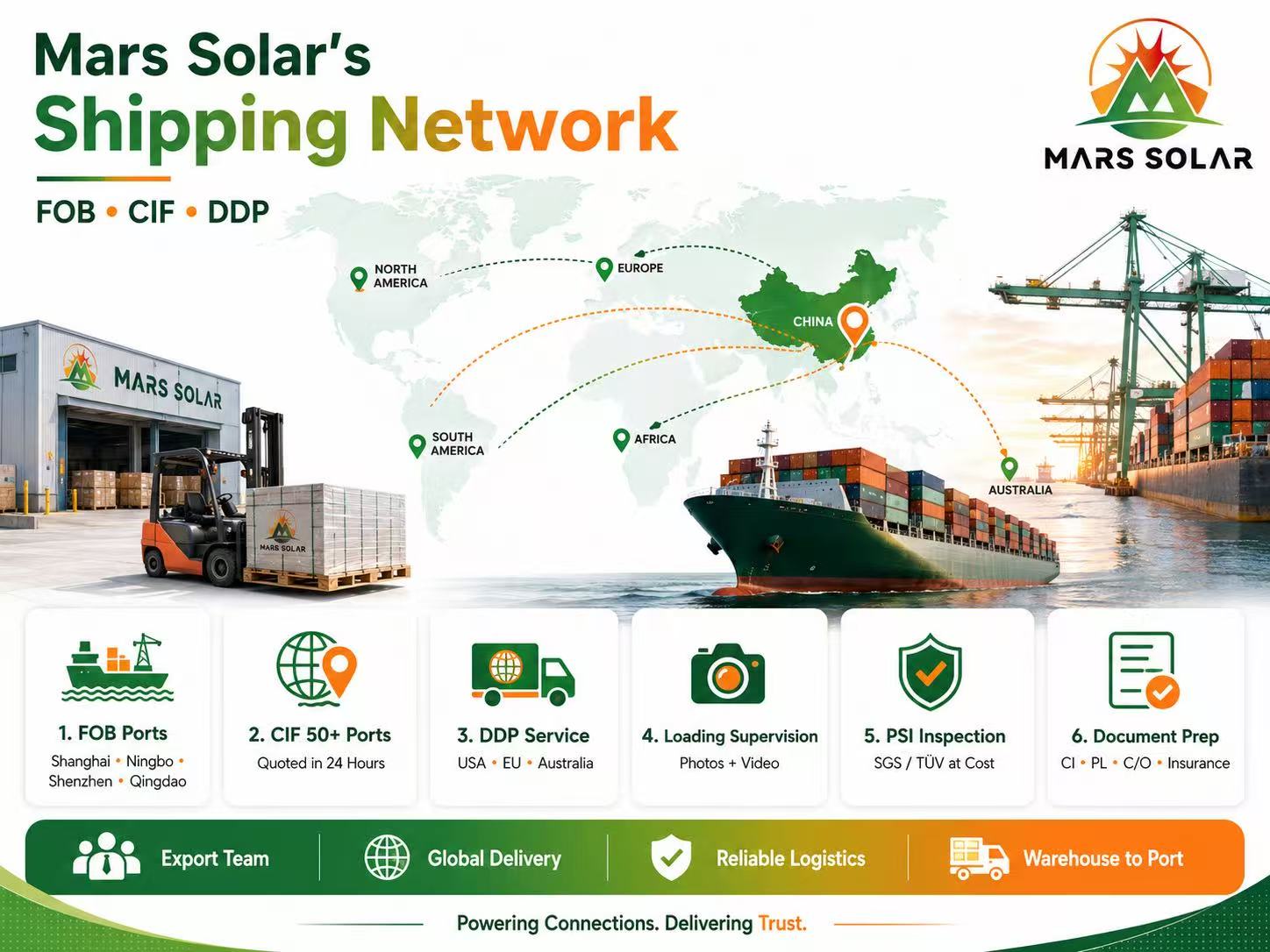
Para los compradores que utilizan Mars Solar, esto es lo que ofrecemos de serie:
- MANDO Shangai/Ningbo/Shenzhen/Qingdao — Usted elige el puerto, sin cargos portuarios adicionales al precio FOB.
- CIF a más de 50 puertos principales — Tarifas prenegociadas con Maersk, MSC, COSCO, CMA-CGM y Evergreen. Cotización en 24 horas.
- DDP a EE. UU., UE, Australia — Coste total de desembarque, incluidos los aranceles, entregado en su almacén.
- Supervisión gratuita de la carga de contenedores — Nuestro equipo de control de calidad supervisa cada carga de contenedor y le envía fotos y vídeos.
- Inspección previa al envío — Inspección por SGS o TÜV a precio de coste, con informe completo antes de la emisión del conocimiento de embarque.
- Preparación de documentos aduaneros — Factura comercial, lista de empaque, certificado de origen, seguro e informes de pruebas preparados por nuestro equipo de exportación.
Preguntas frecuentes
P: ¿Cuántos paneles caben en un contenedor de 40HQ?
A: Para paneles PERC mono estándar de 550 W: 288-336 paneles (158-185 kW). Para paneles bifaciales de 700 W: 220-260 paneles (154-182 kW). La cantidad exacta depende de las dimensiones del panel y la configuración del palé.
P: ¿Debo elegir FOB o CIF para mi primer pedido?
A: CIF para sus primeros 1-2 pedidos. Esto le proporciona un costo de entrega predecible y reduce su riesgo. Una vez que se sienta cómodo con el proveedor, cambie a FOB para ahorrar 5-10%.
P: ¿Cuál es el índice de daños típico en los envíos de paneles solares?
A: Un valor entre 0,5 y 1,51 TP3T es normal y aceptable. Cualquier valor superior a 31 TP3T indica un problema de embalaje o logística. Si supera los 51 TP3T, cambie de proveedor o agente de transporte.
P: ¿Cuánto tarda el transporte marítimo desde China hasta mi país?
A: Sudeste Asiático 7-12 días, Oriente Medio 18-25 días, Costa Oeste de EE. UU. 18-25 días, Europa 28-35 días, África 35-50 días, Sudamérica 35-45 días. Añadir 5-14 días para el despacho de aduanas.
P: ¿Necesito seguro para el envío de mis paneles solares?
R: Sí, siempre. El seguro de carga a todo riesgo (Cláusulas A del Instituto de Seguros de Carga) cuesta entre 0,3 y 0,51 TP3T del valor de la carga y cubre daños, pérdidas y robos. No lo omita para ahorrar 1 TP4T100 en un envío de 1 TP4T50 000.
P: ¿Cuál es el código HS para paneles solares?
A: 8541.43 (células solares ensambladas en módulos o paneles). Algunos países tienen códigos distintos para diferentes potencias o tecnologías; verifique con su agente de aduanas antes del envío.
Artículos relacionados
Continúa tu investigación sobre fuentes de energía solar:
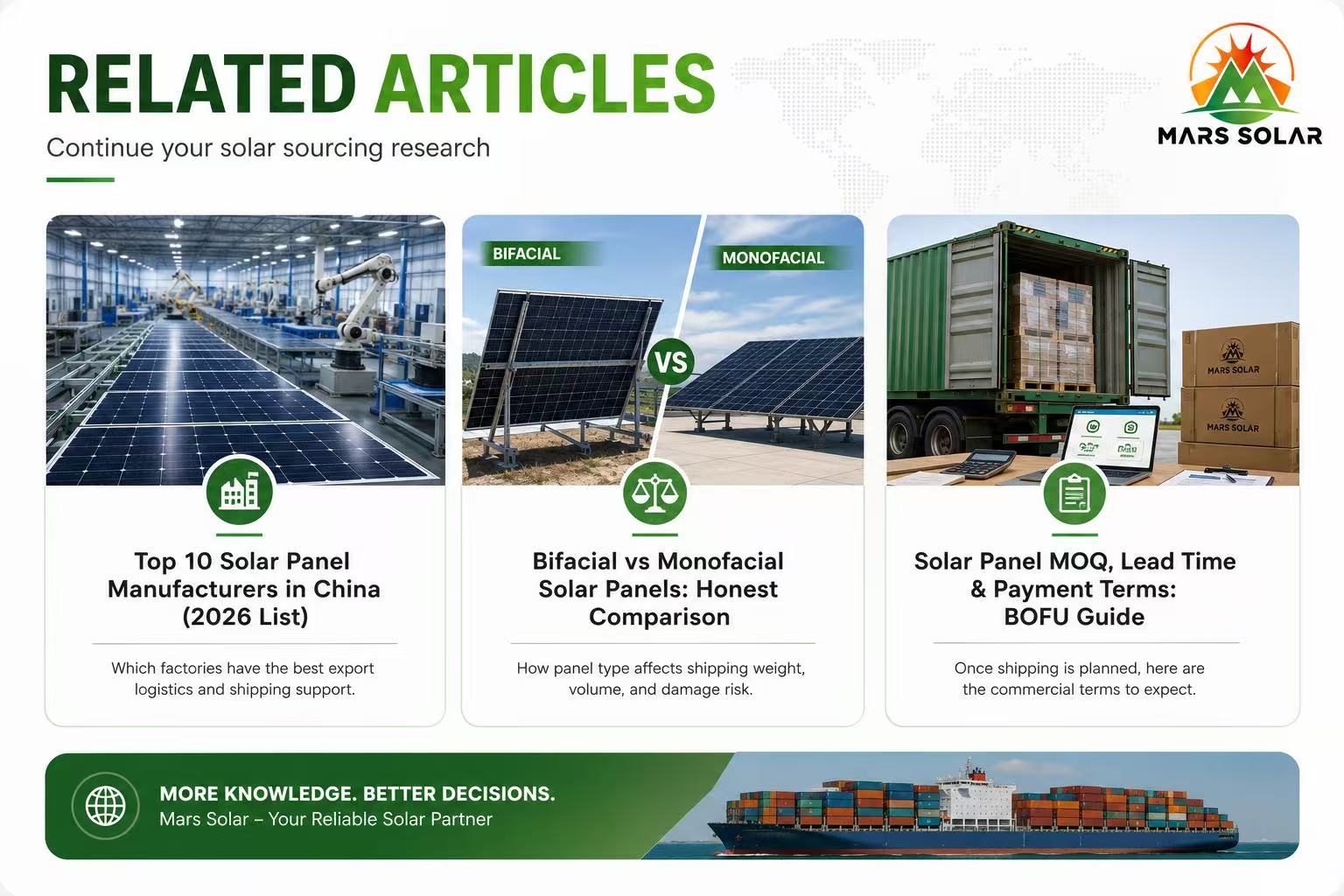
- Los 10 principales fabricantes de paneles solares en China (lista de 2026) — ¿Qué fábricas ofrecen la mejor logística de exportación y soporte para envíos?.
- Paneles solares bifaciales frente a monofaciales: una comparación honesta — Cómo afecta el tipo de panel al peso, el volumen y el riesgo de daños durante el envío.
- Cantidad mínima de pedido, plazo de entrega y condiciones de pago para paneles solares: Guía BOFU — Una vez planificado el envío, estas son las condiciones comerciales que cabe esperar.
Acerca de Mars Solar
Mars Solar envía más de 50 000 paneles mensuales a más de 130 países a través de los puertos de Shanghái, Ningbo, Shenzhen y Qingdao. Ofrecemos condiciones FOB, CIF y DDP con inspección previa al envío y documentación aduanera completas. Solicite un presupuesto con envío incluido. https://sunenergyfactory.com/contact-us/.
Correo electrónico:admin@solarpowermanufacturer.com


 English
  Chinese
 Cebuano
 Arabic
 Czech
Czech
 Danish
 German
 Greek
Greek
 Spanish (Spain)
 Spanish (Mexico)
 Persian
 French
 Indonesian
 Italian
 Japanese
 Korean
 Dutch
Dutch
 Portuguese
 Russian
 Tagalog
 Turkish
 Vietnamese