Full Guide of Cargo Container Loading

Why Shipping Logistics Make or Break a Solar Panel Import Deal

Good cargo container loading is the difference between a profitable shipment and a write-off: the solar panels leaving the factory are perfect. By the time they arrive at your warehouse, 3-7% of them might be damaged, the delivery could be 2 weeks late, and the demurrage charges at the destination port could wipe out your margin.

Shipping is where most first-time solar importers lose money — not because of bad factories, but because of bad logistics decisions made before the container was even loaded.

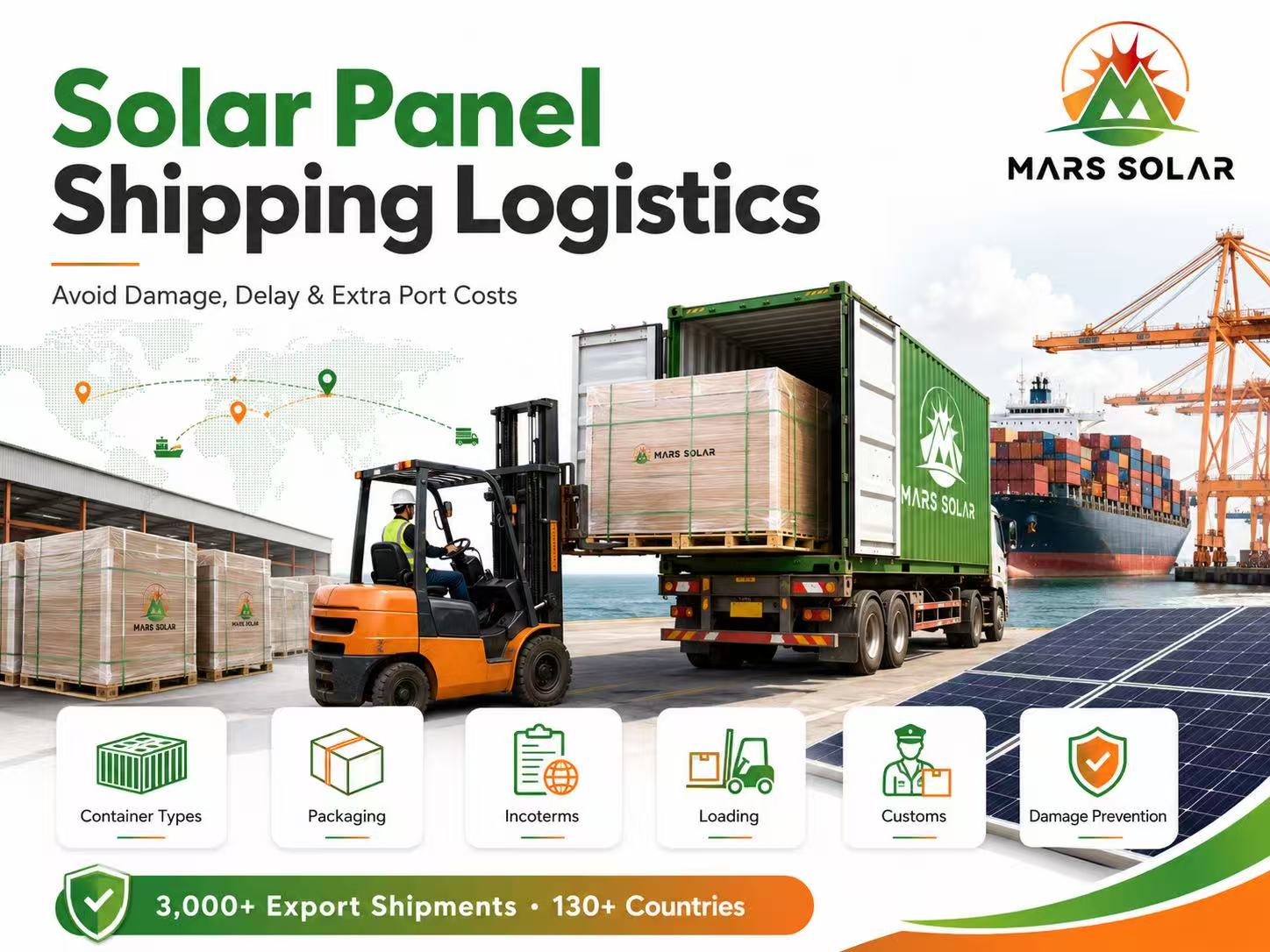
This guide covers everything you need to know about shipping solar panels internationally: container types, packaging, Incoterms, loading, customs, and damage prevention. Based on Mars Solar's 3,000+ export shipments across 130+ countries.
Full Guide of Cargo Container Loading

Container Types & Capacity: What Fits in What

Not all containers are equal. The wrong container choice can mean 30% underutilization (paying for empty space) or worse, panels sticking out the door and rejected at the port.

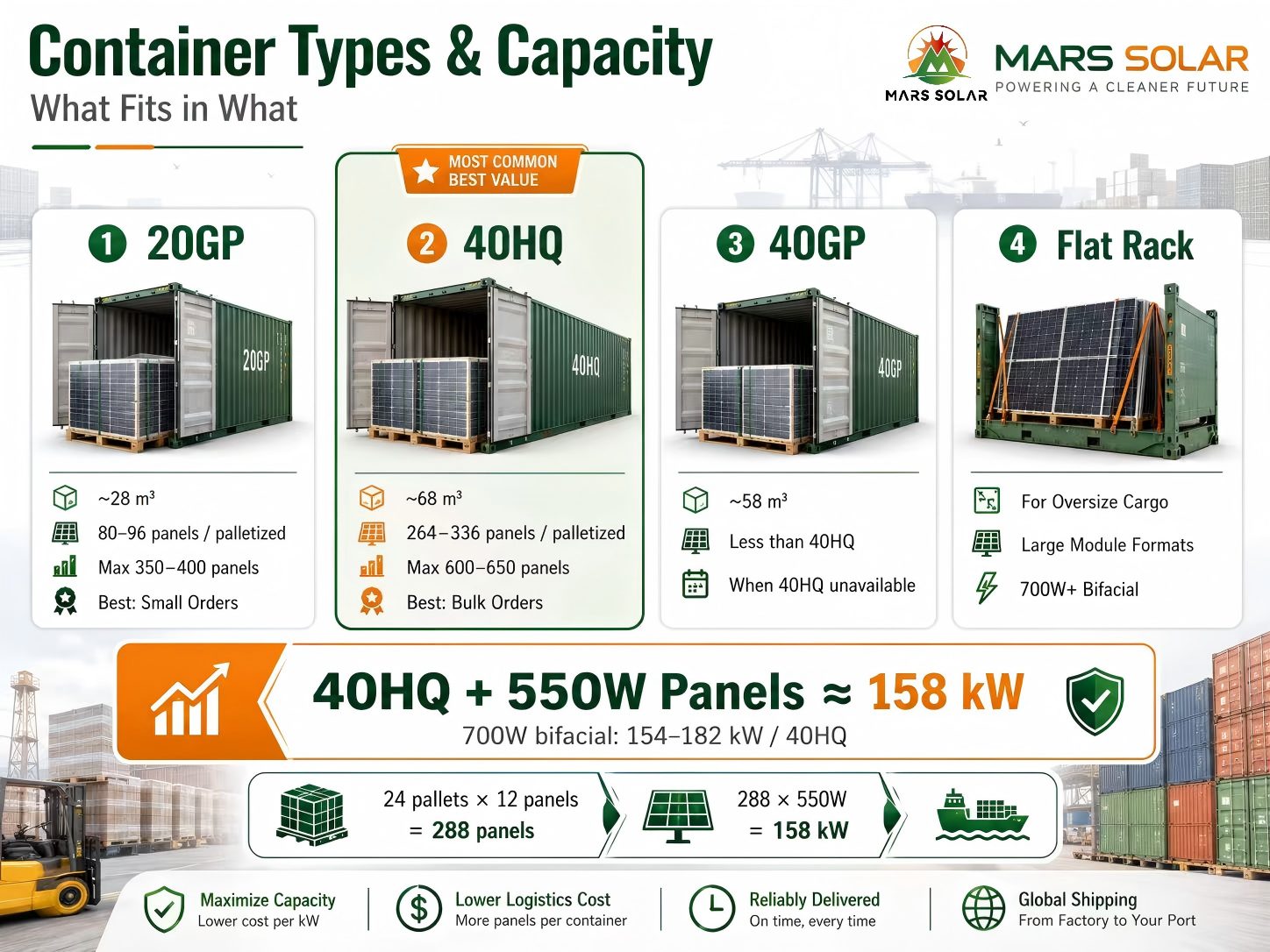
Capacity by container type:

  • 20GP (20-foot General Purpose): ~28 m³, 8 panels per pallet × 10-12 pallets = 80-96 panels. Max 350-400 panels for high-efficiency 550W modules. Best for: small orders, sample shipments, remote destinations.
  • 40HQ (40-foot High Cube): ~68 m³, 12-14 panels per pallet × 22-24 pallets = 264-336 panels. Max 600-650 panels for standard 550W. Best for: bulk orders, 50kW-5MW projects.
  • 40GP (40-foot General Purpose): ~58 m³, slightly less capacity than 40HQ. Used when 40HQ isn't available.
  • Flat Rack (for oversize): Used for palletized panels that exceed standard dimensions or for very large module formats (700W+ bifacial).

Calculation example (550W mono PERC, 2278×1134×35mm):

  • Per panel: 2.58 m² × 0.035m = 0.09 m³
  • Per pallet (12 panels stacked): 0.09 × 12 = 1.08 m³ + pallet base 0.6 m³ = 1.68 m³
  • Per 40HQ: 24 pallets × 1.68 m³ = 40.3 m³ used out of 68 m³ available = 60% utilization
  • Per 40HQ: 24 × 12 = 288 panels × 550W = 158 kW

Bottom line: 158 kW per 40HQ for 550W panels. For 700W bifacial, expect 220-260 panels = 154-182 kW per 40HQ (slightly more panels but heavier per cubic meter).
Full Guide of Cargo Container Loading

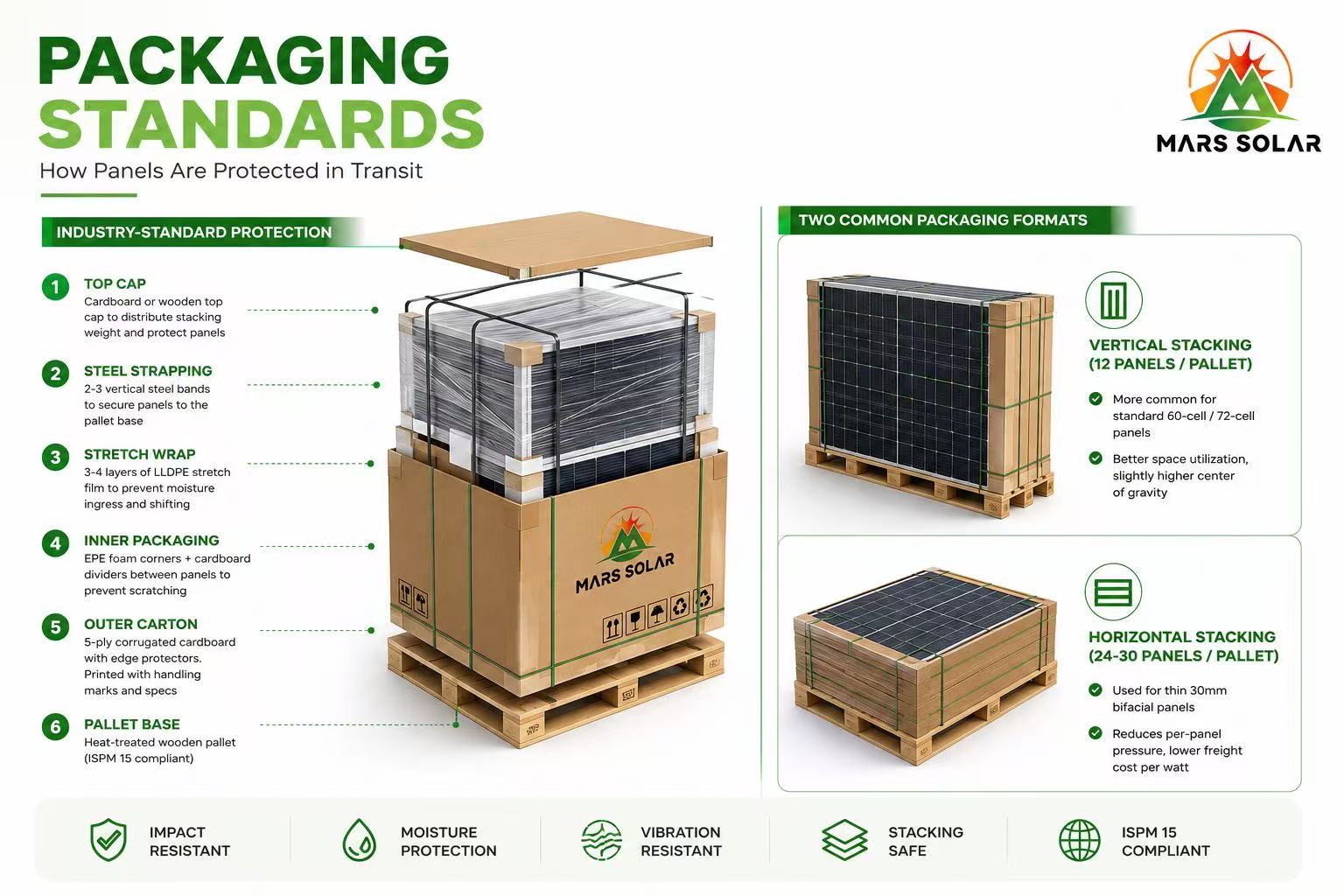
Packaging Standards: How Panels Are Protected in Transit

Modern solar panels are designed to withstand 2,400 Pa wind load and 5,400 Pa snow load. But that's at the installed angle. During shipping, panels are stacked horizontally and vulnerable to vibration, impact, and pressure from above.

Industry-standard packaging layers (from outside in):

  1. Outer carton: 5-ply corrugated cardboard, edge protectors on all 8 corners, water-resistant coating. Brand, model, specs, and handling marks printed on the side.
  2. Inner packaging: EPE foam corners (4 per panel) + cardboard dividers between panels to prevent surface scratching.
  3. Pallet base: Heat-treated wooden pallet (ISPM 15 compliant for international shipping). Standard size: 1100×2300mm (European) or 1100×2400mm (Asian standard).
  4. Stretch wrap: 3-4 layers of LLDPE stretch film around the entire pallet to prevent moisture ingress and shifting during transport.
  5. Steel strapping: 2-3 vertical steel bands per pallet to secure panels to the pallet base. Required for containerized shipping.
  6. Top cap: Cardboard or wooden top cap to distribute stacking weight and protect the top panels.

Two common packaging formats:

  • Vertical stacking (12 panels per pallet): More common for standard 60-cell/72-cell panels. Better space utilization, slightly higher center of gravity.
  • Horizontal stacking (24-30 panels per pallet): Used for thin 30mm bifacial panels to reduce per-panel pressure. Lower freight cost per watt.
Full Guide of Cargo Container Loading

Incoterms Explained: FOB vs CIF vs DDP for Solar Panels

Incoterms define who's responsible for what costs and risks at each stage of the shipping process. Choosing the wrong one can cost 10-30% of the order value in unexpected fees.

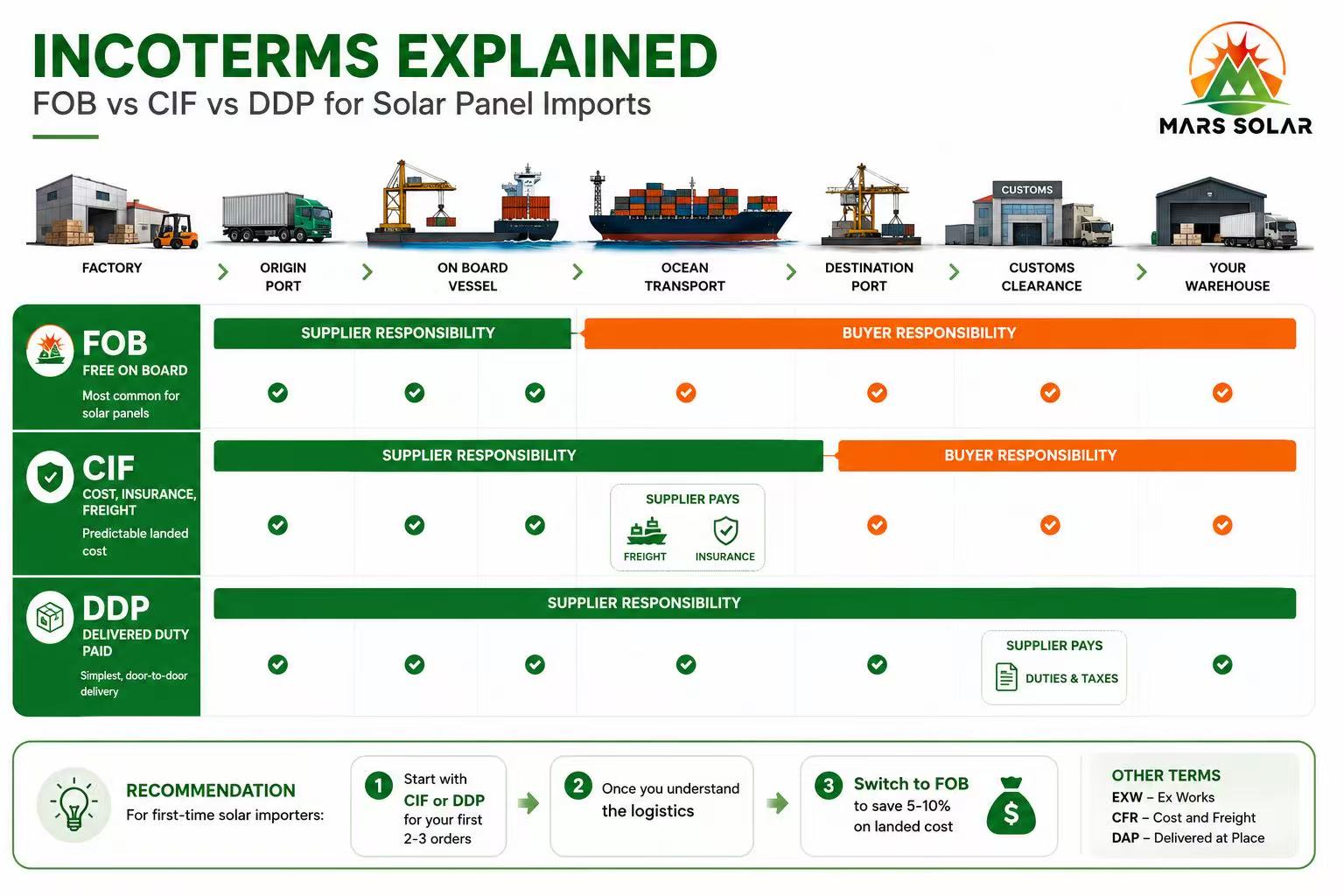
Three common Incoterms for solar panel imports:

  • FOB (Free On Board) — Most common for solar panels. The supplier delivers the goods to the port of origin and loads them onto the vessel. From that moment, you own the goods in transit, the shipping cost, the insurance, and all risks. Best for: experienced importers with their own freight forwarder and insurance.
  • CIF (Cost, Insurance, Freight). The supplier pays for freight and insurance to the destination port, but you own the goods during transit. The supplier selects the carrier and insurer, which can be a conflict of interest. Best for: first-time importers who want predictable landed cost.
  • DDP (Delivered Duty Paid). The supplier handles everything including customs clearance and import duties at the destination. Most expensive, but the simplest. Best for: small orders, complex destinations, or when you don't have a customs broker.

Other terms you might see:

  • EXW (Ex Works): You pick up at the factory. Cheapest but most risk and hassle.
  • CFR (Cost and Freight): Like CIF but without insurance. Rare for solar panels.
  • DAP (Delivered at Place): Supplier delivers to your warehouse, but you handle import duties.

Recommendation for first-time solar importers: Start with CIF or DDP for your first 2-3 orders. Once you understand the logistics, switch to FOB to save 5-10% on landed cost.
Full Guide of Cargo Container Loading

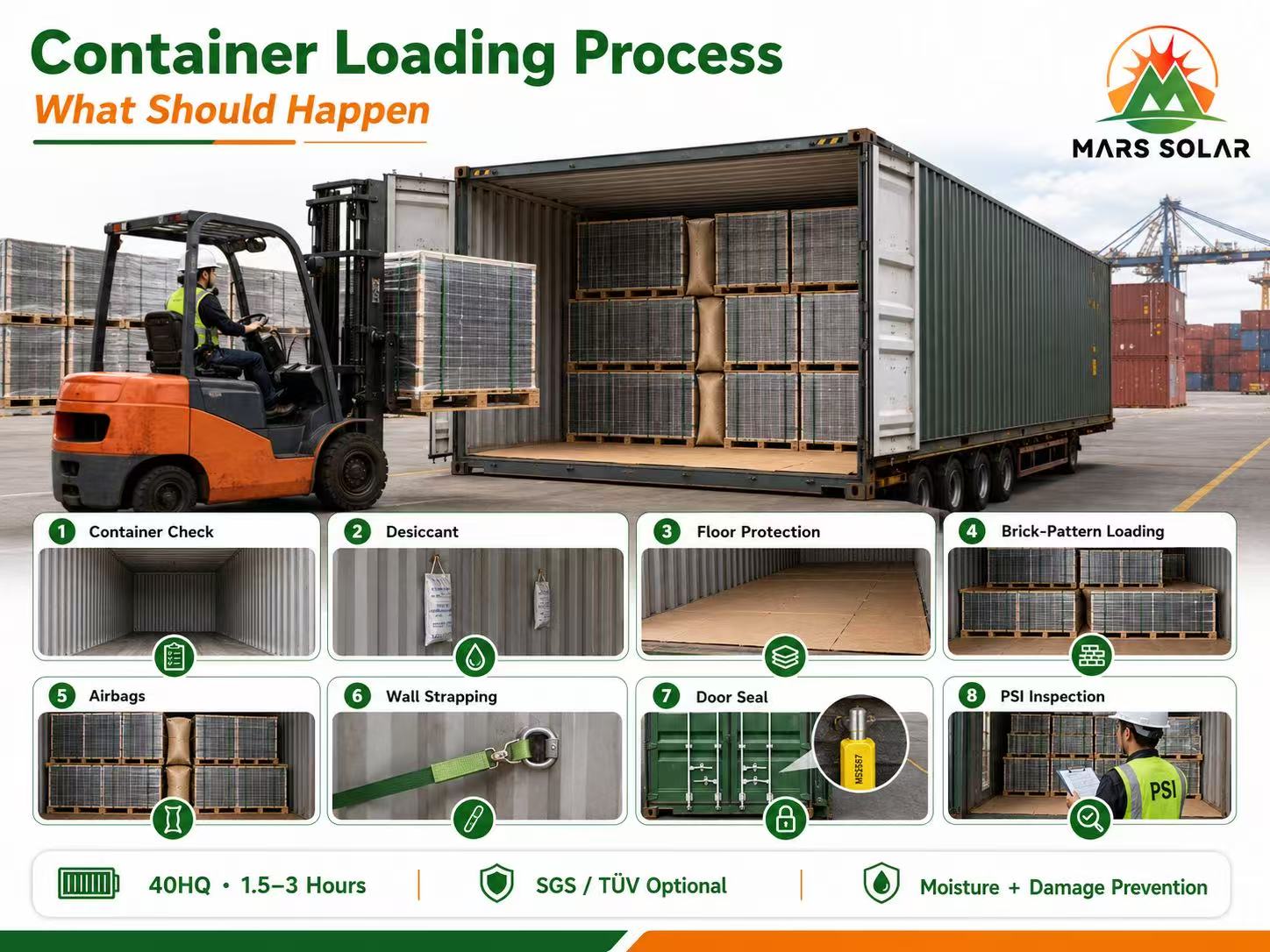
Container Loading Process: What Should Happen

Loading is where damage happens. A properly loaded container arrives in perfect condition; a poorly loaded one arrives with cracked glass, scratched frames, and water damage.

Step-by-step loading process:

  1. Container inspection (1 hour before loading). Walk into the empty container, check for: previous cargo residue, water stains, holes, damaged floor, strong odors. The container should be clean, dry, and odor-free. A moisture-free container reduces water damage risk by 90%.
  2. Desiccant placement. 10-20 kg of silica gel desiccant bags hung on the container walls. Critical for sea transport through humid climates (West Africa, Southeast Asia, South America).
  3. Floor protection. Cardboard sheets or wooden battens on the container floor to protect the bottom pallets from condensation.
  4. Loading pattern. Palletized panels loaded in a brick-pattern offset, not stacked directly above each other. This distributes weight and prevents crushing.
  5. Airbags for gap filling. Inflatable dunnage bags placed between pallet stacks to prevent shifting during ocean transit. 1-2 bags per container.
  6. Strapping to container walls. The first and last pallets of each row strapped to the container's lashing rings. Prevents horizontal shifting during vessel rolling.
  7. Door sealing. Container door sealed with a numbered bolt seal. Record the number on the B/L for verification at destination.

Time required: 1.5-3 hours per 40HQ container, depending on whether the factory has a side-loader or only a forklift.

Pre-shipment inspection: For orders above $50,000, hire SGS or TÜV to inspect the loading process and randomly open 1-2 finished cartons to verify panel quality. Cost: $200-500 per inspection.
Full Guide of Cargo Container Loading

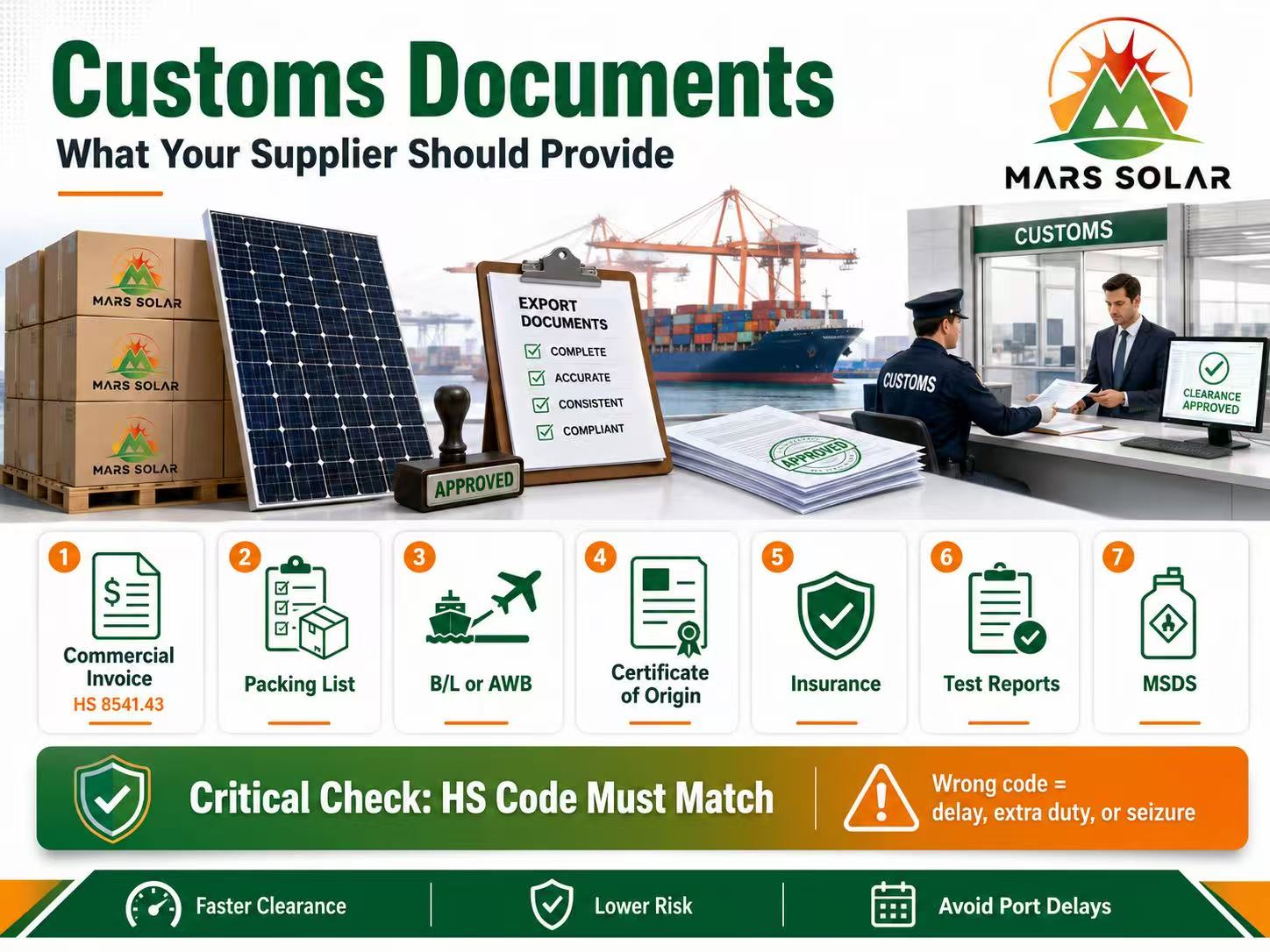
Customs Documents: What Your Supplier Should Provide

Missing or incorrect customs documents are the #1 cause of port delays. Here's what you need for a smooth import:

  • Commercial Invoice (CI). Lists the goods, value, currency, Incoterm, parties, and HS code (8541.43 for solar modules).
  • Packing List (PL). Detailed list of cartons, pallets, dimensions, weights, and contents.
  • Bill of Lading (B/L) or Air Waybill (AWB). The transport contract between carrier and shipper. The B/L is also the title document for ocean freight.
  • Certificate of Origin (C/O). Issued by China Chamber of Commerce or CIQ. Required for preferential tariffs (e.g., China-ASEAN FTA reduces import duty to 0% for many ASEAN countries).
  • Insurance Certificate (for CIF/CIP). Covers all-risks during transit. Institute Cargo Clauses (A) is the standard for solar panels.
  • Test Reports. TÜV, IEC, UL certificates for the specific panel model. Required by some countries (US, EU, Australia).
  • MSDS (Material Safety Data Sheet). Required for some destinations (especially for the battery in storage systems). Less common for pure solar panels.

Critical check: The HS code on the invoice must match your country's tariff schedule. Mismatched HS codes can result in 10-25% additional duty or cargo seizure.
Full Guide of Cargo Container Loading

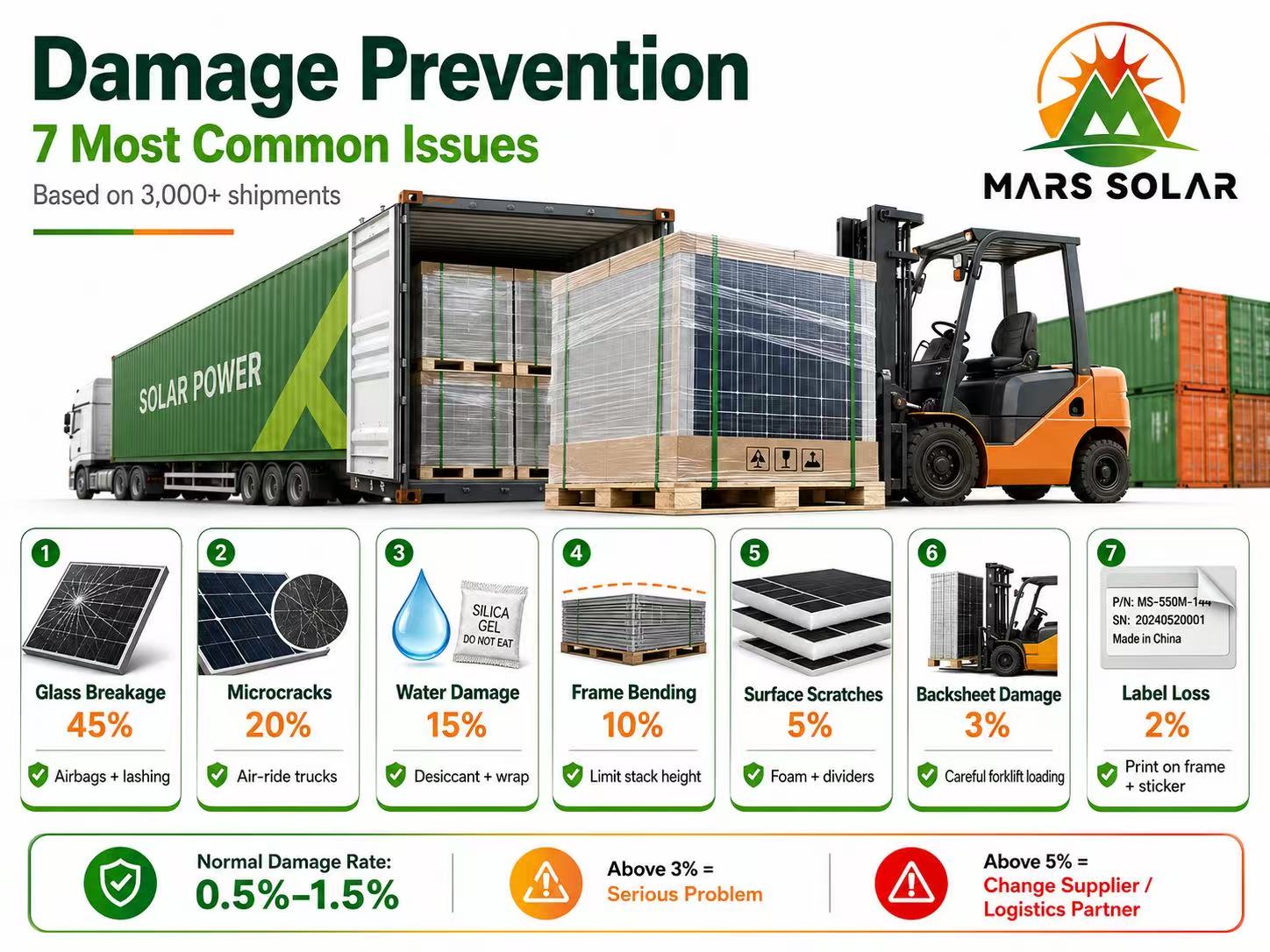
Damage Prevention: The 7 Most Common Issues

Based on Mars Solar's data across 3,000+ shipments, here are the most common damage issues and how to prevent them:

  1. Glass breakage from container shifting (45% of damage cases). Cause: inadequate airbags or lashing. Prevention: 2-3 airbags per container, lashing first and last pallets to walls.
  2. Cell microcracks from vibration (20%). Cause: poor road transport from port to warehouse. Prevention: request air-ride suspension trucks, avoid rough roads.
  3. Water damage to junction boxes (15%). Cause: condensation or container rain. Prevention: silica gel desiccant, water-resistant packaging, intact stretch wrap.
  4. Frame bending (10%). Cause: stacking too high. Prevention: max 24 panels per pallet for 35mm-thick panels, 20 panels for 30mm bifacial.
  5. Surface scratches (5%). Cause: panels rubbing inside carton. Prevention: EPE foam corners + cardboard dividers between every panel.
  6. Backsheet damage (3%). Cause: forklift punctures during loading/unloading. Prevention: trained operators, side-loader preferred.
  7. Label/serial number loss (2%). Cause: rubbing during transit. Prevention: serial number labels also printed on the back of the panel frame, not just the sticker.

Damage rate benchmark: 0.5-1.5% damage rate is normal. Above 3% indicates a serious packaging or logistics problem. Above 5% means a systemic issue — change supplier or logistics partner.
Full Guide of Cargo Container Loading

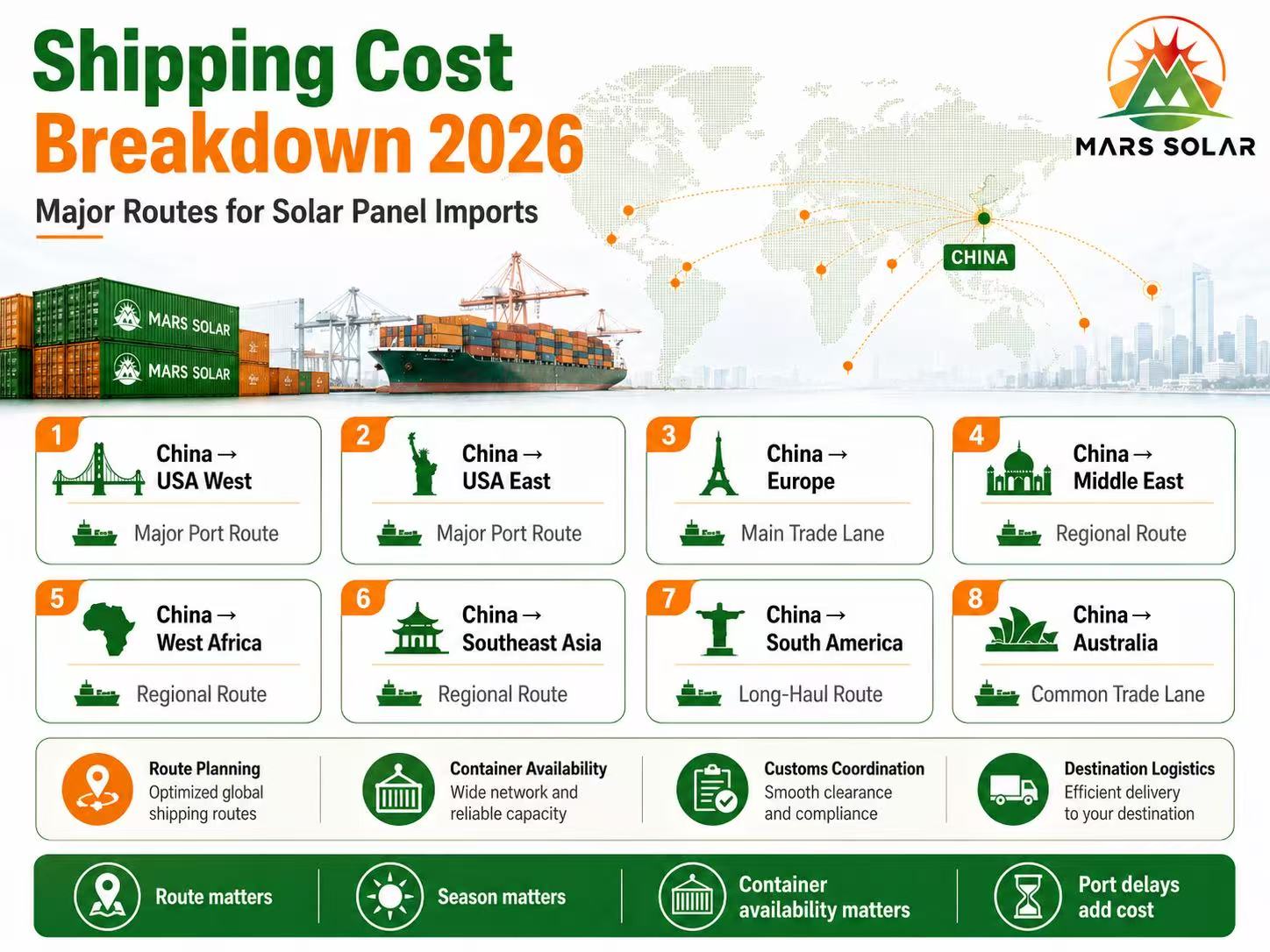
Shipping Cost Breakdown 2026: What You'll Pay

Solar panel shipping costs vary dramatically by route, season, and container availability. As of mid-2026, here are typical rates per 40HQ:

  • China → USA West Coast: $3,500-5,500 (LA/LB), transit 18-25 days. Above pre-2020 levels due to Red Sea tensions.
  • China → USA East Coast: $5,500-7,500 (NY/Norfolk), transit 32-38 days via Panama Canal or 45-55 days via Suez.
  • China → Europe (North): $4,500-7,000 (Rotterdam/Hamburg), transit 28-35 days. Higher due to Red Sea routing via Cape of Good Hope.
  • China → Middle East: $1,800-3,000 (Jeddah/Dubai), transit 18-25 days.
  • China → Africa (West): $4,000-6,500 (Lagos/Abidjan), transit 35-50 days, plus 7-14 days port clearance.
  • China → Southeast Asia: $800-1,800 (Singapore/Jakarta), transit 7-12 days.
  • China → South America (East): $5,500-8,000 (Santos/Buenos Aires), transit 35-45 days.
  • China → Australia: $2,500-4,000 (Sydney/Melbourne), transit 18-25 days.

Cost per watt landed (rough example for 40HQ of 550W panels, 158 kW): Add shipping cost to FOB panel cost. If FOB = $0.13/W and shipping = $4,000/158kW = $0.025/W, CIF landed cost = ~$0.155/W. Add 5-15% import duty depending on country, plus 1-3% customs broker fee.
Full Guide of Cargo Container Loading

Lead Time by Region: When Will Your Panels Arrive?

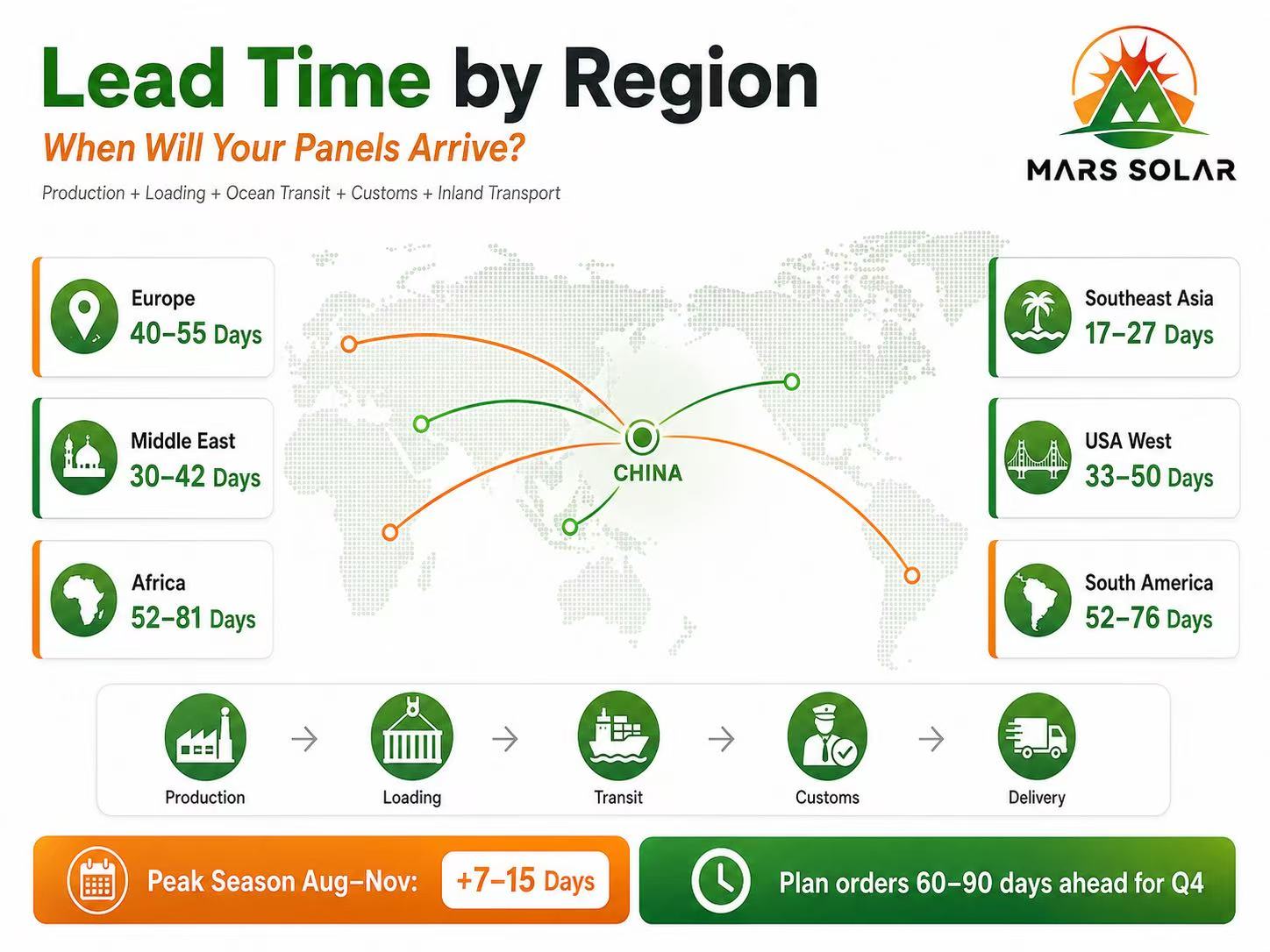
Lead time = production time + loading time + ocean transit + customs clearance + inland transport. Here's realistic 2026 timing:

  • Southeast Asia (Singapore, Indonesia, Philippines, Vietnam): Production 7-10 days + transit 7-12 days + customs 3-5 days = 17-27 days total.
  • Middle East (UAE, Saudi Arabia): Production 7-10 days + transit 18-25 days + customs 5-7 days = 30-42 days total.
  • Europe (Germany, Netherlands, Spain): Production 7-10 days + transit 28-35 days + customs 5-10 days = 40-55 days total.
  • USA (West Coast): Production 7-10 days + transit 18-25 days + customs 5-10 days + inland 3-5 days = 33-50 days total.
  • Africa (Nigeria, Kenya, South Africa): Production 7-10 days + transit 35-50 days + customs 7-14 days + inland 3-7 days = 52-81 days total.
  • South America (Brazil, Chile, Argentina): Production 7-10 days + transit 35-45 days + customs 7-14 days + inland 3-7 days = 52-76 days total.

Peak season delays: August-November (back-to-school, Black Friday, year-end projects) sees 7-15 day transit extensions and 30-50% rate increases. Plan orders 60-90 days in advance for Q4 delivery.
Full Guide of Cargo Container Loading

Mars Solar's Shipping Network

For buyers using Mars Solar, here's what we offer out of the box:
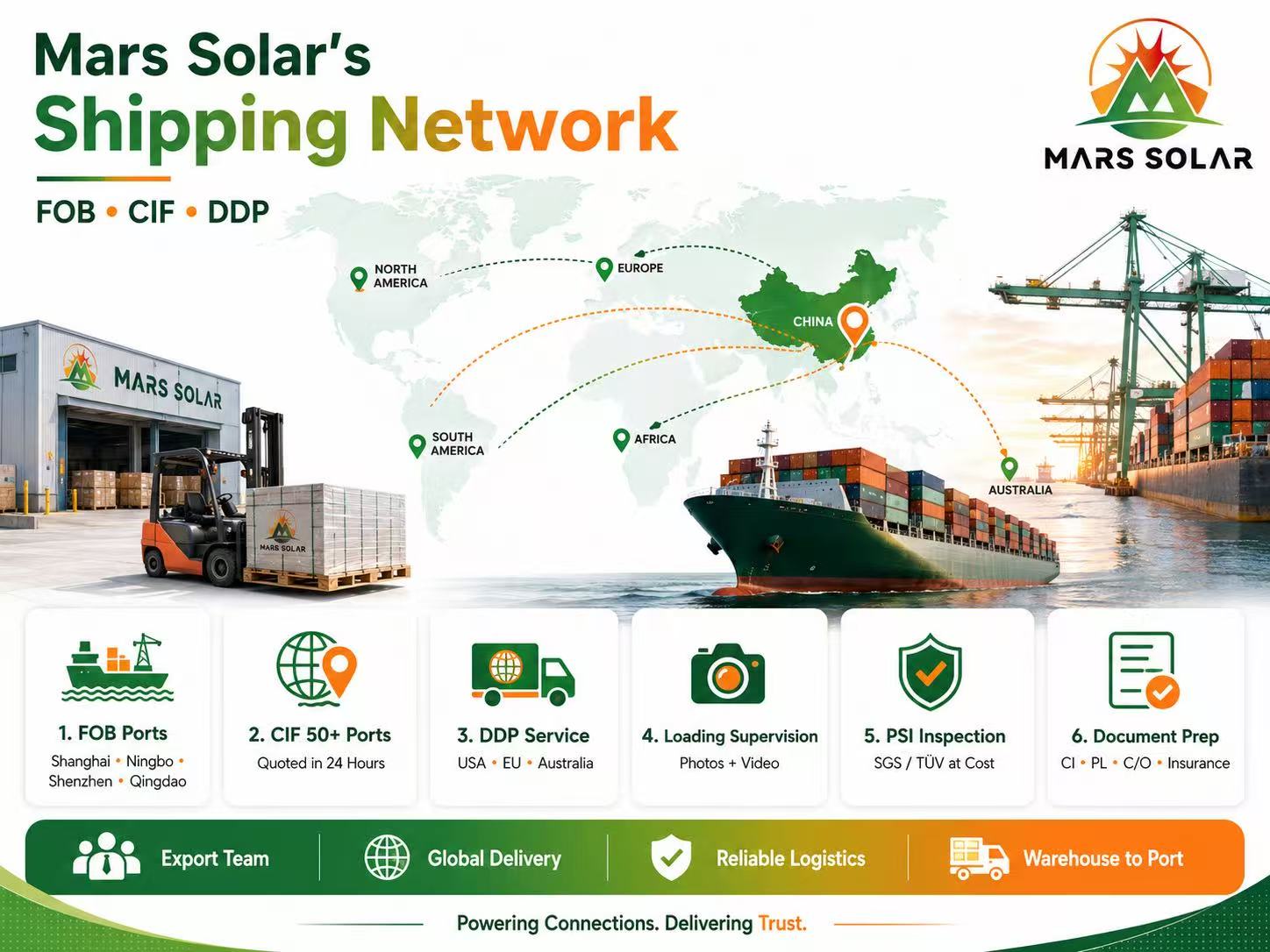
  • FOB Shanghai / Ningbo / Shenzhen / Qingdao — your choice of port, no port fees added to FOB price.
  • CIF to 50+ major ports — pre-negotiated rates with Maersk, MSC, COSCO, CMA-CGM, Evergreen. Quoted within 24 hours.
  • DDP to USA, EU, Australia — full landed cost including duties, delivered to your warehouse.
  • Free container loading supervision — our QC team supervises every container load and sends you photos + video.
  • Pre-shipment inspection — SGS or TÜV inspection at cost, with full report before B/L is released.
  • Customs document prep — commercial invoice, packing list, C/O, insurance, and test reports prepared by our export team.
Full Guide of Cargo Container Loading

Frequently Asked Questions About Cargo Container Loading

Q: How many panels fit in a 40HQ container?
A: For standard 550W mono PERC panels: 288-336 panels (158-185 kW). For 700W bifacial: 220-260 panels (154-182 kW). The exact number depends on panel dimensions and pallet configuration.

Q: Should I choose FOB or CIF for my first order?
A: CIF for your first 1-2 orders. It gives you predictable landed cost and reduces your risk. Once you're comfortable with the supplier, switch to FOB to save 5-10%.

Q: What's the typical damage rate for solar panel shipments?
A: 0.5-1.5% is normal and acceptable. Anything above 3% indicates a packaging or logistics problem. Above 5%, change supplier or freight forwarder.

Q: How long does sea freight take from China to my country?
A: Southeast Asia 7-12 days, Middle East 18-25 days, USA West Coast 18-25 days, Europe 28-35 days, Africa 35-50 days, South America 35-45 days. Add 5-14 days for customs clearance.

Q: Do I need insurance for my solar panel shipment?
A: Yes, always. All-risks cargo insurance (Institute Cargo Clauses A) costs 0.3-0.5% of the cargo value and covers damage, loss, and theft. Don't skip it to save $100 on a $50,000 shipment.

Q: What's the HS code for solar panels?
A: 8541.43 (solar cells assembled into modules or panels). Some countries have separate codes for different wattages or technologies — verify with your customs broker before shipping.

Q: How many panels does one cargo container loading hold?
A: A 40HQ takes 288 to 336 standard 550 W mono PERC panels, or 158 to 185 kW. A cargo container loading of thinner bifacial modules fits 220 to 260 pieces but weighs more per cubic metre. Getting the cargo container loading count wrong at quotation stage is the fastest way to lose a margin.

Q: Which container type should a cargo container loading use?
A: 40HQ for volume, 40GP only when the cargo is weight-limited. A cargo container loading of 550 W modules usually cubes out before it weighs out, so the 40HQ is the default for a cargo container loading of panels. Confirm the internal height before you fix the packing plan.

Q: What packaging should a cargo container loading follow?
A: Cartons rated for stacking, corner protection and moisture control. A cargo container loading that skips edge reinforcement transfers every road shock into the frame, which is where most cargo container loading damage actually starts. Specifying the packing method is part of planning the cargo container loading, not an afterthought.

Q: FOB or CIF for a cargo container loading?
A: CIF for the first two or three orders, FOB once you know the route. A cargo container loading on CIF terms hands the freight risk to the supplier while you learn the port, and switching the cargo container loading to FOB later typically saves 5 to 10% on landed cost.

Q: What documents does a cargo container loading need?
A: Commercial invoice, packing list, bill of lading, certificate of origin, insurance and test reports. A cargo container loading with a mismatched HS code between invoice and bill of entry can attract 10 to 25% extra duty or seizure. Check the paperwork before the cargo container loading is sealed, not after.

Q: What damage rate is normal for a cargo container loading?
A: Under 5% of panels, argued case by case. A higher figure on a cargo container loading points to a systemic packing or handling problem rather than bad luck, and it means changing supplier or freight partner. Track every cargo container loading against that threshold instead of treating claims as noise.

Q: What does a cargo container loading cost to ship in 2026?
A: About $0.155 per watt all-in on mainstream routes. Add 5 to 15% import duty by destination, plus a customs broker fee of 1 to 3%, so the cargo container loading cost is only part of the landed number. Model the cargo container loading against the full delivered cost before comparing suppliers.

Q: How far ahead should a cargo container loading be booked?
A: Sixty to ninety days for Q4 delivery. Seasonal rate increases of 30 to 50% and rollovers hit any cargo container loading booked late, which is why exporters plan the cargo container loading against the sailing schedule rather than the production finish date.

Q: Who should supervise the cargo container loading?
A: A third party, on any order over $50,000. An inspection runs $200 to $500, and opening one or two cartons during the cargo container loading catches the panel damage and count errors that paperwork never shows.

Related Articles

Continue your solar sourcing research:
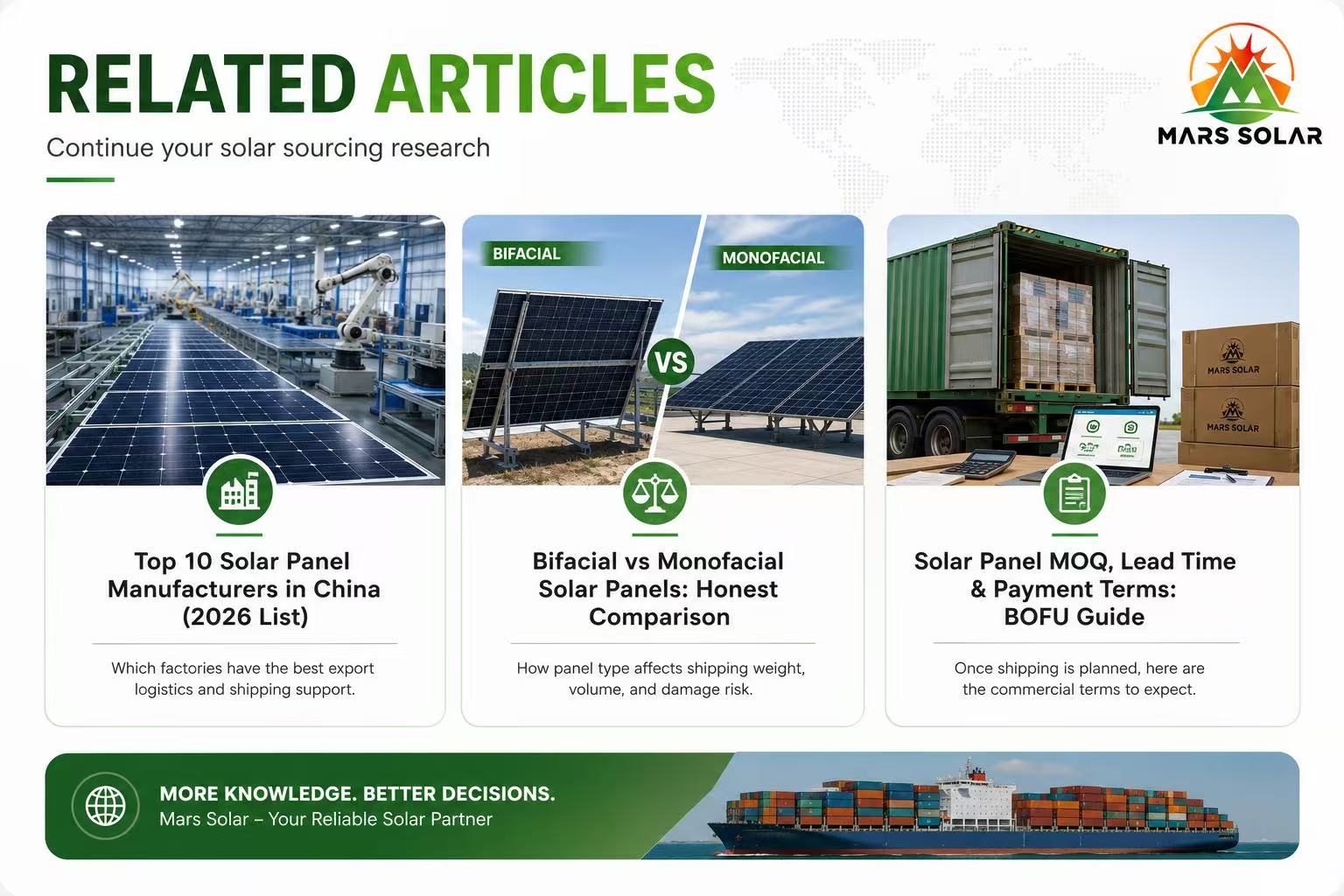
  • Top 10 Solar Panel Manufacturers in China (2026 List) — Which factories have the best export logistics and shipping support.
  • Bifacial vs Monofacial Solar Panels: Honest Comparison — How panel type affects shipping weight, volume, and damage risk.
  • Solar Panel MOQ, Lead Time & Payment Terms: BOFU Guide — Once shipping is planned, here are the commercial terms to expect.
Full Guide of Cargo Container Loading

About Mars Solar

Mars Solar ships 50,000+ panels monthly to 130+ countries via Shanghai, Ningbo, Shenzhen, and Qingdao ports. We provide FOB, CIF, and DDP terms with full pre-shipment inspection and customs documentation. Get a quote with shipping included: https://sunenergyfactory.com/contact-us/.
Emial:info@marssolargroup.com

Cargo Container Loading: The Numbers That Matter

Cargo container loading for solar equipment is measured on three numbers: containers used, damage rate on arrival, and freight cost per watt. Good cargo container loading improves all three at once — a well-planned load uses fewer containers, arrives intact, and costs less to ship per unit of capacity.

A 40-foot high-cube container holds roughly 600 to 700 standard panels depending on pallet configuration. Packing panels vertically on edge in a purpose-built rack usually beats flat stacking on both damage rate and count.

Cargo Container Loading Sequence

The sequence for cargo container loading matters as much as the layout. Heavy items — batteries and inverters — go in first and forward, panels go aft, and the centre of gravity stays low and near the middle. Load distribution affects road and rail handling far more than most shippers expect.

Dunnage and strapping are not optional. Panels flex, and flexed glass cracks. Every layer gets separation and the whole load gets cross-strapped before the doors close.

Cutting Damage in Cargo Container Loading

Damage in cargo container loading comes from three causes: inadequate restraint, moisture, and handling at transhipment. Restraint is solved with strapping and dunnage; moisture with desiccant and a sealed liner; transhipment risk by choosing direct services where the freight premium is smaller than the expected damage cost.

We photograph every load before sealing and share the images with the buyer, so any claim has evidence from day one. For the equipment itself see our rack mounted energy storage battery and 100kW hybrid system pages, and for market context the World Bank energy programme.

Loading guides are usually read while an order is being planned, so it helps to fix the system size first. A 200KW 200KVA solar system is a good worked example, because its module and battery counts fill a 40HQ container almost exactly.
SHARE:

Subscribe Our Newsletter

    Design and Manufacture of Domestic and Commercial Solar Energy Systems

    Contact Info

    7th Floor, Building 5, Phase II, Wanyang Innovation City, Xiaotang Industrial Avenue, Shishan Town, Nanhai District, Foshan City

    Follow Us

    Do You Want A Free Solar System Design for Your building?

    Leave your mobile number/whatsapp/email and we can respond within an hour!

      Get free consultations, catalogs, product specifications, quotes and more now.

      Language

      en_usaresfrnlpt

      Language