Factory-Direct · CIF Lagos & Onne Port

Solar System Nigeria: Factory-Direct Supply to Lagos and Onne Port

A solar system Nigeria businesses install is a PV array plus lithium storage sized to the load they are already running on diesel — in this market that usually means 50kWh to 4MWh of battery with 20kW to 5MW of PV, priced CIF Lagos or Onne Port.

Mars Solar builds and ships complete solar system Nigeria projects — from 50kWh BESS cabinets for clinics and telecom towers to 6MW hybrid plants — with the SONCAP file set and Form M paperwork prepared before the vessel sails. Every unit is load-tested for 72 hours before it leaves the line. Send your load profile and your last three months of diesel receipts, and get a sized quotation within one working day.

₦300–650

Diesel generation cost per kWh

₦55–150

Solar levelized, 25 years

8–12 mo

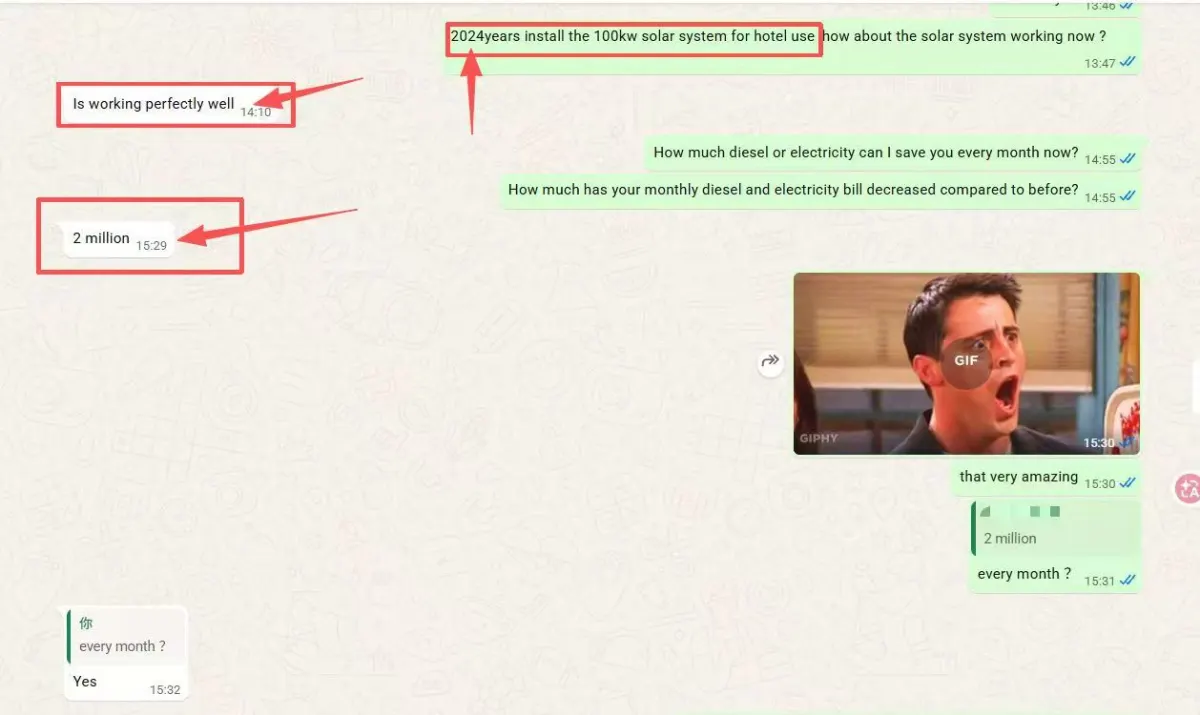
Payback, our 100kW hotel

0%

Duty on modules, ECOWAS CET

A Solar System Nigeria Buyer Can Inspect: Recent Site Photos

Four projects delivered in Nigeria — installed, commissioned and photographed by our own engineers. Ask for the full photo set and the commissioning report on any of them.

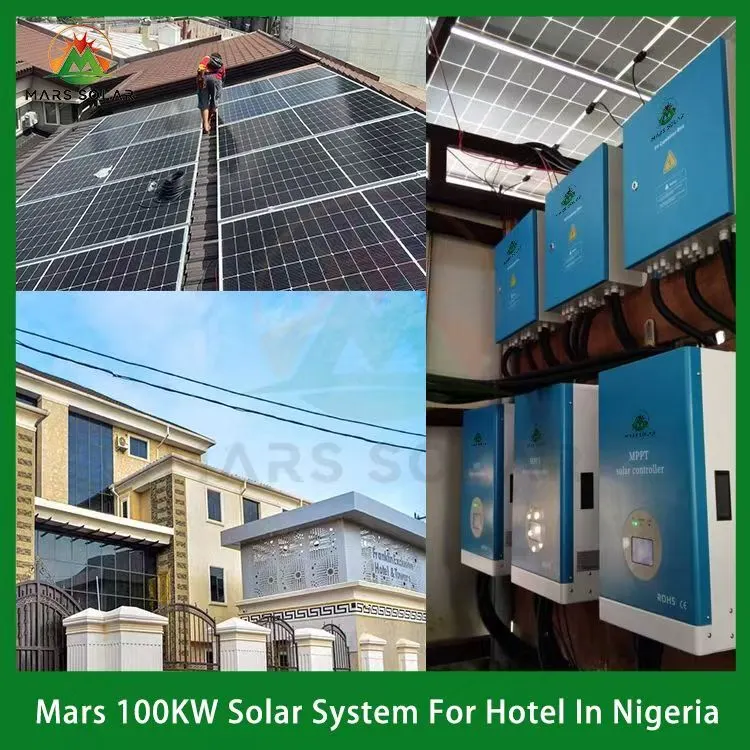
Solar system Nigeria reference: 100kW rooftop PV array installed on a hotel in Nigeria
Nigeria · 100kW hotel, Lagos
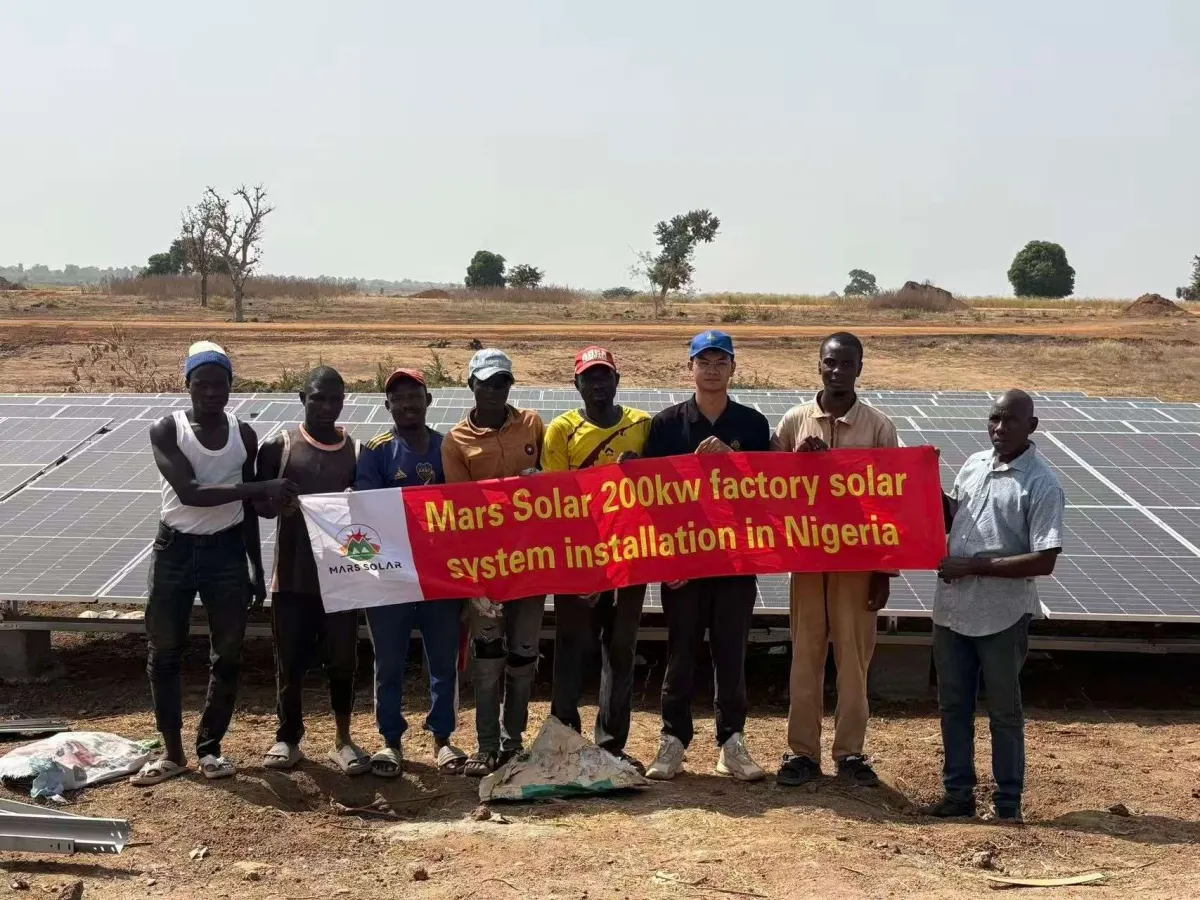
Solar system Nigeria reference: 200kW solar and battery storage project for a rice mill in Abuja
Nigeria · 200kW rice mill, Abuja
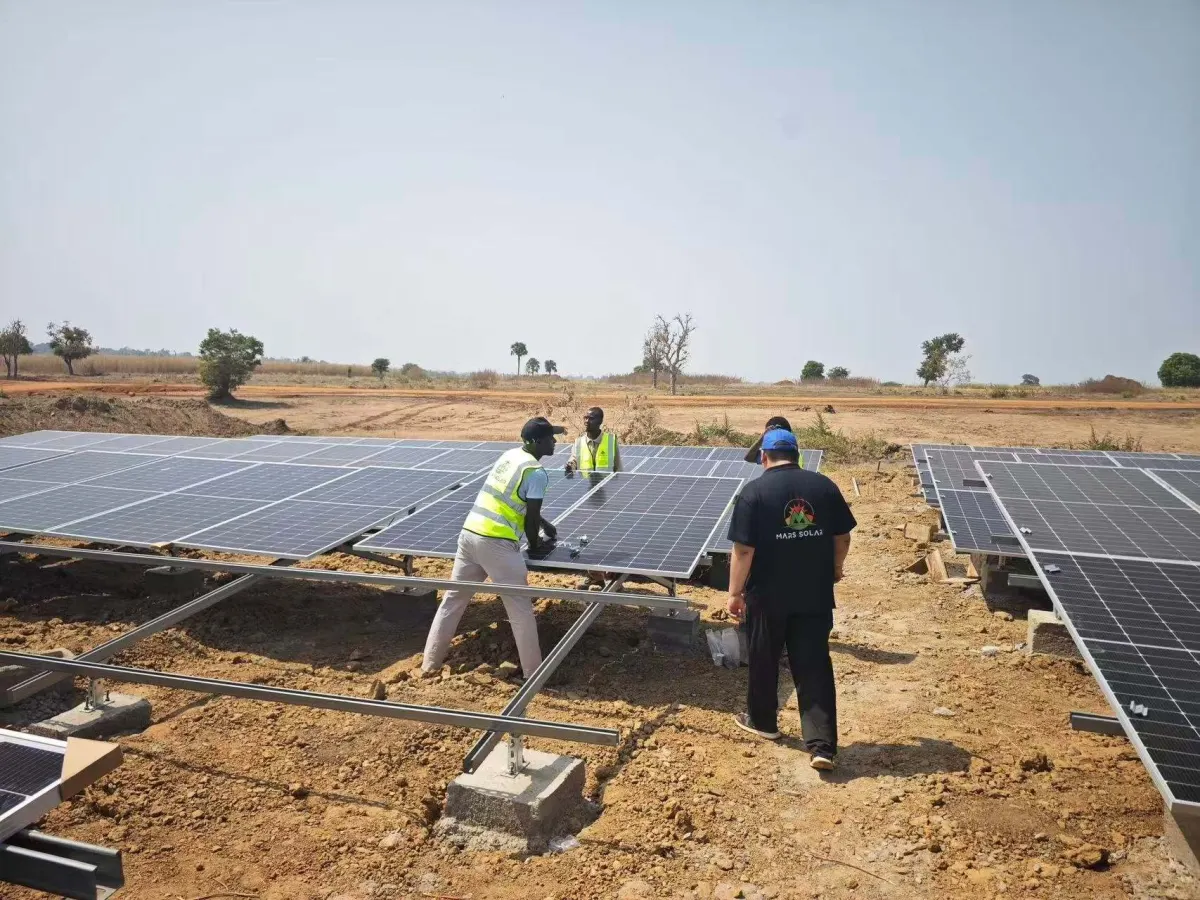
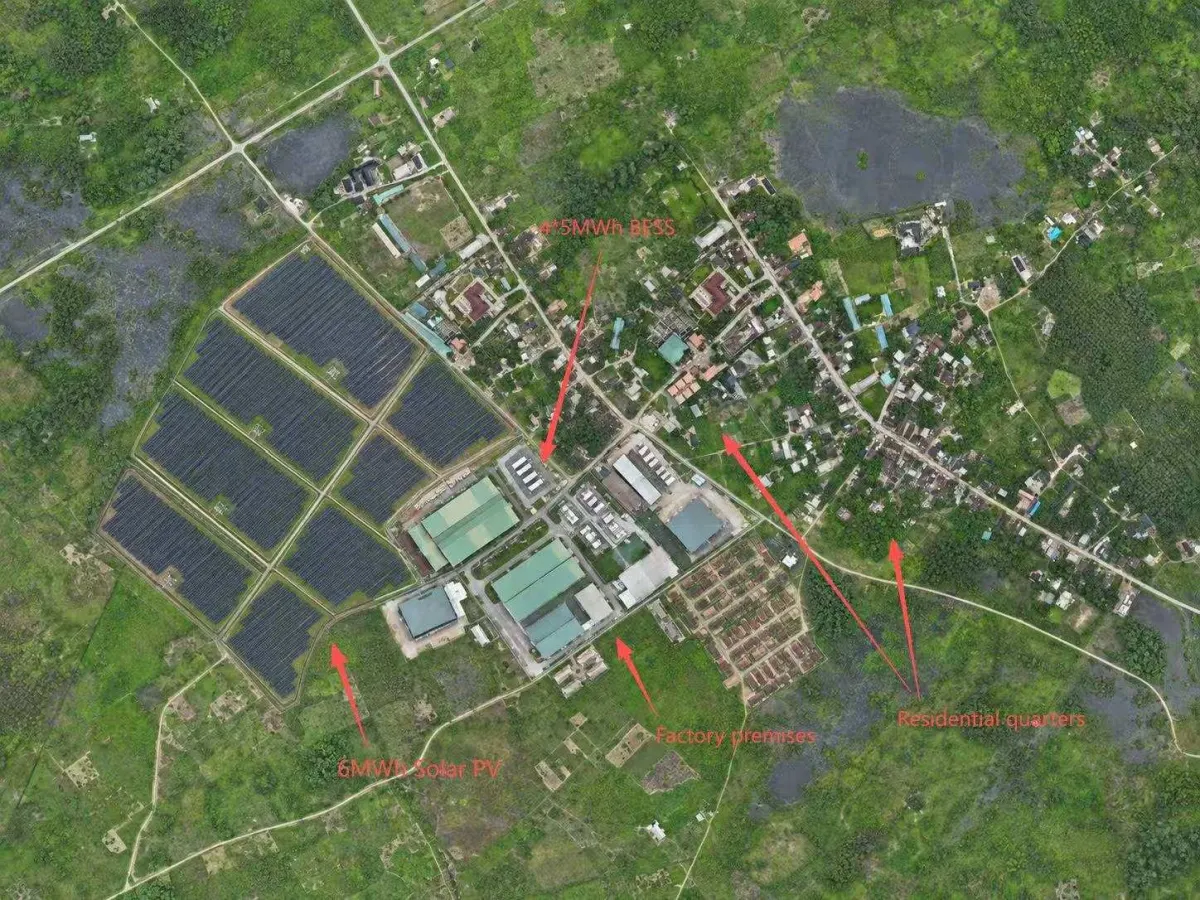
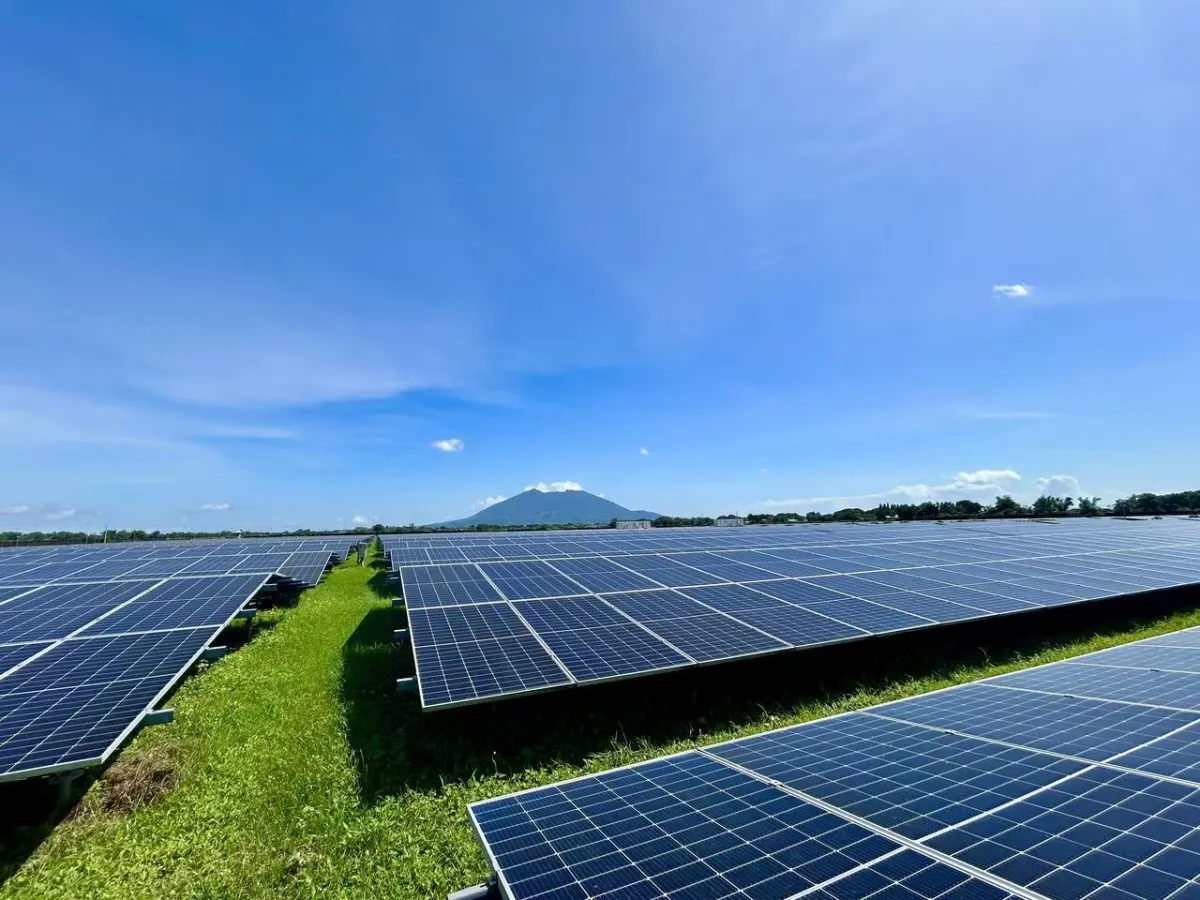
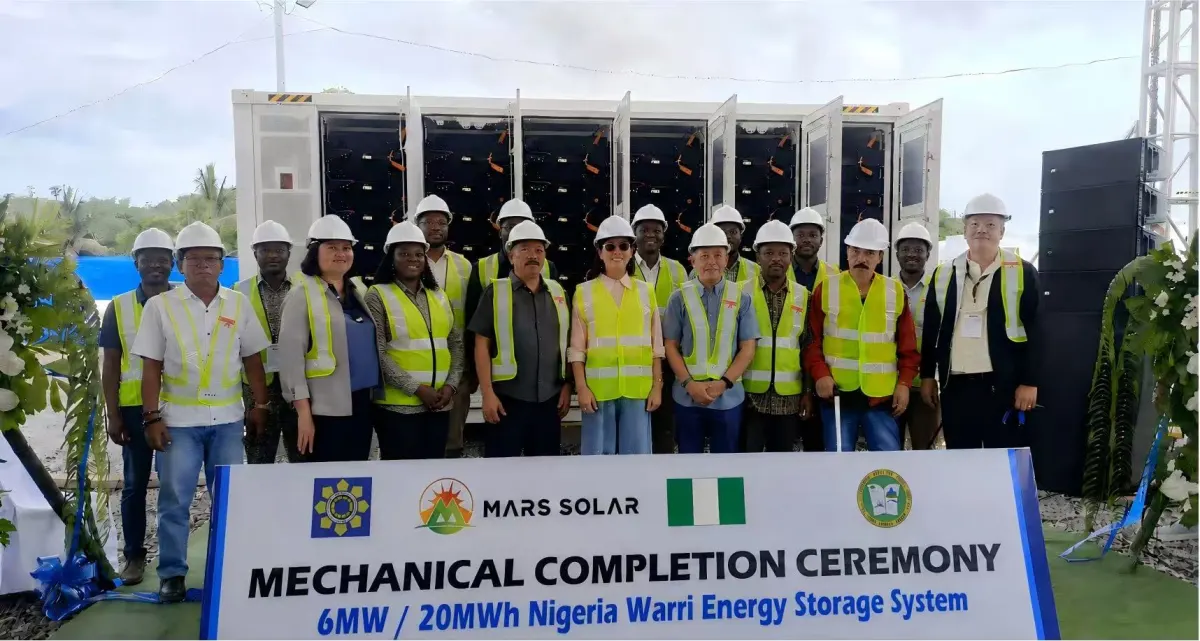
Solar system Nigeria reference: 6MW ground-mount PV array with containerised battery storage in Nigeria
Nigeria · 6MW + 20MWh BESS
Solar system Nigeria reference: hybrid solar and storage installation for a Nigerian commercial site
Nigeria · hybrid commercial install

Why a Solar System Nigeria Buyer Should Source Factory-Direct

Four things decide whether a solar system Nigeria project survives its first rainy season or quietly drives you back to diesel.

01

Own factory, not a trading desk

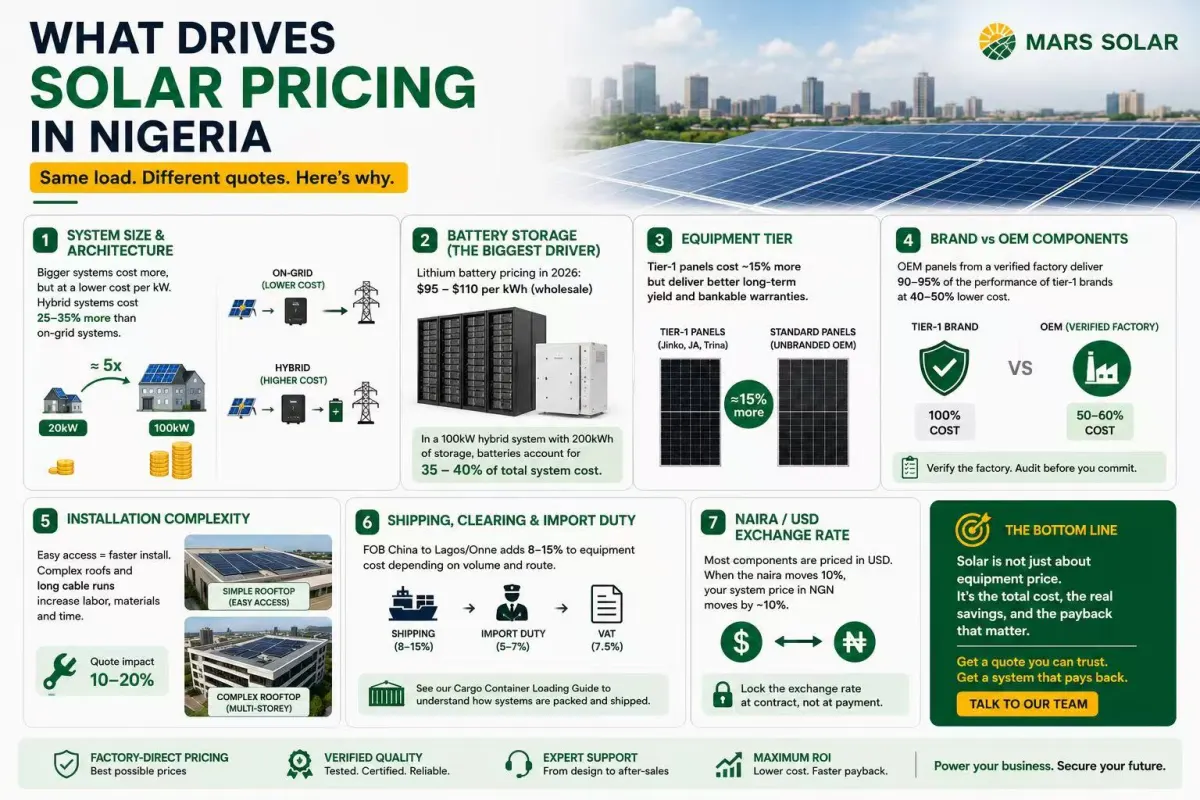
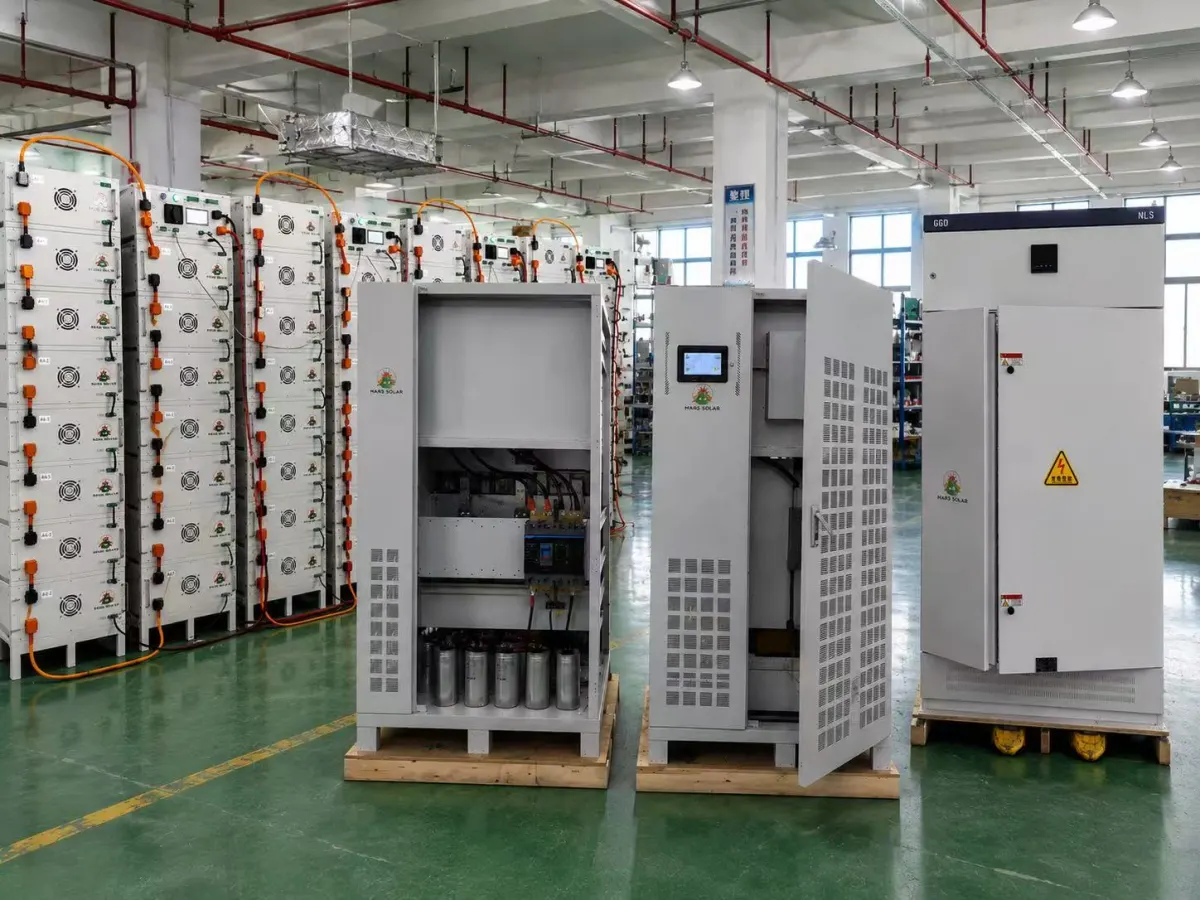
The LFP battery cabinets, hybrid inverters and mounting systems come off our own line, so sizing, the bill of materials and the warranty all sit with one party. No reseller margin stands between the factory price and your landed cost in Lagos. It is also why a solar system Nigeria quotation from a trading desk can come in 20 percent higher for the same bill of materials.

02

CIF Lagos or Onne Port, no clearing surprises

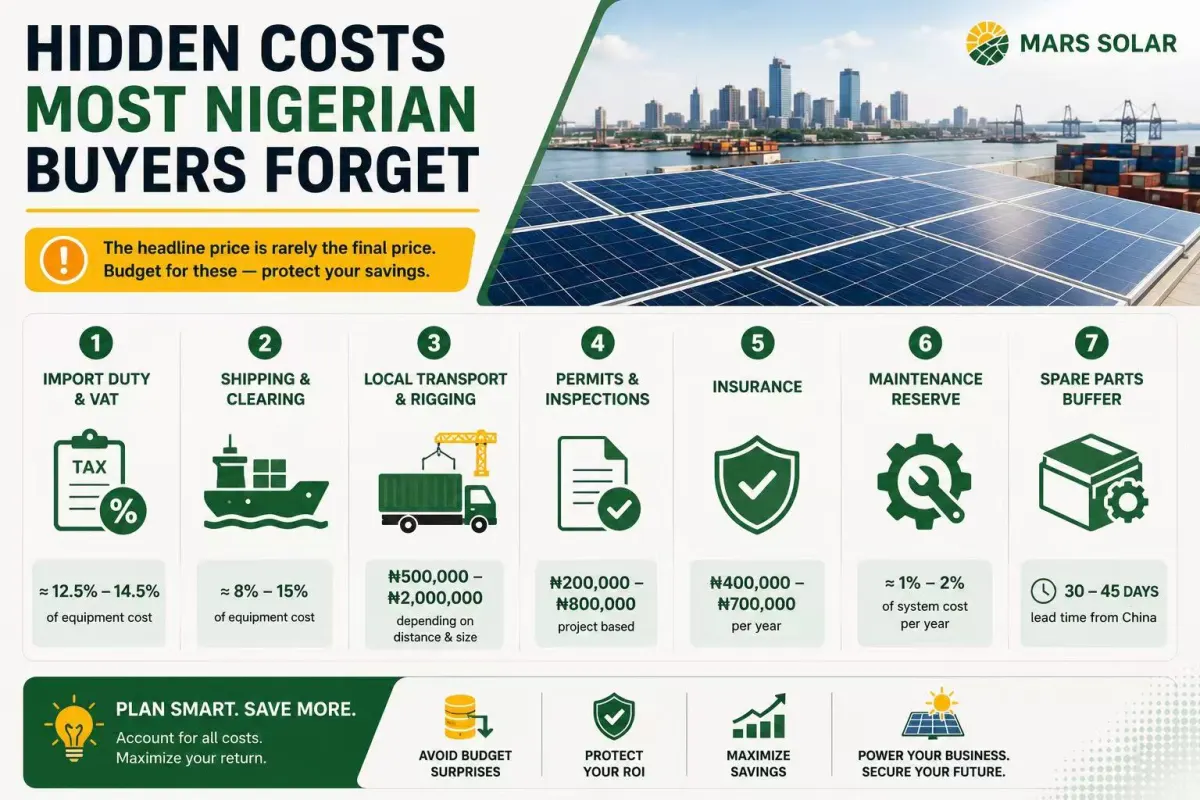
We quote CIF rather than FOB, because shipping, clearing and duty to Lagos or Onne add 8 to 15 percent on their own. You see one delivered number for the port you nominate instead of invoices from three different agents arriving after the fact.

03

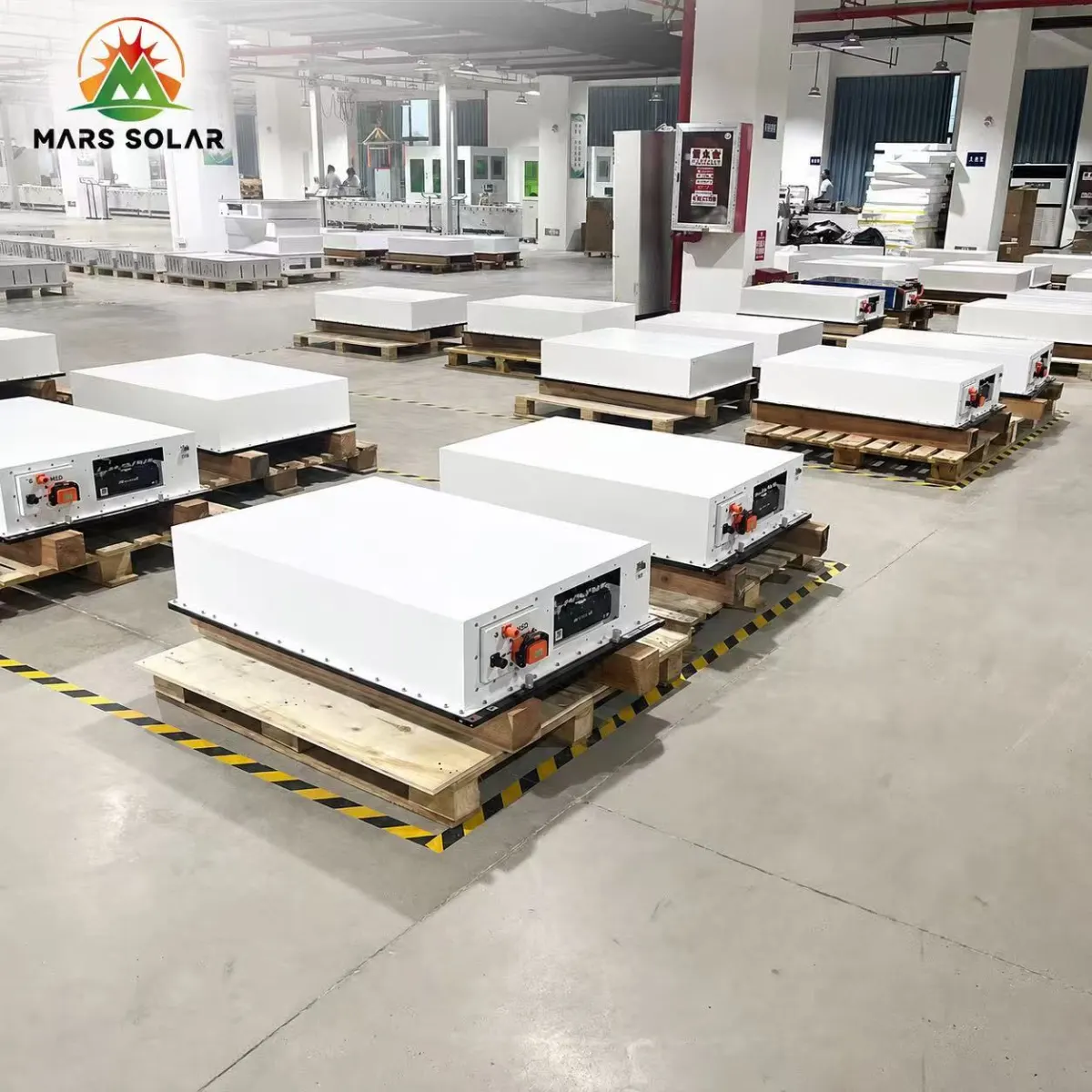
72-hour burn-in before it ships

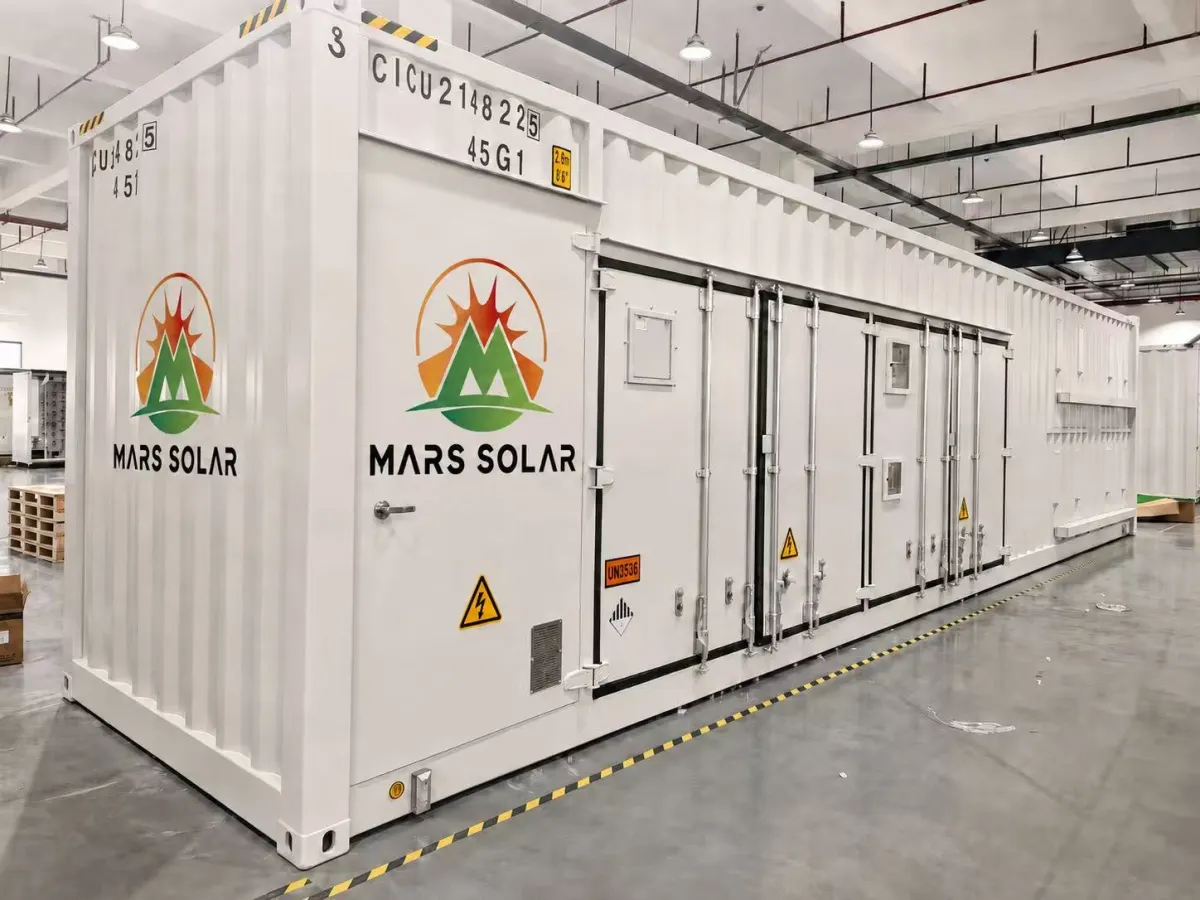
Every solar system Nigeria order is load-tested, BMS-calibrated and grid-tested on the line, then photographed inside the container. Failures surface in our factory, not in an Abuja hotel at nine in the evening.

04

SONCAP and Form M ready before the vessel sails

Panels enter at zero duty under the ECOWAS Common External Tariff, but nothing clears Apapa without a SONCAP certificate in the right PC grade, and a missing Form M leaves the container accruing demurrage at the port. We assemble that file set with you; your agent files it.
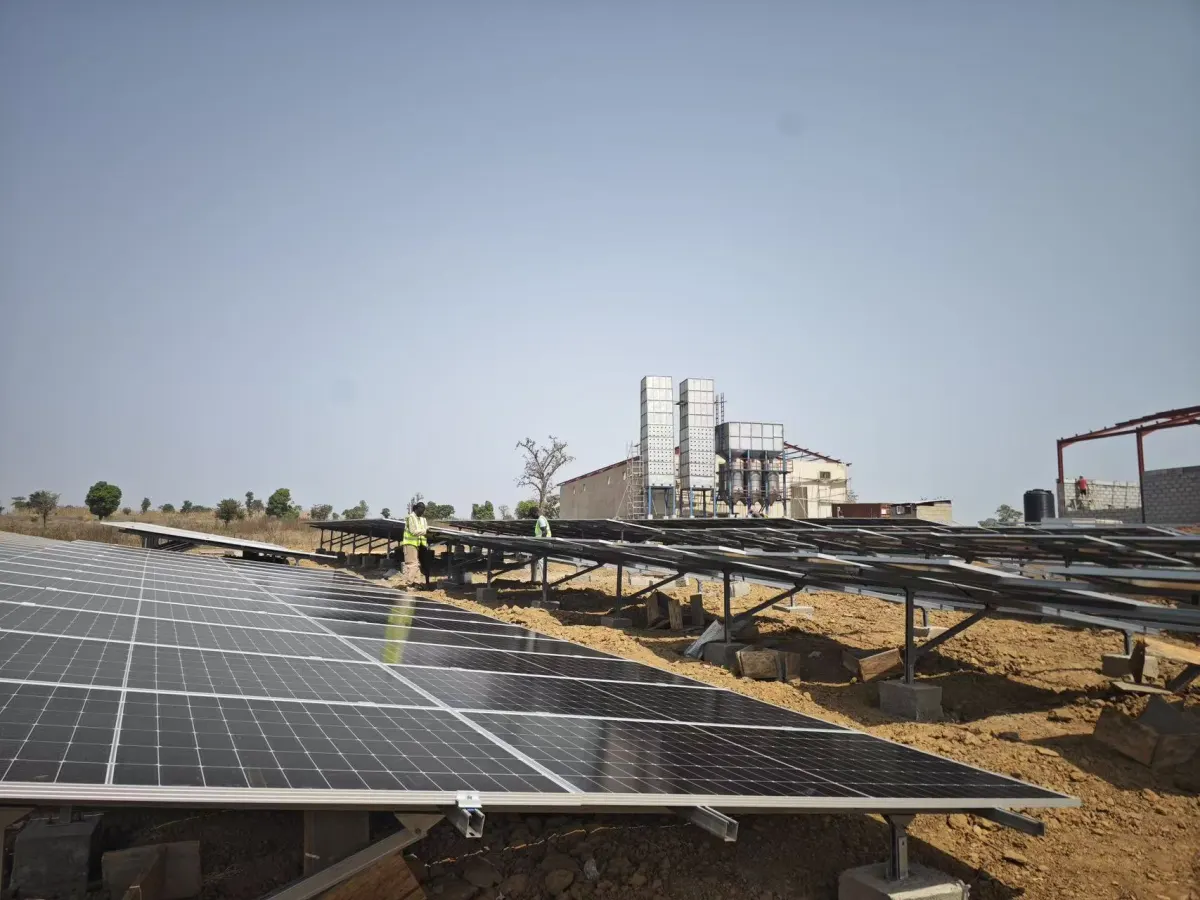
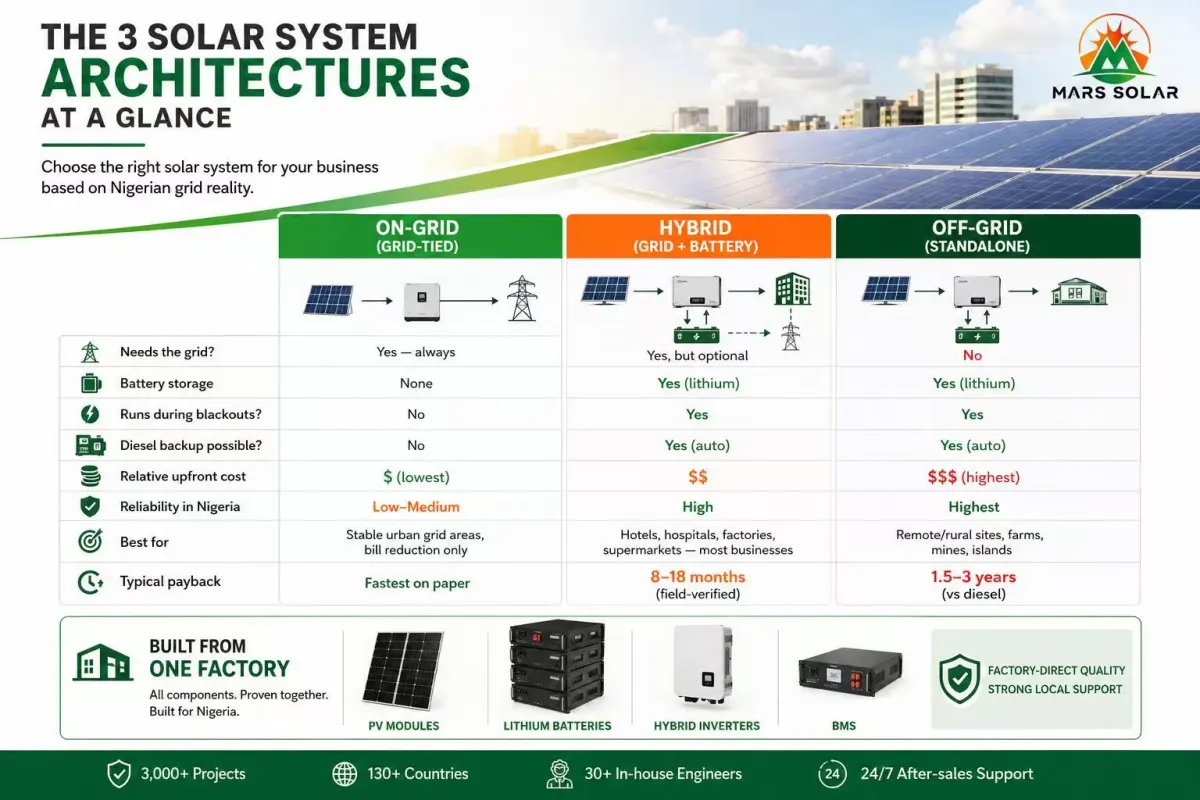
Solar panels on the roof of the Mars Solar factory building, where every solar system Nigeria order is assembled and testedSolar system Nigeria reference: hybrid solar and battery architecture on a commercial site

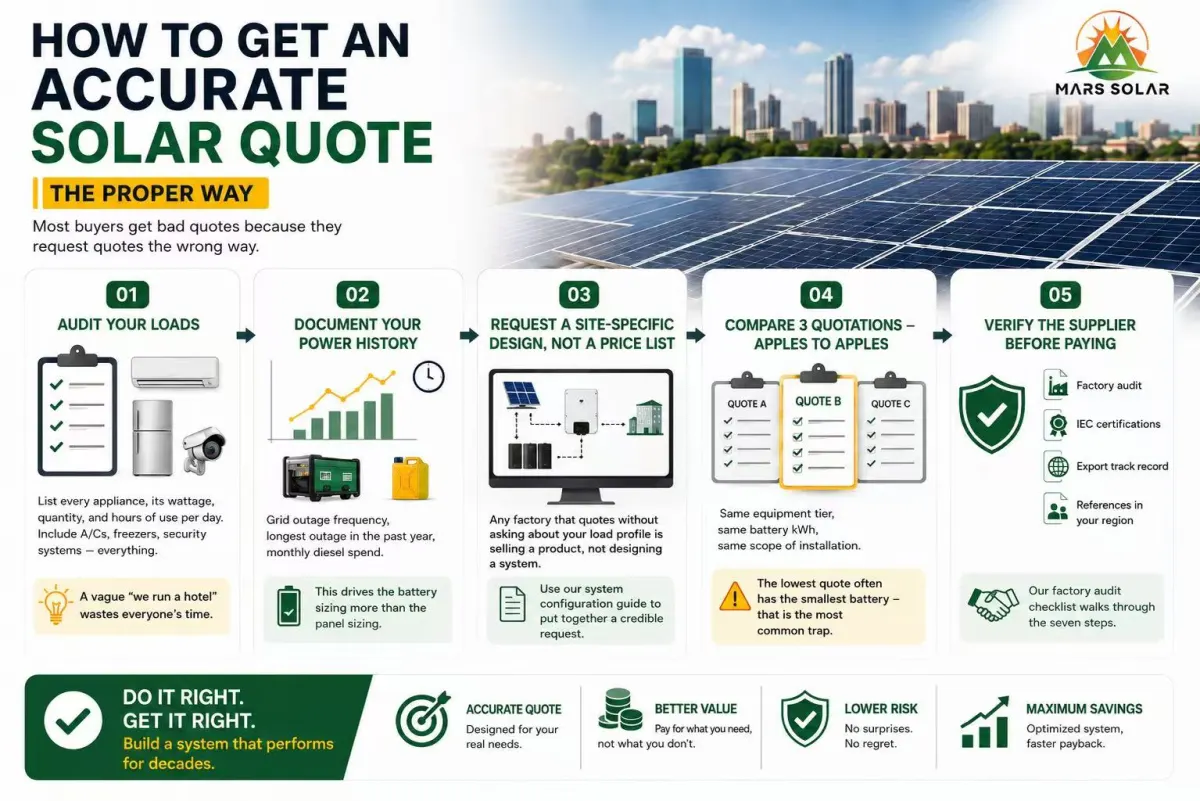
Want the sizing logic for your own site instead of a catalogue page? Send your load list and three months of diesel receipts.

Size my system on WhatsApp

Solar System Nigeria: Configurations We Ship

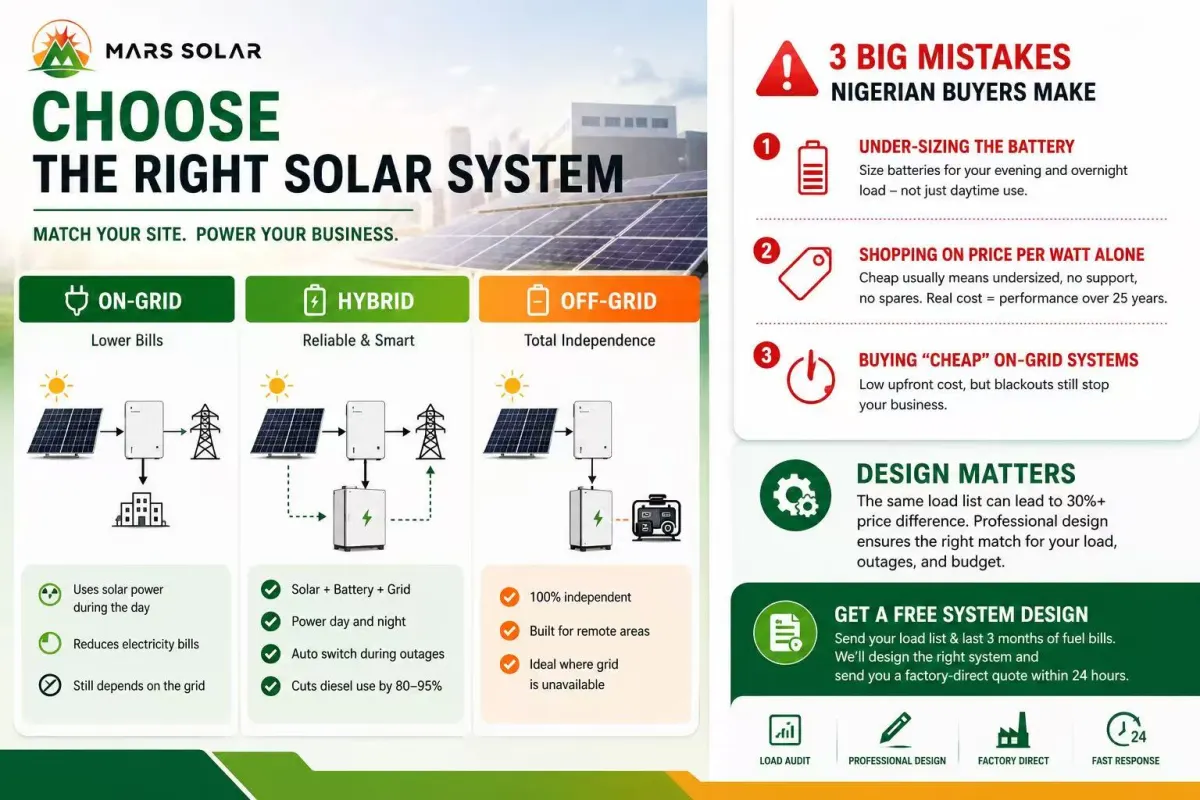
Most solar system Nigeria enquiries fall into three profiles. Sizing always starts from the load you are running today and the diesel you are buying today — not from a catalogue page.

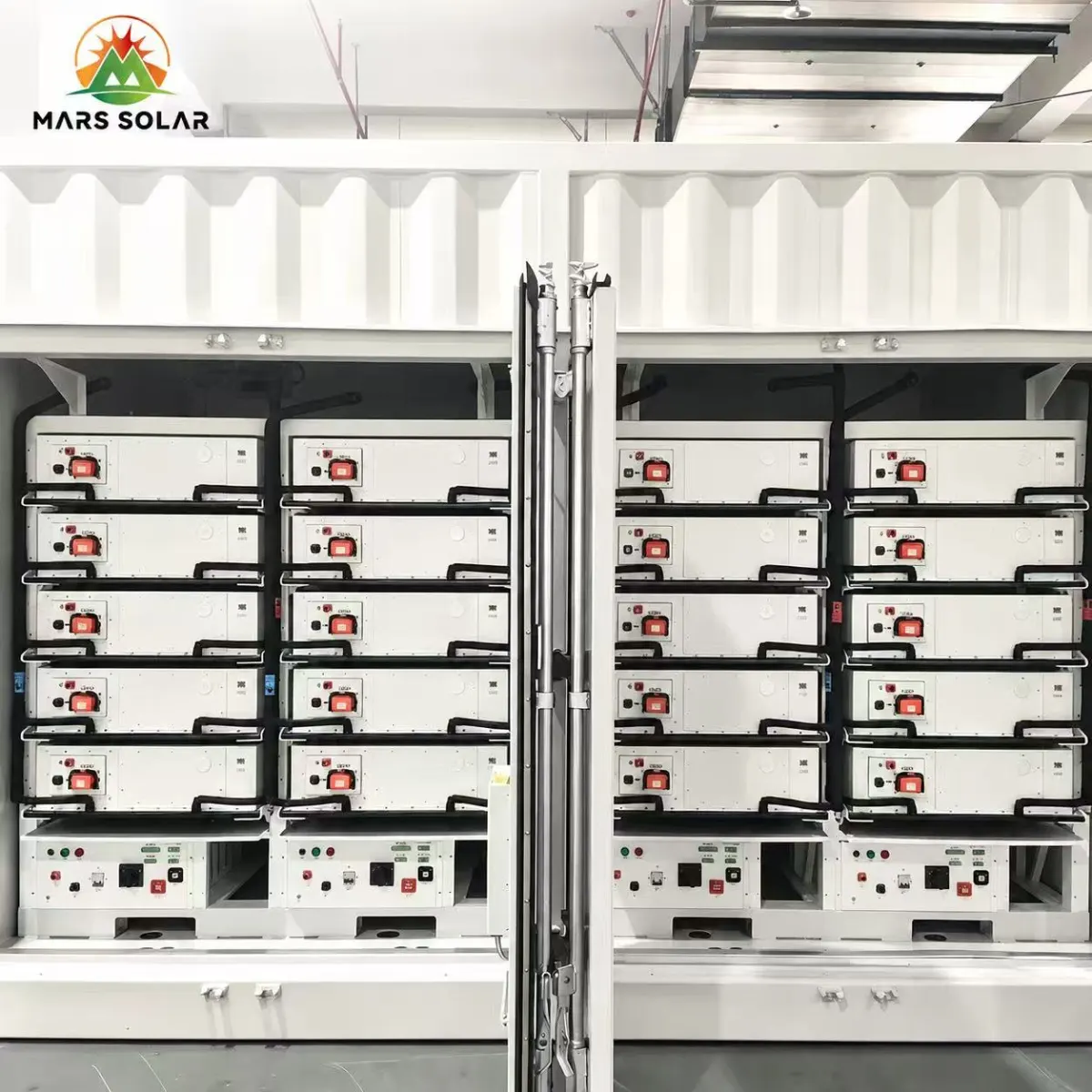
Solar system Nigeria BESS reference: rack-mounted indoor battery cabinet for a small commercial site

Rack-mounted, indoor

50 – 100kWh BESS

Clinics, small offices, retail units and telecom towers. A 50–100kWh cabinet paired with a small array cuts diesel consumption by 60 to 80 percent and takes the hard hours off the generator. It is the smallest solar system Nigeria configuration we ship, and the one most clinics start with.

See the matching systems →

Solar system Nigeria hybrid reference: rooftop PV with battery storage for a hotel or factory load profile

Hybrid, hotels and factories

100 – 500kW

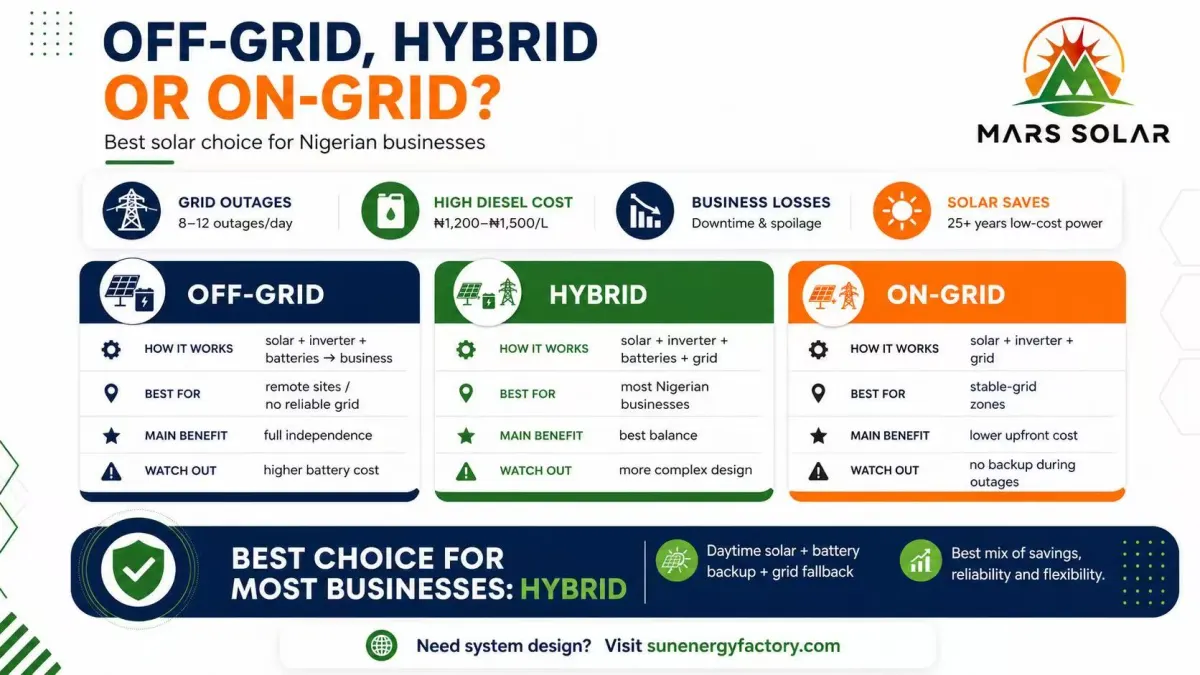
A 30 to 80 room hotel in Lagos or Abuja runs air-conditioning 18 hours a day. The battery carries evening and overnight demand, which removes the genset for 14 to 18 hours a day.

See the matching systems →

Solar system Nigeria containerised BESS reference: outdoor battery container for an industrial site

Containerised, outdoor

1 – 4MWh

Industrial parks, cold-chain hubs and campus micro-grids. 20ft and 40ft containers from 500kWh to 2MWh per unit, paralleled to your existing switchgear.

See the matching systems →

Solar System Nigeria Pricing: 2026 Reference Ranges

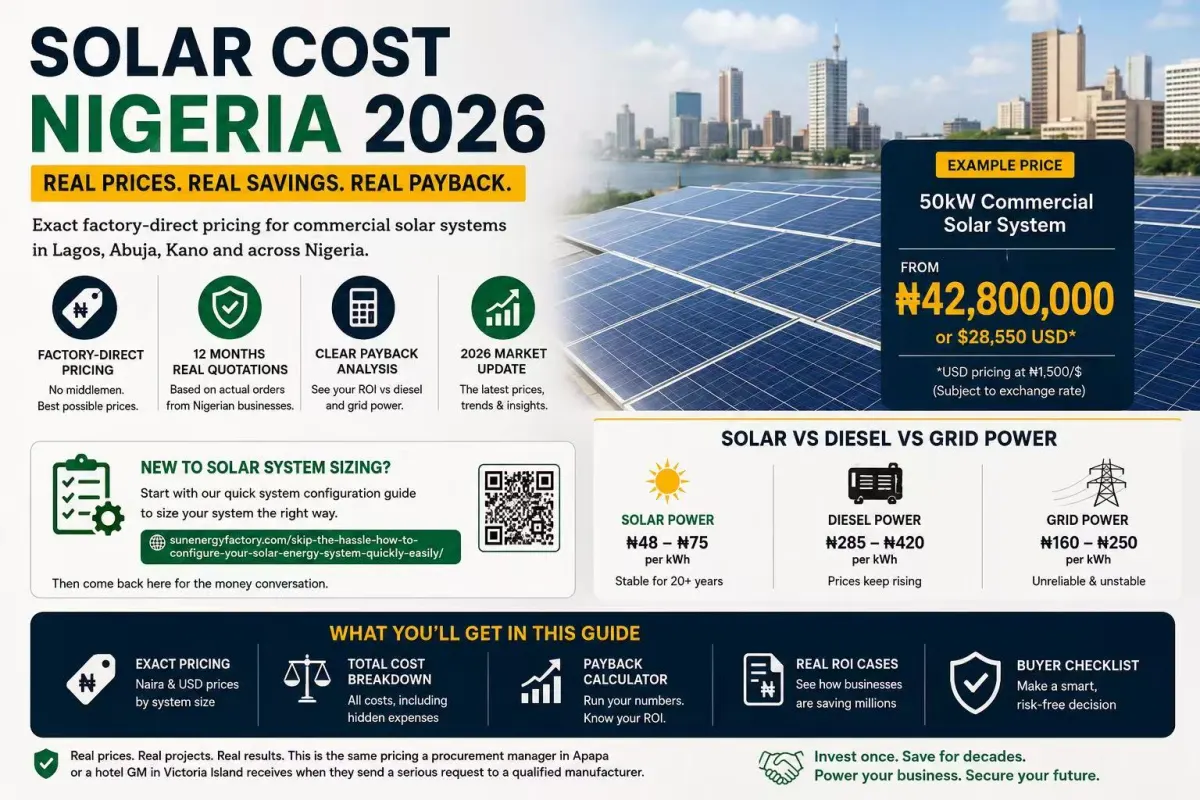
Two tables matter for any solar system Nigeria decision: what a complete hybrid system costs delivered in Nigeria, and what a standalone battery costs CIF Lagos. Both sets of figures are taken from our own published Nigeria cost guides, so you can see where your site should land before you ask for a quotation.

Hybrid solar + storage — factory-direct landed quotation in Lagos or Port Harcourt

System sizeLanded price (Naira)Typical site
10 kW₦8M – ₦12MSmall clinic, 15–25 staff office, guest house
20 kW₦16M – ₦24MSupermarket, 10–15 room guest house, small cold room
50 kW₦42M – ₦62MMid-size manufacturing, 20-room hotel, hospital wing
100 kW₦85M – ₦125M30–50 room hotel, mid-size factory, large commercial building
250 kW₦210M – ₦310M100+ room hotel, large industrial site, manufacturing plant

Standalone BESS — CIF Lagos

Usable storageCIF Lagos (USD)CIF Lagos (Naira)
50 kWh$47,500 – $60,000₦71.3M – ₦90M
100 kWh$90,000 – $115,000₦135M – ₦172.5M
500 kWh$380,000 – $480,000₦570M – ₦720M
1 MWh$700,000 – $900,000₦1.05B – ₦1.35B

The hybrid figures are complete delivered jobs — panels, hybrid inverter, lithium battery, mounting, balance of system, installation and commissioning. Our Nigeria cost guide breaks that number into its five cost blocks, which is where most of the spread between two quotes comes from.

The battery figures are CIF Lagos and exclude Nigerian import duty, VAT and clearing. The BESS import guide carries the full container-by-container table up to 2MWh.

Exchange rate used in both published guides: ₦1,500 per USD (August 2026 indicative). Every component is priced in dollars at the factory, so when the naira moves ten percent the naira price of your solar system Nigeria project moves with it.
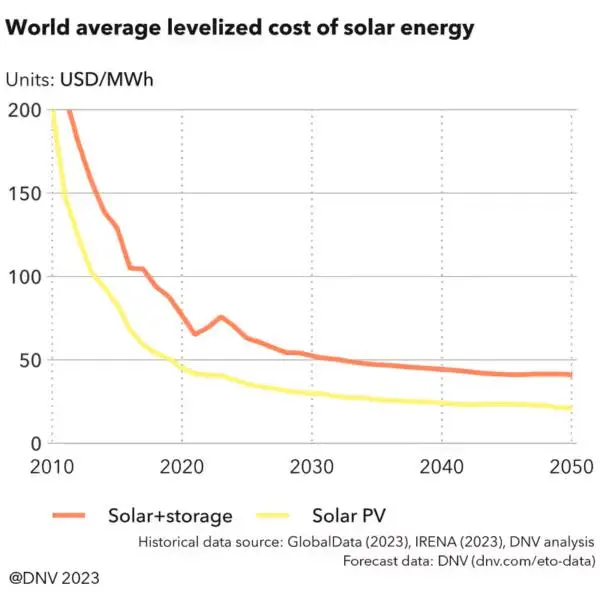
LCOE comparison chart showing the levelized cost per kWh of diesel generation against solar and battery storage in Nigeria

Nigerian import duty on solar equipment ranges from 5 to 7 percent depending on classification, while the panels themselves sit at 0 percent under the ECOWAS Common External Tariff. VAT is 7.5 percent, assessed on CIF plus duty plus levies, and it is not waived for ordinary importers — a VAT-registered company recovers it as input tax. Confirm the current rate with the Standards Organisation of Nigeria and your clearing agent before you finalise a landed-cost model. Every figure above is an indicative 2026 range for comparison only.

Send your load list and we will come back with an exact CIF Lagos price for your solar system Nigeria project.

Get my exact price

Where a Solar System Nigeria Project Pays Back Fastest

Payback in Nigeria is measured in months rather than years, because the alternative is a diesel genset burning fuel at ₦1,200 to ₦1,500 a litre.

Hotels and hospitality

A 30 to 80 room hotel in Lagos or Abuja runs air-conditioning 18 hours a day. The battery carries the evening and overnight load, which eliminates the genset for 14 to 18 hours a day. Our 100kW hotel installation paid back in 8 to 12 months.

Factories and agro-processing

Replacing significant diesel runtime is where a solar system Nigeria project pays back fastest — 8 to 14 months. Our 200kW rice mill installation in Abuja is a live reference for exactly this application.

Cold rooms and pharma storage

Cold-chain sites cannot tolerate an outage. A 50 to 100kWh BESS cabinet with a modest array cuts diesel consumption by 60 to 80 percent and takes the load spikes off the generator, which extends its life. That is the solar system Nigeria case we size most often for cold-chain operators.

Offices, banks and residential estates

A business burning 15 to 25 litres of diesel a day lands at 10 to 18 months. Homes running a small generator for four to six hours daily land at 18 to 28 months, and the saving is the fuel line you stop buying.
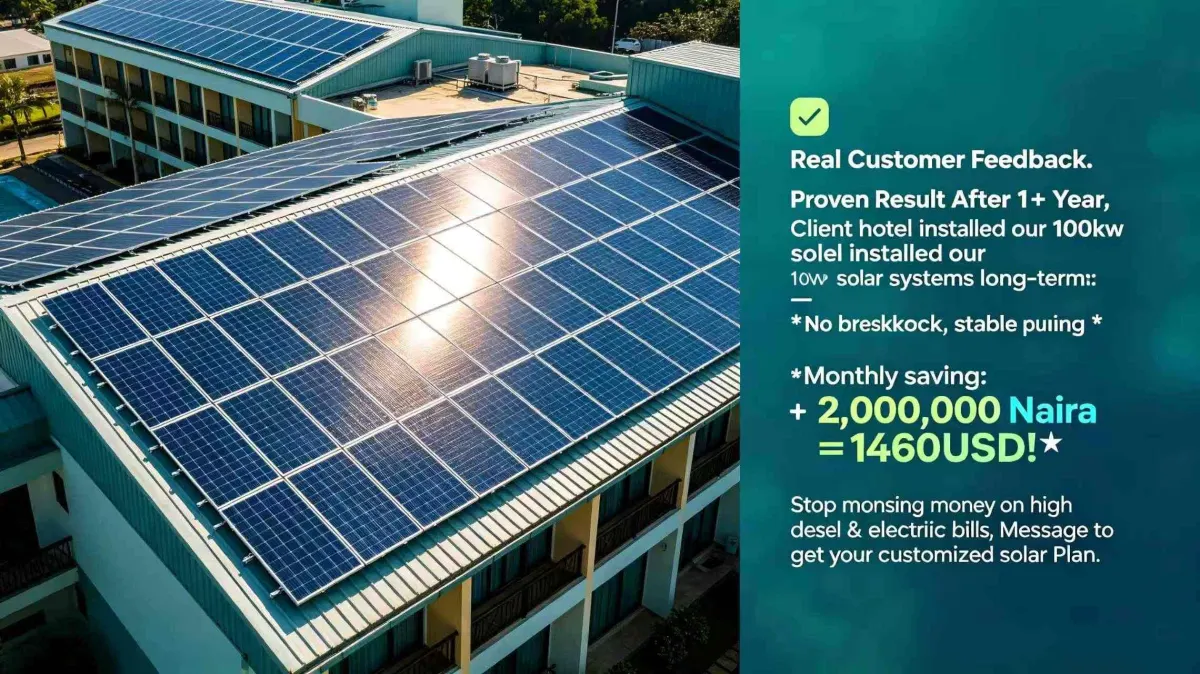
Nigerian hotel running a solar system Nigeria installation that displaced most of its diesel generator runtime

Not sure which of these your site looks like? Send the site type and your monthly diesel spend and we will tell you what solar actually displaces.

Benchmark my site on WhatsApp

Solar System Nigeria Projects and Our Track Record

Every photo below is a solar system Nigeria project we built and shipped. Open the case studies for the sizing, the equipment list and the measured result.

Solar system Nigeria project reference: 100kW solar power system with battery storage for a Nigerian hotelHotel · Lagos

100kW PV + storage

Saving ₦2,000,000 a month against the diesel-and-grid baseline it replaced.

Read the case study →

Solar system Nigeria project reference: 200kW solar and battery storage for a rice mill in AbujaRice mill · Abuja

200kW PV + storage

Installed, commissioned and handed over with the monitoring dashboard live.

Read the case study →

Solar system Nigeria project reference: 6MW ground-mount PV array with 20MWh of battery storageIndustrial · Nigeria

6MW PV + 20MWh BESS

Installed, commissioned and handed over with the monitoring dashboard live.

Read the case study →

Solar system Nigeria project reference: containerised battery storage cabinets for a 6MW hybrid plantIndustrial · Nigeria

Containerised BESS

Installed, commissioned and handed over with the monitoring dashboard live.

Read the case study →

Solar system Nigeria project reference: 500kW commercial solar power systemCommercial · Nigeria

500kW system

Installed, commissioned and handed over with the monitoring dashboard live.

Ask for the photo set on WhatsApp

Solar System Nigeria Site Photos From Our Projects

Straight from the solar system Nigeria job files — roof arrays, ground-mount rows, battery rooms and the commissioning walk-through.

Solar system Nigeria site photo: 6MW ground-mount array and containerised storage
Nigeria
6MW ground-mount array and containerised storage
Solar system Nigeria site photo: Rooftop array on a Nigerian commercial building
Nigeria
Rooftop array on a Nigerian commercial building
Solar system Nigeria site photo: Hybrid solar and battery installation
Nigeria
Hybrid solar and battery installation
Solar system Nigeria site photo: Commercial solar array serving a Nigerian business load
Nigeria
Commercial solar array serving a Nigerian business load

Delivery to Lagos and Onne Port: SONCAP, Form M and Inland Haulage

We quote CIF Lagos and CIF Onne Port rather than FOB on every solar system Nigeria order, because the freight, clearing and demurrage lines are the ones that move your final number.

Production

15 to 25 working days after deposit, depending on whether the battery is rack-mounted or containerised, and on how much of the string wiring is factory-terminated.

Ocean freight

Booked to Apapa, Tin Can Island or Onne Port. The SONCAP certificate, the correct PC grade and the Form M all have to be in place before the vessel sails — not after it lands.

SONCAP and clearance

Clearing agents familiar with Apapa and Onne typically charge ₦500,000 to ₦1,500,000 for a 20ft or 40ft BESS shipment. We prepare the file set; your agent files it with the Nigeria Customs Service. Every solar system Nigeria shipment leaves with that file set complete.

Inland delivery

Lagos, Abuja, Ibadan, Kano, Kaduna and Port Harcourt are routine. Port-to-site logistics in Lagos runs ₦1,500,000 to ₦4,000,000, and more for sites further out. Crated racks ship with lifting points and a commissioning pack.
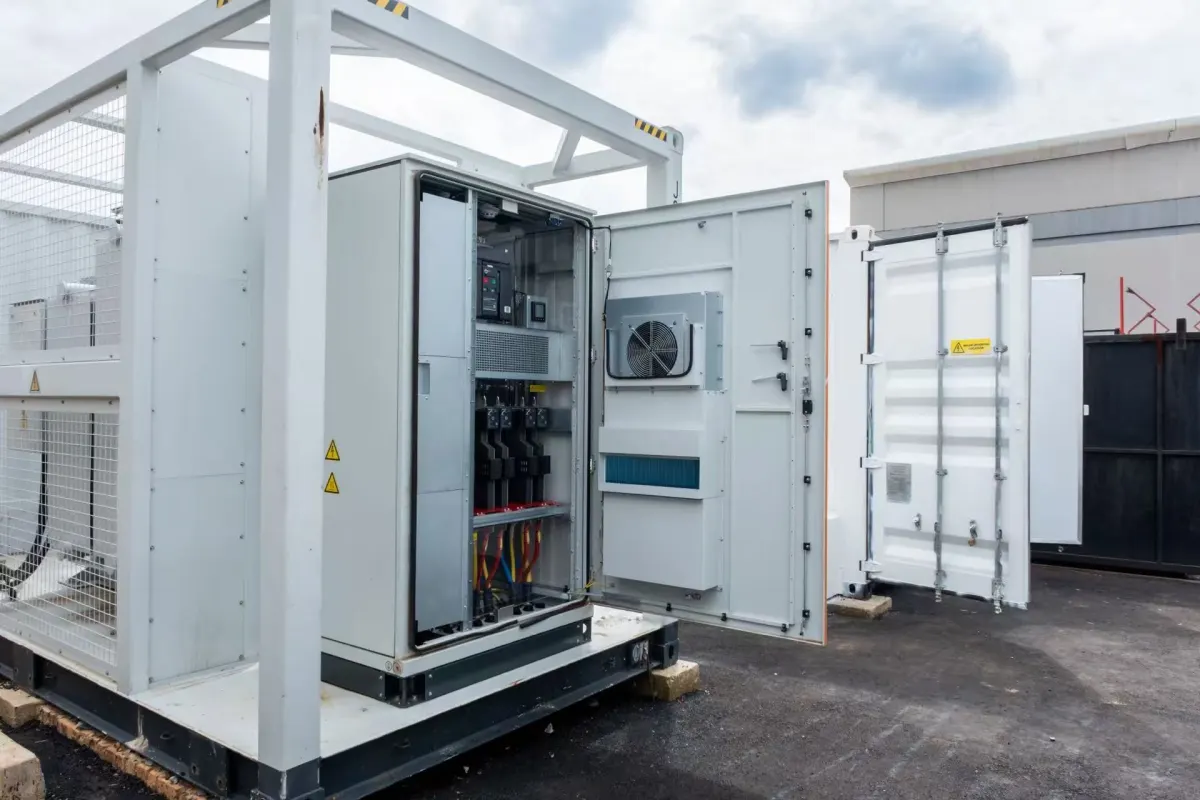
Solar system Nigeria reference: containerised battery storage and ground-mount array on an industrial site

A container that lands in Lagos with the wrong PC grade or a missing Form M sits at the port accruing demurrage at a rate that erases the margin on the entire order. Zero duty on the panels does not mean zero compliance on the shipment, and it is the single most expensive mistake we see on Nigeria orders.
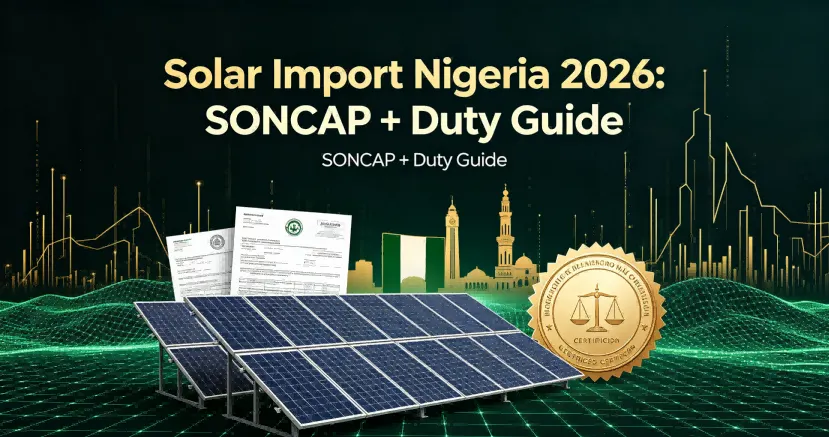
Solar import Nigeria 2026 guide covering SONCAP certification and import duty requirements for solar equipment

Both the duty schedule and the SONCAP conformity programme were still moving through 2026. Confirm the current rate and the current PC grade with the Standards Organisation of Nigeria and your clearing agent — see also our Nigeria, Ghana and Kenya duty note and the full solar import Nigeria guide.

Need the zero-duty pathway rather than the standard one? Tell us who the importing entity is and we will map the document list.

Confirm my import route

Solar System Nigeria: Frequently Asked Questions

The ten questions that come up in almost every Nigeria enquiry. For the diesel comparison behind them, see our diesel versus solar cost guide.

How much does a solar system cost in Nigeria in 2026?
A complete hybrid system lands at roughly ₦8M to ₦12M for 10kW, ₦42M to ₦62M for 50kW, ₦85M to ₦125M for 100kW and ₦210M to ₦310M for 250kW. Standalone batteries start at $47,500 to $60,000 CIF Lagos for a 50kWh cabinet and reach $700,000 to $900,000 for 1MWh. The naira figures in our published guides use ₦1,500 per USD.
How do I size a solar system Nigeria site when I am running a generator?
Start with the diesel you are actually buying. Pull your last three months of fuel receipts and convert them: a typical genset burns about 0.35 litres per kWh at rated load. That monthly fuel line is the saving a solar system Nigeria project is competing for, and it decides the battery size far more accurately than a catalogue table does.
Is imported solar equipment duty-free in Nigeria?
The panels are. Modules enter at 0 percent under the ECOWAS Common External Tariff, but inverters, charge controllers, mounting structures, DC cabling and switchgear all carry duty, some of it at 10 to 20 percent. VAT is 7.5 percent assessed on CIF plus duty plus levies, and it is not waived for ordinary importers, although a VAT-registered company recovers it as input tax.
What is SONCAP and do I need it for a solar system Nigeria shipment?
Yes. SONCAP is the conformity assessment programme run by the Standards Organisation of Nigeria, and nothing clears Apapa or Onne without a certificate in the correct PC grade for your shipment volume. A supplier holding CE, TUV and IEC certificates but no SONCAP pathway will still see the container held at the port.
Can you deliver CIF Lagos or Onne Port instead of FOB?
Yes, and we recommend it on every solar system Nigeria shipment. Shipping, clearing and duty to Lagos or Onne add 8 to 15 percent to equipment cost on their own, so a CIF quotation gives you one delivered number for the port you nominate instead of invoices from three agents.
What does a solar system Nigeria installation cost per kWh compared with diesel?
Diesel generation runs at ₦300 to ₦650 per kWh once fuel, maintenance and depreciation are counted, while a solar and storage system delivers the same kWh at roughly ₦55 to ₦150 levelized over 25 years. Diesel is three to eight times more expensive per kWh over the life of the system.
What is the payback period for solar in Nigeria?
Our 100kW hotel installation paid back in 8 to 12 months and saves ₦2,000,000 a month against the diesel-and-grid baseline. Businesses replacing significant diesel runtime land at 8 to 14 months, sites burning 15 to 25 litres a day at 10 to 18 months, and homes running a small generator four to six hours daily at 18 to 28 months.
Does the system work during grid outages?
Yes. A hybrid solar system Nigeria sites use for backup islands from the grid and keeps the backed-up circuits running. For a Lagos hotel the battery carries the evening and overnight load, which removes the genset for 14 to 18 hours a day rather than only during outages.
How much battery do I need?
It depends on what you want the battery to do. A 50 to 100kWh cabinet with a modest array cuts diesel consumption by 60 to 80 percent for a clinic, office or telecom tower. A hotel or factory chasing full overnight coverage needs 100kWh to 500kWh, and an industrial park moves to containerised units of 500kWh and above. For a solar system Nigeria site on a 12-hour generator schedule, that usually means 100kWh or more.
What warranty do you provide?
Modules carry a 25-year performance warranty, LFP storage 6,000 cycles or 10 years depending on model, and inverters 5 years. Spare parts are held for the warranty term.

Get a Quote for Your Solar System Nigeria Project

Send your load list, your site type and your last three months of diesel receipts — that is enough — and we will come back with a sized solar system Nigeria configuration, a component-level breakdown, CIF Lagos or Onne Port pricing and the SONCAP document list, usually within one working day.

Prefer email? sunenergyfactory@163.com

Prefer Email? Send Us Your Solar System Nigeria Requirements

Prefer to write rather than chat? Tell us your site type, load list, monthly diesel spend, the importing entity and your target timeline. We come back with a sized system, a component-level breakdown, CIF Lagos or Onne Port pricing and the SONCAP document list — usually within one working day.
    Subscribe Our Newsletter

      Design and Manufacture of Domestic and Commercial Solar Energy Systems

      Contact Info

      7th Floor, Building 5, Phase II, Wanyang Innovation City, Xiaotang Industrial Avenue, Shishan Town, Nanhai District, Foshan City

      Follow Us

      Do You Want A Free Solar System Design for Your building?

      Leave your mobile number/whatsapp/email and we can respond within an hour!

        Get free consultations, catalogs, product specifications, quotes and more now.

        Language

        en_usaresfrnlpt

        Language