Language
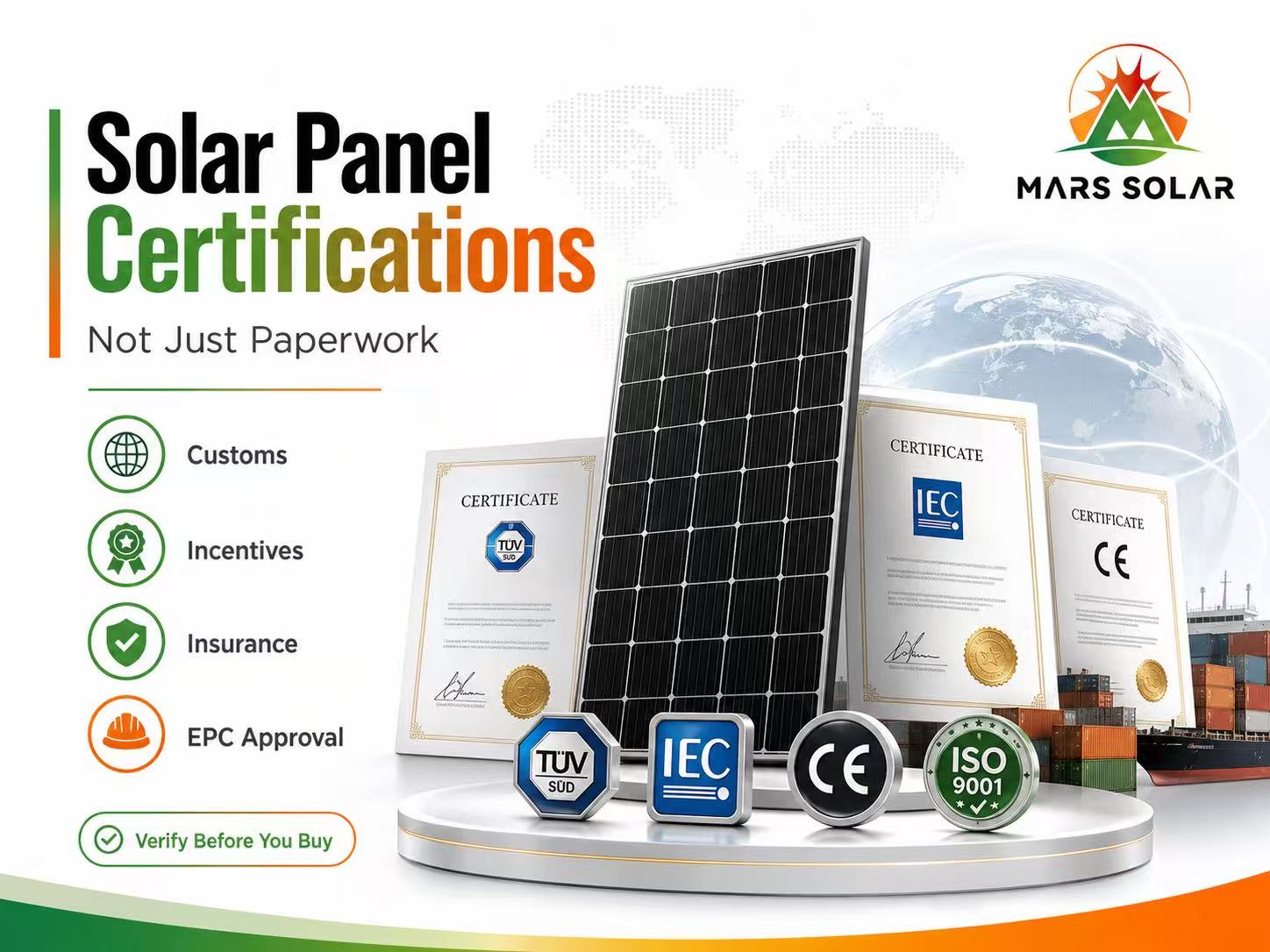
A solar panel without proper certifications is unsellable in 90% of international markets. It won't pass customs in the EU, won't qualify
for incentives in the US, won't get insurance in Australia, and won't be installed by any licensed EPC. This is why you need a **solar certification guide** before sourcing any equipment.
Yet many first-time solar buyers don't understand which certifications they actually need, how to verify them, or how to tell a real certificate from a photoshopped one.
This **solar certification guide** explains every major solar panel certification — what it covers, who issues it, which markets require it,
and how to verify it's real. By the end of this **solar certification guide**, you'll be able to read a datasheet like a quality manager and spot fake certificates from a mile away.
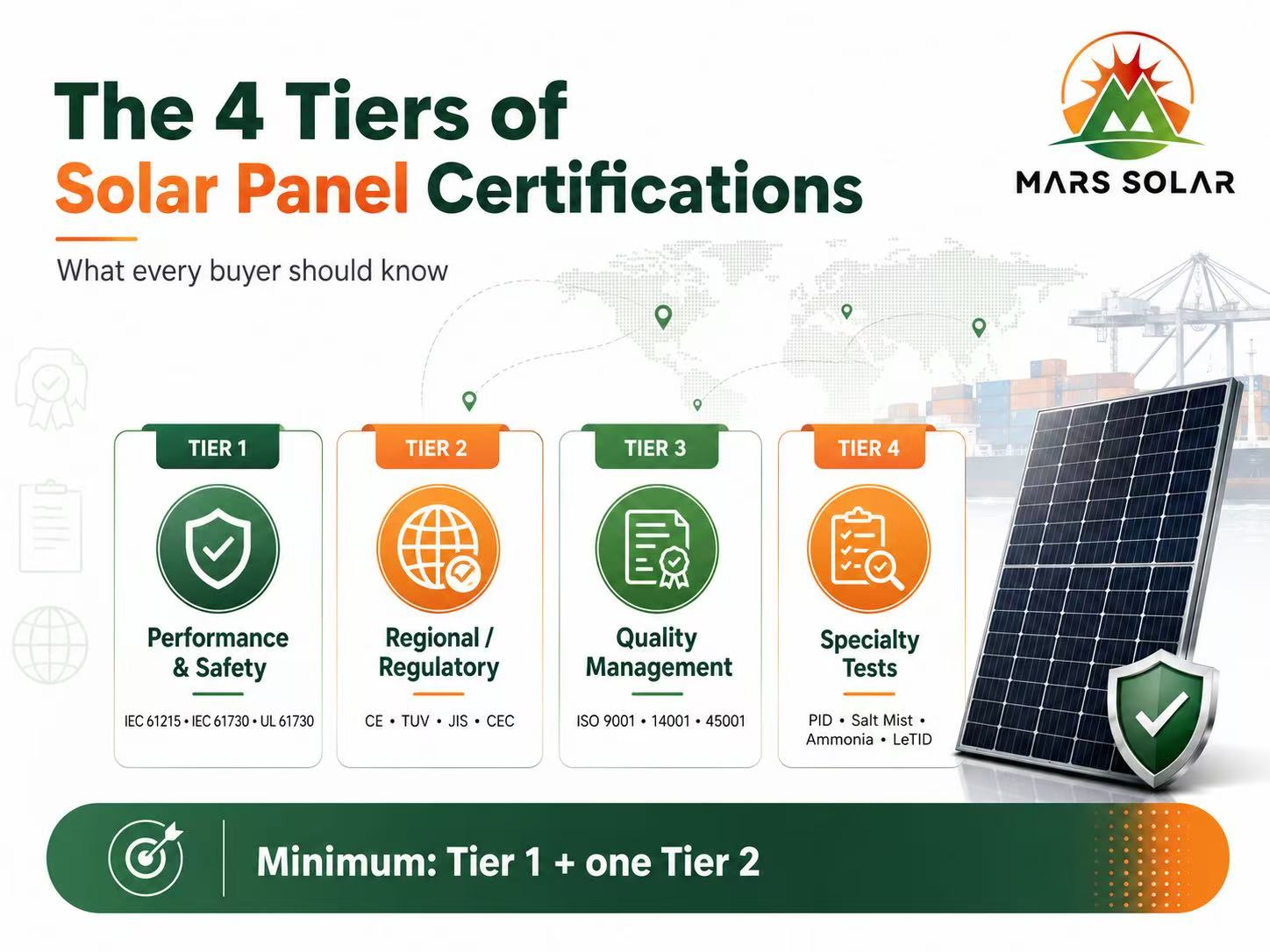
Solar certifications fall into 4 functional tiers. Understanding the tier helps you know which one is non-negotiable for your market:
Rule of thumb: A serious solar manufacturer should have at minimum Tier 1 + at least one Tier 2 covering your target market. Tier 3 and 4 are bonuses.
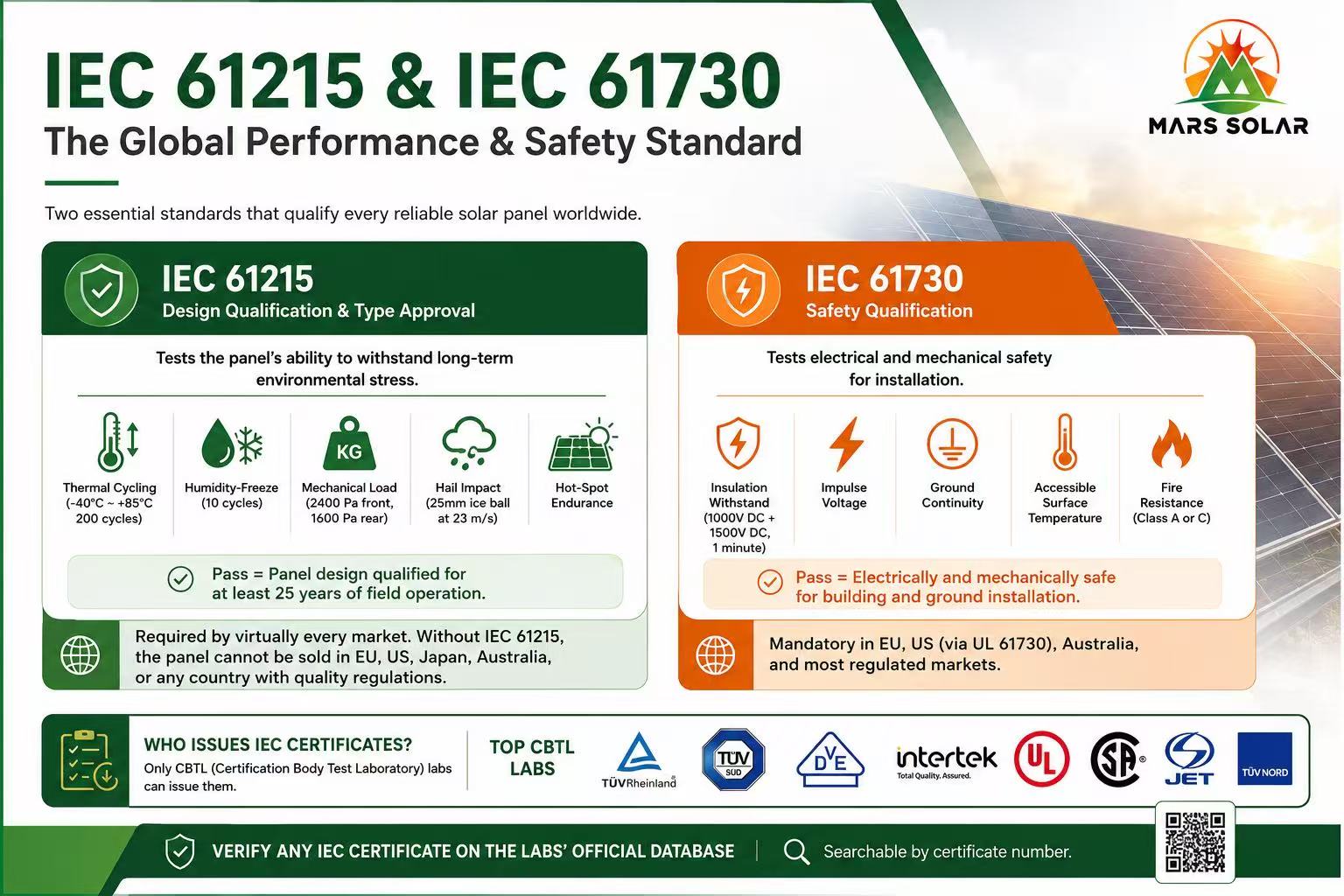
IEC (International Electrotechnical Commission) standards are the foundation of solar panel qualification worldwide. Two standards matter most:
IEC 61215 — Design Qualification and Type Approval:
IEC 61730 — Safety Qualification:
Who issues IEC certificates? Only CBTL (Certification Body Test Laboratory) labs can issue them. Top labs: TÜV Rheinland, TÜV SÜD, VDE (Germany), Intertek, UL, CSA, JET (Japan), TÜV NORD. Verify any IEC certificate on the lab's official database (searchable by certificate number).
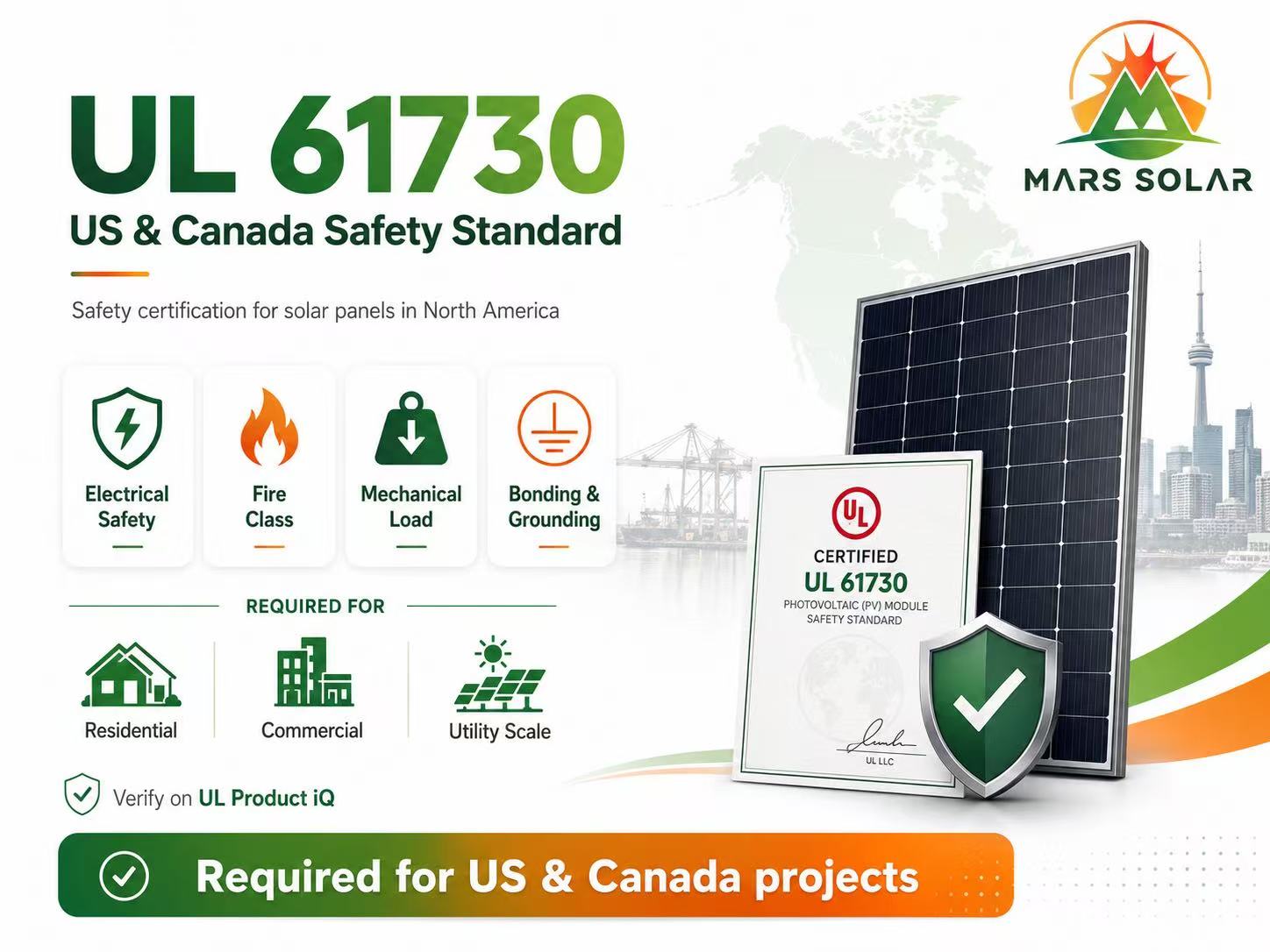
UL (Underwriters Laboratories) is the dominant safety certification body in North America. UL 61730 is the North American equivalent of IEC 61730, with some additional US-specific fire and mechanical tests.
What UL 61730 covers:
Who needs UL 61730? Any panel installed in the US or Canada, whether residential, commercial, or utility-scale. It's required for:
How to verify: Look up the certificate on UL's Product iQ database at iq.ul.com. The certificate must list the specific panel model, factory location, and be currently valid (UL audits annually and can suspend certificates).
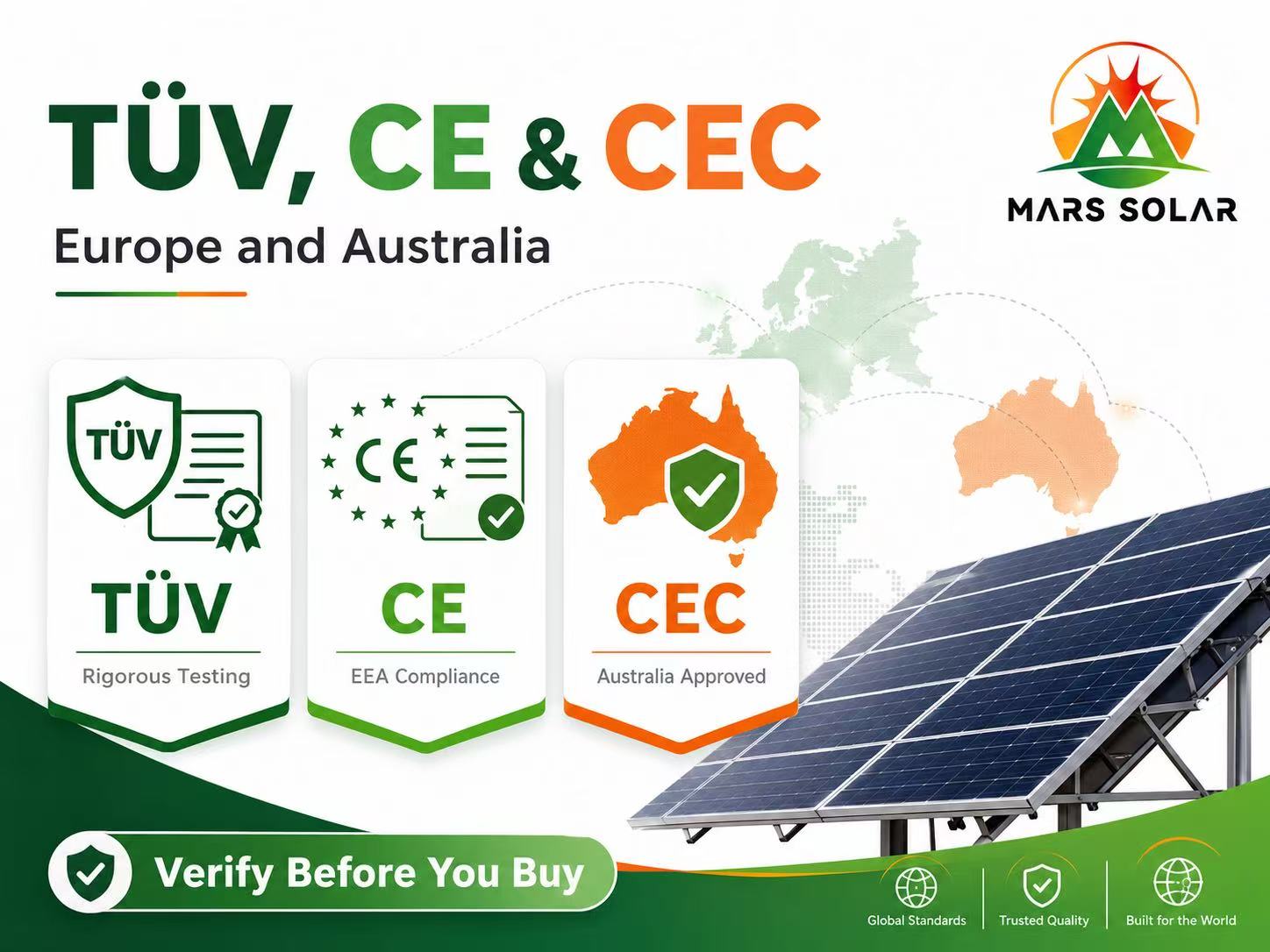
Three related certifications cover the EU, UK, and Australia:
TÜV (Technischer Überwachungsverein) Certification:
CE Marking (Conformité Européenne):
CEC Listing (Clean Energy Council, Australia):
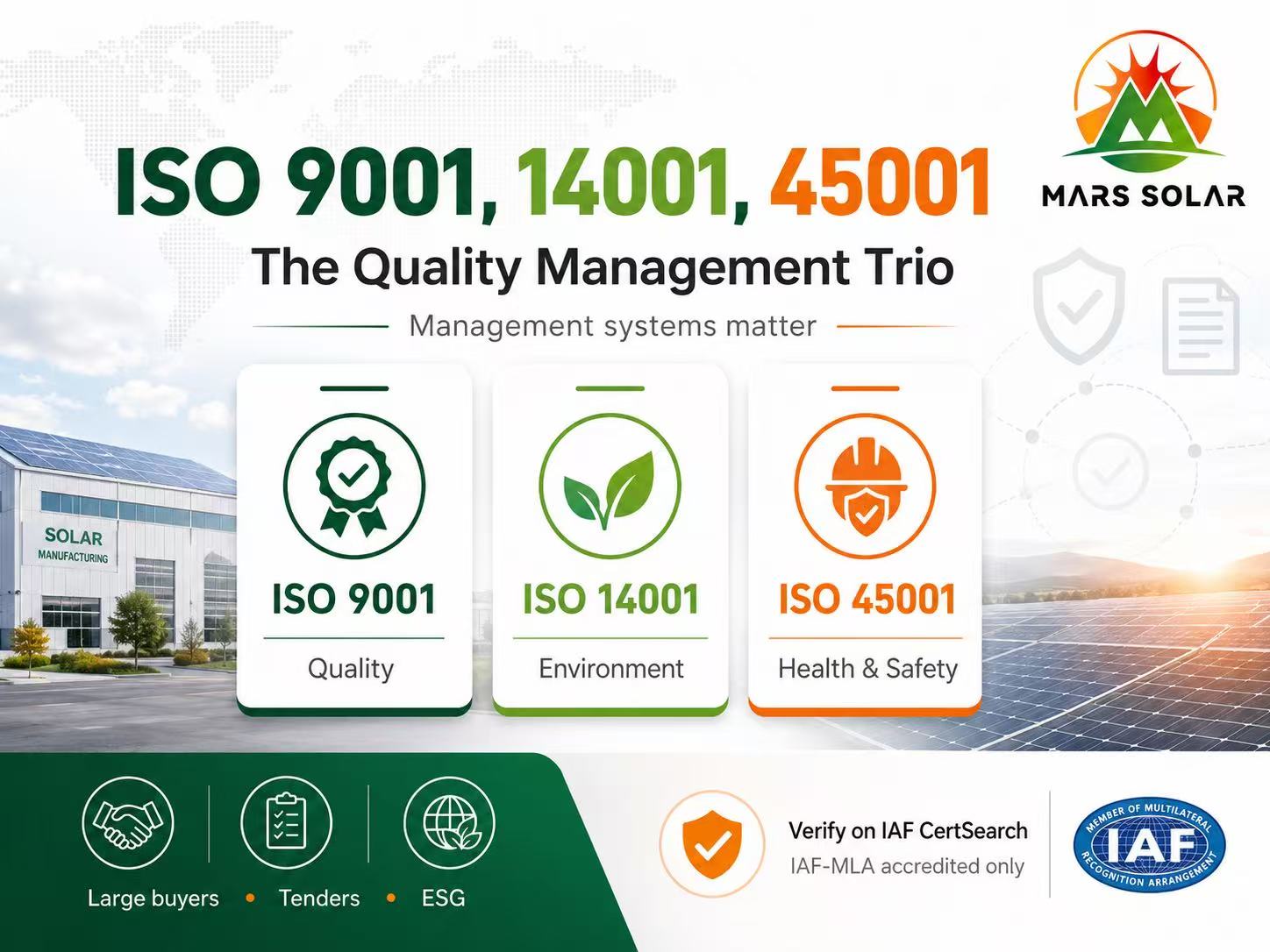
ISO certifications don't test the product — they test the factory's management systems. Required by most large buyers and government tenders.
Who issues ISO certifications? Accredited certification bodies: DNV, Bureau Veritas, SGS, TÜV, LRQA, BSI, Intertek. The certificate must be issued by an IAF-MLA accredited body — check the issuing body's accreditation on the IAF CertSearch database at www.iafcertsearch.org.
Common red flag: "ISO 9001" certificate issued by an unknown body not in the IAF database. Many "ISO certificates" from Chinese agencies are essentially self-issued and have no real value.
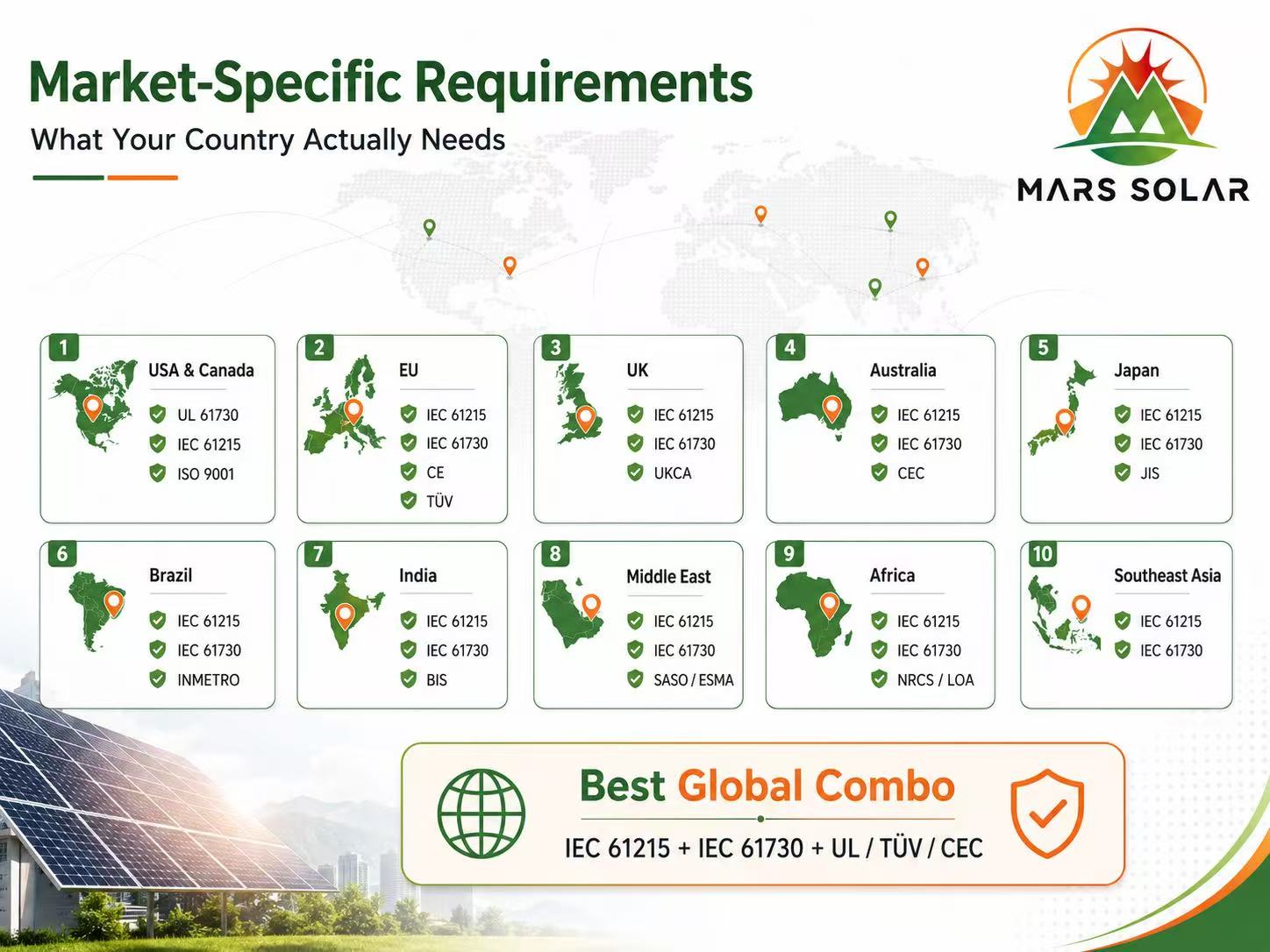
Here's the practical map — which certifications you need based on your target market:
Quick decision: For the broadest market access, ensure your panels have IEC 61215 + IEC 61730 + at least one of (UL 61730 for US, TÜV for EU, CEC for Australia). This covers 90% of global demand.
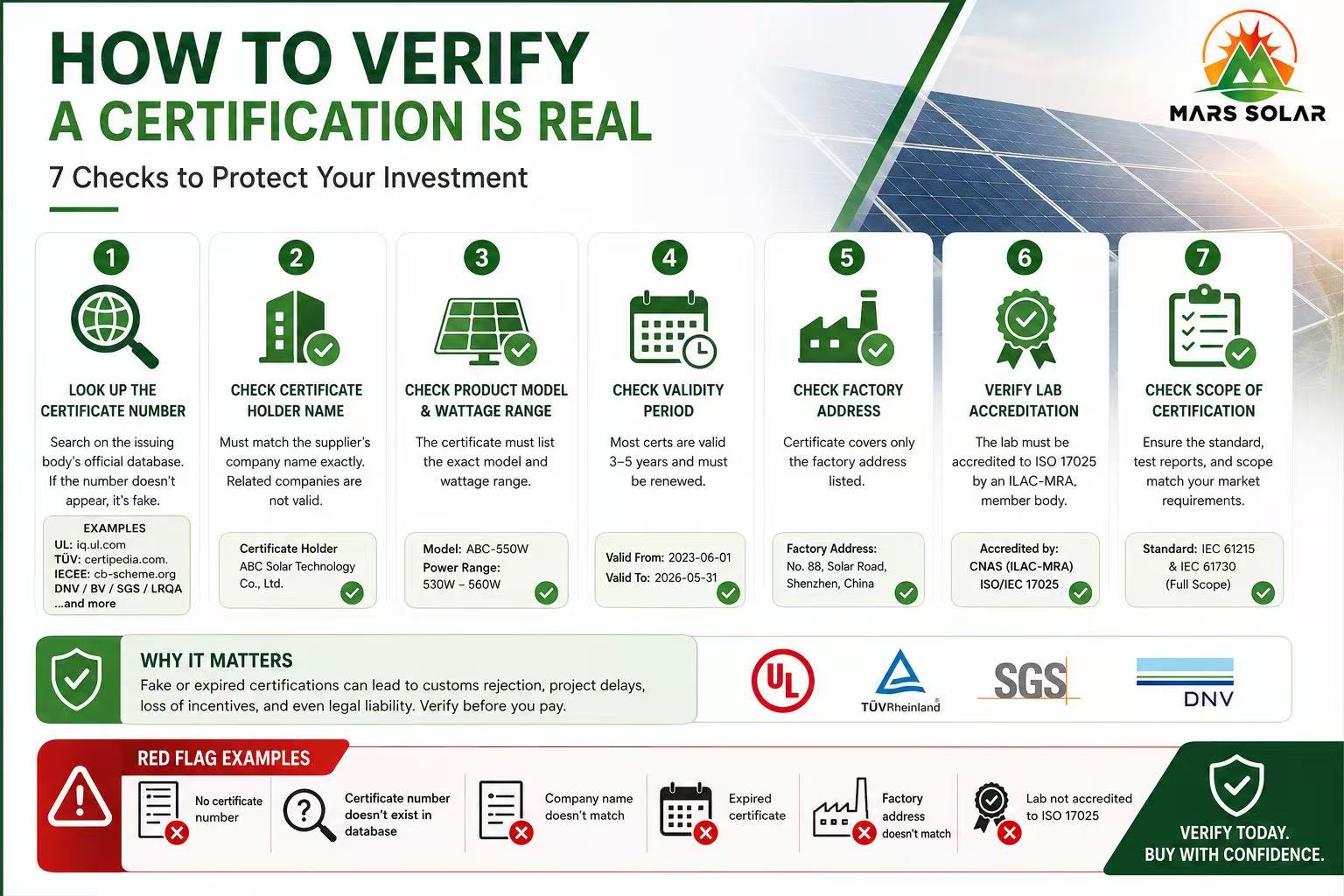
Fake or expired certifications are a multi-million dollar problem. Here's how to spot a fake:
Red flag sample: Supplier sends a "TÜV certificate" with no certificate number, or a number that doesn't exist in the TÜV database. Always verify before paying. And for vetting beyond certificates, use our reliable solar system suppliers checklist.
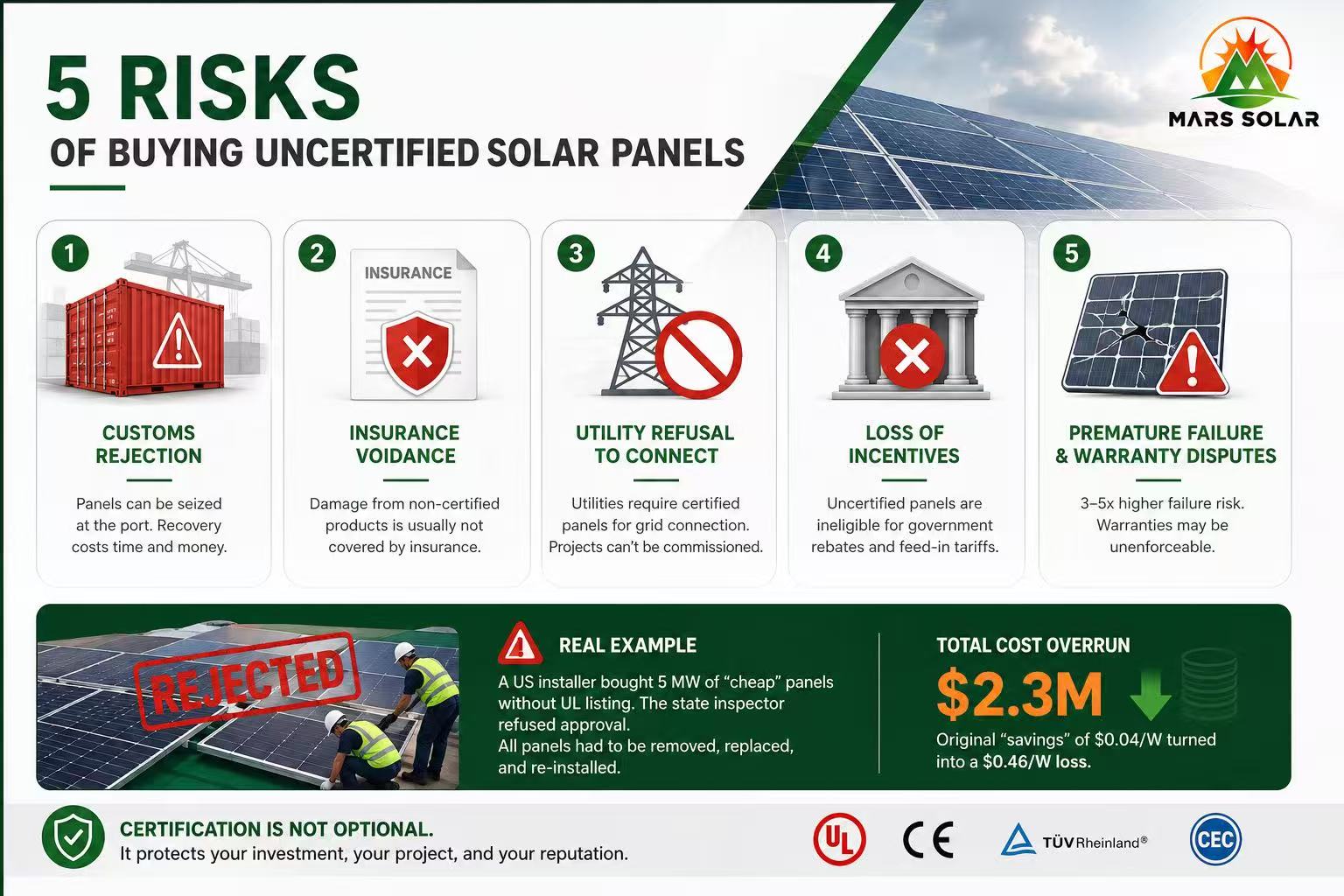
Why does this matter? Because uncertified panels create real, expensive problems:
Real example: A US solar installer bought 5 MW of "cheap" panels from a new Chinese supplier without UL listing. After installation, the state electrical inspector refused to approve the project. The installer had to remove all panels, source UL-listed replacements, and re-install. Total cost overrun: $2.3M. The original "savings" of $0.04/W turned into a $0.46/W loss.
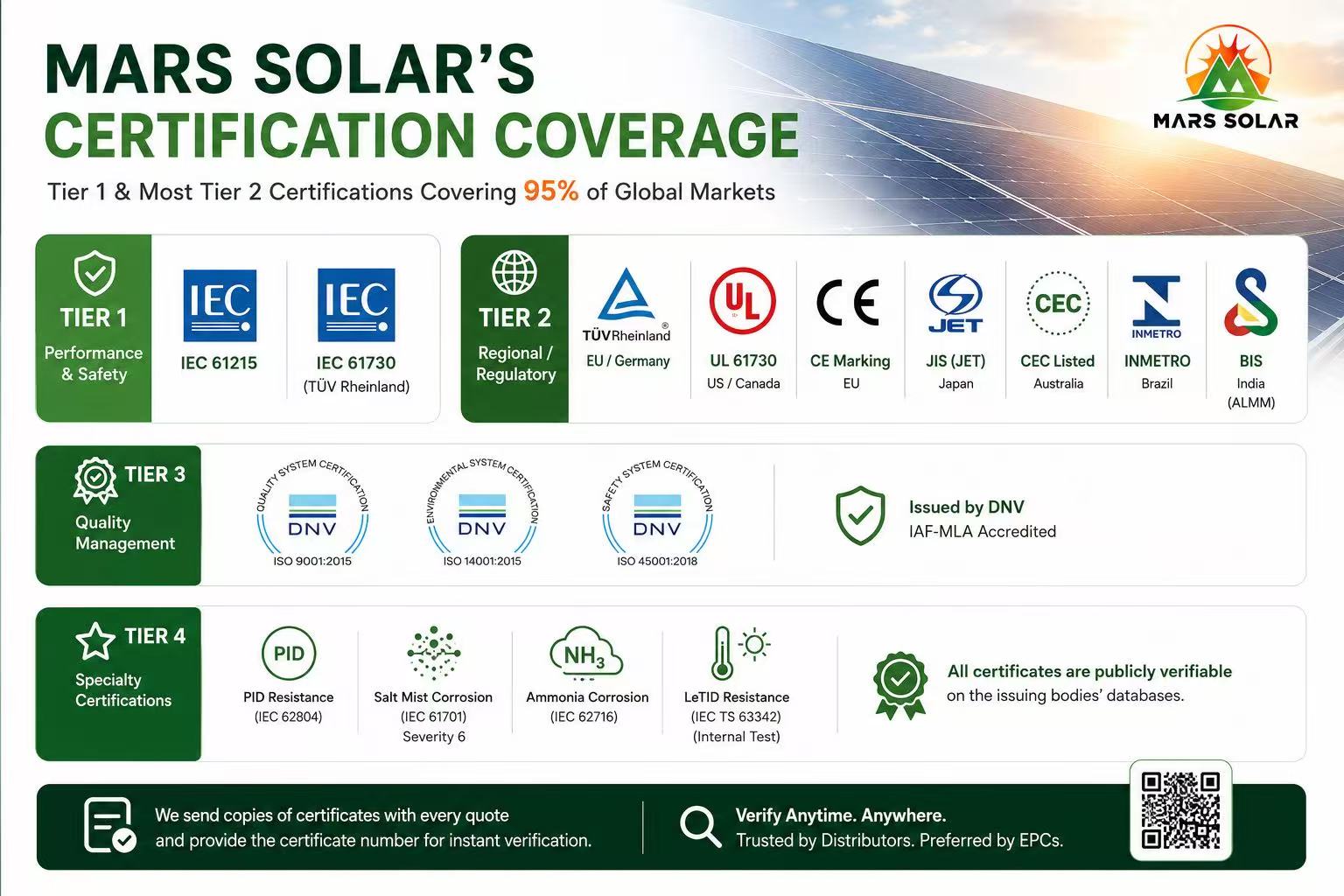
Mars Solar holds all Tier 1 and most Tier 2 certifications covering 95% of global markets:
All certificates are publicly verifiable on the issuing bodies' databases. We send copies of certificates with every quote and provide the certificate number for instant verification.
Q: What's the difference between IEC 61215 and UL 61730?
A: IEC 61215 is performance and type approval (25-year design life under standard conditions). UL 61730 is electrical and fire safety for the US market. They overlap in some tests but serve different purposes.
Q: Are CE and TÜV the same?
A: No. CE is self-declared by the manufacturer; TÜV is third-party tested. CE alone is the minimum for EU sale; TÜV is required by Germany, Austria, and most large EU EPCs.
Q: Do I need IEC certification if I only sell in my country?
A: Almost certainly yes. Even China, India, and Brazil require IEC-equivalent standards. Only a handful of unregulated markets (some African countries) accept uncertified panels — and the cost savings are usually offset by insurance and resale problems.
Q: How much does it cost to get IEC 61215 and IEC 61730?
A: For a new panel model: $50,000-150,000 for the full test sequence at TÜV or VDE, plus 3-6 months of testing. This is why established manufacturers with 50+ certified models have a significant advantage over newcomers.
Q: Can a certificate issued for one factory cover another factory?
A: Only if explicitly stated in the certificate. Multi-site certifications exist (e.g., Mars Solar's Hefei and Vietnam factories are both covered under the same UL listing), but the certificate must list both sites.
Q: What's the difference between "TUV approved" and "TUV certified"?
A: "TUV approved" can mean anything — it's not a regulated term. "TUV certified" or "TUV Rheinland certificate number XXXX" means there's a real, verifiable certificate.
Q: Do older IEC standards (e.g., IEC 61215:2005) still apply?
A: New panel designs must be tested to the current standard (IEC 61215:2021). Older certificates may still be valid for existing models, but new buyers typically require the latest standard.
Q: What should a solar certification guide cover before anything else?
A: Tier 1 performance and safety, without exception. A solar certification guide that opens with ISO badges is aimed at the wrong reader. This solar certification guide puts IEC 61215 and IEC 61730 first because those two decide whether a panel can legally be sold, insured and grid-connected in most of the markets our buyers export into.
Q: How many tiers does a complete solar certification guide describe?
A: Four, and they are not interchangeable. A complete solar certification guide separates performance and safety (Tier 1), regional registration (Tier 2), quality management (Tier 3) and climate-specific testing (Tier 4). Ranking them in that order is what makes a solar certification guide usable for procurement rather than for a sales brochure.
Q: Which certificates does a solar certification guide treat as mandatory in the EU?
A: IEC 61215, IEC 61730 and CE marking at minimum, with TÜV strongly preferred. A solar certification guide written for Europe should also flag ISO 9001 and ISO 14001 for larger buyers. Where this solar certification guide differs from a supplier datasheet is that every document must list the exact model and wattage you are importing.
Q: What does a solar certification guide say about US and Canadian imports?
A: UL 61730 is the gate. A solar certification guide covering North America must pair UL 61730 with IEC 61215 for utility-scale work, and add California CEC listing where the state incentive applies. This solar certification guide treats UL Product iQ verification as the proof step, because a printed UL mark on its own proves nothing.
Q: How can a solar certification guide help me spot a forged certificate?
A: By naming the four checks that matter. A usable solar certification guide tells you to confirm the model number matches exactly, the validity window is current, the issuing lab is accredited to ISO 17025 under ILAC-MRA, and the factory acceptance test report exists. A solar certification guide that skips those steps lets photoshopped documents through.
Q: Why does a solar certification guide care about ISO 17025?
A: Because an unaccredited certificate is not evidence. Any solar certification guide should say plainly that a report from a laboratory outside the ILAC-MRA network carries no weight with customs, insurers or utilities. That single rule in this solar certification guide has saved more buyers from bad purchases than any other line in the document.
Q: What real risk does a solar certification guide warn about most often?
A: Modules that pass inspection on paper and then fail in the field. Uncertified panels are statistically three to five times more likely to fail within five years, and warranties become unenforceable across borders. A solar certification guide that quantifies that risk is why this solar certification guide recommends paying for certified product rather than for the lowest quote.
Q: Does a solar certification guide need to cover battery and inverter standards?
A: Yes, and most skip it. A solar certification guide covering a full system must add IEC 62619 for lithium cells, UN 38.3 for transport and IEC 62109 for the solar inverter. This solar certification guide extends certification to the battery because that is where clearance delays actually happen.
Q: How long do certificates stay valid according to a solar certification guide?
A: Three to five years for most schemes, with annual factory surveillance on top. A solar certification guide should tell you to re-verify at order time rather than at specification time, because a certificate that was valid during the tender can be suspended before the container ships. Checking that date is the cheapest step in this solar certification guide.
Q: Can a solar certification guide reduce my customs risk?
A: Materially, yes. Customs officials apply the same standard the certificate states, so a customs duty assessment built on mismatched paperwork is where delay starts. A solar certification guide should pair every certificate with its test report number. Doing that is what lets this solar certification guide turn a three-entry clearance into a single-entry one.
Q: Should a solar certification guide verify the factory as well as the product?
A: Both, and in that order. A solar certification guide that stops at the module leaves the buyer exposed on process control, which is exactly what ISO 9001 and ISO 45001 measure. This solar certification guide treats the factory audit as the second half of the exercise, because process failures surface as field failures two years later.
Q: Where can I get the certificates behind this solar certification guide?
A: Directly from the manufacturer, attached to the quotation. A solar certification guide is only useful if the paperwork arrives with the offer, so Mars Solar issues certificates with every quote and includes the certificate number for instant verification. Email info@marssolargroup.com and this solar certification guide becomes a verified document set rather than a reading exercise.
Continue building your solar sourcing expertise:
Certification requirements scale with system size, and a 300KW 300KVA solar system is a useful reference point, because it sits at the boundary where IEC 62446-1 commissioning documentation and utility witness testing become mandatory in most of the markets we ship to.
Where certificates are being assembled for a publicly funded build, the Ghana SREP and NCEP subsidy project shows which documents the funding body asked for.
Mars Solar holds all major global certifications: IEC 61215, IEC 61730, UL 61730, TÜV Rheinland, CE, JIS, CEC, INMETRO, BIS, ISO 9001/14001/45001, plus specialty tests (PID, salt mist, ammonia, LeTID). All certificates are publicly verifiable on issuing bodies' databases. We send copies of relevant certificates with every quote — and the certificate numbers for instant verification.
Get a quote with certificates attached: Email info@marssolargroup.com with your target market and required certifications. We respond within 24 hours with FOB/CIF pricing, test reports, and certificate copies.
 English English
  Arabic
 Spanish
 French
 Dutch
Dutch
 Portuguese