
Grid-Forming vs Grid-Following Inverters: 2026 Complete Guide
A grid-forming vs grid-following inverter decision is set by the strength of the network where you connect, not by preference. The practical measure is the short-circuit ratio (SCR) at your point of connection: above roughly 3 a conventional grid-following unit is normally adequate, below about 1.5 the grid-forming vs grid-following inverter question moves to a technical requirement, and at 1.0 or lower a grid-forming unit is often the only architecture that will energise an islanded bus at all. Commercial and industrial buyers in Nigeria, the Philippines, Ghana, Kenya and the Caribbean cross that band more often than most datasheets admit.
Quick answer: grid-forming vs grid-following inverter
Grid-following equipment is a current source: it measures the existing voltage with a phase-locked loop and injects current in step with it. Grid-forming equipment is a voltage source: it sets its own voltage and frequency, and everything else synchronises to it. That is the whole difference, and every downstream consequence follows from it. Any grid-forming vs grid-following inverter comparison that starts from efficiency numbers misses the point entirely.
- Grid-following — cheaper, proven, and correct whenever a stiff utility supply already exists at the site.
- Grid-forming — required for islanded operation, black start, or a point of connection weak enough that a phase-locked loop cannot lock reliably.
- The cost gap is real: industry reporting puts the premium for grid-forming capability at roughly 15% to 50% over equivalent grid-following equipment, depending on size, current headroom and how much of the control is firmware rather than new hardware. That range is the main variable in any grid-forming vs grid-following inverter budget.
What actually differs: current source vs voltage source
Grid-following: it copies a reference it cannot create
A grid-following inverter has no opinion about frequency. It watches the AC waveform at its terminals, locks a phase-locked loop to it, and pushes current in phase. This works well on a strong network where voltage and frequency are held by large synchronous machines upstream. On such a network the grid-forming vs grid-following inverter distinction rarely changes the outcome, which is why the same product is sold successfully into both roles.
It fails gracefully in one specific way: when there is no reference to follow, there is nothing to lock onto. In an islanded microgrid with no other source, a grid-following unit cannot establish a voltage, so the microgrid simply never energises. That is a functional precondition failing, not an efficiency loss. It is also the single clearest field test for whether a grid-forming vs grid-following inverter requirement applies to your site.
Grid-forming: it creates the reference
A grid-forming unit behaves like a synchronous generator from the outside. It holds an internal voltage phasor at a locally set magnitude and frequency, and other sources and loads synchronise to that. It can start from a de-energised bus, which is what black start means in practice.
This is also why a grid-forming vs grid-following inverter comparison is not a like-for-like efficiency comparison. A grid-forming unit normally has to source current above its rating on demand, up to the converter's saturation limit of roughly 1.1 to 1.2 per unit, and then sustain that duty thermally. The hardware and the thermal design carry the cost, not only the control firmware. That is why two quotes for the same grid-forming vs grid-following inverter scope can differ by far more than the control change suggests.
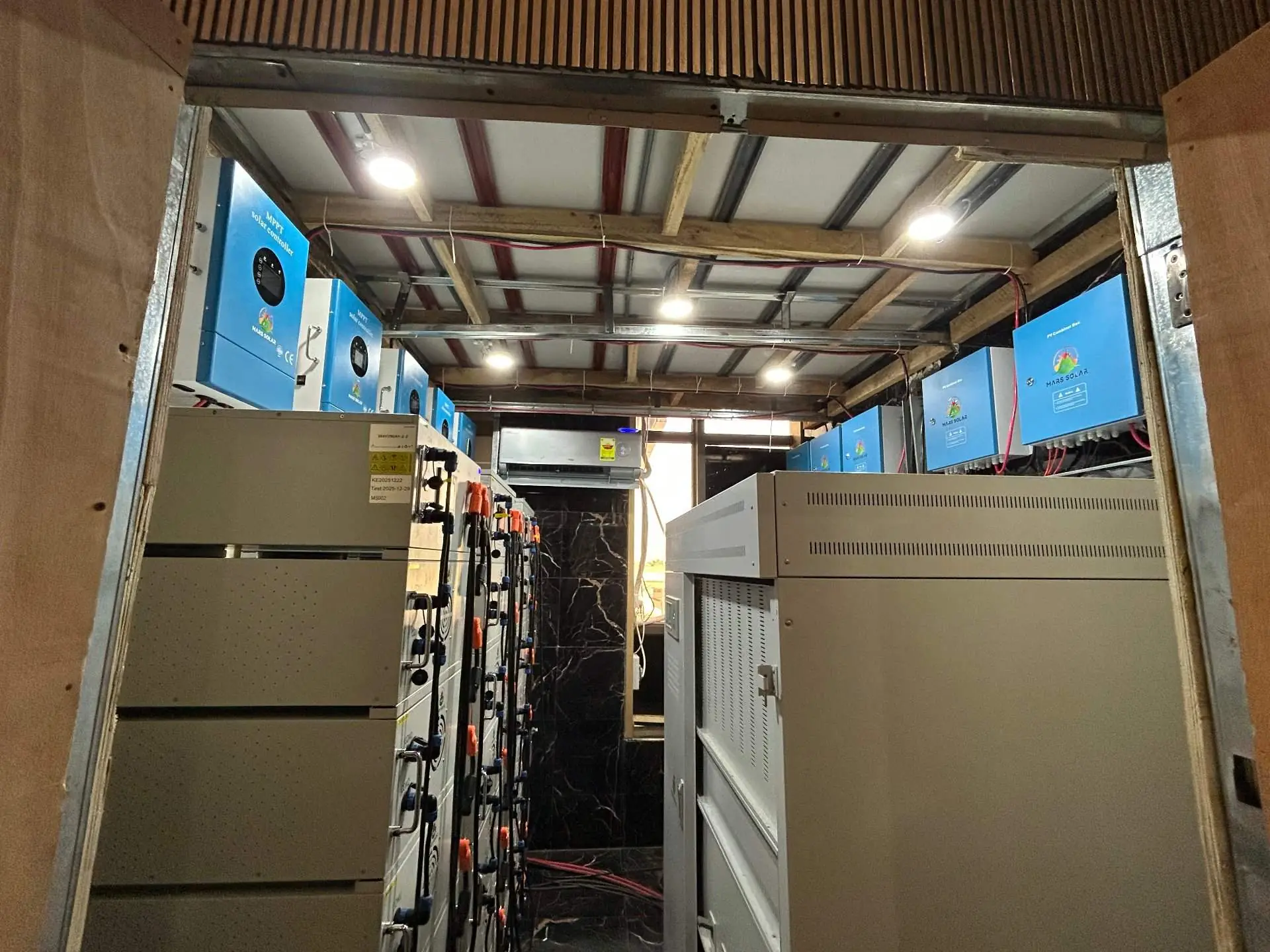
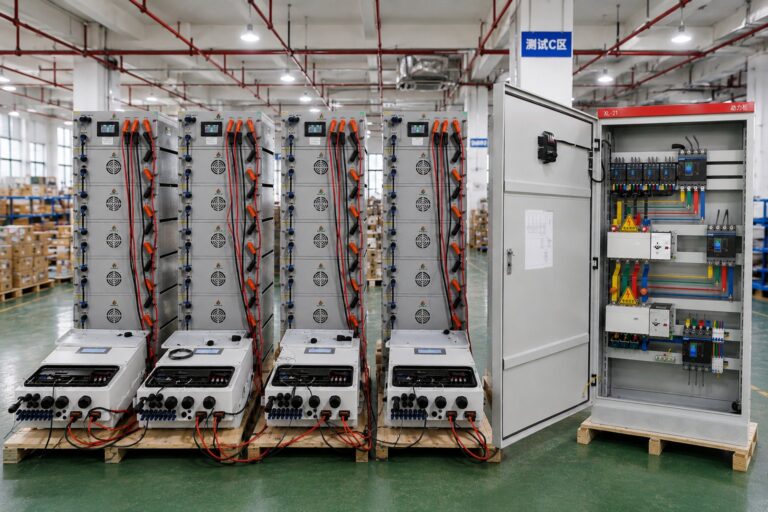
Inverter and PCS cabinets on a commissioned site in Ghana, where the grid-forming vs grid-following inverter choice was fixed at the specification stage.
The number that decides it: short-circuit ratio at the point of connection
SCR is the ratio of the short-circuit capacity available at your point of connection to the rating of the plant you are connecting. A high SCR means a stiff network. A low SCR means the network impedance is high relative to your plant, so your inverter's behaviour starts to move the voltage rather than follow it. The current needed to correct a voltage error scales as the error divided by that impedance, which is why weak networks saturate converters later but destabilise them sooner. It also explains why the grid-forming vs grid-following inverter answer changes the moment the feeder impedance changes, even with identical load.
| SCR at the point of connection | What it usually means | Grid-forming vs grid-following inverter call |
|---|---|---|
| Above 3.0 | Stiff network, voltage held by upstream plant | Grid-following is normally adequate |
| 2.0 to 3.0 | Moderately weak; interaction studies start to matter | Grid-following possible, but model the control interaction |
| 1.5 to 2.0 | A formal stability study is normally expected | Specify grid-forming, or a defined mix of both |
| 1.0 to 1.5 | Weak; phase-locked loops become unreliable | Grid-forming is the default choice |
| 1.0 or below | Very weak or islanded by design | Often the only workable architecture |
These bands are screening practice, not a published standard, and the exact thresholds move with the mix of plant already on the feeder. Use them to decide whether you need a study, then let the study set the requirement. For a plant feeding a factory load through a weak feeder, the same logic is what makes the off-grid versus hybrid versus on-grid decision in Nigeria so configuration-sensitive. We run the same screening on a grid-forming vs grid-following inverter basis before quoting any hybrid system, because the architecture decides the battery sizing as much as the inverter rating does.
What a grid-forming unit must actually deliver
Black start and islanded operation
Black start means establishing a voltage on a de-energised bus without external help. Ask for the initiation time from loss of grid to a stable voltage, and ask whether it can do it into the site's real transformer and motor load rather than a resistive test bank. That detail is where most grid-forming vs grid-following inverter claims are either proven or quietly withdrawn. Islanded operation also means surviving the transition back, so the mode change has to be bumpless in both directions.
Inertia, droop and current limits
Grid-forming control has to supply synthetic inertia and droop response that a phase-locked loop cannot produce. The measurable quantities worth writing into a specification are active power frequency droop, reactive power voltage droop, virtual inertia constant, phase-jump response and post-fault power recovery time. Great Britain's Grid Code modification GC0137, approved in February 2022, is a useful external reference because it defines these quantities concretely. Treat that document as the template for your own grid-forming vs grid-following inverter schedule, then add the site-specific values.
| Capability | Why it decides the grid-forming vs grid-following inverter call |
|---|---|
| Voltage-source behaviour across timescales | A phase-jump response cannot be faked by fast measurement; only a real voltage source produces it |
| Current headroom toward 1.1 to 1.2 pu | Motor starting and fault ride-through need current above rating without tripping |
| Thermal duty at high current | Short-term capability is easy to quote and hard to sustain; ask for the duty cycle, not the peak |
| Multi-unit parallel operation | Two grid-forming units from different vendors on one node can oscillate if nobody owns the tuning |
| Smooth grid-connected to islanded transfer | Most failures happen in the transition, not in steady-state islanding |
What the 15% to 50% premium actually buys
The premium is usually quoted as a share of inverter or PCS cost, and it is not a single number. At the low end you are buying firmware and a control law change on hardware that already has the current headroom. At the high end you are buying larger magnetics, more thermal capacity and faster control hardware. A grid-forming vs grid-following inverter quotation that does not separate those two cases is not comparable with one that does.
| Situation | Is the premium justified? |
|---|---|
| Islanded microgrid with no grid connection | Yes. Without it the system has no voltage reference and cannot run |
| Weak feeder, SCR below about 1.5 | Yes. The alternative is repeated nuisance tripping and a failed interconnection |
| Grid-tied site that must ride through outages with part of the load | Usually yes, because the island transition is the requirement |
| Stiff urban network, SCR above 3, no islanding intent | Rarely. Spend the money on protection coordination and monitoring instead |
| Pure peak-shaving BESS behind a strong meter | Not by default. Quantify the ancillary revenue first, then decide |
One caveat worth stating plainly: some grid-forming claims are firmware upgrades on existing hardware, and some are not. Retrofit is only credible if the unit has the current and thermal margin, and even then it must pass grid-code qualification testing. Ask for the test report before you accept the upgrade path. The same evidence standard applies to every variant of a grid-forming vs grid-following inverter offer you are shown.
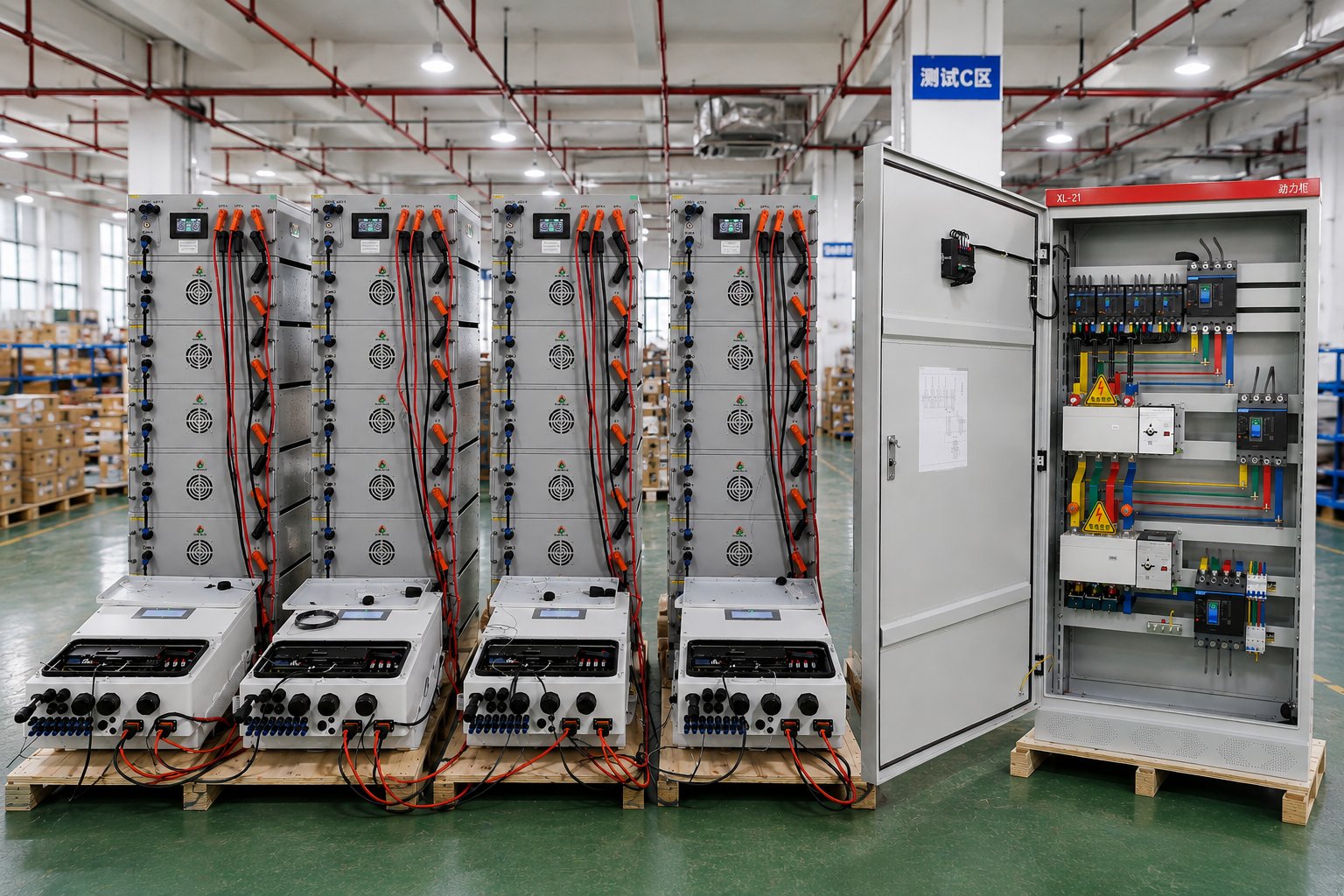
Factory acceptance testing before shipment. A grid-forming vs grid-following inverter claim is only worth what the test report proves at your SCR.
Standards: what is finalised in 2026 and what is still a draft
This is where most supplier articles overstate the position. As of October 2026 there is no single published IEC product standard that certifies a converter as grid-forming. What exists is a layered set: IEEE 2800-2022 for inverter-based resource interconnection performance, IEEE 2800.2-2026 for test and verification procedures, and IEEE P2800.1 still in development specifically for grid-forming functional capabilities. That gap is the single most common reason a grid-forming vs grid-following inverter tender ends in a commissioning dispute.
Alongside IEEE, the UNIFI consortium specifications for grid-forming inverter-based resources, now in their third version, are the reference most buyers actually test against, because they define voltage-source behaviour, phase-jump response, fault behaviour and multi-vendor interoperability in testable terms. Safety still sits with IEC 62109-1 and IEC 62109-2; distribution interconnection with IEC 62786 and IEEE 1547-2018.
Regulatory pull is uneven. NERC adopted parts of IEEE 2800-2022 through reliability standard PRC-029, with ride-through requirements becoming mandatory for inverter-based plants above 75 MVA at 100 kV or higher from 1 October 2026, and above 20 MVA at 60 kV or higher from 1 January 2027. Great Britain published its grid-forming capability specification through Grid Code modification GC0137, and AEMO imposes grid-forming behaviour through connection conditions in weak parts of the Australian network. None of these settlements answers the grid-forming vs grid-following inverter question for a site in Lagos, Manila or Port of Spain.
The practical conclusion for a buyer in West Africa, South-East Asia or the Caribbean is that no regulator will hand you the acceptance criteria. If you do not write them into the tender, the grid-forming vs grid-following inverter question gets settled in the field, at commissioning, with the equipment already on site.
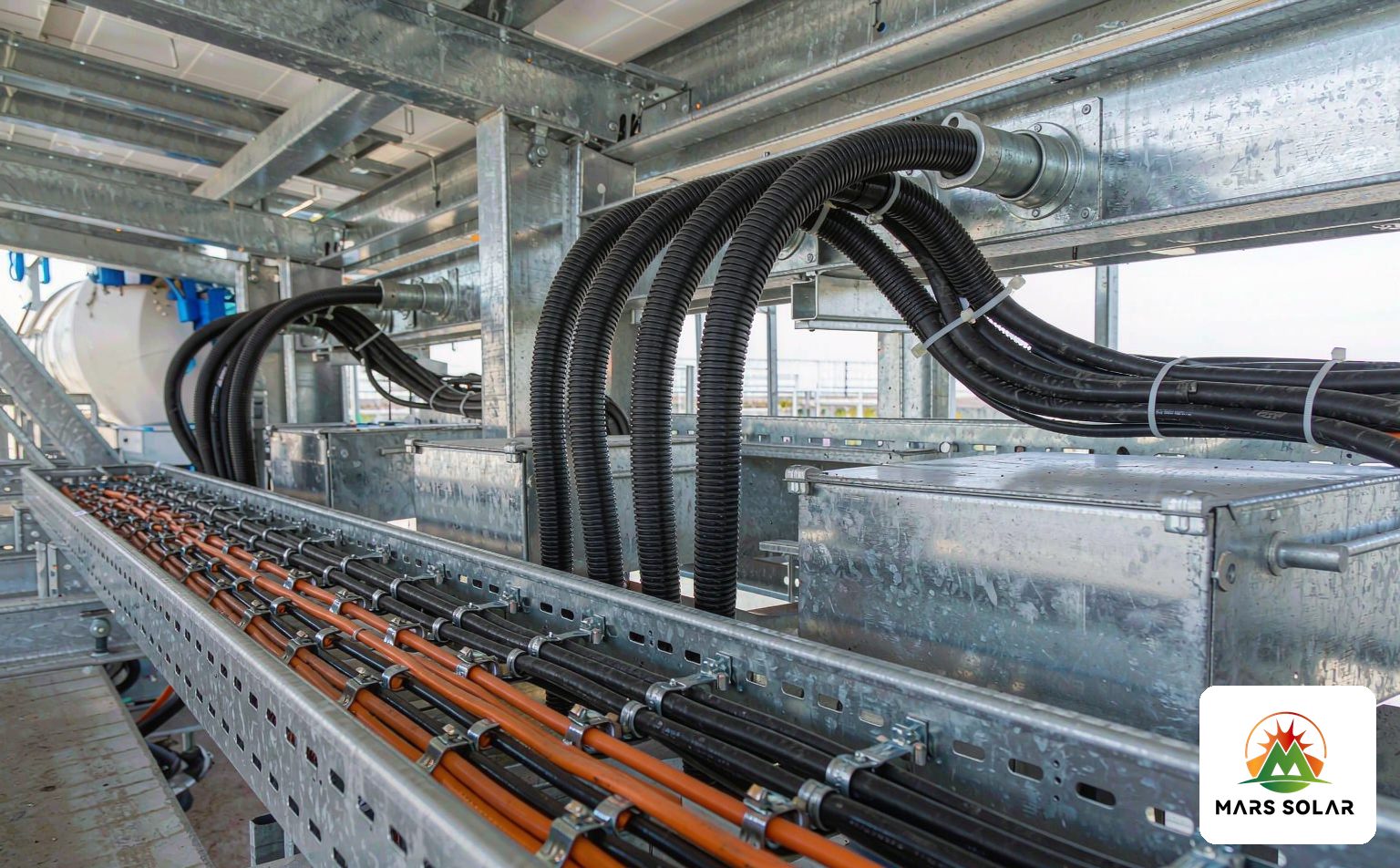
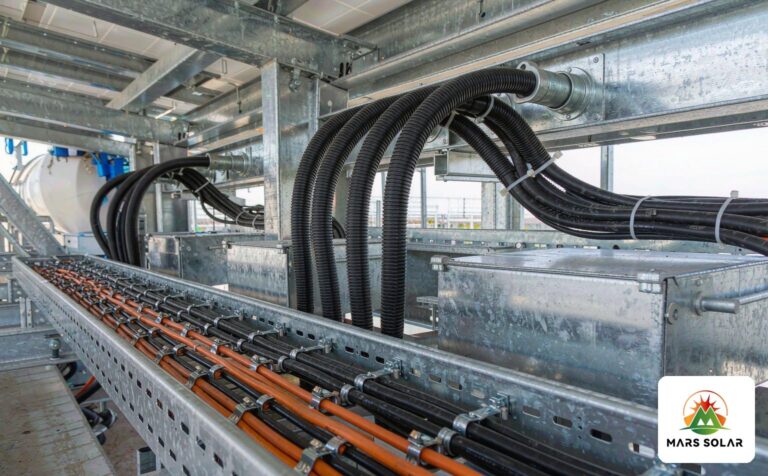
Electrical room detail. Protection coordination and current-limiting behaviour are where a grid-forming vs grid-following inverter specification usually collides with reality.
Where this matters most in our markets
Nigeria: a weak transmission grid with a tightening voltage band
Nigeria's grid code, administered through the regulator and the transmission company, requires distributed generation connected at 33 kV or 11 kV to hold voltage within plus or minus 10% of nominal at the point of common coupling. On a weak feeder a grid-following inverter that cannot regulate voltage becomes a compliance problem rather than only a performance one. Sites that already run diesel alongside PV are effectively running a weak-grid microgrid every day. There the grid-forming vs grid-following inverter decision is a weekly operating question rather than a one-off design choice.
Philippines and the Caribbean: islanded operation is the business case
For island resorts, cold storage and municipal loads, the alternative to solar plus storage is imported diesel. There is no grid to follow, so the architecture question is settled by definition. For islanded work we fix the grid-forming vs grid-following inverter choice before storage sizing begins, because it sets the current headroom the battery has to support. This is also why the storage design, not the inverter label, usually drives the outcome on projects like a commercial off-grid system in the Philippines.
Middle East: high penetration plus heavy motor load
Large PV penetration on a network with limited inertia raises the same question even where the grid is nominally strong, and the motor load profile adds inrush current to the requirement. Screening by SCR still works, but the study has to include motor starting rather than only steady-state load. Motor-heavy sites are also where a grid-forming vs grid-following inverter retrofit most often fails in practice.
| Market | Typical condition | What to specify |
|---|---|---|
| Nigeria | Weak feeder, diesel back-up, 33 kV or 11 kV connection | Voltage regulation to the grid code band, black start, diesel coexistence |
| Filipinas | Island grids, typhoon exposure, weak distribution | Islanded operation, multi-unit parallel, salt-air-rated enclosures |
| Ghana | Tariff-band-driven design, net metering limits | Self-consumption priority, export limiting, grid-following unless islanding is required |
| Kenia | Relatively strong grid, strict interconnection review | Ride-through evidence, protection study, documented test reports |
| Caribbean | Small island systems, hurricane resilience | Black start, inertia support, containerised and serviceable locally |
Five specification mistakes that force retrofits
- Specifying grid-forming by product name. Two units marketed as grid-forming can behave differently at SCR 1.2. Specify the performance, then ask for the test evidence. If a vendor cannot name the SCR at which the claim was demonstrated, the grid-forming vs grid-following inverter label on the datasheet carries no information.
- Ignoring the SCR at the actual point of connection. Buyers often quote the substation SCR, not the value at the plant's terminals after the site transformer and cabling.
- Testing into a resistive bank. A resistive test proves almost nothing about motor inrush or phase-jump response. Demand a test at your site's impedance.
- Skipping protection coordination. Grid-forming units inject fault current differently, and legacy overcurrent settings can fail to clear faults as a result.
- Assuming firmware can fix it later. Retrofits work only where current and thermal headroom already exist, and they still need re-qualification.

A 6 MW / 20 MWh project in Nigeria. On projects at this scale the grid-forming vs grid-following inverter decision is made in the interconnection study, not in the procurement meeting.
How we size grid-forming capacity for a 100 kW to 5 MW site
- Get the real fault level. Ask the utility for the short-circuit MVA at the point of connection, and re-derive it at the plant terminals.
- Build a load profile with transient events. Motor starting, transformer energisation and welding loads matter more than average kW.
- Decide the islanding intent. Full-site islanding, essential-load islanding and no islanding are three different specifications.
- Size the grid-forming block for the worst transient, not the average. Then check that the thermal duty over a day is inside the rating.
- Model the multi-unit case. If two or more grid-forming units share a node, the control interaction needs an owner and a vendor-neutral test.
- Write the acceptance criteria into the contract. Test reports as a payment milestone is the cheapest insurance on the project.
For a smaller commercial site the same logic shows up in how hybrid inverter sizing is set by load profile, surge and C-rate, because a hybrid unit is the grid-forming element in most 100 kW to 500 kW systems. Where a site already runs BESS for peak shaving, the incremental cost of grid-forming capability is often far lower than a standalone comparison suggests, because the grid-forming vs grid-following inverter delta shrinks once the power conversion stage is already being paid for — see the cost structure in our BESS pricing guide for Nigeria and the commercial BESS approach in the Philippines.
Frequently asked questions: grid-forming vs grid-following inverter
Can a grid-following inverter run an off-grid system?
No. Without an external voltage reference there is nothing for the phase-locked loop to lock onto, so the inverter cannot establish a voltage. In a microgrid that means the system will not energise at all, which is why the grid-forming vs grid-following inverter choice is a precondition rather than a performance upgrade for islanded sites. Reverse the test and the same logic holds: a decision made on purchase price alone usually ends in a retrofit.
Is a grid-forming vs grid-following inverter comparison the same as comparing efficiency?
No. Efficiency differences are usually small and secondary. What changes is behaviour: a voltage source can black start, supply synthetic inertia and ride through phase jumps, while a current source cannot. Compare test evidence at your SCR, not datasheet efficiency alone. Put the grid-forming vs grid-following inverter evidence side by side under your own network impedance before either number is believed.
What SCR requires a grid-forming inverter?
Common screening practice treats SCR below about 2.0 as the point where a formal stability study is expected, below 1.5 as the point where grid-forming is normally specified, and 1.0 or below as the point where it is often the only workable architecture. These bands are practice, not a standard.
How much does grid-forming add to the cost?
Industry reporting puts the premium at roughly 15% to 50% over equivalent grid-following equipment, depending on current headroom, thermal design and whether the change is firmware only. On a project that already needs storage, the incremental share is smaller than a standalone comparison implies.
Can a grid-following inverter be upgraded to grid-forming later?
Sometimes, and only where the hardware already has current and thermal margin. It is a control-software change in principle, but the unit must then pass grid-code qualification testing. Treat retrofit claims as conditional until you see the test report.
Which standard should I put in a tender for a grid-forming vs grid-following inverter requirement?
As of October 2026 there is no single published IEC product standard certifying grid-forming converters. Use IEEE 2800-2022 for interconnection performance, IEEE 2800.2-2026 for verification procedures, and the UNIFI consortium specifications for grid-forming functional behaviour, then add your own site-specific acceptance test. That test clause is the only thing that makes a grid-forming vs grid-following inverter requirement enforceable after the purchase order is signed.
Does grid-forming help if I am not islanding?
On a weak network it can, because voltage and frequency support reduce nuisance tripping and improve ride-through. On a stiff network with SCR above about 3 and no islanding intent, the money is usually better spent on protection coordination and monitoring.
What is the difference between black start and islanding mode?
Black start is establishing voltage from a de-energised state. Islanding mode is holding voltage and frequency while disconnected from the grid. A unit can support one and handle the other badly, so ask for evidence of the transfer in both directions.
How does grid-forming affect protection settings?
Grid-forming units inject fault current differently from grid-following units, and legacy overcurrent relays may not clear faults correctly. The protection study has to be redone with the converter's actual current-limiting behaviour, not a generic synchronous-machine assumption.
What does a grid-forming vs grid-following inverter decision look like on a 500 kW commercial site?
Most 500 kW grid-tied sites on a reasonable feeder stay grid-following. If the site must ride through outages with part of the load, or the feeder is weak, a grid-forming hybrid unit with battery storage is usually the cheaper route than a separate PCS, which changes the grid-forming vs grid-following inverter economics compared with buying a standalone unit — the sizing sequence is set out in our hybrid inverter sizing guide.
Data sources and freshness
Figures in this article were checked in October 2026. Standards positions are drawn from IEEE Power and Energy Society material on inverter-based resource standards (ieee-pes.org), NERC's grid-forming technology reliability work (nerc.com), and the UNIFI consortium specifications for grid-forming inverter-based resources. The SCR screening bands and the 15% to 50% premium range are industry practice and vendor-reported ranges, not published standards, and should be confirmed against a project-specific study. Safety and interconnection standards referenced are IEC 62109-1, IEC 62109-2, IEC 62786, IEEE 1547-2018 and IEEE 2800-2022. Background on grid-forming control is available for readers new to the terminology.
Reviewed 26 October 2026. Policy and standard positions change; confirm current editions and local grid-code annexes before tender.
Need the SCR screening done before you specify?
Send us the point-of-connection fault level, the site load profile and the islanding intent. We will come back with the grid-forming vs grid-following inverter split, the sizing block and the acceptance test list for your tender.
Chatear por WhatsAppRelated reading: commercial BESS in the Philippines · off-grid solar in the Philippines · hybrid systems in Ghana · commercial solar in Kenya · Caribbean BESS costs · Philippines BESS cost guide · Africa market comparison · 6 MW / 20 MWh Nigeria project · 100 kW off-grid plant · solar PPA in Kenya · Guía de certificación solar · Contáctanos


 English
 Arabic
 Spanish
 French
 Dutch
 Portuguese