Linguagem
Solar cost Nigeria — the first question every Lagos, Abuja or Kano business owner asks when they consider going solar. They want to know two things: how much does it cost, and will it really pay back? Both deserve a serious, data-backed answer — not a sales pitch.
This 2026 guide is built on real factory-direct quotations delivered to Nigerian commercial buyers over the last 12 months. It is not a marketing number designed to make solar look cheap. It is the same pricing a procurement manager in Apapa or a hotel GM in Victoria Island would receive this month if they sent a serious request to a qualified manufacturer.
You will see exact Naira and USD figures by system size, a side-by-side comparison against diesel and grid power, the hidden costs most buyers forget, and a payback calculator you can run on your own numbers. If you are new to system sizing, start with our guia rápido de configuração do sistema — then come back here for the money conversation.
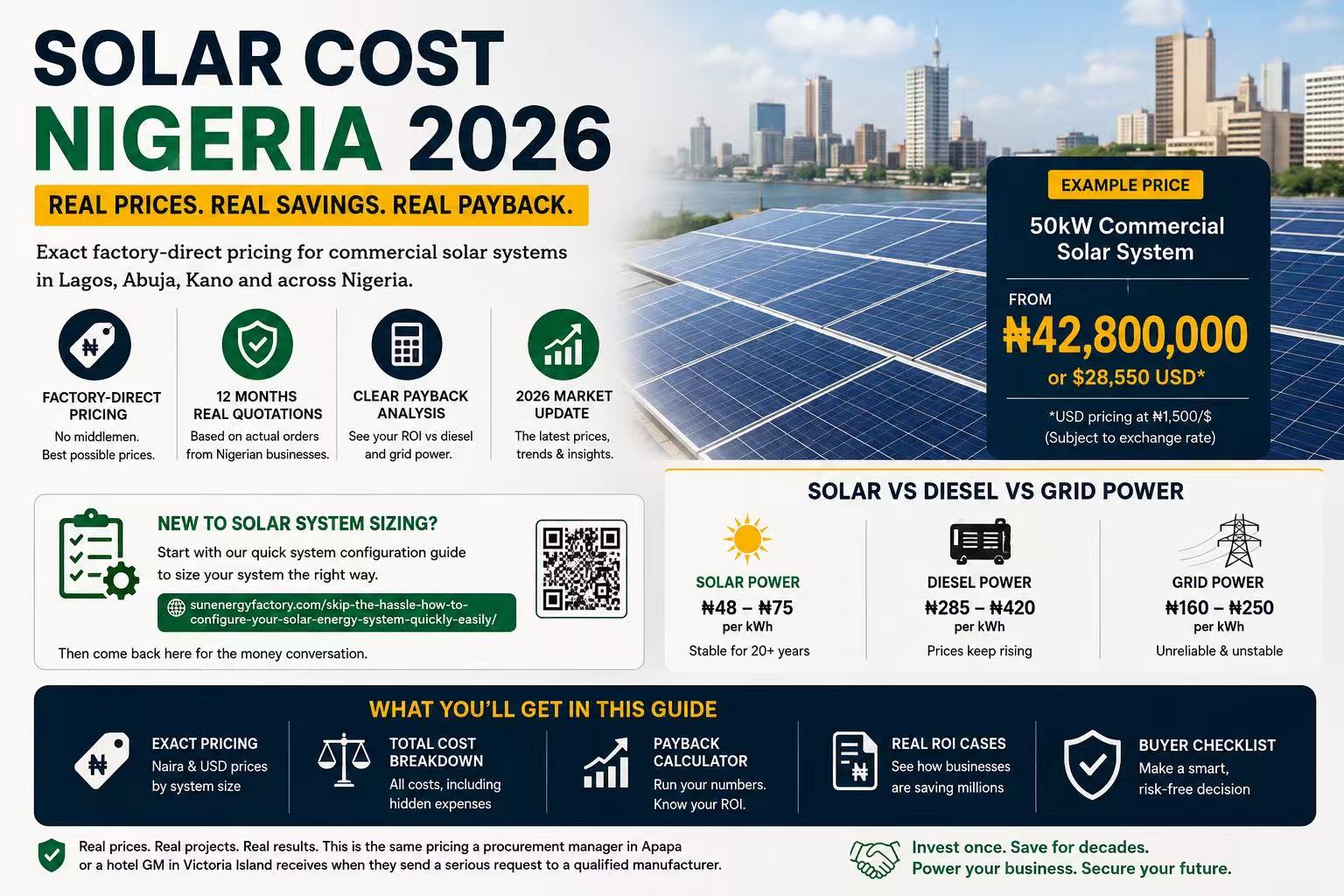
Before the detail, the headlines. All prices below are factory-direct landed quotations in Lagos or Port Harcourt, including panels, hybrid inverter, lithium battery bank, mounting, BOS, installation and commissioning. Excludes building modifications and import duty adjustments.
| Tamanho do sistema | Typical Load (Nigeria) | Hybrid System Range | Off-Grid System Range |
|---|---|---|---|
| 5 kW | 1 home, small shop | N4.5M – N6.5M (~$3,000 – $4,300) | N5.5M – N8M (~$3,700 – $5,300) |
| 10 kW | Small office, clinic | N8M – N12M (~$5,300 – $8,000) | N10M – N15M (~$6,700 – $10,000) |
| 20 kW | Supermarket, guest house | N16M – N24M (~$10,700 – $16,000) | N20M – N30M (~$13,300 – $20,000) |
| 50 kW | Mid-size business, cold storage | N42M – N62M (~$28,000 – $41,300) | N55M – N80M (~$36,700 – $53,300) |
| 100 kW | Hotel, hospital, factory | N85M – N125M (~$56,700 – $83,300) | N110M – N165M (~$73,300 – $110,000) |
| 250 kW | Industrial, large hotel | N210M – N310M (~$140,000 – $206,700) | N275M – N420M (~$183,300 – $280,000) |
Exchange rate: N1,500 / USD (Aug 2026 indicative). On-grid systems run roughly 25–35% cheaper than hybrid, but only suit sites with reliable grid.
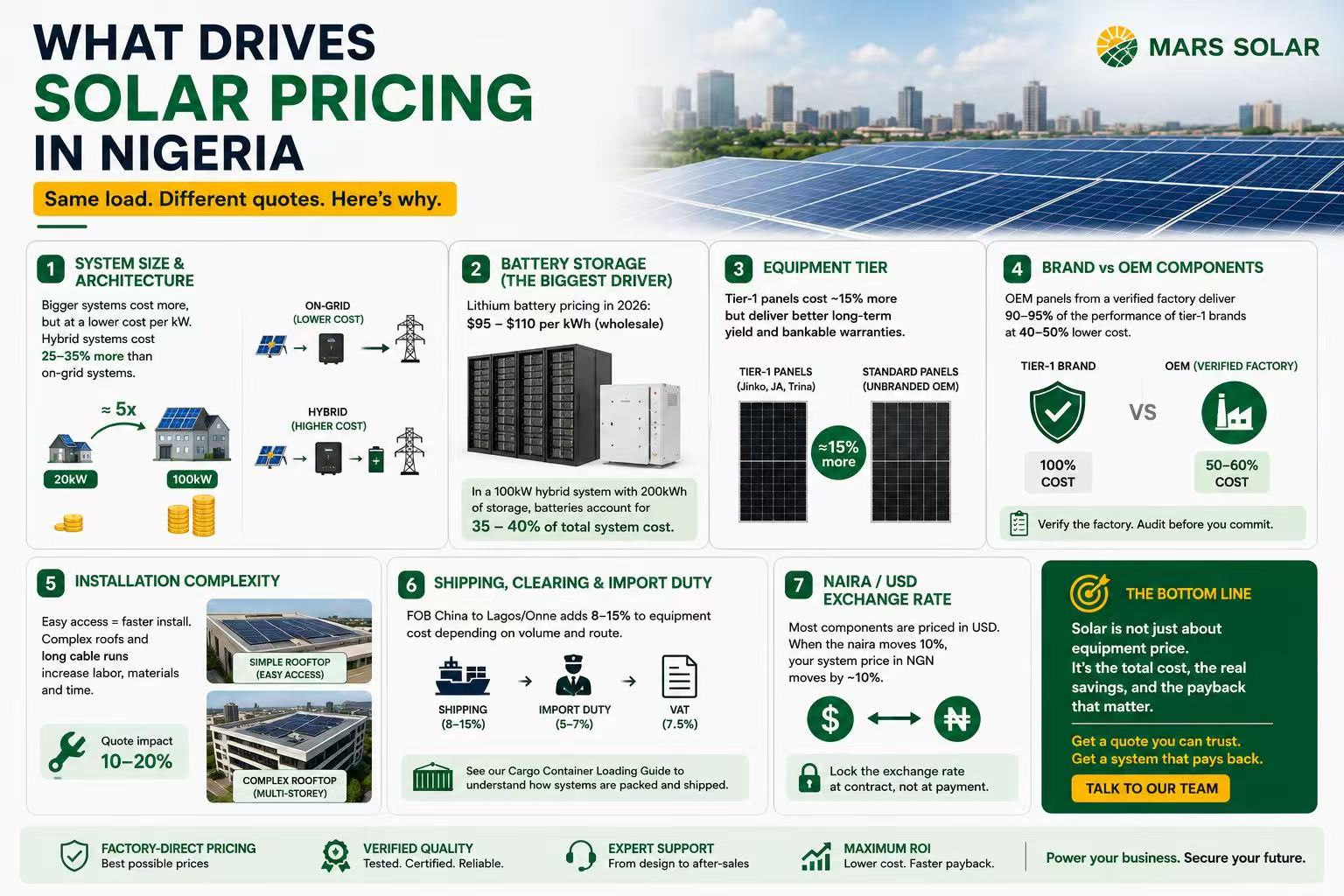
Two buyers with the same load list can receive quotes that differ by 40%. Here is why:
1. System size and architecture
The biggest driver — a 100kW system costs roughly 5x a 20kW system, with mild economies of scale. Architecture matters too: a hybrid system with batteries costs 25–35% more than a pure on-grid system with the same panel count.
2. Battery storage (the single largest cost driver)
Lithium battery pricing in 2026 sits around $95–110 per kWh wholesale. A 100kW hybrid system with 200kWh of battery storage carries roughly 35–40% of the total system cost in batteries alone. See our energy storage systems lineup for capacity options.
3. Equipment tier
Tier-1 panels (Jinko, JA, Trina) cost ~15% more than unbranded OEM panels but come with bankable warranties and better long-term yield. Same logic applies to hybrid inverters.
4. Brand vs OEM components
OEM panels from a verified Chinese factory deliver 90–95% of the performance of tier-1 brands at 40–50% of the cost — when the factory is real, audited, and export-ready. That is why we publish a Guia de auditoria à fábrica em 7 passos e uma repartição de Quantidade mínima de encomenda (MOQ), prazo de entrega e condições de pagamento.
5. Installation complexity
A flat rooftop with easy access installs faster than a multi-storey building with restricted roof space. Structural mounting, cable runs, and switchgear can swing a quote by 10–20%.
6. Shipping, clearing, and import duty
FOB China to Lagos or Onne Port adds 8–15% to equipment cost depending on volume and route. Nigerian import duty on solar equipment ranges 5–7% depending on classification; VAT is 7.5%. Our guia de carregamento de contentores de carga shows exactly how systems are packed and shipped.
7. Naira / USD exchange rate
Most solar components are priced in USD at the factory. When the naira moves 10% against the dollar, the naira price of your system moves with it. Lock the exchange rate at the time of contract — not at the time of payment — to avoid nasty surprises.
What follows is a kW-by-kW breakdown for the most common commercial sizes in Nigeria. Each section includes the equipment list, the realistic quote range, and the type of business it suits. All figures assume hybrid architecture (solar + battery + grid fallback), tier-1 or verified-OEM components, factory-direct supply, professional installation.
5 kW Hybrid — N4.5M to N6.5M (~$3,000 – $4,300)
Powers: a 3-bedroom home, a small retail shop, or a 5–10 person office.
Components: ~10 x 550W panels, 5kW hybrid inverter, 10kWh lithium battery, roof mounting, full BOS, installation. Off-grid variant: N5.5M – N8M. Payback: 18–28 months for homes currently running a small generator 4–6 hours daily.
10 kW Hybrid — N8M to N12M (~$5,300 – $8,000)
Powers: a small clinic, an office of 15–25 staff, a guest house, or a medium shop with refrigeration.
Components: ~18 x 550W panels, 10kW hybrid inverter, 20kWh lithium battery, roof mounting, full BOS. Off-grid variant: N10M – N15M. Payback: 10–18 months for businesses burning 15–25 litres of diesel daily.
20 kW Hybrid — N16M to N24M (~$10,700 – $16,000)
Powers: a supermarket, a 10–15 room guest house, or a small cold-storage facility.
Components: ~36 x 550W panels, 20kW hybrid inverter, 40kWh lithium battery, mounting structure. Off-grid variant: N20M – N30M. Payback: 10–16 months. This is the size where solar becomes a no-brainer for most Nigerian SMEs.
50 kW Hybrid — N42M to N62M (~$28,000 – $41,300)
Powers: mid-size manufacturing, a 20-room hotel, cold-chain logistics, or a hospital wing.
Components: ~90 x 550W panels, 50kW hybrid inverter, 100kWh lithium battery, ground or rooftop array. Off-grid variant: N55M – N80M. Payback: 8–14 months for businesses replacing significant diesel runtime.
100 kW Hybrid — N85M to N125M (~$56,700 – $83,300)
Powers: a 30–50 room hotel, a mid-size factory, a hospital, or a large commercial building.
Components: ~180 x 550W panels, 100kW hybrid inverter, 200kWh lithium battery, switchgear, monitoring. Off-grid variant: N110M – N165M.
Field reference: our 100kW Nigerian hotel installation paid back in 8–12 months and continues to save N2,000,000 ($1,460) per month versus diesel-and-grid. Similar pattern in our 250kW Ghana hotel case study (60% electricity cost reduction).
250 kW Hybrid — N210M to N310M (~$140,000 – $206,700)
Powers: a 100+ room hotel, a large industrial site, or a manufacturing facility with significant daytime load.
Components: ~455 x 550W panels, 250kW hybrid inverter, 500kWh lithium battery, MV switchgear, full monitoring. Off-grid variant: N275M – N420M. Payback: 14–22 months at current diesel prices.
The real comparison is not the sticker price. It is what each kWh actually costs you over 5 years — and whether it is even there when you need it. Here is the honest 2026 picture.
| Power Source | N/kWh | Reliability | Initial Cost | 5-Year Cost (100kW site) |
|---|---|---|---|---|
| National Grid (Disco) | N90–110 | Very low (8–12 outages/day) | Nenhum | N180M – N220M (incl. diesel + downtime losses) |
| Diesel Generator | N350–450 | High (fuel-dependent) | N15M – N25M | N420M – N540M (fuel + maintenance) |
| Hybrid Solar (this guide) | N55–80 (levelized) | High (auto-switch) | N85M – N125M | N95M – N140M |
| Off-Grid Solar | N80–110 (levelized) | Highest (no grid) | N110M – N165M | N125M – N185M |
Note: "5-year cost" for grid and diesel includes estimated business losses from downtime (spoiled inventory, idle staff, lost production). That line is often invisible in a quote — but it is the most expensive part of staying on grid + diesel.
A real quotation is not a one-line price per watt. It is a bill of materials. If your quote is missing half of these line items, it is not a quote — it is a guess.
If a quote lumps everything into "solar system — NX", ask for the breakdown. A transparent supplier will provide it without hesitation.
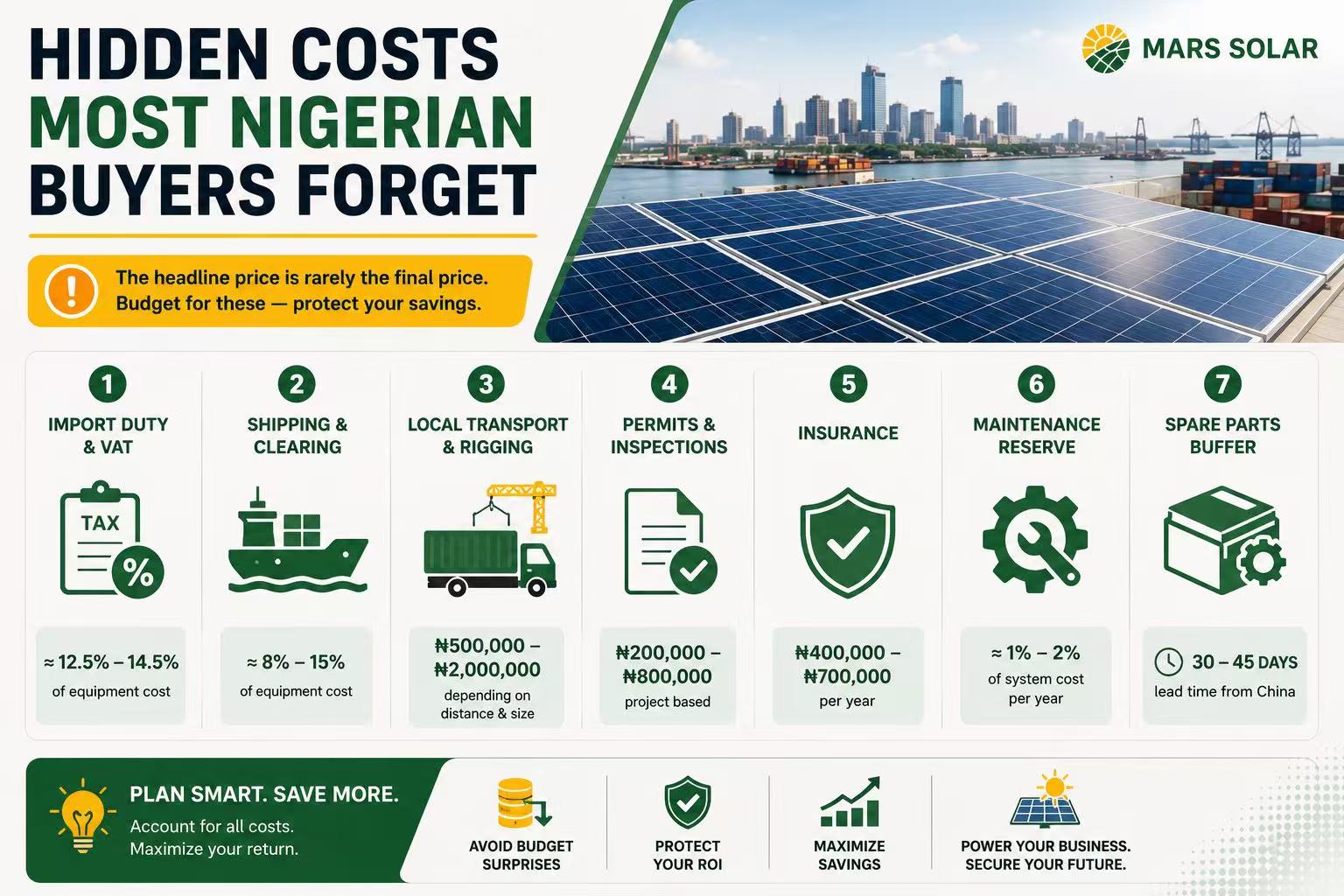
The headline price is rarely the final price. Budget for these line items or they will eat into your savings.
Import duty and VAT
Solar equipment imported into Nigeria attracts 5–7% import duty depending on HS code classification, plus 7.5% VAT. Confirm the rate with your clearing agent before signing a contract — re-classification mid-shipment is expensive.
Shipping and clearing
FOB China to Lagos or Onne Port typically adds 8–15% to equipment cost. CIF terms bundle this into the supplier quote but cost more upfront. Our guia de carregamento de contentores de carga shows how the equipment is packed and what to expect.
Local transportation and rigging
Port to site, especially for sites outside Lagos or Port Harcourt, can run N500,000 – N2,000,000 depending on distance and equipment size. Includes crane hire for large systems.
Permits and inspections
NERC registration for grid-tied systems above 100kW. Local government permits vary by state. Factor in N200,000 – N800,000 for paperwork and inspections on a commercial project.
Insurance
All-risk cover on a N100M solar system runs roughly N400,000 – N700,000 per year. It is not optional for financed projects.
Maintenance reserve
Budget 1–2% of system cost per year for routine maintenance, panel cleaning, and consumables. Lithium batteries typically last 8–12 years; inverters 10–15 years; panels 25+ years.
Spare parts buffer
Keep a small reserve of fuses, surge protectors, and a spare inverter fan. Lead time from China is 30–45 days — being down for that long during peak season is not acceptable for most businesses.
Forget generic "solar pays back in X years" claims. Run your own number in four steps. Takes 5 minutes.
Step 1: Your monthly power bill
Pull your last 3 months of electricity bills and your last 3 months of diesel purchase receipts. Total them. That is your true current monthly power cost.
Step 2: Solar coverage estimate
A well-designed hybrid system typically covers 70–85% of a commercial site's annual kWh consumption. The remainder still comes from grid or diesel during low-sun periods and peak demand events.
Step 3: Monthly savings
Multiply your current monthly cost by 0.75 to get a realistic monthly savings figure. Be conservative — under-promising and over-delivering is better than the reverse.
Step 4: Payback months
Divide your system quote by your monthly savings. That is your payback period in months. Most well-designed Nigerian commercial hybrid systems land between 8 and 18 months.
Worked example:
A Lagos hotel currently spends N4,000,000/month on diesel + grid. A 100kW hybrid system costs N110,000,000. Estimated monthly savings = N4M x 0.75 = N3M. Payback = N110M / N3M = ~37 months. The system pays back in ~37 months, then produces near-free electricity for 23+ more years. Compare that lifetime picture against continuing to spend N4M every month forever.
Upfront cash is one path. Not the only one. Here is what is actually available to Nigerian commercial buyers in 2026.
| Option | Como funciona | Typical Terms (2026) |
|---|---|---|
| Cash upfront | Pay 50–100% on order, balance on delivery | Best total cost; no financing charge |
| Bank loan (commercial) | Standard commercial facility | 18–28% interest, 24–60 month tenor |
| CBN renewable energy intervention | Concessional facility for renewable energy projects | 9–12% interest, longer tenor (subject to program availability) |
| Vendor / supplier financing | Manufacturer-financed portion of the order | 15–22% interest, 12–36 month tenor |
| Lease-to-own | Third party owns the system, you pay monthly | Monthly OPEX-style payment; system transfers at end of term |
| Crowdfunding / cooperative | Pooled capital from investors or a buying group | Terms negotiated by the group |
The cheapest financing is not the lowest interest rate — it is the path that gets you to operational savings the fastest. Our MOQ, lead time and payment terms guide explains the typical supplier payment structure.
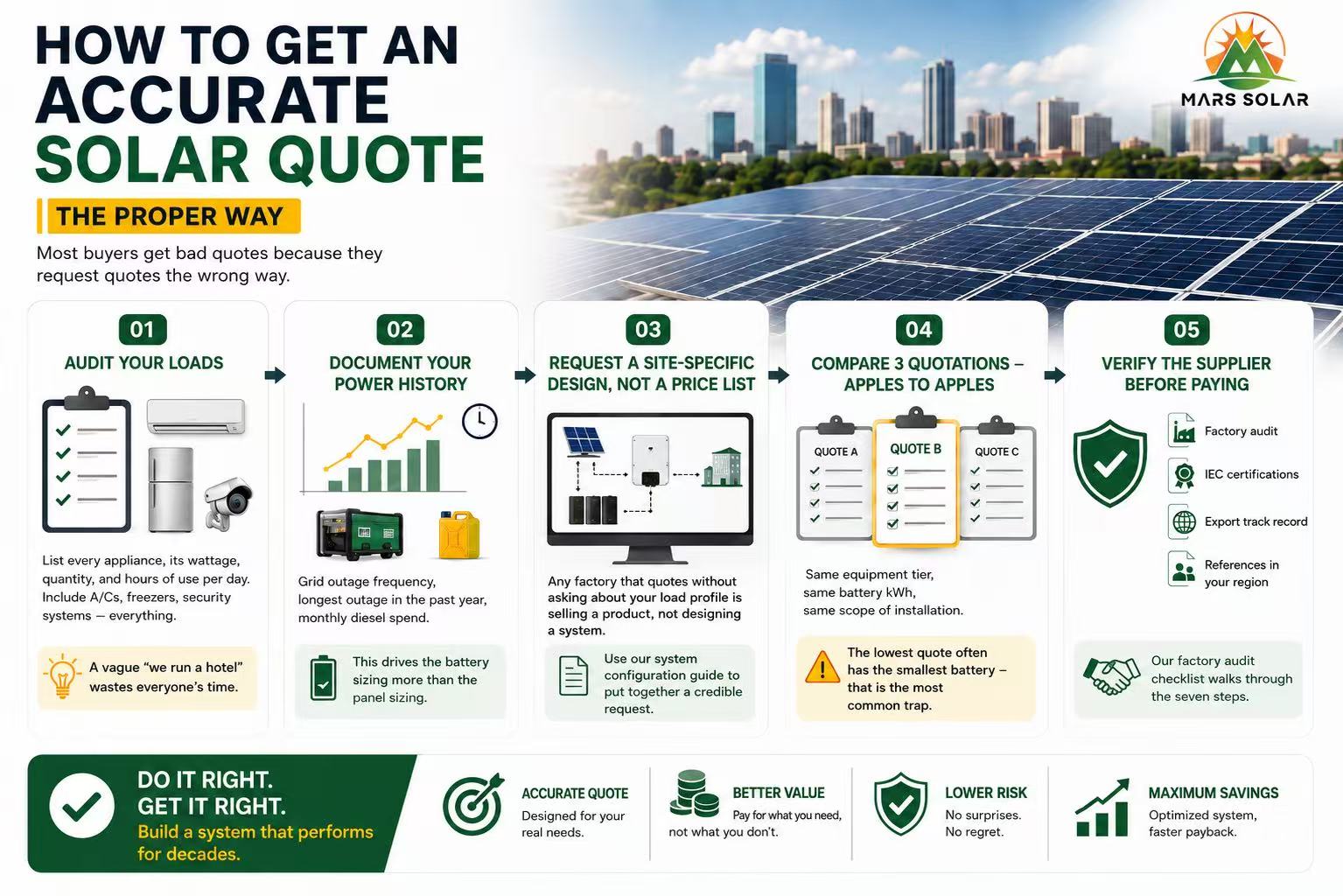
Most buyers get bad quotes because they request quotes the wrong way. Five steps to fix that:
Quanto custa um sistema solar de 5 kW na Nigéria em 2026?
Um sistema híbrido de 5 kW (energia solar + bateria + ligação à rede elétrica como alternativa) custa entre N4,5M e N6,5M, incluindo a instalação. Variante fora da rede: N5,5M – N8M. Ligado à rede (sem bateria): N3,2M – N4,5M.
Quanto custa um sistema solar de 100 kW na Nigéria?
A 100kW hybrid system with 200kWh of battery storage costs N85M – N125M. Off-grid variant: N110M – N165M. Our 100kW hotel case study shows a real installation at this scale.
A energia solar é mais barata do que um gerador a gasóleo na Nigéria?
Sim. A um preço de 1 400 N por litro e considerando que um gerador típico consome 0,4 L/kWh, o gasóleo custa entre 350 e 450 N por kWh. Um sistema solar híbrido fornece eletricidade a um custo de 55 a 80 N por kWh, nivelado ao longo de 20 anos — cerca de 5 vezes mais barato.
Qual é o período de retorno do investimento num sistema solar híbrido?
For Nigerian commercial sites replacing significant diesel runtime, payback is typically 8–18 months. See the worked example in our 250kW Ghana hotel case study e 100kW Abuja rice mill project for field-verified numbers.
Posso pagar a instalação de painéis solares a prestações na Nigéria?
Sim. As opções incluem empréstimos bancários comerciais (juros de 18–28%), fundos de intervenção do CBN para energias renováveis (juros de 9–12%, sujeitos à disponibilidade do programa), financiamento pelo fabricante (15–22%) e contratos de locação com opção de compra.
A energia solar funciona durante a estação das chuvas na Nigéria?
Yes — but with reduced output. A properly designed system accounts for the lowest-yield months (typically July–September in southern Nigeria). The battery bank and grid fallback carry the load during cloudy weeks.
Why is solar more expensive in Nigeria than in South Africa?
Three reasons. Import duties add 5–7%. Shipping and clearing add 8–15%. And the FX rate means every USD-denominated component costs more naira. Factory-direct supply short-circuits most of this — that is why our China factory-direct component line matters.
What certifications do my solar panels need for Nigeria?
At minimum: IEC 61215 (panel performance), IEC 61730 (panel safety), and IEC 62109 (inverter safety). For grid-tied systems above 100kW, NERC registration is also required. Our certification guide covers the full list.
The comparison above follows the same logic as the levelised cost of electricity framework — lifetime cost divided by lifetime kWh — which is the only basis on which diesel and solar can be compared fairly. It counts fuel, maintenance and replacement, not just the purchase price.
What is the solar cost in Nigeria for a 5kW hybrid system in 2026?
₦4.5M to ₦6.5M, roughly $3,000 to $4,300 at ₦1,500 per dollar. That covers ten 550 W panels, a 5 kW hybrid inverter, a 10 kWh lithium battery and installation. Solar cost in Nigeria at this size pays back in 18 to 28 months for a home running a small generator four to six hours a day.
What is the solar cost in Nigeria for a 10kW system?
₦8M to ₦12M, about $5,300 to $8,000. Solar cost in Nigeria scales steeply at the small end because the inverter and battery are a larger share of the bill. A 10 kW hybrid suits a clinic, a guest house or an office of 15 to 25 staff, and the solar cost in Nigeria at that size is the band most often quoted.
Does solar cost in Nigeria scale linearly with system size?
Not quite — a 100 kW system runs about five times a 20 kW system rather than five times plus a premium. Solar cost in Nigeria benefits from mild economies of scale once you leave the residential band. That flattening is why the solar cost in Nigeria per kilowatt falls as commercial systems get larger.
How much more does hybrid add to solar cost in Nigeria?
Twenty-five to thirty-five per cent over a pure on-grid system with the same panel count. For most Nigerian sites that premium is not optional, because on-grid alone shuts down with the grid. Solar cost in Nigeria is therefore best compared hybrid to hybrid, since that solar cost in Nigeria reflects what the site needs.
How does diesel compare with solar cost in Nigeria per kWh?
Diesel generation runs ₦350 to ₦450 per kWh; hybrid solar levels at ₦55 to ₦80. Measured over five years on a 100 kW site, diesel lands at ₦420M to ₦540M against ₦95M to ₦140M. Solar cost in Nigeria is the lower number wherever a genset runs daily.
How does grid power compare with solar cost in Nigeria?
The grid tariff looks cheapest at ₦90 to ₦110 per kWh, but reliability is very low — eight to twelve outages a day on many commercial sites. Once diesel backup and downtime losses are counted, the five-year grid cost reaches ₦180M to ₦220M on a 100 kW site. Solar cost in Nigeria has to be judged against that total, not against the tariff alone.
What drives solar cost in Nigeria more than anything else?
Battery storage. On a hybrid system the battery is the single largest line item, so architecture moves solar cost in Nigeria more than panel selection does. Trimming the battery to cut solar cost in Nigeria usually converts a working system into one that trips at night.
Why do quotes for the same load differ by 40% in solar cost in Nigeria?
Because architecture, battery chemistry, certification and after-sales service all vary between suppliers. Two quotes can describe identical loads and still differ by 40% on solar cost in Nigeria. Ask for the component list behind the solar cost in Nigeria figure before comparing headline prices.
What hidden costs add to solar cost in Nigeria?
Import duty of 5 to 7% depending on HS code, VAT at 7.5%, and 8 to 15% for shipping and clearing from China to Lagos or Onne Port. Port-to-site transport and rigging adds another ₦500,000 to ₦2,000,000. Solar cost in Nigeria is decided by these lines as much as by equipment price.
How should I calculate payback on solar cost in Nigeria?
Divide the installed cost by the monthly energy spend you actually displace, not by your total bill. A 5 kW hybrid at ₦4.5M to ₦6.5M typically pays back in 18 to 28 months. Any solar cost in Nigeria projection should use logged consumption, because payback moves with the generator hours you remove.
Is solar cost in Nigeria higher because of the naira?
Largely, yes. Indicative pricing here assumes ₦1,500 per dollar in August 2026, and the equipment is imported, so solar cost in Nigeria tracks the exchange rate closely. That is why a solar cost in Nigeria quotation should state its exchange-rate assumption and its validity window.
Can financing change the solar cost in Nigeria?
It changes the cash-flow question rather than the equipment price. Financing spreads the solar cost in Nigeria across the payback window, which makes a system affordable for a business that cannot fund the capital upfront. Compare the monthly repayment against the diesel bill being removed, not against the headline solar cost in Nigeria.
What should a proper quote for solar cost in Nigeria include?
Equipment list with brands, battery chemistry and capacity, balance of system, mounting, installation, commissioning and a warranty schedule. A quote without that detail hides where the solar cost in Nigeria actually sits. Insist on the bill of materials behind any solar cost in Nigeria figure you receive.
Does off-grid increase solar cost in Nigeria much?
Yes — a 5 kW off-grid variant runs ₦5.5M to ₦8M against ₦4.5M to ₦6.5M for hybrid, and levels at ₦80 to ₦110 per kWh against ₦55 to ₦80. Off-grid raises solar cost in Nigeria because the battery carries the whole night with no grid fallback.
What is the biggest mistake that inflates solar cost in Nigeria?
Sizing from a wish list rather than from measured consumption. Over-specified systems raise solar cost in Nigeria with capacity nobody uses, and under-specified ones raise it again when the system is extended. Interval data is what keeps the solar cost in Nigeria honest.
What does solar cost in Nigeria look like for a 100kW commercial site?
₦85M to ₦125M installed for a hybrid system, which levels at ₦55 to ₦80 per kWh over its life. Solar cost in Nigeria per kilowatt falls at this scale compared with smaller systems, and the five-year running cost lands at ₦95M to ₦140M. Solar cost in Nigeria at 100 kW is normally compared against diesel rather than against the grid.
Which components should I not cut to reduce solar cost in Nigeria?
The battery, the inverter and the mounting. Cutting those lowers the invoice but raises solar cost in Nigeria over the asset's life through failures and replacements. The honest way to reduce solar cost in Nigeria is to size accurately, not to downgrade components.
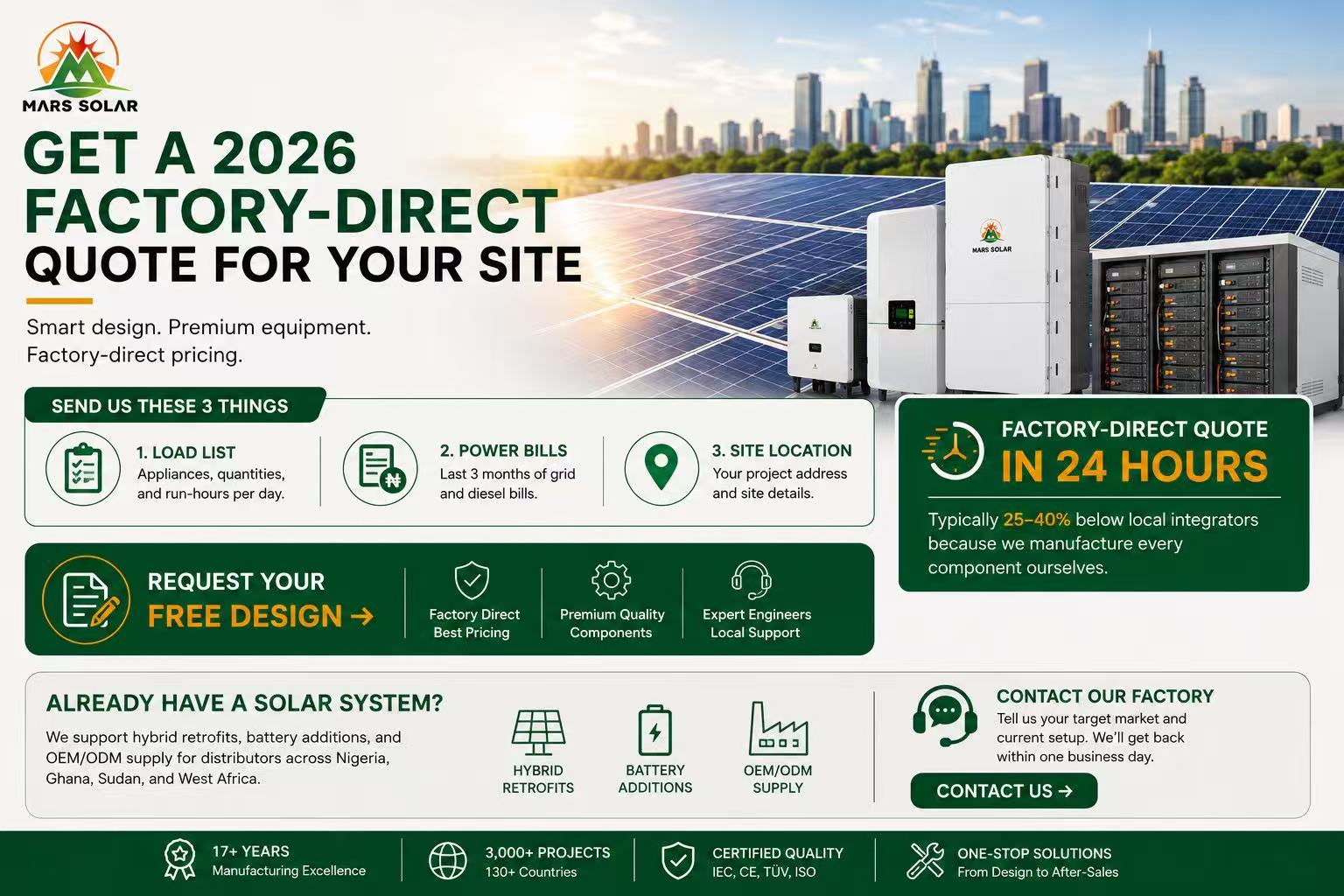
Send us your load list (appliances, quantities, run-hours), your last 3 months of grid and diesel bills, and your site location. Our engineers will design the right hybrid or off-grid system for your loads and grid pattern, and send a factory-direct quotation in 24 hours — typically 25–40% below what local integrators quote because we manufacture every component ourselves. Solicite o seu projeto gratuito →
Already running a solar system and looking to expand? We support hybrid retrofits, battery additions, and OEM/ODM supply for distributors across Nigeria, Ghana, Sudan, and West Africa. Contacte a nossa fábrica with your target market and current setup — we will respond within one business day.
Continue a desenvolver a sua experiência em fornecimento de energia solar:
Once the budget range above is clear, the next step is matching it to a real build: a 30kW off-grid system for a large home, a Sistema de 200 kW for a mid-size factory, or a 400KW system for heavier industrial loads. Our Africa installation plan shows how those orders are sequenced through the year, and the 100 kW hotel project in Nigeria is a useful reference for a site with a heavy evening peak.

 English English
  Arabic
 Spanish
 French
 Dutch
Dutch
 Portuguese