
Lingua
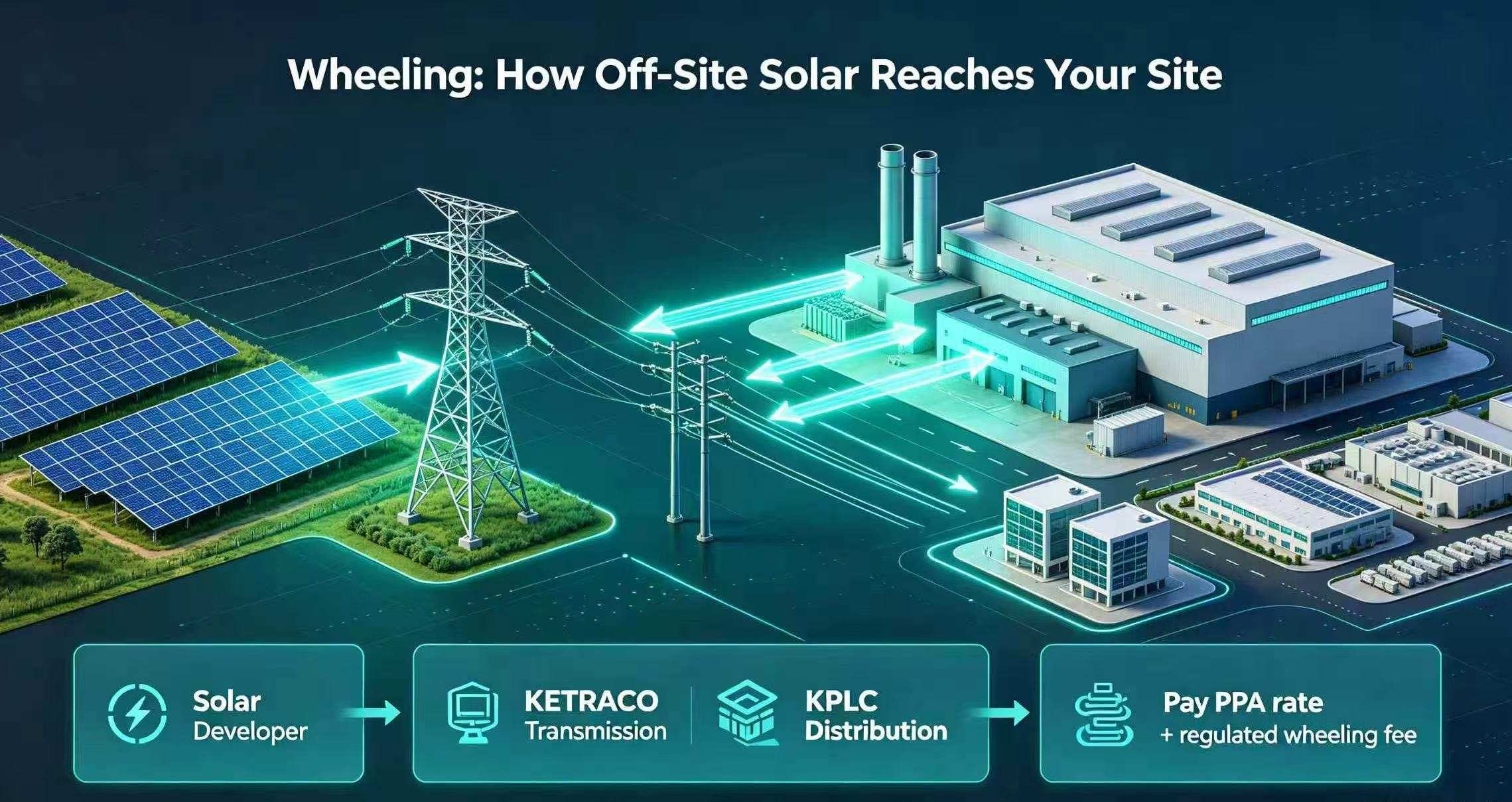
Solar PPA Kenya is now open to every large power consumer, not just utilities. Under the Energy (Electricity Market, Bulk Supply and Open Access) Regulations of 2026, gazetted by the Energy and Petroleum Regulatory Authority (EPRA), a factory, industrial park, data centre or commercial complex can sign a 10–20 year power purchase agreement directly with a solar developer — and KPLC is no longer the mandatory buyer in between. You simply pay the developer the contracted PPA price per kWh, plus a regulated “wheeling” fee to use KPLC and KETRACO’s transmission lines.
This is the biggest structural change to Kenya’s electricity market since the Energy Act 2019, and it is aimed squarely at the businesses that currently pay the highest rates. Here is exactly what changed, how a solar PPA works, what it costs, and whether it is right for your site in 2026.
Kenyan businesses have long paid some of the highest commercial electricity prices in East and Central Africa — an effective KSh 18–28 per kWh all-in once fuel cost charges, forex adjustment, levies and 16% VAT are added. Large industrial users (70% of KPLC’s sales by revenue) have been subsidising cheaper residential tariffs. The 2026 Open Access Regulations let those same industrial users bypass KPLC’s retail margin and contract a solar generator directly, often locking in a rate well below grid.
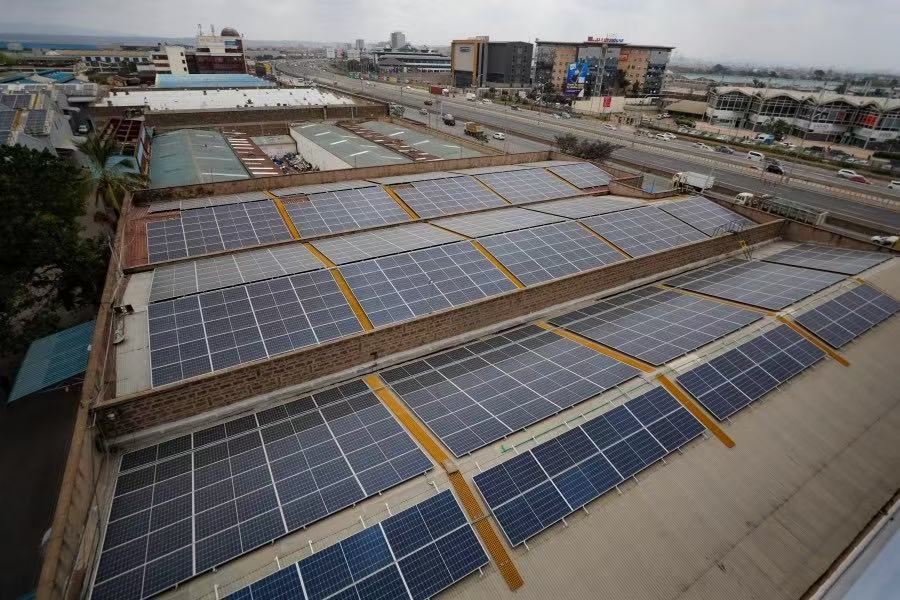
A Power Purchase Agreement is a long-term contract where a solar developer builds, owns and operates the system, and you agree to buy the electricity it produces at a fixed price per kWh. You pay nothing upfront — the developer finances the project, and your savings start from day one.
| Step | Che succede |
|---|---|
| 1. Feasibility | Developer audits your load, roof/land and consumption profile. |
| 2. PPA signing | Agree a fixed ₹/kWh (KSh) price for 10–20 years, often with an annual escalation cap. |
| 3. Permits | EPRA compliance, NEMA approvals, KPLC interconnection — handled by the developer. |
| 4. Construction | Developer funds, builds and commissions the plant. |
| 5. Operation | You pay only for the solar kWh you consume, at the PPA rate. |
The two ways a solar PPA is delivered in Kenya after the 2026 rules:
Commercial and industrial tariffs are a moving target because EPRA adjusts fuel and forex surcharges monthly. Here is the real 2026 picture.
| Componente | Typical 2026 Cost |
|---|---|
| KPLC C&I base tariff (CI1, 400V) | KSh 13.44/kWh |
| Fuel Cost Charge (FCC) + Forex (FERFA) | KSh 4–7/kWh, monthly variable |
| REP + ERC + WRMA levies | ~KSh 0.50–0.55/kWh |
| 16% VAT + demand charge | applied on top |
| Effective all-in grid rate | KSh 18–28/kWh |
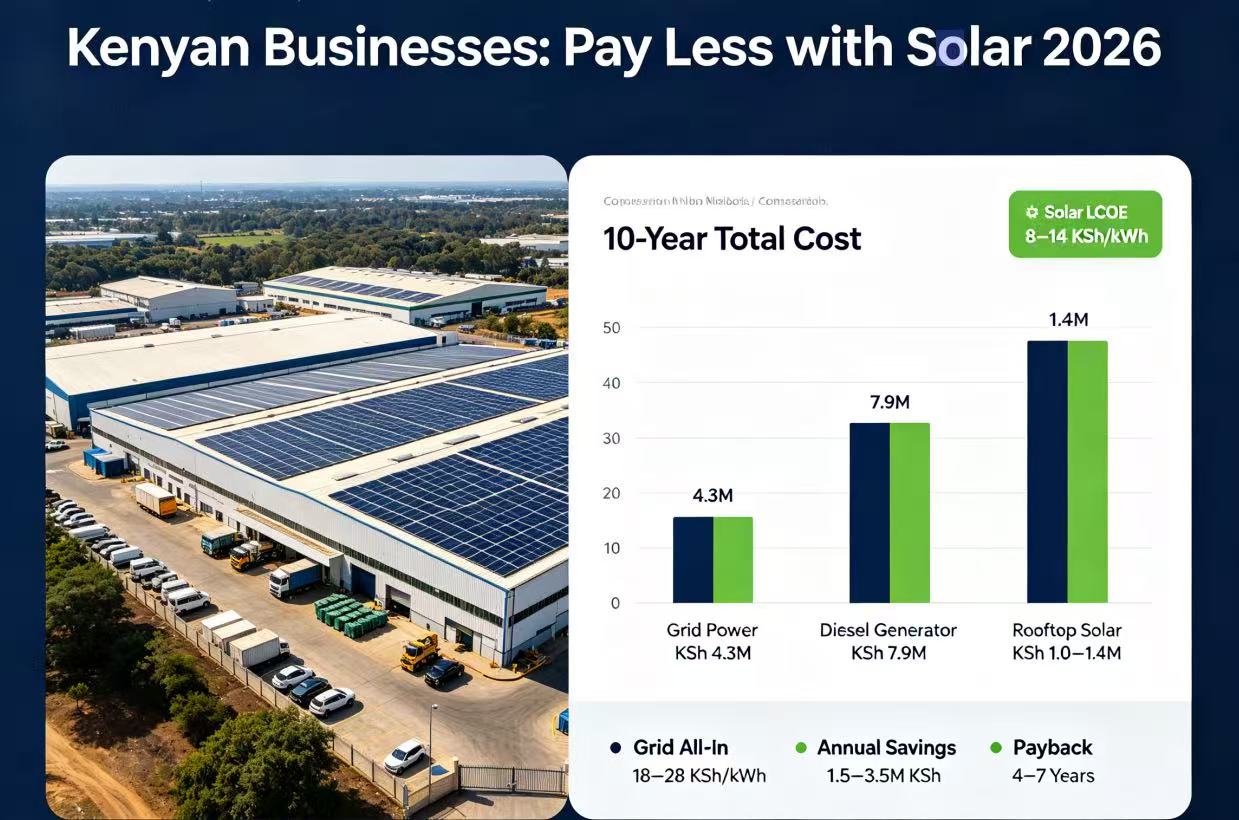
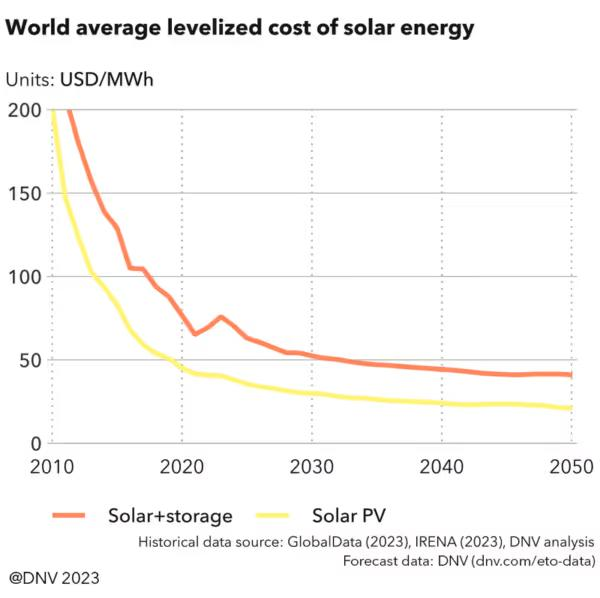
A well-sized commercial solar system delivers electricity at an LCOE of KSh 8–14/kWh over 25 years — roughly half to a third of grid. A 200 kW rooftop system on a Nairobi factory generates ~290 MWh per year and cuts annual electricity cost by KSh 1.5–3.5 million, with a 4–7 year payback.
Even compared with diesel backup — which many Kenyan factories run for hours daily — solar is dramatically cheaper. Over 10 years, grid power costs a typical SME about KSh 4.3 million and diesel generators about KSh 7.9 million, while solar totals just KSh 1.0–1.4 million including maintenance.
The Energy (Electricity Market, Bulk Supply and Open Access) Regulations of 2026 formally ended KPLC’s near-exclusive right to be the counterparty for large power deals. The key provisions:
| Provision | What It Means for You |
|---|---|
| Direct PPAs | Generators can sell straight to large consumers — no KPLC PPA required. |
| Open access / wheeling | KPLC & KETRACO must give non-discriminatory network access for a regulated fee. |
| Bulk-supply threshold | Consumers above it can contract a solar farm anywhere in Kenya. |
| Retail competition | Licensed retailers can buy and resell power to businesses. |
This builds on the November 2025 lifting of the two-year PPA moratorium, which also allowed new PPAs to be denominated in shillings, foreign currency, or a mix — cutting currency risk for locally-financed projects. Solar and battery storage are the fastest routes to new capacity, and the first renewable energy auction is expected in late 2026.
Kenya’s tax framework keeps solar equipment cheap to import. Bare solar cells and modules are exempt from import duty and VAT (VAT Act 2013, Section 15(n)). The Business Laws Amendment Bill 2026 goes further, proposing to cut import VAT on broader green energy equipment from 16% to 8%. One caution: a separate Finance Bill 2026 proposal could move batteries from zero-rated to exempt VAT, which would raise battery prices — so lock in battery-heavy quotes early.
What is a solar PPA in Kenya?
A power purchase agreement where a solar developer builds and owns the system and you buy the electricity at a fixed rate — zero upfront cost, savings from day one.
Can I now buy solar power without going through KPLC?
Yes. The 2026 Open Access Regulations let large consumers sign PPAs directly with solar developers, using KPLC/KETRACO’s network only for “wheeling” at a regulated fee.
How much can a solar PPA save my business?
Commercial solar costs KSh 8–14/kWh versus KSh 18–28/kWh all-in grid — typically a 40–60% cut on the solar portion of your bill.
Do I need to pay anything upfront?
No. In a PPA the developer finances the plant; you only pay for the electricity you use, at the contracted rate.
Is my business eligible?
Factories, industrial parks, data centres, cement plants and large commercial complexes above the bulk-supply threshold qualify. Smaller sites can still go on-site (captive) solar below 1 MW with no EPRA licence.
Sources: EPRA Energy (Electricity Market, Bulk Supply and Open Access) Regulations 2026; Kenya Power/EPRA tariff schedule 2025/2026; SurgePV Kenya C&I Solar Guide (April 2026); KI Energy-Tech Commercial Solar ROI Guide 2026.
Want a free feasibility study for your site? Contact us for a WhatsApp quote or email admin@solarpowermanufacturer.com.

 English English
  Chinese
 Arabic
 German
 Spanish
 French
 Italian
 Japanese
 Korean
 Dutch
Dutch
 Portuguese