Confronto - Bifacciale vs Monofacciale

Bifacial and monofacial solar panels look almost identical from the front. But under the surface, they work differently — and choosing the wrong type can cost your project 15-25% in annual energy yield, or add 20% to your upfront cost unnecessarily.

This article cuts through the marketing noise. Based on real performance data from Mars Solar projects across Africa, Southeast Asia, and the Middle East, we give you an objective Bifacial vs Monofacial comparison.

TL;DR — The 30-Second Summary:

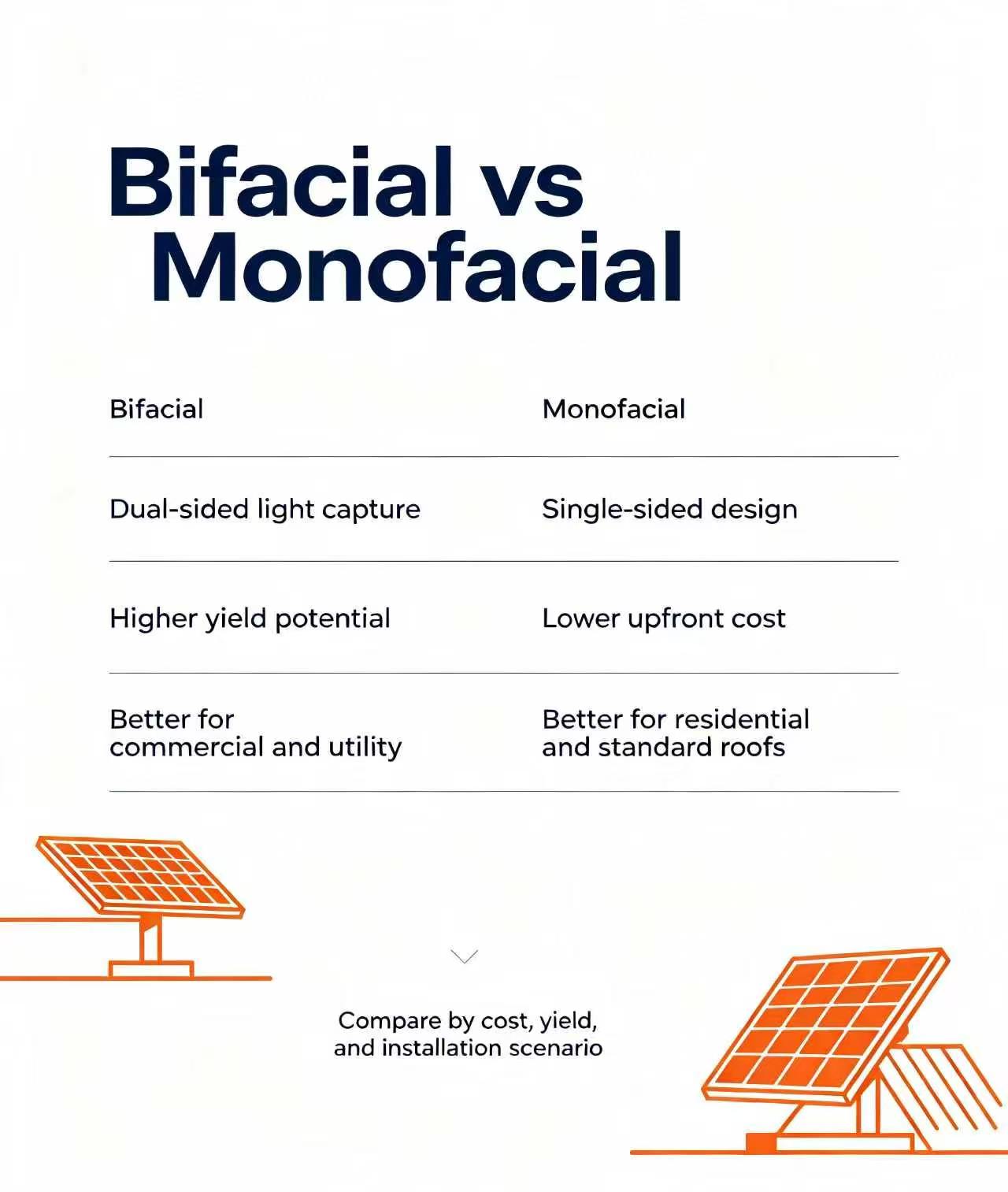
  • Bifacial panels: Capture light from front AND rear. Best for ground-mount, snow/sand surfaces, elevated installations. +15-25% energy yield gain. +15-20% cost premium.
  • Monofacial panels: Front-facing only. Best for rooftops, limited space, cost-sensitive projects. Standard pricing.
  • For 80% of projects in 2026: Monofacial still wins on ROI. For ground-mount in desert/coastal areas, bifacial earns its premium.
  • Key decision factor: Albedo (ground reflectivity) + installation height + available space.

2026 Technology Snapshot:

SpecificheMonofacial PERCBifacial N-Type TOPCon
Efficiency range19-22%22-26%
Power range400-600W400-700W+
Typical FOB price$0.10-0.14/W$0.13-0.18/W
Warranty12-15yr / 25yr performance15-25yr / 30yr performance
Temperature coefficient-0.36%/°C-0.29%/°C (better in heat)
Best use caseRooftops, residentialGround-mount, utility-scale

1. How Each Panel Technology Actually Works

Monofacial Solar Panels — Single-Sided Light Capture

Standard monofacial panels have solar cells only on the front surface. The rear surface is either fully opaque (white backsheet) or lightly reflective.

Key characteristics:

  • Single active cell surface (front)
  • Standard white or black backsheet on rear
  • Easier to handle and install
  • No special mounting requirements
  • Lower cost manufacturing process

How light is utilized:

  • Direct sunlight: 100% utilized (front)
  • Diffuse light (clouds): ~100% utilized (front)
  • Reflected light (ground): 0-10% (rear reflection only)

Bifacial Solar Panels — Dual-Sided Light Capture

Bifacial panels capture reflected and scattered light that bounces off the ground (called "albedo light").

Key characteristics:

  • Active cell surface on front AND rear
  • Transparent backsheet or glass-glass construction
  • Requires elevated or open-rack mounting to allow rear light access
  • Higher efficiency per square meter

How light is utilized:

  • Direct sunlight: 100% utilized (front)
  • Diffuse light: 100% (front) + 10-20% (rear)
  • Reflected light (ground albedo): 10-30% additional (rear)

The bifacial gain depends entirely on:

  1. Ground albedo — White concrete: 70-80%, sand: 40-50%, grass: 20-25%, dark soil: 10-15%
  2. Mounting height — Higher clearance = more rear light access
  3. Tilt angle — Optimal tilt maximizes rear capture

2. Side-by-Side Comparison: Bifacial vs Monofacial

CriteriaMonofacial PERCBifacial N-Type TOPConWinner
Efficiency19-22%22-26%Bifacial
Power output (typical)400-600W per panel400-700W per panelBifacial
FOB price China$0.10-0.14/W$0.13-0.18/WMonofacial
Cost per wattLinea di base+15-25% premiumMonofacial
Bifacial gain0% (single-sided)+10-25% (depends on albedo)Bifacial
Mounting height requirementAny (rooftop/ground)Minimum 0.5-1m clearanceMonofacial
Temperature coefficient-0.36%/°C-0.29%/°CBifacial
Hot climate performanceGoodBetterBifacial
Lifespan25-30 years25-35 years (glass-glass)Bifacial
Weight~23kg (60-cell)~26-32kgMonofacial
Best for rooftops✅ Perfect⚠️ Needs height clearanceMonofacial
Best for ground-mount✅ Good✅ ExcellentBifacial
Best for Africa (desert)✅ Good✅ Excellent (sand albedo)Bifacial

3. When Bifacial Panels Are the Right Choice

Scenario A: Ground-Mount in Desert / Sandy Areas

  • Albedo: 40-50% (sand reflects 40-50% of sunlight upward)
  • Typical bifacial gain: +15-25% additional power output
  • Real example: 500kW ground-mount in Dubai with elevated bifacial → 75-125kW additional annual output
  • Payback on premium: 2-3 years in high-irradiance locations

Scenario B: Ground-Mount with White/Concrete Backing

  • Albedo: 60-80% (white concrete, gravel, light-colored roofs)
  • Typical bifacial gain: +15-30%
  • Best for: Solar farms on concrete, carport installations

Scenario C: Snow-Covered Regions

  • Albedo: 70-90% (fresh snow)
  • Typical bifacial gain: +20-35% in winter months

Scenario D: High-Temperature Regions (Africa, Middle East)

  • Bifacial N-type has better temp coefficient (-0.29%/°C vs -0.36%/°C)
  • In 40°C heat, bifacial produces 2-3% more power per degree vs monofacial

Real Mars Solar Projects Using Bifacial:

4. When Monofacial Panels Are the Smarter Choice

Scenario A: Residential Rooftops (Any Country)

  • Problem: Limited mounting height, often flush against roof tiles
  • Bifacial gain: 0-5% (no rear light access)
  • Verdict: Monofacial at $0.11-0.13/W wins every time

Scenario B: Shaded or Partially Obstructed Rooftops

  • Problem: Low albedo, nearby buildings/trees blocking light
  • Bifacial gain: 0-8% (minimal)
  • Verdict: Standard monofacial PERC

Scenario C: Cost-Sensitive Projects

  • Bifacial premium: $0.02-0.04/W extra
  • On 100kW: $2,000-4,000 extra for marginal gain
  • Verdict: If budget is tight, monofacial is the right call

Scenario D: Flat Commercial Rooftops with No Clearance

  • Bifacial gain: 3-8% (limited)
  • Verdict: High-efficiency monofacial PERC (550W-600W) is better value

5. ROI Analysis: 5 Real Project Scenarios

Project 1: 100kW Commercial Rooftop, Lagos Nigeria

  • Surface: Flat concrete roof, ~25% albedo
  • Monofacial: 550W × 182 panels = 100.1kW. Cost: $12,000
  • Bifacial: 600W × 167 panels = 100.2kW. Cost: $14,500 (+$2,500)
  • Bifacial gain: +8% = +8kW/year. Annual benefit: $960
  • Payback: 2.6 years ✅ Bifacial is worth it

Project 2: 10kW Residential, Manila Philippines

  • Surface: Sloped tiled rooftop, no clearance, ~10% albedo
  • Monofacial: $1,200. Bifacial: $1,580 (+$380)
  • Bifacial gain: +3% = +0.3kW/year. Annual benefit: $90
  • Payback: 4.2 years (marginal). Verdict: Monofacial ✅

Project 3: 1MW Ground-Mount, Accra Ghana

  • Surface: Open ground, light gravel base, ~40% albedo
  • Monofacial: $130,000. Bifacial: $148,000 (+$18,000)
  • Bifacial gain: +18% = +180kW/year. At $0.10/kWh: $18,000/year benefit
  • Payback: 1 year ✅ Bifacial is excellent value

Project 4: 50kW Hotel Rooftop, Nairobi Kenya

  • Surface: Corrugated metal roof, ~15% albedo
  • Monofacial: $6,500. Bifacial: $7,800 (+$1,300)
  • Bifacial gain: +5%. Annual benefit: $325. Payback: 4 years
  • Verdict: Monofacial high-efficiency 580W PERC ✅

Project 5: 200kW Off-Grid Mining Site, DRC Congo

  • Surface: Red soil, ~12% albedo
  • Critical need: Maximum power density (limited land)
  • Decision: High-efficiency bifacial N-type (700W) despite low albedo (space savings justify premium)

6. Mars Solar's 2026 Panel Recommendation by Project Type

Tipo di progettoRecommended Panel TypeWhy
Residential (3-20kW)Mono PERC 550WBest ROI, easy install
Hotel/Factory Rooftop (50-500kW)Mono PERC 580-600WHigh efficiency + reliability
Ground-Mount Africa (Desert/Sand)Bifacial N-type 600W+Maximize albedo gain
Ground-Mount Southeast AsiaMono PERC 580W elevatedLower albedo, better value
Solar Farm (1MW+)Bifacial N-type 660-700WLand efficiency + bifacial gain
Off-Grid Island/MiningBifacial N-type (glass-glass)Durability + humidity resistance
Carport/CanopyBifacial 580-600WNatural rear light access

7. Frequently Asked Questions

Do bifacial panels work in cloudy weather?

Yes, but the gain is reduced. On cloudy days, diffuse light dominates. Bifacial gain drops from 15-25% to 5-10%. In consistently cloudy regions (Northern Europe, UK), bifacial premium is harder to justify.

Are bifacial panels worth the extra cost in Africa?

For ground-mount: YES. Saharan and sub-Saharan regions have 40-50% albedo from sand. Bifacial gain of 15-25% is well-documented. For rooftop in Africa: usually NO (low mounting height, dark roofs).

Which is better for very hot climates?

Bifacial N-type TOPCon has better temperature coefficient (-0.29%/°C vs -0.36%/°C). In temperatures above 35°C, this means 2-3% less power loss per degree. Bifacial is the best choice for UAE, Saudi Arabia, Nigeria, and similar climates.

Do bifacial panels need special inverters?

No. Bifacial panels work with any standard inverter. The DC input from bifacial panels is identical to monofacial.

Need Help Choosing the Right Panel for Your Project?

Mars Solar's 30+ engineers can recommend the optimal panel type for your specific project. We supply both monofacial PERC and bifacial N-type TOPCon panels — and we'll always recommend the type that gives your project the best ROI.

How to Get a Free Panel Recommendation:

  1. Tell us your project: location, size (kW), surface type, budget
  2. Our engineers will send a technical recommendation within 24 hours
  3. We provide FOB/CIF/DDP pricing for your preferred incoterms

Mars Solar Panel Supply Options:

Contact Mars Solar:

  • Raccomandazione: +86-15302966051
  • E-mail: admin@solarpowermanufacturer.com
  • Sito web: Get a Free Quote

Informazioni su Mars Solar

Mars Solar (Foshan Mars Solar Technology Co., Ltd.) produce e progetta sistemi solari dal 2008. Con Oltre 17 anni di esperienza, Oltre 30 ingegneri, E Oltre 3.000 progetti di successo in più di 130 paesi, we help distributors and EPC contractors choose the right solar equipment for their specific conditions.

Get a Free Panel Recommendation | Chi siamo | Guarda i nostri casi

Last Updated: July 2026
Keywords: bifacial vs monofacial solar panels, best solar panel type 2026, mono PERC vs TOPCon, solar panel comparison, Mars Solar panel recommendation
CONDIVIDERE:

Lascia un commento

Il tuo indirizzo email non sarà pubblicato. I campi obbligatori sono contrassegnati *

Iscriviti alla nostra newsletter

    Progettazione e produzione di sistemi di energia solare domestici e commerciali

    Desideri un progetto gratuito per un impianto solare per il tuo edificio?

    Lasciaci il tuo numero di cellulare/Whatsapp/email e ti risponderemo entro un'ora!

      Ottieni subito consulenze gratuite, cataloghi, specifiche di prodotto, preventivi e altro ancora.

      Lingua

      it_itzh_cncebessocsdadiluieses_mxfafridEssokonlpuntorutltrvi

      Lingua