
Solar + Battery + Diesel: Three Ways to Integrate
Solar diesel generator integration is the work of putting PV and a battery beside a genset you already own, so the engine runs fewer hours without the building noticing. There are only three architectures, and which one you get is decided by a single question: who holds the voltage and frequency reference. Diesel costs ₦450–650 per kWh all-in against ₦45–150 per kWh for solar, and one 184 kWh cycle displaces 55–64 litres, worth ₦66,000–96,000 at the pump.
Most retrofits fail before the order: the design leaves the genset as master and asks a grid-following inverter to behave like a grid-forming one. The fuel bill falls a third, and the owner concludes that solar diesel generator integration does not pay. It usually pays; the topology was wrong.
Quick answer: solar diesel generator integration
- Three topologies, not thirty. Diesel priority keeps the genset as master; storage priority makes the battery master and demotes the genset to backup; a microgrid controller sits above both.
- Diesel priority is cheapest and saves the least. PV can only trim load, so expect 20–40% of the fuel, not 70%.
- Storage priority is what removes genset hours. Our Abuja hotel retrofit took more than 70% of runtime out of a site that ran a 400kVA and a 250kVA unit every evening.
- Reverse power is the failure to design against. When array output exceeds site load with the genset running, the alternator gets motored instead of driving it.
- The battery, not the array, decides the saving. In any solar diesel generator integration the evening block is the load that matters, and it is dark when the evening block arrives.
Why there are only three ways to do this
Every source on a site either sets the reference or follows it. A genset sets frequency through its governor and voltage through its AVR. A grid-following inverter measures that reference and pushes current into it. A grid-forming inverter creates the reference itself. A utility supply sets it when present.
That is the entire design space, and any solar diesel generator integration drawing claiming a fourth option is one of these three with a new cover page. The test is always the same question: during a genset-only hour, which device is holding 50 Hz? The answer fixes whether PV may export, how long a transfer takes, and what protection is fitted.
Topology A: diesel priority, PV trims the load
This is the solar diesel generator integration most sites actually get, because it needs the least new equipment. The changeover panel stays, the genset stays master, PV connects on the load side through a grid-following inverter, and the battery, if present, charges from the genset or grid.
During a genset hour the array covers part of the building load and the engine covers the remainder. If array output rises above site load the surplus has nowhere to go except backwards through the alternator, which is the reverse-power problem below. That caps the array in any diesel-priority solar diesel generator integration at whatever the site's minimum load can absorb, which is why the fuel saving lands at 20–40% instead of 70%.
It fits a solar diesel generator integration where the genset already runs eight to twelve hours a day and will keep running, and a first phase where the owner wants to prove the saving before buying storage. A stable minimum load — cold store, processing line, one occupied hotel wing — is what makes it work.

Topology B: storage priority, genset becomes backup
Here the battery inverter is master. The building is fed from the inverter, PV charges the battery, and the genset starts only when state of charge falls below a floor or demand exceeds the inverter rating. This is the solar diesel generator integration topology that produces the headline fuel numbers, because the engine stops being a source and becomes an emergency appliance.
Two requirements are non-negotiable. The inverter must be grid-forming, since it runs an island with no synchronous machine to lock onto. And the site needs enough battery to bridge a genset start — seconds, not milliseconds — a gap the battery covers silently.
Our Abuja hotel project is this shape in practice. A 400kVA and a 250kVA unit ran every evening behind an unreliable 500kVA grid supply. The installed 250kW PV and 500kWh LFP bank now carry the evening block, and generator runtime fell by more than 70%, saving ₦13.7 million a month against diesel at ₦650 per kWh. Both gensets are still on site; they simply no longer schedule the evening.
This is also where solar diesel generator integration gets its best return: the genset you remove is the one at 40% load, where fuel per delivered kWh is worst.
Topology C: a microgrid controller above both
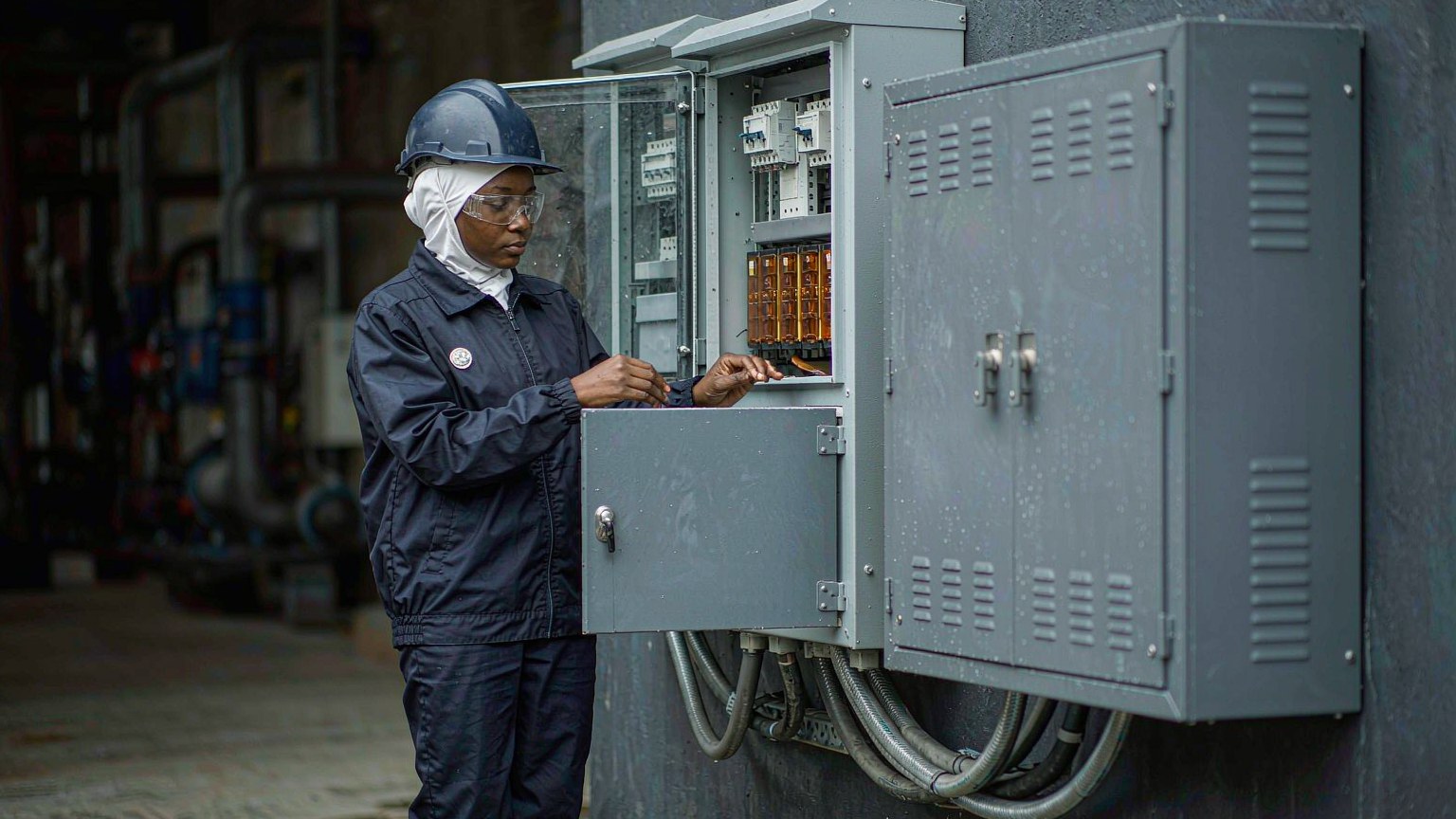
The third option in a solar diesel generator integration puts a controller in charge and makes all three sources members of one system. It dispatches PV first, then battery, then genset, then grid, and can run the engine in its efficient band to bulk-charge the battery when cloudy days stack up.
This is the only topology that scales past one genset and one cabinet, black-starts a site after total failure, and treats an array larger than the daytime load as an asset. The cost sits in controls: a controller, communications to every device, grid-forming converters, and someone who owns the tuning. Two grid-forming units from different vendors on one node can oscillate if nobody does.
The three topologies side by side
Bring this table to a site meeting: it forces the argument onto control authority, not equipment brands.
| Topology | Who holds 50 Hz | Genset hours removed | New equipment | Fits a site that… |
|---|---|---|---|---|
| A — diesel priority | Genset governor | 20–40% of fuel; hours barely move | PV, grid-following inverter, reverse-power relay | …runs its genset 8–12 h a day with a stable minimum load |
| B — storage priority | Grid-forming battery inverter | 60–75% of runtime | PV, grid-forming PCS, battery, genset-start logic | …wants the evening block off diesel and can host a cabinet |
| C — microgrid | Central controller | 70–85% of runtime, at a lower L/kWh | A, B, plus controller, comms and a tuning scope | …has several sources, several buildings, or a black-start duty |
The bands are planning ranges from our own retrofits, not a guarantee; a site already on two hours a day has little left to remove. What the table fixes is direction: for fewer diesel hours, topology A cannot deliver, however large the array.
Transfer time decides which loads survive
Every topology has a moment when supply changes hands, and its length decides what the building experiences: a chiller restarts after thirty seconds, a server room does not.
| Event | Typical gap | Loads that ride through |
|---|---|---|
| Grid loss, battery already on line | under 20 ms | Everything, including servers and drives |
| Grid loss, static transfer to inverter | 20–100 ms | Lighting, motors, most electronics; check the PLC supply |
| Genset start and ATS close | 8–30 s | Lighting, chillers, pumps; servers need the battery in front |
| Hand-back from genset to inverter | brief, synchronised | Everything, if the sources are synchronised first |
Those gaps are equipment characteristics; a supplier who cannot quote them has not finished the design. The rule for solar diesel generator integration is that any load you refuse to interrupt sits behind the battery, not behind the transfer switch. That also changes the battery size: twenty seconds needs inertia, twenty minutes needs stored energy.
Reverse power: the failure that kills gensets
Reverse power is the failure mode specific to solar diesel generator integration: it is what happens when the array produces more than the site consumes while the genset runs. The surplus has one path left — back into the generator. A synchronous machine driven backwards becomes a motor: it draws power, loses excitation control, and in the worst case is damaged. In a milder version the engine hunts, smokes and trips, and the site blames the inverter.
It appears more often than owners expect, because site load collapses at the hour PV peaks: lunchtime in an office, the afternoon lull in a hotel, a shift change in a factory. A 200 kWp array on a site dropping to 40 kW at noon will back-feed a running genset.
| Guión | Symptom on site | Protection that belongs in the design |
|---|---|---|
| PV output exceeds load while the genset runs | Engine speeds up, hunts, trips on overspeed | Reverse-power relay at 5–10% of genset rating, plus export limiting |
| Battery charging from the genset at low site load | Engine overloads minutes after the charge starts | Charge-current limit and a soft charge ramp |
| Two gensets paralleled with PV | One unit absorbs the other's output | Load-sharing controller, or run one engine at a time |
| Noon export on a grid-tied site | Meter runs backwards, utility notice arrives | Zero-export CT on the incoming feeder, proved at commissioning |
The 5–10% relay setting is a planning assumption, not a standard; use the figure your genset supplier accepts in writing. What is not optional is that the relay exists before the array is energised — retrofitting protection after a damaged alternator costs more than relay and panel.

Sizing the three parts in the right order
Most solar diesel generator integration mistakes start with the array. Start with the diesel hours you want to delete, and the rest follows in three steps.
Battery nameplate (kWh) = diesel kWh to displace ÷ (DoD × RTE)
An 184 kWh evening block that should run on battery needs 184 ÷ (0.90 × 0.95) ≈ 215 kWh of nameplate, which is why a single 100kW 215kWh cabinet suits this duty, and why the same arithmetic in our sizing method for 100kW peak loads keeps landing on that cabinet.
PV (kWp) = recharge kWh per day ÷ daily yield per kWp
Refilling 184 kWh at 95% efficiency needs about 194 kWh back. Our Abuja hotel makes roughly 29,000 kWh a month from 250 kWp, about 3.9 kWh per kWp per day, so 194 divided by 3.9 lands near 50 kWp per cabinet per day.
| Artículo | Low case | High case | Basis |
|---|---|---|---|
| Usable energy per cycle | 184 kWh | 184 kWh | 215 kWh × 90% DoD × 95% RTE |
| Fuel avoided | 55 L | 64 L | 0.30–0.35 L/kWh at rated load |
| Value of fuel avoided | ₦66,000 | ₦96,000 | ₦1,200–1,500 per litre |
| Equivalent diesel cost per kWh | ₦450 | ₦650 | All-in, including maintenance, depreciation, part-load penalty |
That is arithmetic on published site figures, not a quotation. At ₦66,000–96,000 a cycle, a cabinet earning its cycle every evening repays itself in a different league from one that runs twice a week.
The step buyers skip: the genset's minimum load. An engine run below roughly 30–40% of rating for long periods fouls itself — wet stacking, unburnt fuel, shorter service life. In storage priority it runs in its efficient band or not at all, and that constraint, not the battery, sets the smallest block worth starting it for. On a 100kVA unit the floor is 30–40kVA, so a 20 kW residual load is no reason to start it.
The part-load penalty that pays for the battery
A genset's fuel curve — the thing that decides whether solar diesel generator integration pays at all — is flat near rated load and steep below it. Our diesel cost guide for Nigeria puts consumption at 0.30–0.35 litres per kWh at rated load and notes that a 100kVA unit carrying 40kVA can burn almost as much as at 70kVA. Per delivered kWh that is a large penalty, and it is invisible on a fuel receipt.
| Load band | Fuel vs rated | What it means for solar diesel generator integration |
|---|---|---|
| 90–100% of rating | 1.0× | The band a controller aims for when charging the battery from the engine |
| 70–85% | about 1.05× | Acceptable; the target for any genset hour you keep |
| 40–60% | about 1.5× | The band most retrofits actually run in, and the one storage removes |
| Below 30% | about 2× and rising | No longer a power source but a maintenance liability — do not design for it |
Read it as an instruction. A solar diesel generator integration should either remove the genset hour or push it into the top two bands. A design that keeps every hour and trims each one has moved a 60% load to a 45% load, the worst of both worlds.
When not to integrate
Seven requests in solar diesel generator integration should be declined or re-scoped; writing them down saves more money than any efficiency claim.
- A genset running under two hours a day. There is almost nothing to displace and the fixed cost of protection and controls dominates. Fix the tariff or the load profile first.
- An array larger than the site's minimum load on a diesel-priority design. Without storage or a controller the surplus has one destination, and it is the alternator.
- A site that refuses new switchgear or protection. Reverse power, zero export and genset-start logic need panel space and a competent electrician. Skipping them is not a cheaper design, it is an unfinished one.
- Two different gensets paralleled with PV and no load-sharing controller. That is topology C work on topology A hardware, and it will oscillate.
- A battery expected to start a large direct-on-line motor. A 100 kW inverter will not start a 100 kW DOL motor; fix the starting method before sizing storage.
- A site with nobody to maintain it. Filters, coolant, battery cooling and firmware all need an owner; where nobody holds that job, the honest answer is a simpler topology.
- An export-limited connection treated as revenue. Ghana's net metering code caps a customer at 500 kW, and in most of our markets self-consumption is the only bankable revenue.
Retrofit checklist
This is the sequence we run before quoting a solar diesel generator integration; each line has a cost attached if skipped.
| Step | What to collect or change | Why it decides the design |
|---|---|---|
| 1. Two weeks of genset logs | Run hours, load percentage, fuel issued, every trip | Sets the kWh to displace; estimates are always optimistic |
| 2. Logger on the incoming feeder | 15-minute kW and kWh, plus the noon minimum | The noon minimum caps a diesel-priority array |
| 3. Genset nameplate and minimum load | kVA, alternator data, acceptable continuous band | Fixes the smallest block worth starting the engine for |
| 4. Changeover and protection audit | ATS type, existing relays, panel space, earthing | Decides whether storage priority is even installable |
| 5. Load segmentation | Which circuits must never see a gap | Moves critical loads behind the battery, not the ATS |
| 6. Battery and PV siting | Pad, clearance, cable route, roof structure | Changes the price, not the concept |
| 7. Control and monitoring | SoC, genset start signal, remote visibility | Without it the site reverts to manual operation |
| 8. Documentation | Single-line diagram, relay settings, commissioning records | The only artefact that survives staff turnover |

Five tests that prove the design
A solar diesel generator integration is a claim until it is measured. These tests catch five classes of error.
- Force a grid loss at 80% state of charge. Measure the gap the load actually sees, not the one on the datasheet.
- Run the genset at minimum load for an hour. If it sits below 40%, the topology is wrong for the site.
- Drive PV above site load deliberately. Trip the largest load at noon; the relay or export limit must act before the engine reacts.
- Kill the genset mid-charge. The battery takes over without dropping critical circuits, and charging resumes without a manual reset.
- Log a full week. Compare genset hours and litres with the pre-retrofit log; if the saving is not there, it is not real.
Background on how PV and storage interact at distribution level: the U.S. Department of Energy Solar Energy Technologies Office publishes an open overview of solar and storage research and deployment programmes. For converter behaviour, our grid-forming vs grid-following comparison sets out what to write into a specification; IEEE 2800-2022 and its 2800.2-2026 test procedures are the interconnection reference.
Frequently asked questions
What does solar diesel generator integration cost?
It depends on the topology: solar diesel generator integration can mean three very different scopes. Our Cebu resort project delivered 60kW PV and 120kWh of storage for $25,000; the 250kW plus 500kWh Abuja hotel sat between $198,000 and $228,000.
Which topology of solar diesel generator integration suits an existing site?
Start from the genset log. Eight to twelve run-hours a day with a stable minimum load suits diesel priority at 20–40% of fuel. If the evening block is the cost you want gone, only storage priority removes the hours.
Can I keep my diesel generator after integration?
Yes, and most sites should: solar diesel generator integration does not require removing the genset. In storage priority it becomes a backup started on low state of charge, and the Abuja hotel kept both units while runtime fell by more than 70%.
How much diesel does solar diesel generator integration actually save?
Count litres. One 184 kWh cycle displaces 55–64 litres at 0.30–0.35 L/kWh, worth ₦66,000–96,000 at ₦1,200–1,500 per litre, so daily cycling for 300 days is a five-figure dollar saving.
What is reverse power in solar diesel generator integration?
Current flowing from the array back into the genset when array output exceeds site load. The alternator is motored instead of driving, which can damage it. Fit a reverse-power relay at 5–10% of rating before the array is energised.
How long does the transfer take in solar diesel generator integration?
Under 20 milliseconds with the battery on line, 20–100 milliseconds through a static transfer, and 8–30 seconds when a genset must start and an ATS close. Loads intolerant of that belong behind the battery.
Can solar diesel generator integration work without a battery?
It can: solar diesel generator integration without a battery works only as diesel priority, within the array limit set by the site's minimum load. The evening block stays on diesel, which is where the money is.
Do I need a grid-forming inverter for solar diesel generator integration?
For storage priority, yes: the inverter must hold voltage and frequency with the genset off, which is what makes that form of solar diesel generator integration possible. Grid-forming carries a 15–50% premium at the same rating.
What breaks first in solar diesel generator integration?
The controls. Most solar diesel generator integration faults sit in genset-start logic, state-of-charge floors and hand-back sequences, where sites quietly revert to manual operation.
How do I size the PV array for solar diesel generator integration?
Divide daily recharge energy by local yield. Refilling one 184 kWh cabinet needs about 194 kWh back; at 3.9 kWh per kWp per day that is an array near 50 kWp. Two cycles a day doubles it.
Next step
Send two weeks of genset logs — run hours, load percentage and litres issued — and we will tell you which topology of solar diesel generator integration your site can support, what it removes, and what has to change in the changeover panel before anything is ordered.
Start from the 100kW 215kWh cabinet specification, or the 125kW 261kWh cabinet if the evening block runs past four hours. Two references: Abuja hotel that cut generator runtime by 70% and the Cebu resort on 60kW and 120kWh. Market context: Nigeria, Filipinas y Ghana supply guides. Request a topology review and we will return a single-line sketch with the protection schedule within two working days.



 English
 Arabic
 Spanish
 French
 Dutch
 Portuguese