
Battery Storage Sizing for 100kW Peak Loads: Full Method
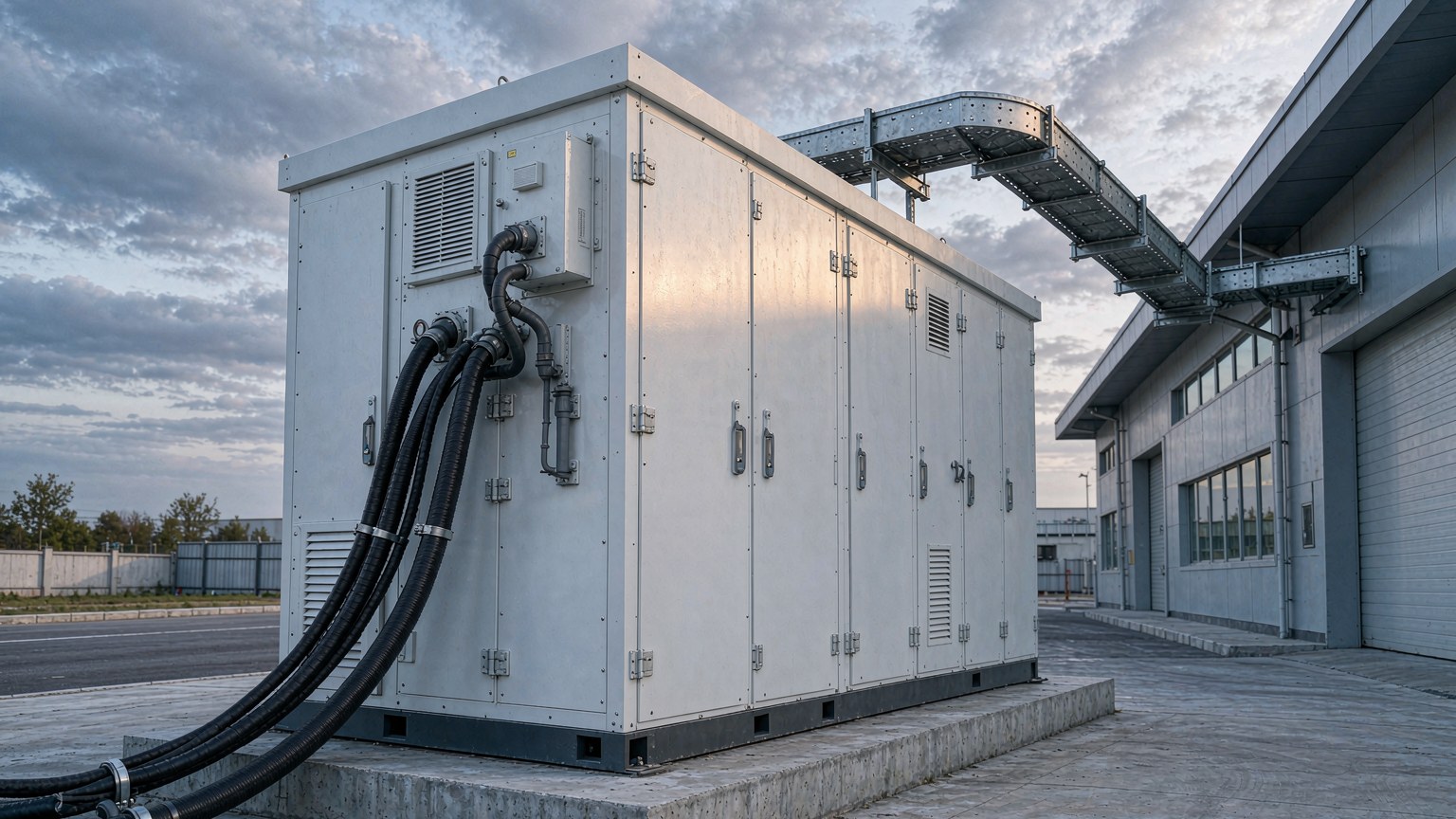
Battery storage sizing for a 100kW peak load starts from the peak you want to remove, not from the kilowatt-hours on your bill. If a business needs to shave 100 kW for two hours, the duty is 200 kWh of delivered AC energy, which after depth-of-discharge, round-trip and end-of-life corrections becomes roughly 250 to 290 kWh of nameplate LFP capacity behind a 125 kW converter. In most commercial projects that single number collapses onto one standard outdoor cabinet — the 125kW/261kWh class.
That is the whole answer in one paragraph. The rest of this page is the arithmetic behind it, the four places where the arithmetic usually goes wrong, and the checks that separate a battery storage sizing that survives commissioning from one that quietly underperforms in year three.
Quick answer: battery storage sizing for a 100kW peak
- Power first, energy second. In any battery storage sizing, the kW rating is set by the gap between your site peak and your target cap. The kWh rating is set by how long that gap lasts.
- 100 kW for 2 hours is not 200 kWh of battery. It is 200 kWh of delivered energy, which needs roughly 250–290 kWh of nameplate capacity once corrections are applied.
- Never size on a monthly bill. A demand charge is set by one 15-minute interval. Monthly kWh tells you nothing about the shape of that interval.
- Check the C-rate before signing. A high-power, short-duration duty on a small energy bank is the most common cause of premature degradation.
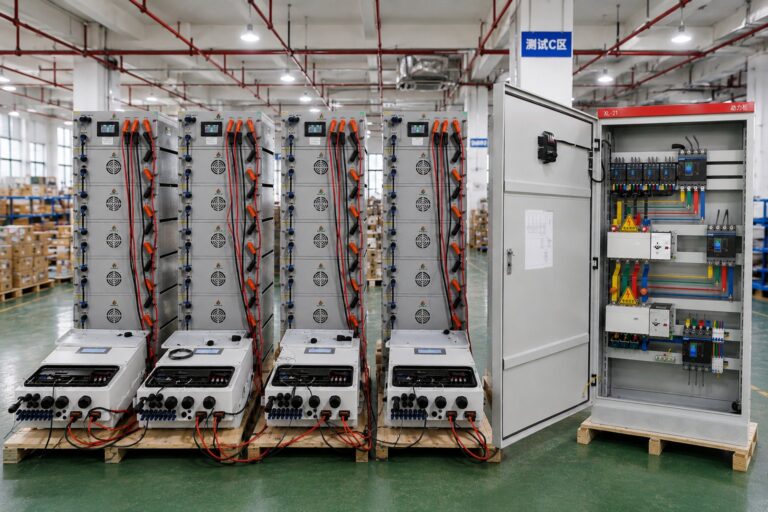
- Expect one cabinet, not a bespoke build. Most 100 kW commercial duties land on a 100–125 kW / 215–261 kWh unit, which is why those two sizes exist as catalogue products.
Why battery storage sizing begins with kW, not kWh
Two numbers define a battery: how fast it can deliver (kW) and how much it holds (kWh). Commercial buyers usually arrive with the second one, because kWh is what appears on an electricity bill. But a demand charge is billed on the highest power draw recorded in a billing period, measured over a short interval — typically 15 or 30 minutes. Energy charges accumulate; demand charges do not. Hit one peak on one afternoon and it sets that line for the whole month.
That asymmetry is why battery storage sizing has to start with the peak. Two factories can consume identical monthly kWh and face completely different bills, because one runs a smooth two-shift load and the other starts three large motors together at shift change. The battery only has leverage on the second factory.
| Bill component | Billed on | Can storage reduce it? |
|---|---|---|
| Energy / generation charge | kWh consumed | Indirectly — by shifting solar or cheap-tariff kWh into expensive hours |
| Demand charge | Highest 15- or 30-minute kW | Yes — this is the direct target of battery storage sizing |
| Fixed / metering charge | Per connection | No |
| Power factor adjustment | Measured PF | Sometimes — confirm with the inverter vendor rather than assume |
| Contracted capacity (kVA) | Contract, not measurement | Only after you log a lower stable peak and formally request a reduction |
Notice the last row. Some utilities bill a fixed capacity charge that no battery can touch on day one — a distinction worth settling before any battery storage sizing work begins. If your site is on that structure, the first year's saving comes from removing excess-demand penalties, and the contracted-capacity reduction only follows once you have months of logged lower peaks to show. Build that lag into the payback model instead of discovering it after commissioning.
Step 1 — Measure the peak you can realistically remove
Battery storage sizing fails most often at this step, not in the formulas. The question is not "what is my peak" but "which part of my peak is removable without disrupting production".
Any defensible battery storage sizing needs interval data, not a bill. Ask the utility for 12 to 24 months of 15-minute consumption, or install a three-phase power quality logger for two to four weeks. What you are looking for:
- The peak-to-average ratio. A site that peaks at 100 kW and averages 40 kW has a large removable spike. A site that sits at 90 kW for ten hours has almost none — a battery would need enormous energy to flatten a plateau.
- How long the peak lasts. Fifteen minutes, or four hours? This single number decides whether you are buying a power product or an energy product.
- What causes it. Simultaneous motor starts, shift-change HVAC recovery, compressors cycling together. If the cause is controllable by sequencing loads, that is cheaper than a battery.
- The process constraint. A cold store cannot let its compressors stop. A plating line cannot lose rectifier current. Where the load is genuinely non-negotiable, the battery must cover it rather than shave it.
Rule of thumb. If the top 1% of intervals account for most of the gap between average and peak, you have a shaveable spike and a small battery will do. If the load is flat-topped, storage is probably the wrong tool and you should be looking at tariff restructuring first.

Step 2 — Convert kW into kWh
The naive calculation is power × time. The accurate one measures the area above your target cap.
Suppose the site peaks at 100 kW and management wants grid import capped at 75 kW. The power requirement is 25 kW. If that peak sits above 75 kW for four hours, the delivered energy is 100 kWh. If it sits there for twenty minutes, it is 8.3 kWh — a tenth of the battery, for the same 25 kW of power.
The more precise method integrates the load curve rather than multiplying the single highest reading by an assumed duration:
Required AC energy = Σ max(site load − target cap, 0) × interval length
The maximum gap sets the kW. The accumulated area above the cap sets the kWh. For battery storage sizing, those two outputs are computed separately and only combined at the end — mixing them is how projects end up with a battery that is powerful enough but empty by 7pm.
Step 3 — Turn usable kWh into nameplate kWh
This is where battery storage sizing stops being arithmetic and starts being honest. A 200 kWh figure is energy you want delivered at the AC terminals. The nameplate on the cabinet has to be larger, because four things eat into it.
| Correction | Typical range | Why it exists |
|---|---|---|
| Depth of discharge (DoD) | 0.80 – 0.90 | The system does not run to 0% or 100% state of charge; operating windows protect cycle life |
| Round-trip efficiency (RTE) | 0.90 – 0.95 | Losses in the PCS, transformer, cooling and auxiliaries — you charge more than you discharge |
| End-of-life retention (EoL) | 0.80 | The duty must still be met in year 10–15, not only on day one |
| Operating reserve | 10 – 20% | Headroom kept for backup duty or for an outage at the end of a shaving window |
The working battery storage sizing formula:
Nameplate energy = delivered AC energy ÷ (DoD × RTE × EoL)
Put the 200 kWh example through the battery storage sizing formula: 200 ÷ (0.85 × 0.93 × 0.80) ≈ 316 kWh. That is higher than most first-pass estimates, and it is the number a supplier should be quoting if the duty has to hold for the life of the asset.
If the site also wants the same battery to carry critical loads through an outage, the reserve is not optional. Partition a minimum state-of-charge floor — commonly 20–30% — so that a grid failure at the end of a shaving window does not find an empty battery. That floor is subtracted from usable energy before anything else is calculated.
Step 4 — Check the C-rate before you accept the quote
C-rate is power divided by energy. In battery storage sizing it is the check that tells you how hard the cells will work, and therefore how much of the cycle life you are trading away.
| System | C-rate | Interpretation |
|---|---|---|
| 30 kW / 140 kWh | 0.21C | Gentle, long-duration duty — easiest on the cells |
| 100 kW / 215 kWh | 0.47C | Normal commercial peak shaving |
| 125 kW / 261 kWh | 0.48C | Same class, larger cabinet, room to grow |
| 100 kW / 100 kWh | 1.0C | Short-duration only; confirm the datasheet allows continuous 1C |
Above roughly 0.5C continuous, ask for the cycle-life curve at that rate rather than the headline cycle count, which is almost always quoted at a gentler C-rate. A cabinet rated 6,000 cycles at 0.5C may be rated materially lower at 1C. For battery storage sizing, this is the difference between a ten-year asset and a six-year one on the same duty.
Step 5 — Land on a standard cabinet
Once a battery storage sizing exercise has produced a kW and a kWh, the last step is not design — it is selection. Commercial storage has consolidated around a small number of cabinet sizes, and most 100 kW duties fall inside one of them.
- If your corrected nameplate lands between 200 and 225 kWh at ~100 kW, you are in the 100kW/215kWh class.
- If it lands between 240 and 290 kWh — the usual outcome once you add a 20% reserve or size for a four-hour evening block — you are in the 125kW/261kWh class.
Choosing the larger cabinet is often cheaper than specifying a custom build, and it leaves headroom for a load that grows. Choosing the smaller one is correct when the duty is genuinely short and the site has no backup requirement. What you should not do is accept a bespoke configuration purely because a first-pass battery storage sizing produced an odd number — the odd number usually means a correction factor was missed.
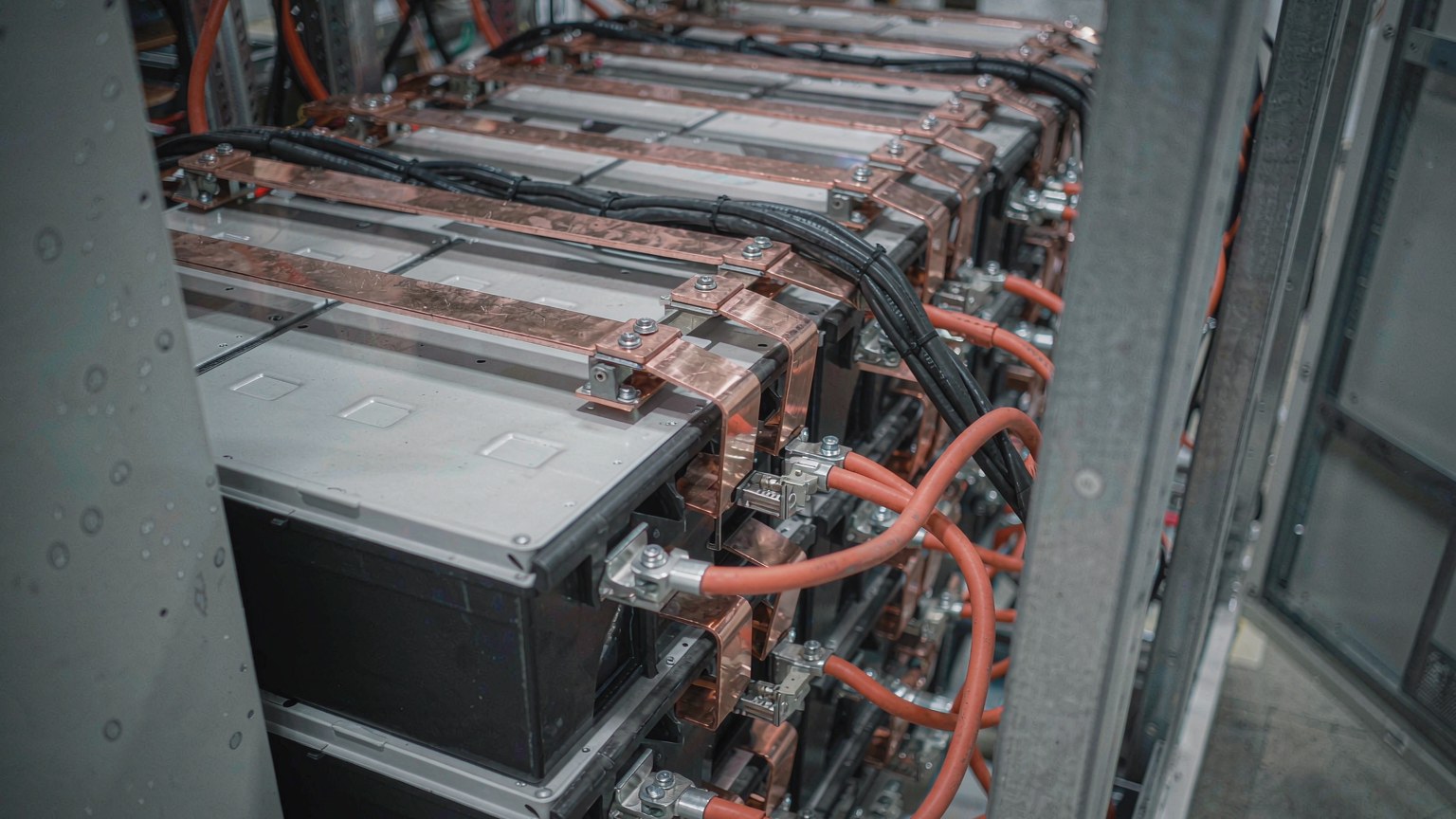
Three worked examples
| Profile | Duty | Corrected nameplate | Result |
|---|---|---|---|
| Office block, 100 kW peak, target cap 70 kW, peak lasts 2 h | 30 kW / 60 kWh delivered | 60 ÷ (0.85 × 0.93 × 0.80) ≈ 95 kWh | Undersized as a standalone cabinet; either accept a 100 kWh rack or raise the cap to 65 kW and drop to a smaller unit |
| Cold store, 100 kW peak, target cap 100 kW but 3 h autonomy required | 100 kW / 300 kWh delivered | 300 ÷ (0.80 × 0.92 × 0.80) ≈ 510 kWh | Two cabinets in parallel; the duty is energy-led, not power-led |
| Factory with motor starts, 100 kW peak, cap 75 kW, 4 h evening | 25 kW / 100 kWh delivered | 100 ÷ (0.85 × 0.93 × 0.80) ≈ 158 kWh | 215 kWh cabinet at 100 kW — comfortably inside 0.5C |
Read the three rows together and the pattern is obvious: identical 100 kW peaks, three different answers, because battery storage sizing is driven by duration and reserve rather than by the peak. The peak alone tells you almost nothing. Duration and reserve decide everything, which is why a supplier who quotes from your peak figure without asking for interval data is guessing.

A real 100 kW cold storage installation in the Philippines faced exactly the second row — the constraint was temperature integrity during outages, not demand charges, and the system was sized on autonomy. You can see the configuration in the cold storage case study.
What kills these projects
Six failure modes account for most of the commercial storage projects that underperform, and five of the six are battery storage sizing errors rather than equipment faults. None of them are exotic.
- Sizing on monthly kWh. The bill hides the shape of the peak. A battery sized from monthly totals will either be half the size it needs to be or twice the price it should be.
- Treating nameplate as usable. A 200 kWh cabinet does not deliver 200 kWh. If the proposal does not show DoD, RTE and EoL separately, the number is marketing.
- Ignoring the recharge window. A battery that shaves the evening peak has to refill before the next evening. If the site's tariff structure or solar profile does not allow that in the available hours, the duty is not repeatable.
- CT placement and EMS latency. If the current transformers sit on a sub-feeder rather than the main point of common coupling, the meter sees spikes the battery never responds to. Fast motor starts can outrun a slow control loop.
- Skipping the C-rate check. Covered above, but it deserves repeating because it is invisible on the quote sheet.
- No capacity-reduction request. Where the utility bills contracted kVA, savings only appear after you formally request a lower contract based on logged peaks. Nobody does it, and the savings stay theoretical.
When solar is already on site
The battery storage sizing changes if there is PV behind the same meter. Two adjustments matter.
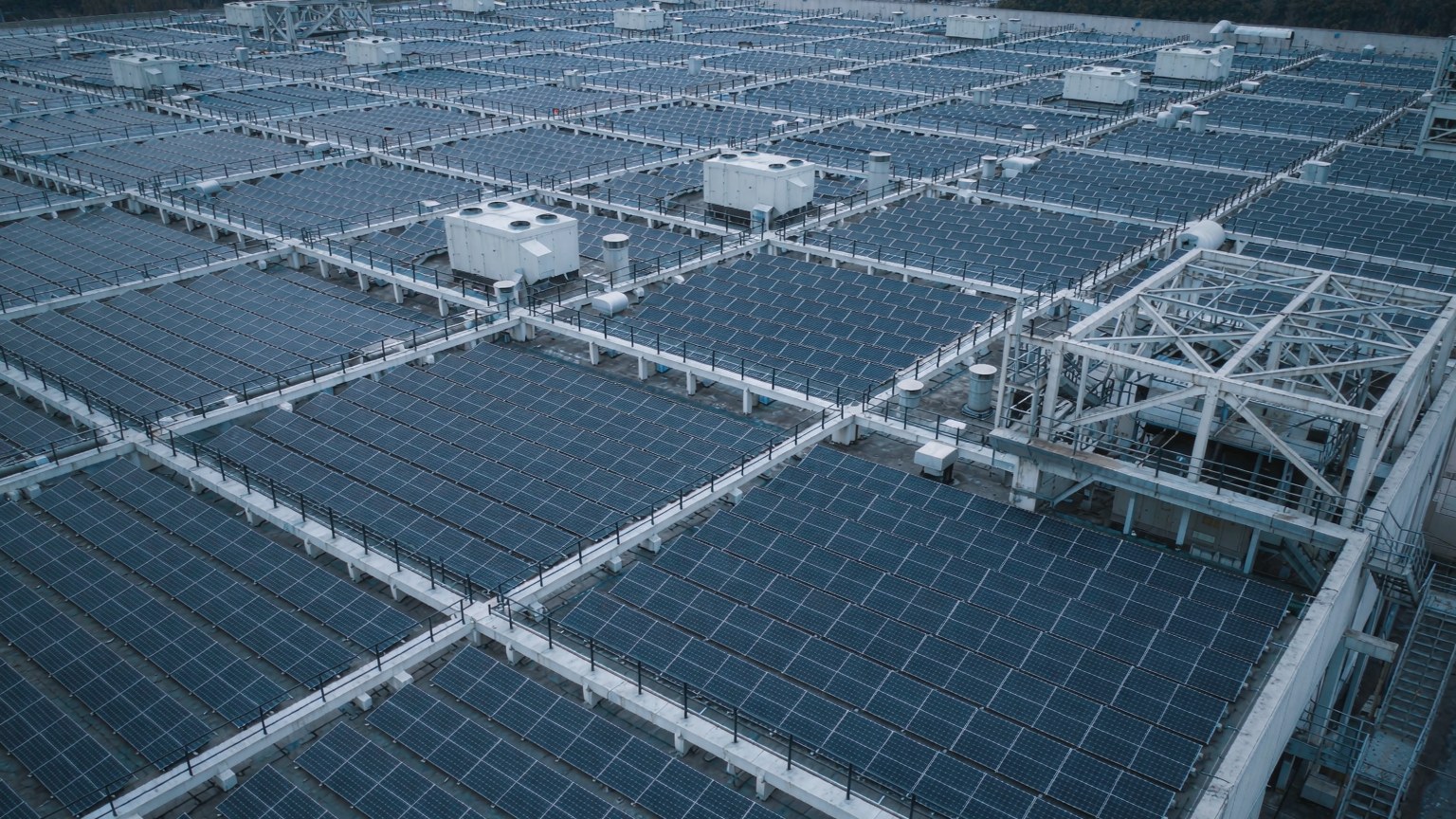
First, the charging source becomes cheaper, so the value per shifted kWh rises — you are moving free midday generation into a paid evening window rather than arbitraging two tariffs. Second, the recharge window is now limited by array size and weather, not by the grid. A battery that can technically recharge in three hours from the grid may need a full solar day to do the same, which changes how deep you can cycle it daily.
In markets with high evening tariffs and weak afternoon grid, this is where most of the return actually sits. Our Philippines market guide works through the tariff structure behind that, and the Accra hotel installation is a case where storage carried the evening load rather than shaving a short spike.
For sites where diesel is the incumbent, the sizing logic shifts again — the battery is competing with fuel cost per kWh, not with a demand charge, and the duty is measured in generator hours displaced. The Nigeria market guide covers that arithmetic in detail.
Commissioning checks that prove the sizing was right
A battery storage sizing is a prediction. These five tests turn it into a verified fact, and they should be written into the commissioning scope before the equipment ships.
- 72-hour continuous run at rated load. Not a two-hour demo. Thermal behaviour and BMS balancing only show up over days.
- Charge and discharge cycling against the real load profile. Use logged interval data, not a resistive load bank.
- Grid-synchronisation and transfer test. Measure the actual transfer time and confirm it against the loads that cannot tolerate a gap.
- Peak-shaving verification at the meter. Prove that the utility meter never exceeded the target cap during a full billing period, including the worst day.
- Reserve-floor test. Force an outage at the end of a shaving window and confirm the reserved capacity is still there.
Standards and background: IEC 62619 and UL 9540A define the safety and thermal-runaway test regime for industrial lithium cells and cabinets; the U.S. Department of Energy maintains a public overview of stationary energy storage technologies and their grid applications.
Frequently asked questions
How much battery storage do I need for a 100kW peak load?
For a two-hour shave of 100 kW, expect roughly 250 to 290 kWh of nameplate capacity. Battery storage sizing depends far more on duration and reserve than on the peak itself, so the same 100 kW can justify 95 kWh or 510 kWh depending on the duty.
Is 100kW battery storage sizing different for a factory and an office?
Yes, because the load shape differs, and battery storage sizing follows shape rather than size. Factories tend to have short, high spikes from motor starts — a power-led duty with a modest kWh requirement. Offices tend to have smoother, longer peaks driven by HVAC — a flatter duty that needs more energy for the same kW.
Can I size storage from my monthly electricity bill?
No. Battery storage sizing cannot be done from a bill: it gives you total kWh and one peak reading, but not the shape or duration of that peak. Battery storage sizing needs 15-minute interval data, ideally 12 months of it, or a two-to-four-week logger campaign.
What depth of discharge should I assume?
Use 80–90% for LFP commercial systems. Assuming 100% will understate the nameplate you need; assuming 50% — a lead-acid habit — will double the cost of the project for no reason.
Why does end-of-life capacity matter in the calculation?
Because the duty does not disappear in year ten. Dividing by an 80% retention factor sizes the system so that it still meets the same shaving target at the end of its warranty period, rather than only on the day it is commissioned.
What C-rate is acceptable for peak shaving?
Most commercial peak-shaving duties sit between 0.2C and 0.5C. Above 0.5C continuous, ask for the cycle-life curve at that specific rate, not the headline cycle count.
Does 100kW battery storage sizing change if I add solar later?
The battery storage sizing requirement stays the same; the economics improve. Adding PV lowers the cost of the energy used to recharge the battery and increases the value of each shifted kWh, but it also constrains the recharge window to daylight hours.
How long does the sizing and design stage take?
With interval data in hand, a first-pass sizing takes a day. The longer items are usually the site survey and the utility interconnection review, which run on the utility's timetable rather than the project's.
Can one cabinet serve both peak shaving and backup?
Yes, provided the battery storage sizing partitions a state-of-charge reserve — commonly 20–30% — for backup duty. Without that floor, a grid failure late in the shaving window will find the battery near empty.
What is the single most common sizing mistake?
Quoting one number. A storage system is a kW rating and a kWh rating, and a proposal that gives only one of them has not been sized — it has been estimated.
Next step
If you have interval data, we will run the battery storage sizing against your actual load curve and tell you which cabinet class it lands in — including the case where the answer is "storage is not your best first move". Send the 15-minute export and the tariff sheet, and we will return a sized configuration with the correction factors shown line by line.
Request a sizing review — or start from the 125kW/261kWh cabinet specification if your duty is already clear.



 English
 Arabic
 Spanish
 French
 Dutch
 Portuguese