
Lingua
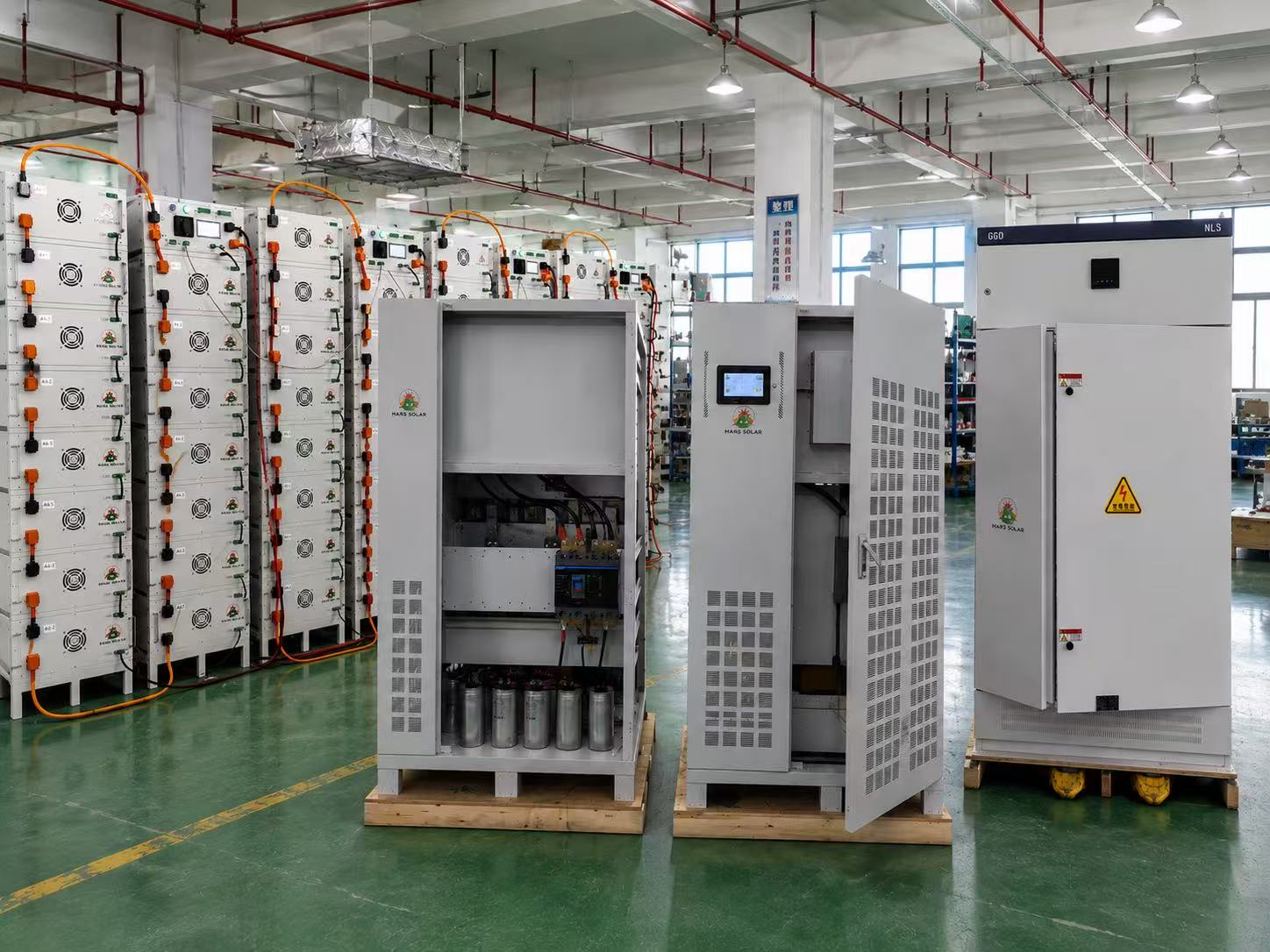
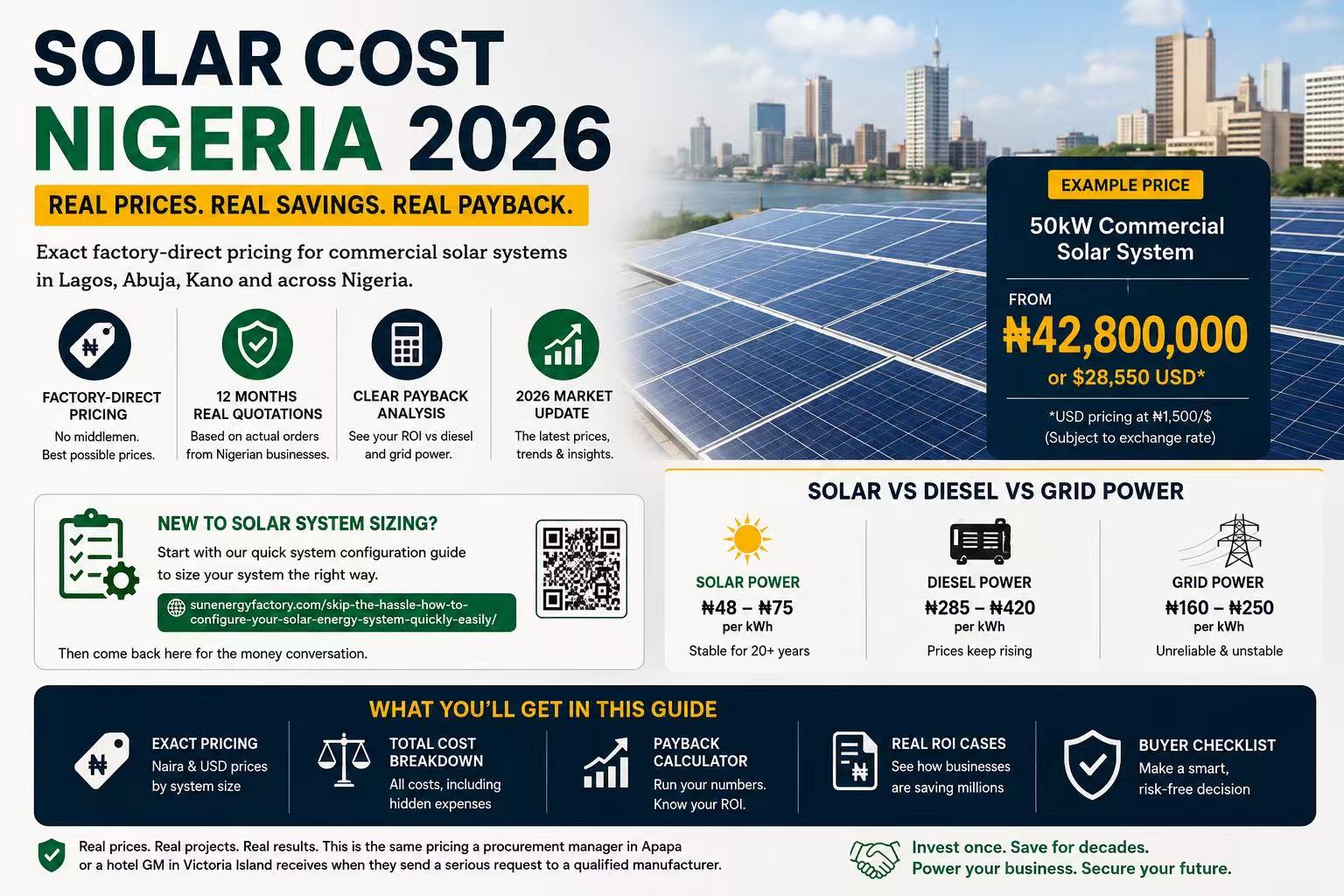
Diesel vs Solar Cost Nigeria in 2026 is no longer a debate — it is a math problem, and the answer is decisive. For a Nigerian business or home running a diesel generator, electricity costs ₦300–₦450 per kWh at 2026 fuel prices, while a solar system delivers the same kWh at a levelized cost of ₦55–₦150 per kWh over its 25-year life. That is a 50–70% saving per unit, and most commercial systems pay for themselves in 8 months to 4 years. After that, the sun costs nothing.
This guide breaks down the real numbers — fuel, maintenance, replacement, and the downtime losses that never appear on a generator invoice — so you can decide with a calculator, not a sales pitch.
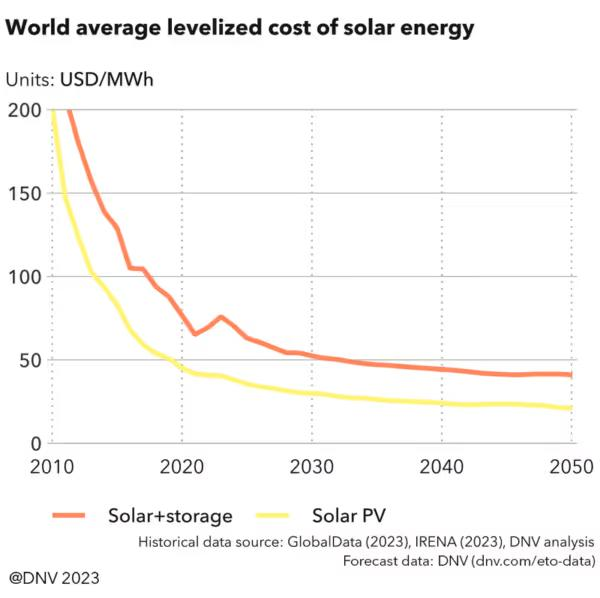
Two forces collided in 2023–2026. First, the removal of the fuel subsidy pushed diesel to ₦1,200–₦1,500 per litre (April 2026), making generator power the single most expensive electricity in Nigeria. Second, solar panel prices have fallen more than 80% over the last decade and battery costs dropped over 50% in three years — 2026 panel prices are the lowest ever recorded.
Meanwhile, the national grid still averages only 4–8 hours of supply per day in most commercial areas, with 8–12 outages a day. Every business that depends on the grid is already burning diesel to bridge the gap. The question is no longer whether to self-generate — it is whether to keep paying for fuel, or to own the power source.
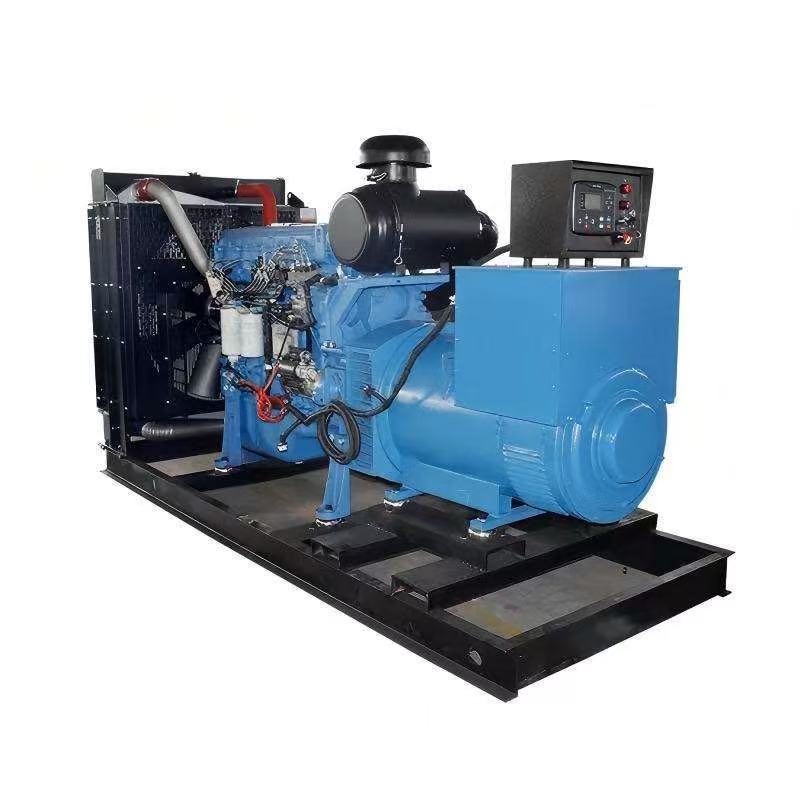
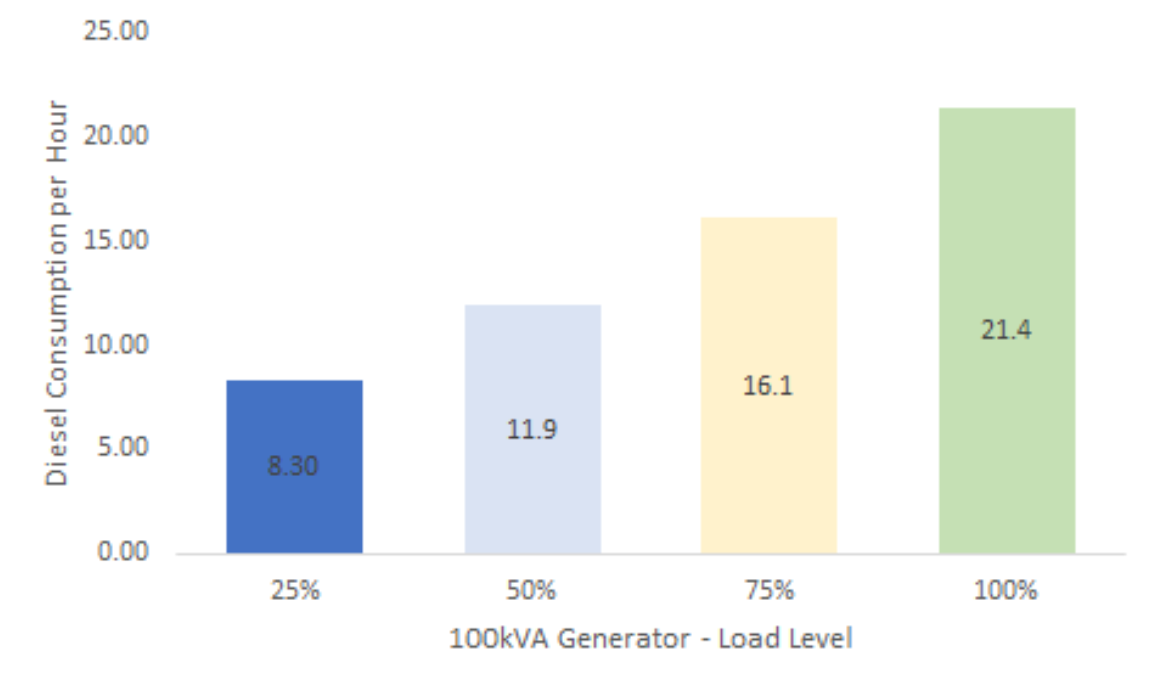
The sticker price of diesel is only the beginning. A typical generator burns 0.30–0.35 litres per kWh at rated load. At ₦1,200–₦1,500 per litre, that is ₦360–₦525 per kWh on fuel alone — before maintenance, depreciation, or the cost of a breakdown during business hours.
| Cost Component | ₦ per kWh |
|---|---|
| Fuel (0.30–0.35 L/kWh × ₦1,200–1,500/L) | ₦360 – ₦525 |
| Maintenance (oil, filters, servicing) | ₦30 – ₦50 |
| Generator depreciation & replacement | ₦40 – ₦60 |
| Total diesel generation cost | ₦300 – ₦650 |
Different sources give different midpoints because they count different things. The widely cited ₦300–₦450/kWh covers fuel, maintenance and depreciation; the ₦450–₦650/kWh figure adds engine wear and the real-world inefficiency of under-loaded generators. Either way, diesel is 3–8 times more expensive per kWh than solar over the system’s lifetime.
Solar has a high upfront cost and a near-zero running cost. The honest way to compare it with diesel is the Levelized Cost of Electricity (LCOE) — total system cost divided by total kWh produced over its lifetime.
In Nigeria, a complete system costs roughly ₦600,000–₦900,000 per kW installed in 2026, depending on battery type, component brand, and installation complexity. A well-sized system produces for 20–25 years with minimal maintenance, which pushes the LCOE down to ₦45–₦150 per kWh — ₦45 is the long-run residential figure, ₦150 the upper bound for a commercial system with battery storage. (See our full 2026 Nigeria pricing guide.)
| Dimensioni del sistema | 2026 Price Range | Typical Payback (replacing diesel) | Ideale per |
|---|---|---|---|
| 5 kW hybrid | ₦4.5M – ₦6.5M | 18–28 months | 3-bedroom home, small shop |
| 10 kW hybrid | ₦8M – ₦12M | 10–18 months | Clinic, 15–25 staff office |
| 20 kW hybrid | ₦16M – ₦24M | 10–16 months | Supermarket, guest house |
| 50 kW hybrid | ₦42M – ₦62M | 8–14 months | Hotel, mid-size factory |
| 100 kW hybrid | ₦85M – ₦125M | 8–12 months | 30–50 room hotel, factory |
| 250 kW hybrid | ₦210M – ₦310M | 14–22 months | 100+ room hotel, industrial |
The pattern is consistent: the more diesel you currently burn, the faster solar pays for itself. A factory running generators 500 kWh/day saves roughly ₦130,000 per day by switching — about ₦47.5 million a year.
The real comparison is not the sticker price — it is what each kWh costs over 5 years, and whether it is even there when you need it.
| Power Source | ₦ per kWh | Reliability | 5-Year Cost (100 kW site) |
|---|---|---|---|
| National grid (DisCo) | ₦90 – ₦110 | Very low (8–12 outages/day) | ₦180M – ₦220M (incl. diesel + downtime) |
| Diesel generator | ₦300 – ₦450 | High (fuel-dependent) | ₦420M – ₦540M |
| Hybrid solar + battery | ₦55 – ₦80 (levelized) | High (auto-switch) | ₦95M – ₦140M |
| Off-grid solar | ₦80 – ₦110 (levelized) | Highest | ₦125M – ₦185M |
Note: grid and diesel 5-year figures include estimated business losses from downtime — spoiled inventory, idle staff, lost production. That line is invisible on a quote but it is usually the most expensive part of staying on grid + diesel.
Even a modest 5 kVA business generator running 10 hours a day burns ~40 litres — about ₦1.5M–₦1.65M in fuel per month. A solar system that replaces it saves that amount every month, year after year, for 25 years.
Is solar cheaper than a generator in Nigeria?
Yes — over its lifetime solar costs ₦45–₦150/kWh versus ₦300–₦650/kWh for diesel, a 50–70% saving per unit.
What about cloudy days and night-time?
A hybrid system stores power in lithium batteries and auto-switches to the grid or a generator as backup. A properly sized battery bank covers your evening and outage load.
How long do the batteries last?
Lithium (LiFePO4) batteries last 10+ years and 6,000+ cycles, versus 2–3 years for lead-acid. Battery is the main replacement cost over 25 years.
Do I still need my generator?
Most businesses keep a small generator as a last-resort backup, but it runs a fraction of the hours — cutting fuel cost by 60–80%.
Get your free system sizing and a written payback calculation for your site. Send your monthly generator fuel spend and daily run-hours, and our engineers will return a tailored diesel-vs-solar comparison within 24 hours.
WhatsApp: +86 133 6034 4720 | admin@solarpowermanufacturer.com
Data sources: SurgePV C&I Solar Nigeria guide (Apr 2026); NERC MYTO 2024 tariffs; Kowatek Solar LCOE analysis (2026). Figures are indicative ranges; request a site-specific quotation for exact numbers.

 English English
  Chinese
 Arabic
 German
 Spanish
 French
 Italian
 Japanese
 Korean
 Dutch
Dutch
 Portuguese